
Open access · 2026
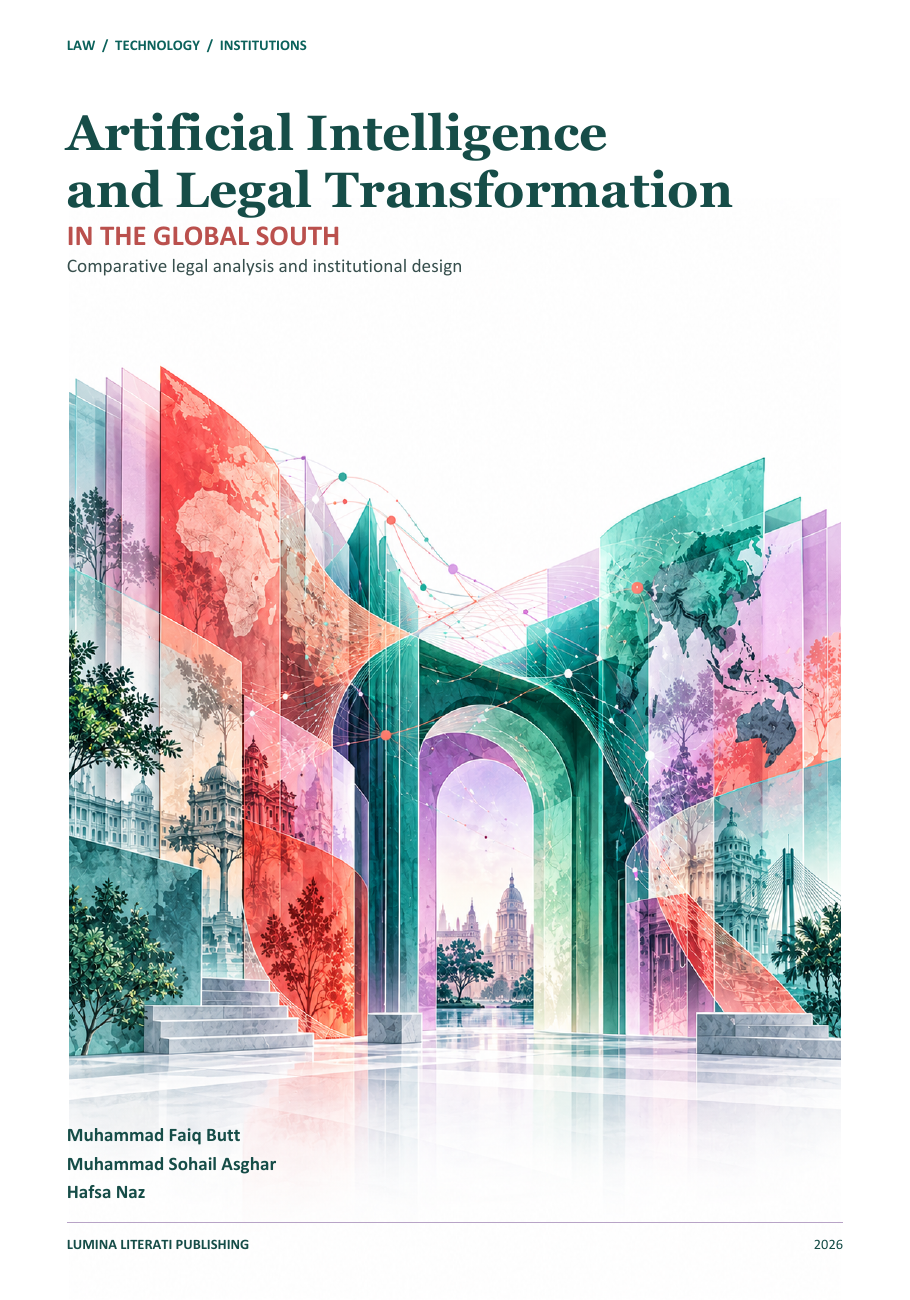
Artificial Intelligence and Legal Transformation in the Global South
Comparative legal analysis and institutional design
Book overview
Artificial Intelligence and Legal Transformation in the Global South examines when AI assistance becomes consequential control in legal institutions, how legal systems distribute that control, and what an affected person needs to challenge it. It is written for scholars of law and technology, lawyers, courts, public authorities and those designing or procuring legal services.
Across five chapters, the book connects legal authority and institutional capacity with professional and judicial practice, data governance, automated decisions, evidence, liability and remedies. It also examines the practical demands of procurement, staffing, security, evaluation and exit.
Its central argument is that accountable legal transformation must connect consequential computational uses to lawful responsibility, usable evidence and effective correction. Selected domestic legal comparisons are paired with proposed institutional forms, model clauses and clearly identified constructed examples.
Inside the book
- 01
Legal Systems and the Conditions of AI Adoption
1.1 AI Systems and the Meaning of Legal Transformation
1.2 Legal Pluralism and Institutional Variation
1.3 Legal Authority for Adopting and Using AI
1.4 Comparative Research Design and Source Assessment
1.5 Criteria for Evaluating Legal and Institutional Change - 02
AI in Legal Practice and the Administration of Justice
2.1 Legal Research, Drafting, and Document Review
2.2 Court Administration and Case Management
2.3 Judicial Reasoning and AI-Assisted Decision-Making
2.4 Legal Aid, Language Access, and Public Legal Information
2.5 Professional Duties and Changes in Legal Work - 03
Data Governance and Automated Decisions
3.1 Legal Bases for Data Collection and Reuse
3.2 Legal Data, Language Coverage, and Intellectual Property
3.3 Public Benefits and Identity: Historical Administrative Analogues for AI
3.4 Automated Decisions in Employment, Credit, and Digital Platforms
3.5 Cross-Border Processing and Technology Supply Arrangements - 04
Liability, Evidence, and Legal Remedies
4.1 Allocation of Responsibility Across AI Systems
4.2 Notice, Reasons, and Access to Decision Records
4.3 AI-Related Evidence and Standards of Proof
4.4 Individual Review and Corrective Remedies
4.5 Collective Harm and Institutional Enforcement - 05
Regulation, Procurement, and Institutional Implementation
5.1 Regulatory Instruments and Institutional Mandates
5.2 Procurement Requirements and Contractual Safeguards
5.3 Impact Assessment and Local Validation
5.4 Staffing, Training, and Financial Planning
5.5 Evaluation, Incident Response, and System Withdrawal
Conclusion · References
Free to read
Read Artificial Intelligence and Legal Transformation in the Global South
Open the cover to browse the complete book in the online reader, or download the PDF to read offline.
Download the complete PDF232 pages · English · PDF
© 2026 Muhammad Faiq Butt, Muhammad Sohail Asghar, and Hafsa Naz. The authors retain 100% copyright ownership of this work. Published open access under the Creative Commons Attribution-NonCommercial-NoDerivatives 4.0 International (CC BY-NC-ND 4.0) licence. Sharing is permitted for noncommercial purposes with attribution; adapted versions may not be distributed under this licence.
Cite this book
Butt, M. F., Asghar, M. S., & Naz, H. (2026). Artificial intelligence and legal transformation in the Global South: Comparative legal analysis and institutional design. Lumina Literati Publishing. https://doi.org/10.65758/isbn.9786277813673
References
The complete bibliography from the book, with links to the cited sources.
View all 54 references
Cases
- Constitutional Court of South Africa. (2008). Shilubana and Others v Nwamitwa [2008] ZACC 9. https://www3.saflii.org/za/cases/ZACC/2008/9.html
- Corte Constitucional de Colombia, Sala Segunda de Revisión. (2024, August 2). Sentencia T-323/24 (Expediente T-9.301.656). https://www.corteconstitucional.gov.co/relatoria/2024/T-323-24.htm
- Sindh High Court, Circuit Court Larkana. (2025, May 20). Shafi Mohammed Sarki v The State (Criminal Appeal No. D-44 of 2024). https://caselaw.shc.gov.pk/caselaw/view-file/MjY2OTc1Y2Ztcy1kYzgz
- High Court of South Africa, Gauteng Division, Pretoria. (2017, May 3). Association of Test Publishers of South Africa v President of the Republic of South Africa and Others (89564/14) [2017] ZAGPPHC 144. https://www.saflii.org/za/cases/ZAGPPHC/2017/144.html
Legislation and institutional instruments
- Autoridade Nacional de Proteção de Dados (Brazil). (2024, August 23). Resolução CD/ANPD nº 19, with correction published August 18, 2025. https://www.gov.br/anpd/pt-br/acesso-a-informacao/institucional/atos-normativos/regulamentacoes_anpd/resolucao-cd-anpd-no-19-de-23-de-agosto-de-2024
- Brazil. (1985). Lei nº 7.347, de 24 de julho de 1985 [Public Civil Action Law]. https://www.planalto.gov.br/ccivil_03/leis/l7347compilada.htm
- Brazil. (1990). Lei nº 8.078, de 11 de setembro de 1990 (Código de Defesa do Consumidor) [Consumer Defence Code]. https://www.planalto.gov.br/ccivil_03/leis/l8078compilado.htm
- Brazil. (1998). Lei nº 9.610, de 19 de fevereiro de 1998 [Copyright Law]. https://www.planalto.gov.br/ccivil_03/leis/l9610.htm
- Brazil. (2002). Lei nº 10.406, de 10 de janeiro de 2002 (Código Civil) [Civil Code]. https://www.planalto.gov.br/ccivil_03/leis/2002/l10406compilada.htm
- Brazil. (2015). Lei nº 13.105, de 16 de março de 2015 (Código de Processo Civil) [Code of Civil Procedure]. https://www.planalto.gov.br/ccivil_03/_ato2015-2018/2015/lei/l13105.htm
- Brazil. (2018). Lei nº 13.709, de 14 de agosto de 2018 (Lei Geral de Proteção de Dados Pessoais) [General Personal Data Protection Law; LGPD]. https://www.planalto.gov.br/ccivil_03/_ato2015-2018/2018/lei/l13709compilado.htm
- Colombia. (1991). Decreto 2591 de 1991: Por el cual se reglamenta la acción de tutela consagrada en el artículo 86 de la Constitución Política. https://www.alcaldiabogota.gov.co/sisjur/normas/Norma1.jsp?i=5304
- Consejo Superior de la Judicatura (Colombia). (2024, December 16). Acuerdo PCSJA24-12243. https://actosadministrativos.ramajudicial.gov.co/Home/GetFile?nombreArchivo=PCSJA24-12243.pdf
- Conselho Federal da Ordem dos Advogados do Brasil. (2015, October 19). Código de Ética e Disciplina da OAB, approved by Resolução 02/2015. https://www.oab.org.br/util/print?numero=02%2F2015&origem=Resolu%C3%A7%C3%B5es&print=Legislacao
- Conselho Nacional de Justiça (Brazil). (2025, March 11). Resolução nº 615/2025. Diário da Justiça Eletrônico do CNJ, 54/2025, March 14, 2–17, as amended by Resolução nº 674, March 25, 2026. https://atos.cnj.jus.br/atos/detalhar/6001
- India. (2023). Bharatiya Sakshya Adhiniyam, 2023 (Act No. 47 of 2023). https://www.indiacode.nic.in/indiacode/bitstream/123456789/20063/1/aa202347.pdf
- Kenya. (2010). Constitution of Kenya, 2010. https://www.parliament.go.ke/sites/default/files/2023-03/The_Constitution_of_Kenya_2010.pdf
- Kenya. (2019). Data Protection Act 24 of 2019. https://www.odpc.go.ke/wp-content/uploads/2024/02/TheDataProtectionAct__No24of2019.pdf
- Legal Practice Council (South Africa). (2019). Code of Conduct for All Legal Practitioners, Candidate Legal Practitioners and Juristic Entities. General Notice 168, Government Gazette 42337, March 29, corrected by Notice 198, Gazette 42364. https://lpc.org.za/wp-content/uploads/2020/10/CODE-OF-CONDUCT.pdf
- Ministry of Home Affairs, India. (2024, February 23). Notification S.O. 849(E): Commencement of the Bharatiya Sakshya Adhiniyam on July 1, 2024. https://www.mha.gov.in/sites/default/files/BharatiyaSakshyaAdhiniyam_24022024.pdf
- Pakistan. (2004). Public Procurement Rules, 2004 (S.R.O. 432(I)/2004). Public Procurement Regulatory Authority. Historical text. https://epms.ppra.gov.pk/public-media?file=L3BkZi9wcHJhLXJ1bGVzLnBkZg%3D%3D
- Pakistan. (2010). Benazir Income Support Programme Act, 2010 (Act XVIII of 2010). Gazette of Pakistan, August 18. https://bisp.gov.pk/SiteImage/Downloads/BISP_ACT_2010.pdf
- Pakistan. (2026). Public Procurement Rules, 2026 (S.R.O. 1658(I)/2026, September 28). Public Procurement Regulatory Authority, official online text. https://epms.ppra.gov.pk/public/procurement-rules
- South Africa. (1969). Prescription Act 68 of 1969. https://www.justice.gov.za/legislation/acts/1969-068.pdf
- South Africa. (1988). Law of Evidence Amendment Act 45 of 1988. https://www.justice.gov.za/legislation/acts/1988-045.pdf
- South Africa. (1996). Constitution of the Republic of South Africa, 1996. https://www.justice.gov.za/constitution/chp02.html
- South Africa. (1998). Employment Equity Act 55 of 1998. Government Gazette 19370, October 19. https://www.gov.za/sites/default/files/gcis_document/201409/a55-98ocr.pdf
- South Africa. (2000). Promotion of Administrative Justice Act 3 of 2000. https://www.justice.gov.za/legislation/acts/2000-003.pdf
- South Africa. (2002). Institution of Legal Proceedings against Certain Organs of State Act 40 of 2002. Government Gazette 24112, November 28. https://www.justice.gov.za/legislation/acts/2002-040.pdf
- South Africa. (2005). National Credit Act 34 of 2005. Government Gazette 28619, March 15, 2006. https://www.gov.za/sites/default/files/gcis_document/201409/a34-050_1.pdf
- South Africa. (2013). Employment Equity Amendment Act 47 of 2013. Government Gazette 37238, January 16, 2014. https://www.labour.gov.za/DocumentCenter/Acts/Employment%20Equity/Amendment/Employment%20Equity%20Amendment%20Act%2047%20of%202013.pdf
- South Africa. (2013). Protection of Personal Information Act 4 of 2013. https://www.justice.gov.za/legislation/acts/2013-004.pdf
- South Africa. (2014). National Credit Amendment Act 19 of 2014. Government Gazette 37665, May 19. https://www.gov.za/sites/default/files/gcis_document/201409/37665gon389.pdf
- South Africa. (2022). Employment Equity Amendment Act 4 of 2022. Government Gazette 48418, April 14, 2023. https://www.labour.gov.za/DocumentCenter/Acts/Employment%20Equity/Amendment/Employment%20Equity%20Amendment%20Act%20No4%20of%202022_14%20April%202023.pdf
Scholarship
- Biega, A. J. (2023). Data repurposing through compatibility: A computational perspective [Preprint, version 1]. arXiv:2309.00939. https://arxiv.org/abs/2309.00939v1
- Citron, D. K. (2008). Technological due process. Washington University Law Review, 85, 1249–1313. https://journals.library.wustl.edu/lawreview/article/id/6697/
- Cobbe, J., Lee, M. S. A., & Singh, J. (2021). Reviewable automated decision-making: A framework for accountable algorithmic systems [University repository version of the FAccT 2021 paper]. https://doi.org/10.1145/3442188.3445921
- Haseeb, M., & Vyborny, K. (2020, October 22). Data, discretion and institutional capacity: Evidence from cash transfers in Pakistan [Working paper]. American Economic Association meeting version. https://www.aeaweb.org/conference/2021/preliminary/paper/d6667hir
- Hoque, S. T. (2023). Neocolonial digitality: Analyzing digital legal databases using legal pluralism. Asian Journal of Law and Society, 10(3), 516–549. https://doi.org/10.1017/als.2023.9
- Magesh, V., Surani, F., Dahl, M., Suzgun, M., Manning, C. D., & Ho, D. E. (2025). Hallucination-free? Assessing the reliability of leading AI legal research tools. Journal of Empirical Legal Studies, 22(2), 216–242. https://doi.org/10.1111/jels.12413
- Selbst, A. D., boyd, d., Friedler, S. A., Venkatasubramanian, S., & Vertesi, J. (2019). Fairness and abstraction in sociotechnical systems. In Proceedings of the Conference on Fairness, Accountability, and Transparency (pp. 59–68). ACM. https://doi.org/10.1145/3287560.3287598
Technical policy and other materials
- African Union Commission. (2024). Continental artificial intelligence strategy: Harnessing AI for Africa’s development and prosperity. https://au.int/en/documents/20240809/continental-artificial-intelligence-strategy
- Chandra, B., Dunietz, J., Roberts, K., Lee, Y., Fontana, P., & Awad, G. (2024). Reducing risks posed by synthetic content: An overview of technical approaches to digital content transparency (NIST AI 100-4). National Institute of Standards and Technology. https://doi.org/10.6028/NIST.AI.100-4
- Clark, J., Haseeb, M., Jalal, A., Siddiqi, B., & Vyborny, K. (2022, March). Using biometrics to deliver cash payments to women: Early results from an impact evaluation in Pakistan. World Bank, ID4D Evidence Note. https://documents1.worldbank.org/curated/en/099155004142238180/pdf/P1763410d1e1af00108e170e5754d04fed9.pdf
- Information Regulator South Africa. (n.d.). POPIA resources. Retrieved October 20, 2026. https://inforegulator.org.za/popia/
- National Institute of Standards and Technology. (2023). Artificial intelligence risk management framework (AI RMF 1.0) (NIST AI 100-1). https://doi.org/10.6028/NIST.AI.100-1
- National Institute of Standards and Technology. (2024). Artificial intelligence risk management framework: Generative artificial intelligence profile (NIST AI 600-1). https://doi.org/10.6028/NIST.AI.600-1
- Nelson, A., Rekhi, S., Souppaya, M., & Scarfone, K. (2025). Incident response recommendations and considerations for cybersecurity risk management: A CSF 2.0 community profile (NIST Special Publication 800-61, Revision 3). National Institute of Standards and Technology. https://doi.org/10.6028/NIST.SP.800-61r3
- Organisation for Economic Co-operation and Development. (2024). Explanatory memorandum on the updated OECD definition of an AI system (OECD Artificial Intelligence Papers, No. 8). OECD Publishing. https://doi.org/10.1787/623da898-en
- Public Buyers Community. (2025, March 5). Updated EU AI model contractual clauses, with commentary. https://public-buyers-community.ec.europa.eu/communities/procurement-ai/resources/updated-eu-ai-model-contractual-clauses
- South African Government, Department of Employment and Labour. (2024, December 5). Minister Nomakhosazana Meth announces commencement of Employment Equity Amendment Act reducing regulatory burden for small employers [Media statement]. https://www.gov.za/news/media-statements/minister-nomakhosazana-meth-announces-commencement-employment-equity
- UNESCO. (2025, December 3). Guidelines for the use of AI systems in courts and tribunals [Publication description]. https://www.unesco.org/en/articles/guidelines-use-ai-systems-courts-and-tribunals
- Vassilev, A., Oprea, A., Fordyce, A., Anderson, H., Davies, X., & Hamin, M. (2025). Adversarial machine learning: A taxonomy and terminology of attacks and mitigations (NIST AI 100-2e2025). National Institute of Standards and Technology. https://doi.org/10.6028/NIST.AI.100-2e2025
- World Wide Web Consortium. (2013, April 30). PROV-Overview: An overview of the PROV family of documents (P. Groth & L. Moreau, Eds.). W3C Working Group Note. https://www.w3.org/TR/prov-overview/