
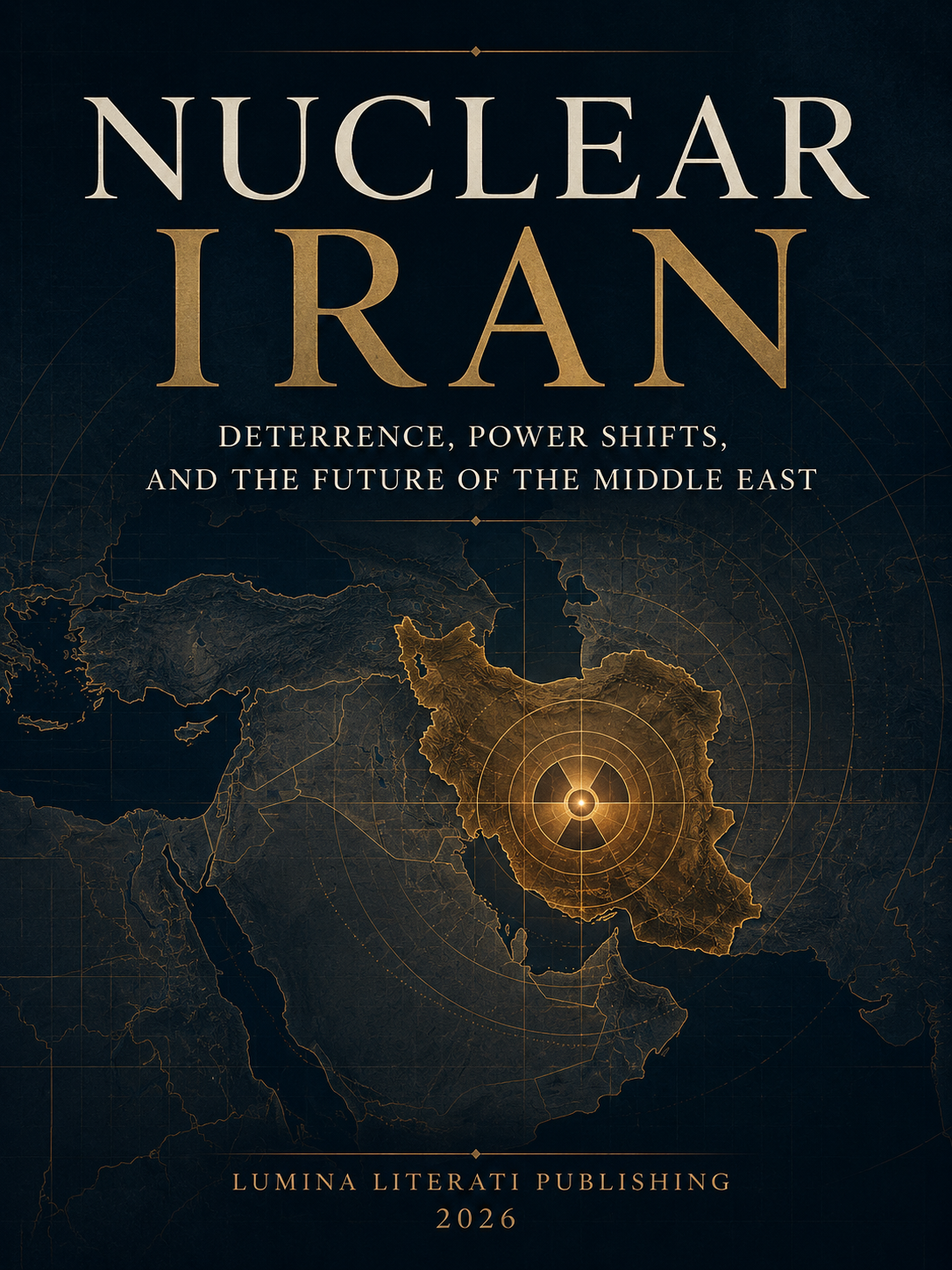
Nuclear Iran: Deterrence, Power Shifts, and the Future of the Middle East – Lumina Literati Publishing
Nuclear Iran: Deterrence, Power Shifts, and the Future of the Middle East book cover

Nuclear Iran

Deterrence, Power Shifts, and the Future of the Middle East

By

Published by Lumina Literati Publishing
Publication Year:
ISBN: 978-627-7813-56-7

Book Overview

Nuclear Iran: Deterrence, Power Shifts, and the Future of the Middle East investigates the rise of the nuclear question in Iran — one of the most consequential geopolitical developments of the modern Middle East. The Iranian nuclear programme, this book argues, is not merely a technical or military problem: it is a question of history, sovereignty, deterrence, sanctions, and the regional and global balance of power. Iranian fears of external intervention and Western pressure, together with Israel’s nuclear advantage and the chronic instability of the region, have stood at the heart of Tehran’s security concerns for decades — shaping its strategic thinking and its determination to retain the capacity to develop nuclear weapons as a manifestation of independence and resistance.

Tracing the programme from its origins under the Atoms for Peace initiative, through the 1979 revolution and the searing experience of the Iran–Iraq War, the book shows how nuclear capability became embedded in Iran’s national security doctrine — a guarantor of regime survival in a region where states that abandoned their nuclear programmes did not survive foreign intervention. It examines the logic of deterrence through the lenses of realism, deterrence theory, constructivism, and the security dilemma, building an integrated analytical model for understanding why states pursue the bomb.

The volume then widens its aperture to the regional and global stage: Israel’s nuclear monopoly and its impact on Middle Eastern geopolitics; the fears of the Gulf states; the policies of the United States, Russia, and China; the economics of sanctions and their role in pushing the nuclear debate from a purely military dimension into a broader geopolitical contest; the emergence of the Axis of Resistance; and the Iran–Israel–U.S. confrontation of 2026, whose escalation dynamics and strategic aftermath are analysed in detail. A closing chapter offers recommendations for the world — from revived diplomatic engagement and a reinforced NPT framework to regional security cooperation and the management of nuclear escalation risks.

This book is not designed to promote or glorify nuclear weapons. Its purpose is to critically examine the rationale behind states’ nuclear policies, the nature of deterrence, and the implications of its adoption for regional and global security. By situating Iran’s nuclear pursuit within a broader historical, strategic, economic, and ideological framework, it gives readers a deeper understanding of one of the most contentious questions of contemporary international relations.

About the Author

Dr. Syed Rizwan Haider Bukhari

PhD Political Science (Strategic Studies) · Islamia College University (Established 1913), Peshawar, Khyber Pakhtunkhwa, Pakistan

Dr. Syed Rizwan Haider Bukhari is a renowned researcher in the dynamic sphere of the social sciences, recognised for his influential contributions to the field. Holding a PhD in Political Science with a specialisation in Strategic Studies, he is a dedicated scholar committed to advancing knowledge through rigorous academic research and the integration of perspectives from multiple disciplines. He is the author of more than 110 research papers and five books.

Through his intellectual engagement with contemporary world affairs, Dr. Bukhari represents the scholarly strength of the Muslim world and its participation in global discourse. His research has proven both relevant and far-reaching, attracting more than 370 citations, over 1.6 million global reads, and a Research Interest Score of 1,515 on ResearchGate. He serves as a reviewer for twelve leading international journals, playing an active role in safeguarding academic quality and advancing scholarly excellence in the international system. His expertise spans strategic analysis, policy research, and emerging socio-political issues in the Islamic world and their implications for the new world order.

Dr. Bukhari maintains an active academic presence on platforms including ORCID, Google Scholar, LinkedIn, Academia.edu, Web of Science, and Scopus, enabling collaboration with scholars worldwide and the wide dissemination of knowledge. With more than 16,000 followers, he continues to inspire researchers, students, and policymakers alike. His output reflects a deep dedication to innovation, academic leadership, and meaningful contribution to global discourse in the social sciences.

Endorsements & Reviews

“A clear-eyed account of why the Iranian nuclear question refuses to stay a technical dispute. By weaving together history, deterrence theory, and the political economy of sanctions, this book explains what decades of headlines have obscured — that Tehran’s nuclear calculus is, at its core, a question of sovereignty and survival.”

“Rare is the study that moves so fluently from the CIA-led coup of 1953 to the multipolar realignments of the 2020s. Rigorous in its theoretical framework and unflinching in its analysis of Israel’s nuclear monopoly and the Gulf’s anxieties, it neither glorifies the bomb nor wishes the dilemma away.”

“The chapters on the 2026 confrontation and the closing recommendations — on diplomacy, the NPT framework, and the management of escalation — are among the most practical contributions to this debate in years. Essential reading for scholars, diplomats, and anyone seeking to understand the future of the Middle East.”

Open Access Promotion – Final Design

Free & Open Access

This scholarly work is available to everyone. Click the cover to start reading our new publication without barriers.

Nuclear Iran: Deterrence, Power Shifts, and the Future of the Middle East

References

Showing 10 of 27 referencesShowing all 27 references

1
Baig, Z. (2024, August 16). Iran’s nuclear quest and the unraveling of Middle Eastern power dynamics. The Platform, International Policy Digest. https://intpolicydigest.org/the-platform/iran-s-nuclear-quest-and-the-unraveling-of-middle-eastern-power-dynamics/
2
Barzegar, K. (2010). Balance of power in the Persian Gulf: An Iranian view. Belfer Center for Science and International Affairs, Harvard Kennedy School. https://www.belfercenter.org/sites/default/files/pantheon_files/files/publication/Barzegar-Balance-of-Power-in-the-Persian-Gulf.pdf
3
Ben Taleblu, B. (2025). The potential challenges of deterring a nuclear Iran. In A. Asghedom (Ed.), The nuclear future of the Middle East (pp. 315–340). Center for Global Security Research, Lawrence Livermore National Laboratory. https://cgsr.llnl.gov/sites/cgsr/files/2025-01/occasional-paper-nuclear-middle-east_0.pdf
4
Bob, Y. J., & Evyatar, I. (2023). Target Tehran: How Israel is using sabotage, cyberwarfare, assassination—and secret diplomacy—to stop a nuclear Iran and create a new Middle East. Simon & Schuster.
5
Riedel, B., & Samore, G. (2008). Managing nuclear proliferation in the Middle East. In R. N. Haass & M. Indyk (Eds.), Restoring the balance: A Middle East strategy for the next president. Brookings Institution Press. https://www.brookings.edu/wp-content/uploads/2016/06/12_nuclear_proliferation_riedel.pdf
6
Cingöz, M., Özkan, F., Alkan, Y. S., & İzol, R. (2024). Iran’s axis of resistance through the lens of ontological security. Third World Quarterly, 45(13), 1963–1980. https://doi.org/10.1080/01436597.2024.2398613
7
Pollack, K. M. (2010). Deterring a nuclear Iran: The devil in the details (Working paper). Council on Foreign Relations. https://www.cfr.org/sites/default/files/pdf/2010/06/Iran_Working_Paper_Pollack.pdf
8
Eisenstadt, M. (2025). The risk and reward of preventive strikes against Iran. Survival, 67(5). https://doi.org/10.1080/00396338.2025.2561480
9
Eslami, M. (2024). Exploring the driving forces behind Iran’s nuclear deterrence strategy: A novel methodological approach. Journal for Peace and Nuclear Disarmament, 7(1), 211–235. https://doi.org/10.1080/25751654.2024.2319381
10
Allison, D. M. (2025, June 13). Why force fails to stop nuclear proliferation. Foreign Affairs. https://www.foreignaffairs.com/united-states/why-force-fails-stop-nuclear-proliferation
11
Kahl, C. H., & Waltz, K. N. (2012, July 17). Iran and the bomb: Would a nuclear Iran make the Middle East more secure? Foreign Affairs. https://www.foreignaffairs.com/articles/iran/2012-07-17/iran-and-bomb
12
Kamel, A. M. (2024). The art of the Trump-Iran deal: An unsuccessful coercive foreign policy. Global Policy, 15(2). https://doi.org/10.1111/1758-5899.13336
13
Khan, S. (2024). The Iran nuclear deal: Non-proliferation and US-Iran conflict resolution. Palgrave Macmillan.
14
Little, B. (2018, May 9). How America jump-started Iran’s nuclear program. History.com. Retrieved August 15, 2025, from https://www.history.com/articles/iran-nuclear-weapons-eisenhower-atoms-for-peace
15
Meza, A., Ari, I., Al Sada, M., & Koç, M. (2026). Implications of interrupting the Hormuz Strait in the LNG trade. Journal of Transportation Security, 19, Article 28. https://doi.org/10.1007/s12198-026-00350-1
16
Nasr, V. (2025). Iran’s grand strategy: A political history. Princeton University Press.
17
Parker, C. (2018). Paying for Zion: Eisenhower’s Middle East policy, 1953–56. Middle East Policy, 25(2), 100–120. https://doi.org/10.1111/mepo.12345
18
Rezaei, F., & Cohen, R. A. (2014). Iran’s nuclear program and the Israeli–Iranian rivalry in the post-revolutionary era. British Journal of Middle Eastern Studies, 41(4), 442–460. https://doi.org/10.1080/13530194.2014.942081
19
Rodriguez-Diaz, E., Alcaide, J. I., & Garcia-Llave, R. (2024). Challenges and security risks in the Red Sea: Impact of Houthi attacks on maritime traffic. Journal of Marine Science and Engineering, 12(11), Article 1900. https://doi.org/10.3390/jmse12111900
20
Sauer, T. (2024). The failed negotiations to restore the Iran nuclear deal. Global Policy, 15(4), 583–592. https://doi.org/10.1111/1758-5899.13387
21
Kerr, P. K. (2009). Iran’s nuclear program: Status (CRS Report No. RL34544). Congressional Research Service. https://crsreports.congress.gov/product/pdf/RL/RL34544
22
Vieluf, M., Kretzschmar, S., & Saar, E. (2026). Nuclear power plays: Complexities of armament, disarmament, and (non-)proliferation of nuclear weapons. In A. Wimmers, F. Böse, C. Kemfert, & C. von Hirschhausen (Eds.), Nuclear power: Technology, geopolitics, and economics (pp. 155–192). Springer. https://doi.org/10.1007/978-3-031-99894-2_6
23
Volpe, T. A. (2023). Leveraging latency: How the weak compel the strong with nuclear technology. Oxford University Press.
24
Ward, A. (2012, March 2). Iran’s nuclear programme and the stability of the Middle East. E-International Relations. https://www.e-ir.info/2012/03/02/irans-nuclear-programme-and-the-stability-of-the-middle-east/
25
Wastnidge, E. (2024). Reinforcing the resistance: Iran and the Levant in a multipolar Middle East. Middle East Policy, 31(3), 53–68. https://doi.org/10.1111/mepo.12760
26
Wills, M. (2018, May 30). Atoms for … peace? JSTOR Daily. https://daily.jstor.org/atoms-for-peace
27
Wintour, P. (2025, June 23). Why is Iran’s nuclear programme so essential to its identity? The Guardian. https://www.theguardian.com/world/2025/jun/23/why-iran-nuclear-programme-essential-to-its-identity
Scroll to Top