
Open access · 2026
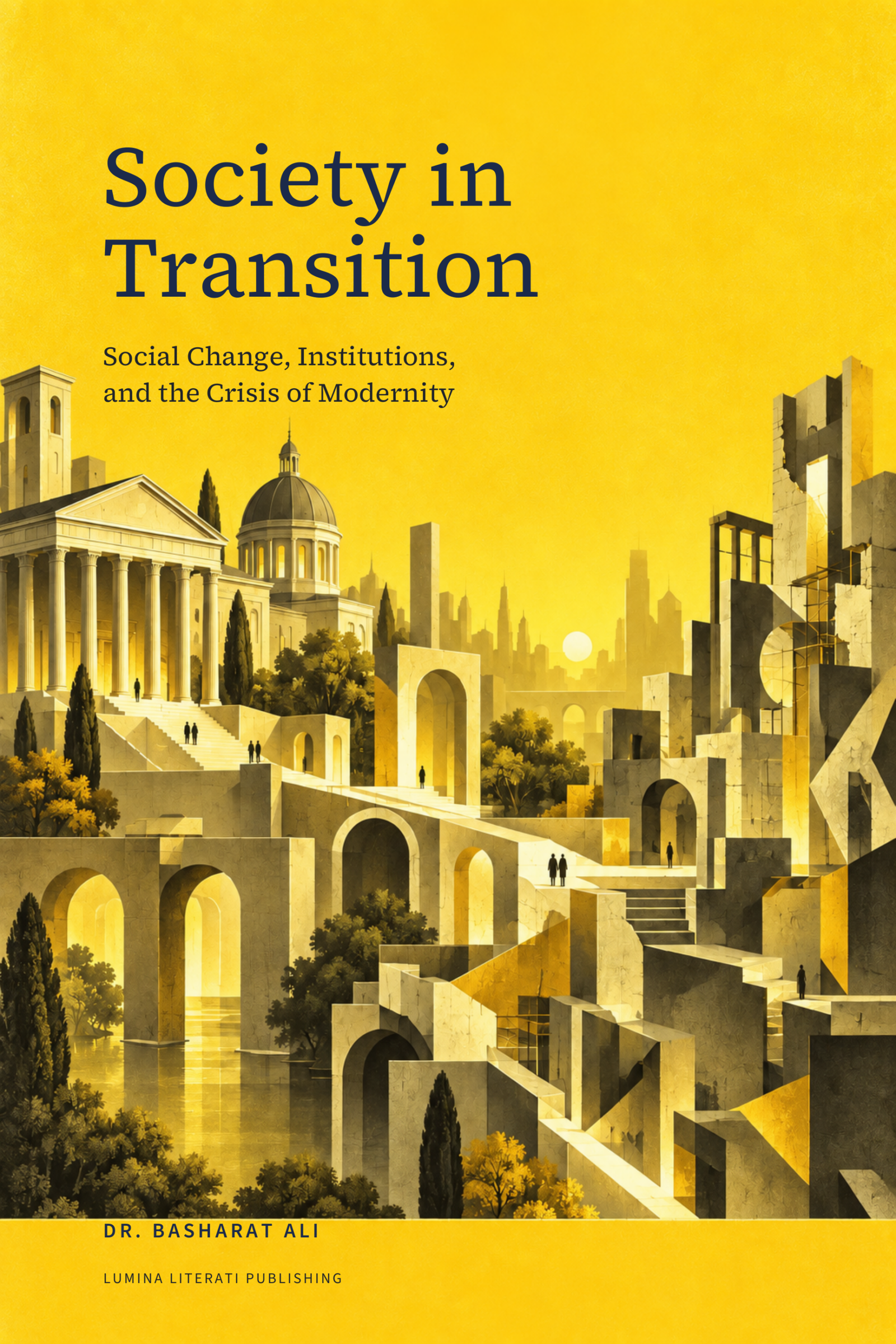
Society in Transition
Social Change, Institutions, and the Crisis of Modernity
Book overview
Society in Transition examines how demographic change, economic restructuring, digital technologies, and ecological and geopolitical pressures reshape everyday life. Bringing classical and contemporary sociology into conversation, it explores the uneven adjustment of families, education, work, welfare, and the state. The book connects institutional lag with inequality, insecurity, declining trust, and fragmented belonging, while considering how public institutions can respond. Its central contribution is a conceptual framework linking transition, institutional fit, distribution, and legitimacy, together with a proposed protocol for comparative empirical research. Written for students, researchers, and policy practitioners, it offers a basis for investigating social change and assessing more inclusive institutional responses.
Inside the book
- 01
Modernity Out of Sync
Conceptualizing and Measuring Social Transition
- 02
The Great Reordering
Demography, Economy, Technology, and Compounded Risk
- 03
The Institutional Lag
Family, Education, Work, Welfare, and State Capacity
- 04
The Crisis of Modernity
Inequality, Insecurity, Trust, and Fragmented Belonging
- 05
Re-Synchronizing Society
Institutional Resilience, Policy, and Collective Responsibility
Free to read
Read Society in Transition
Open the cover to browse the complete book in the online reader, or download the PDF to read offline.
Download the complete PDF277 pages · English · PDF
© 2026 Basharat Ali. The author retains 100% copyright ownership of this work. Published open access under the Creative Commons Attribution-NonCommercial-NoDerivatives 4.0 International (CC BY-NC-ND 4.0) licence. Sharing is permitted for noncommercial purposes with attribution; adapted versions may not be distributed under this licence.
Cite this book
Ali, B. (2026). Society in transition: Social change, institutions, and the crisis of modernity. Lumina Literati Publishing. https://doi.org/10.65758/isbn.9786277813604
References and Further Reading
The complete bibliography from the book, with links to the cited sources.
View all 332 references
- Akkan, B. (2020). An egalitarian politics of care: young female carers and the intersectional inequalities of gender, class and age. Feminist Theory, 21(1), 47-64. https://doi.org/10.1177/1464700119850025
- Albous, M. R., Stephens, M., & Al-Jayyousi, O. R. (2025). Artificial Intelligence and the Gulf Cooperation Council workforce: adapting to the future of work. Humanities and Social Sciences Communications, 12(1), 1649. https://doi.org/10.1057/s41599-025-05984-5
- Allport, G. W. (1954). The nature of prejudice. Addison-Wesley.
- Alluri, R. M., & Yéré, H. M. (2022). Old or new territory? Perspectives On Diversity, Inclusion and Belonging. Autonomy and Responsibility Journal of Educational Sciences, 7(1), 45–58. https://doi.org/10.15170/ar.2022.7.1.4.
- Alturkey, Y. A. (2024). The Gig Economy: Insights into Worker Experiences in the UK and Saudi Arabia. Open Journal of Business and Management, 12(03), 1766-1799. https://doi.org/10.4236/ojbm.2024.123094
- Aluko, K., Ayentimi, D. T., Moloney, B., & Burgess, J. (2026). Contextualising HRM in the Digital Age: Local Government Responses to Technological Change in Australia. Asia Pacific Journal of Human Resources, 64(1), e70049. https://doi.org/10.1111/1744-7941.70049
- Andreou, G. (2022). Solidarity in the EU after 2020; prospects for the cohesion “policy space”. Region & Periphery, 13(13), 65-90. https://doi.org/10.12681/rp.30756
- Andres, L., Jongbloed, J., Pullman, A., & Phan, S. (2024). Tertiary education as social policy: Comparative theoretical perspectives. Journal of International and Comparative Social Policy, 40(1), 57-74. https://doi.org/10.1017/ics.2024.11
- Anthias, F. (2006). Belongings in a globalising and unequal world: Rethinking translocations. In N. Yuval-Davis, K. Kannabiran, & U. M. Vieten (Eds.), The Situated Politics of Belonging (pp. 17–31). SAGE. https://doi.org/10.4135/9781446213490.n2
- Anthias, F. (2013). Moving beyond the Janus Face of Integration and Diversity Discourses: Towards an Intersectional Framing. The Sociological Review, 61(2), 323-343. https://doi.org/10.1111/1467-954x.12001
- Anthias, F. (2016). Interconnecting boundaries of identity and belonging and hierarchy-making within transnational mobility studies: Framing inequalities. Current Sociology, 64(2), 172-190. https://doi.org/10.1177/0011392115614780
- Arnal, J., Riesgo, J. P., Niño, I., & Escobar, C. (2026). The Day After NextGenerationEU: What Could the EU Do? JCMS: Journal of Common Market Studies, 64(3), 1256-1271. https://doi.org/10.1111/jcms.70034
- Arnold, D., & Bongiovi, J. R. (2013). Precarious, Informalizing, and Flexible Work. American Behavioral Scientist, 57(3), 289-308. https://doi.org/10.1177/0002764212466239
- Asian Development Bank. (2022). Windows for Recovering Together and Stronger: Proceedings of the Global Dialogue 2022, A Flagship Event for T20 Indonesia. https://doi.org/10.22617/TCS220345-2
- Assa, S. (2024). Displaced belonging: Poetics and politics of belonging in Leila Aboulela’s ‘The Ostrich’ and ‘Missing Out’. Irish Journal of Sociology, 32(1-2), 128-151. https://doi.org/10.1177/07916035241264091
- Assouad, L., Gethin, A., Piketty, T., & Uraz, J.-N. (2021). Political cleavages and social inequalities in Algeria, Iraq, and Turkey, 1990–2019. In A. Gethin, C. Martínez-Toledano, & T. Piketty (Eds.), Political cleavages and social inequalities: A study of fifty democracies, 1948–2020 (pp. 587–616). Harvard University Press. https://doi.org/10.4159/9780674269910-020
- Auguste, D., Roll, S., & Despard, M. (2024). Democratizing the Economy or Introducing Economic Risk? Gig Work During the COVID-19 Pandemic. Work and Occupations, 51(4), 550-606. https://doi.org/10.1177/07308884231202032
- Autor, D. H. (2014). Skills, education, and the rise of earnings inequality among the “other 99 percent”. Science, 344(6186), 843-851. https://doi.org/10.1126/science.1251868
- Au-Yeung, T. C., & Qiu, J. (2022). Institutions, Occupations and Connectivity: The Embeddedness of Gig Work and Platform-Mediated Labour Market in Hong Kong. Critical Sociology, 48(7-8), 1169-1187. https://doi.org/10.1177/08969205221090581
- Avlijaš, S., Hassel, A., & Palier, B. (2020). Growth strategies and welfare reforms in Europe. In A. Hassel & B. Palier (Eds.), Growth and welfare in advanced capitalist economies: How have growth regimes evolved? (pp. 372–436). Oxford University Press. https://doi.org/10.1093/oso/9780198866176.003.0012
- Baccaro, L., & Benassi, C. (2017). Throwing out the ballast: Growth models and the liberalization of German industrial relations. Socio-Economic Review, 15(1), 85–115. https://doi.org/10.1093/ser/mww036
- Bachas, P. J., Fisher-Post, M., Jensen, A., & Zucman, G. (2023). Globalization and Factor Income Taxation [Preprint]. SSRN. https://doi.org/10.2139/ssrn.4555395
- Balsiger, P., Jammet, T., Cianferoni, N., & Surdez, M. (2023). Coping with digital market re-organization: How the hotel industry strategically responds to digital platform power. Competition & Change, 27(1), 163-183. https://doi.org/10.1177/10245294211055612
- Banco de España. (2024). Annual report 2023. https://doi.org/10.53479/36513
- Barbera, C., Guarini, E., & Steccolini, I. (2020). How do governments cope with austerity? The roles of accounting in shaping governmental financial resilience. Accounting, Auditing & Accountability Journal, 33(3), 529-558. https://doi.org/10.1108/aaaj-11-2018-3739
- Barbera, C., Jones, M., Korac, S., Saliterer, I., & Steccolini, I. (2017). Governmental financial resilience under austerity in Austria, England and Italy: How do local governments cope with financial shocks? Public Administration, 95(3), 670-697. https://doi.org/10.1111/padm.12350
- Barbosa, P. (2024). The developmental welfare state in South Korea under globalization. Brazilian Journal of Political Economy, 44(1), 145-167. https://doi.org/10.1590/0101-31572024-3412
- Barrio Fernandez, A., & Martinez Romera, B. (2026). Welfare States and the Green Transition: Towards an EU Eco‐Social Contract. European Law Journal, 32(1), 162-179. https://doi.org/10.1111/eulj.70027
- Bastia, T. (2013). The Migration–Development Nexus: Current Challenges and Future Research Agenda. Geography Compass, 7(7), 464-477. https://doi.org/10.1111/gec3.12055
- Bauman, Z. (2000). Liquid modernity. Polity Press.
- Beck, U. (1992). Risk society: Towards a new modernity (M. Ritter, Trans.). Sage.
- Behrens, M., & Pekarek, A. (2023). Delivering the goods? German industrial relations institutions during the COVID‐19 crisis. Industrial Relations: A Journal of Economy and Society, 62(2), 126-144. https://doi.org/10.1111/irel.12319
- Béland, D. (2007). Ideas and Institutional Change in Social Security: Conversion, Layering, and Policy Drift. Social Science Quarterly, 88(1), 20-38. https://doi.org/10.1111/j.1540-6237.2007.00444.x
- Béland, D., & Myles, J. (2012). Varieties of federalism, institutional legacies, and social policy: Comparing old-age and unemployment insurance reform in Canada. International Journal of Social Welfare, 21(S1), S75–S87. https://doi.org/10.1111/j.1468-2397.2011.00838.x
- Benassi, C. (2016). Liberalization Only at the Margins? Analysing the Growth of Temporary Work in German Core Manufacturing Sectors. British Journal of Industrial Relations, 54(3), 597-622. https://doi.org/10.1111/bjir.12189
- Beyer, J. (2026). On a branching route: The spectrum of path dependence in policy research. Review of Policy Research, 43(1), e70007. https://doi.org/10.1111/ropr.70007
- Bibri, S. E. (2022). The Social Shaping of the Metaverse as an Alternative to the Imaginaries of Data-Driven Smart Cities: A Study in Science, Technology, and Society. Smart Cities, 5(3), 832-874. https://doi.org/10.3390/smartcities5030043
- Biegert, T. (2017). Welfare Benefits and Unemployment in Affluent Democracies: The Moderating Role of the Institutional Insider/Outsider Divide. American Sociological Review, 82(5), 1037-1064. https://doi.org/10.1177/0003122417727095
- Björck, A., Bläse, R., & Bastida, P. (2024). Becoming crisis‐ready: A systematic literature review on corporate crisis readiness and the process to achieving it. Journal of Contingencies and Crisis Management, 32(3), e12614. https://doi.org/10.1111/1468-5973.12614
- Bodenstein, T., & Schneider, G. (2006). Capitalist junctures: Explaining economic openness in the transition countries. European Journal of Political Research, 45(3), 467-497. https://doi.org/10.1111/j.1475-6765.2006.00306.x
- Bohle, D., & Greskovits, B. (2009). Varieties of Capitalism and Capitalism « tout court ». European Journal of Sociology, 50(3), 355-386. https://doi.org/10.1017/s0003975609990178
- Boik, J. C. (2020). Science-Driven Societal Transformation, Part II: Motivation and Strategy. [Preprint]. Preprints.org. https://doi.org/10.20944/preprints202008.0594.v1
- Bollen, K. A., Glanville, J. L., & Stecklov, G. (2001). Socioeconomic Status and Class in Studies of Fertility and Health in Developing Countries. Annual Review of Sociology, 27(1), 153-185. https://doi.org/10.1146/annurev.soc.27.1.153
- Bourdieu, P. (1986). The forms of capital. In J. G. Richardson (Ed.), Handbook of theory and research for the sociology of education (pp. 241–258). Greenwood Press.
- Brazil, N., & Candipan, J. (2025). Millennials as a demographic bridge to diversity? Segregation and diversity of young adult neighborhoods. Population Research and Policy Review, 44, Article 32. https://doi.org/10.1007/s11113-025-09954-2
- Bruff, I., & Hartmann, E. (2014). Neo-pluralist political science, economic sociology and the conceptual foundations of the comparative capitalisms literatures. Capital & Class, 38(1), 73-85. https://doi.org/10.1177/0309816813512592
- Buhaug, H., & von Uexkull, N. (2021). Vicious Circles: Violence, Vulnerability, and Climate Change. Annual Review of Environment and Resources, 46(1), 545-568. https://doi.org/10.1146/annurev-environ-012220-014708
- Burgi, N. M., & Kyramargiou, E. (2022). The elusive promise of universal social protection: the case of the Greek general minimum income (GMI). International Journal of Sociology and Social Policy, 42(1/2), 60-74. https://doi.org/10.1108/ijssp-11-2020-0497
- Butsch, C., Beckers, L.-M., Nilson, E., Frassl, M., Brennholt, N., Kwiatkowski, R., & Söder, M. (2023). Health impacts of extreme weather events – Cascading risks in a changing climate. Journal of Health Monitoring, 8(Suppl. 4), 33–56. https://doi.org/10.25646/11652
- Buyukkececi, Z., Fasang, A. E., & Kraus, V. (2023). Rising Patriarchy and Declining Economic Opportunity: Life Courses and Social Change in Egypt between 1965 and 2018. Population and Development Review, 49(3), 561-598. https://doi.org/10.1111/padr.12578
- Cansoy, M., & Schor, J. (2024). Commercialization on “Sharing Platforms”: The Case of Airbnb Hosting. American Behavioral Scientist, 68(8), 983-1006. https://doi.org/10.1177/00027642231155366
- Capano, G., & D’Angelo, A. (2026). Local responses to the threats of dramatic crises: do institutional leaders make a difference, and if so, how? Disasters, 50(3), e70059. https://doi.org/10.1111/disa.70059
- Capoccia, G. (2016). When Do Institutions “Bite”? Historical Institutionalism and the Politics of Institutional Change. Comparative Political Studies, 49(8), 1095-1127. https://doi.org/10.1177/0010414015626449
- Caramani, D., & Cicchi, L. (2024). The relief–reform divide: An analysis of national responses to Covid-19 in seven EU member states’ recovery plans. [Preprint]. SocArXiv. https://doi.org/10.31235/osf.io/guabh
- Cassidy, K., Yuval-Davis, N., & Wemyss, G. (2018). Intersectional Border(ing)s. Political Geography, 66, 139-141. https://doi.org/10.1016/j.polgeo.2018.08.004
- Centre for Research on the Epidemiology of Disasters. (n.d.). EM-DAT documentation. Retrieved September 27, 2026, from https://doc.emdat.be/docs/
- Cerniglia, F., Saraceno, F., & Watt, A. (Eds.). (2023). Financing Investment in Times of High Public Debt: 2023 European Public Investment Outlook. Open Book Publishers. https://doi.org/10.11647/OBP.0386
- Chen, L., & Cheng, M. (2022). Exploring Chinese Elderly’s Trust in the Healthcare System: Empirical Evidence from a Population-Based Survey in China. International Journal of Environmental Research and Public Health, 19(24), 16461. https://doi.org/10.3390/ijerph192416461
- Cheng, S., Brand, J. E., Zhou, X., Xie, Y., & Hout, M. (2021). Heterogeneous returns to college over the life course. Science Advances, 7(51), eabg7641. https://doi.org/10.1126/sciadv.abg7641
- Chinnala, B. R., & Poola, D. (2026). Governance for Rights-based Welfarism in India: Context and Assessment. Indian Journal of Public Administration, 72(2), 250-266. https://doi.org/10.1177/00195561261460510
- Cho, S., & Choi, Y. (2017). Convergent or Divergent? The Hidden Dynamics of Institutional Changes in the Labor Markets and Social Welfare Systems in South Korea and Japan. Politics & Policy, 45(4), 594-625. https://doi.org/10.1111/polp.12208
- Chojnicki, X., & Ragot, L. (2016). Impacts of Immigration on an Ageing Welfare State: An Applied General Equilibrium Model for France. Fiscal Studies, 37(2), 258-284. https://doi.org/10.1111/j.1475-5890.2015.12059
- Chung, H. (2019). Dualization and subjective employment insecurity: Explaining the subjective employment insecurity divide between permanent and temporary workers across 23 European countries. Economic and Industrial Democracy, 40(3), 700-729. https://doi.org/10.1177/0143831×16656411
- Ciccia, R., & Sainsbury, D. (2018). Gendering welfare state analysis: tensions between care and paid work. European Journal of Politics and Gender, 1(1-2), 93-109. https://doi.org/10.1332/251510818×15272520831102
- Ciriello, R. F. (2026). How Education Quality and Inclusivity Foster Sustainable Development in the Global South: A Structured Narrative Review. Review of Development Economics, 30(3), 1657–1670. https://doi.org/10.1111/rode.70081
- Clifford, D. (2021). Serving as a Charitable Trustee in England and Wales: Trends in Volunteering by Birth Cohort. Sociology, 55(2), 319-348. https://doi.org/10.1177/0038038520937596
- Colloca, P. (2018). The impact of economic crisis on civic attitudes. International Journal of Sociology and Social Policy, 38(5-6), 378-393. https://doi.org/10.1108/ijssp-08-2017-0103
- Considine, M. (2013). Governance networks and the question of transformation. Public Administration, 91(2), 438–447. https://doi.org/10.1111/j.1467-9299.2012.02065.x
- Çopuroğlu, Ö. (2023). Learning From the Crisis: Multi-layered Resilience Against Migration, Pandemic and Climate Crisis. Kent Akademisi, 16(1), 518-529. https://doi.org/10.35674/kent.1220349
- Corazza, A. (2020). Dualisierung und Solidarität in Europas Arbeitswelt: Eine Hierarchische Perspektive. Momentum Quarterly – Zeitschrift für sozialen Fortschritt, 9(4), 179–199. https://doi.org/10.15203/momentumquarterly.vol9.no4.p179-199
- Costella, C., Jaime, C., Arrighi, J., Coughlan de Perez, E., Suarez, P., & van Aalst, M. (2017). Scalable and Sustainable: How to Build Anticipatory Capacity into Social Protection Systems. IDS Bulletin, 48(4), 31–46. https://doi.org/10.19088/1968-2017.151
- Crespy, A., & Munta, M. (2023). Lost in transition? Social justice and the politics of the EU green transition. Transfer: European Review of Labour and Research, 29(2), 235-251. https://doi.org/10.1177/10242589231173072
- Cristofari, G. (2024). Understanding the “platform” keyword: An inquiry on the contested use of metaphors in platform studies. Platforms & Society, 1, 29768624241285294. https://doi.org/10.1177/29768624241285294
- Croon, T. M., Elsinga, M. G., Hoekstra, J. S. C. M., Sunikka-Blank, M., & Galvin, R. (2026). For the Few, Not the Many: Tracing the Residualist and Compensatory Nature of British Energy Support. Environmental Policy and Governance, 36(3), 529–547. https://doi.org/10.1002/eet.70067
- Crowe, D., Haas, J., Millot, V., Rawdanowicz, Ł., & Turban, S. (2022). Population ageing and government revenue: Expected trends and policy considerations to boost revenue (OECD Economics Department Working Papers No. 1737). OECD Publishing. https://doi.org/10.1787/9ce9e8e3-en
- Cruz‐Martínez, G., & Hernández‐Moreno, J. (2025). Dualization and Social Policies: A Conceptual and Analytical Framework. Politics & Policy, 53(3), e70039. https://doi.org/10.1111/polp.70039
- Daenekindt, S., van der Waal, J., & de Koster, W. (2018). Social mobility and political distrust: Cults of gratitude and resentment? Acta Politica, 53(2), 269–282. https://doi.org/10.1057/s41269-017-0050-4
- Daly, M. (2021). The concept of care: Insights, challenges and research avenues in COVID-19 times. Journal of European Social Policy, 31(1), 108-118. https://doi.org/10.1177/0958928720973923
- Daly, M., & León, M. (2022). Care and the analysis of welfare states. In K. Nelson, R. Nieuwenhuis, & M. A. Yerkes (Eds.), Social policy in changing European societies: Research agendas for the 21st century (pp. 20-33). Edward Elgar Publishing. https://doi.org/10.4337/9781802201710.00009
- Daly, M., & Lewis, J. (2000). The concept of social care and the analysis of contemporary welfare states. The British Journal of Sociology, 51(2), 281–298. https://doi.org/10.1111/j.1468-4446.2000.00281.x
- Davies, A., Hooks, G., Knox-Hayes, J., & Liévanos, R. S. (2020). Riskscapes and the socio-spatial challenges of climate change. Cambridge Journal of Regions, Economy and Society, 13(2), 197-213. https://doi.org/10.1093/cjres/rsaa016
- Deeming, C. (2017). The Lost and the New ‘Liberal World’ of Welfare Capitalism: A Critical Assessment of Gøsta Esping-Andersen’s The Three Worlds of Welfare Capitalism a Quarter Century Later. Social Policy and Society, 16(3), 405-422. https://doi.org/10.1017/s1474746415000676
- de Neubourg, C., Cebotari, V., & Karpati, J. (2021). Systematic approaches to social protection. In E. Schüring & M. Loewe (Eds.), Handbook on social protection systems (pp. 189–209). Edward Elgar Publishing. https://doi.org/10.4337/9781839109119.00030
- Deranty, J.-P., & Corbin, T. (2024). Artificial intelligence and work: a critical review of recent research from the social sciences. AI & SOCIETY, 39(2), 675-691. https://doi.org/10.1007/s00146-022-01496-x
- Derndorfer, J. (2025). The Anxious Middle Class: Risk of Downward Mobility and Support for Radical Right Parties across Western Europe. Review of Income and Wealth, 71(1), e12715. https://doi.org/10.1111/roiw.12715
- Diamond, P., & Lodge, G. (2014). Dynamic Social Security after the crisis: Towards a new welfare state? International Social Security Review, 67(3-4), 37-59. https://doi.org/10.1111/issr.12047
- Di Carlo, D., Moretti, L., & Moschella, M. (2025). What’s in a Polity? Political Institutions and Varieties of Economic Interventionism in the United States and the European Union. Governance, 38(4), e70066. https://doi.org/10.1111/gove.70066
- Diessner, S., Durazzi, N., Filetti, F., Hope, D., Kleider, H., & Tonelli, S. (2026). Skill‐Biased Policy Change: Governing the Transition to the Knowledge Economy in Germany, Sweden and Britain. Regulation & Governance, 20(2), 495-508. https://doi.org/10.1111/rego.70072
- Djalante, R., & Thomalla, F. (2012). Disaster risk reduction and climate change adaptation in Indonesia. International Journal of Disaster Resilience in the Built Environment, 3(2), 166-180. https://doi.org/10.1108/17595901211245260
- Doucet, A. (2017). The Ethics of Care and the Radical Potential of Fathers ‘Home Alone on Leave’: Care as Practice, Relational Ontology, and Social Justice. In M. O’Brien & K. Wall (Eds.), Comparative perspectives on work-life balance and gender equality (pp. 11-28). Springer International Publishing. https://doi.org/10.1007/978-3-319-42970-0_2
- Droste, L. (2021). Feeling Left Behind by Political Decisionmakers: Anti-Establishment Sentiment in Contemporary Democracies. Politics and Governance, 9(3), 288-300. https://doi.org/10.17645/pag.v9i3.3949
- Duarte, F. (2019). The politics of austerity and social citizenship rights: A case study of the impact of the 2008 financial crisis on the welfare state in Portugal [Doctoral thesis, Carleton University]. https://doi.org/10.22215/etd/2019-13478
- Ducastel, A., Rivière, C., & Ferlazzo, E. (2024). The European Investor State has no clothes. Generic promises and local weaknesses of green public subsidies in France. Competition & Change, 28(3-4), 454-473. https://doi.org/10.1177/10245294231213413
- Dulsrud, A., & Bygstad, B. (2022). Digital ecosystems as social institutions: exploring the role of consumption through four research streams of digital ecosystems. Consumption and Society, 1(1), 99-119. https://doi.org/10.1332/quph6141
- Durazzi, N. (2023). Engineering the expansion of higher education: High skills, advanced manufacturing, and the knowledge economy. Regulation & Governance, 17(1), 121-141. https://doi.org/10.1111/rego.12439
- Durkheim, É. (2002). Suicide: A study in sociology (J. A. Spaulding & G. Simpson, Trans.; G. Simpson, Ed.). Routledge. (Original work published 1897)
- Durkheim, É. (2014). The division of labor in society. Free Press. (Original work published 1893)
- Easton, D. (1975). A re-assessment of the concept of political support. British Journal of Political Science, 5(4), 435–457. https://doi.org/10.1017/S0007123400008309
- Eichhorst, W., Krause-Pilatus, A., Marx, P., Dolls, M., & Lay, M. (2023). Minimum Income Support Systems as Elements of Crisis Resilience in Europe. [Preprint]. SSRN. https://doi.org/10.2139/ssrn.4416825
- Eichhorst, W., & Marx, P. (2009). Reforming German Labor Market Institutions: A Dual Path to Flexibility. [Preprint]. SSRN. https://doi.org/10.2139/ssrn.1373334
- Eisenstadt, S. N. (2000). Multiple modernities. Daedalus, 129(1), 1–29.
- Eldar, D., & Young, G. (2024). The ‘Nation‐State Law’ and non‐Jews belonging in Israel: Druze loyalty, citizenship and positionality in the Jewish state. Nations and Nationalism, 30(4), 666-682. https://doi.org/10.1111/nana.13006
- Ergen, T., & Schmitz, L. (2025). Picking Losers: Climate Change and Managed Decline in the European Union. Regulation & Governance, 19(2), 383-398. https://doi.org/10.1111/rego.70004
- Esping-Andersen, G. (1990). The Three Worlds of Welfare Capitalism. Polity Press.
- Farnsworth, K., & Irving, Z. (2024). Crises of the welfare state, resilience, and pessimism of the intellect. Social Policy & Administration, 58(2), 248-263. https://doi.org/10.1111/spol.12996
- Farr, E., Finnegan, L., Grace, J., & Truscott, M. (2022). Dangerous Delay 2: The cost of inaction. Oxfam and Save the Children. https://doi.org/10.21201/2022.8939
- Faulkner-Gurstein, R., & Wyatt, D. (2023). Platform NHS: Reconfiguring a Public Service in the Age of Digital Capitalism. Science, Technology, & Human Values, 48(4), 888-908. https://doi.org/10.1177/01622439211055697
- Ferdosi, M. (2020). The Political Economy of Crisis Recovery. In A. Rozanov, A. Barannikov, O. Belyaeva, & M. Smirnov (Eds.), Public Sector Crisis Management. IntechOpen. https://doi.org/10.5772/intechopen.92586
- Ferragina, E. (2023). The ‘Two Lives’ of Esping-Andersen and the Revival of a Research Programme: Gender equality, employment and redistribution in contemporary social policy [Preprint]. SocArXiv. https://doi.org/10.31235/osf.io/37hy6
- Ferwerda, J., Gest, J., & Reny, T. (2025). Nostalgic deprivation and populism: Evidence from 19 European countries. European Journal of Political Research, 64(3), 1506-1518. https://doi.org/10.1111/1475-6765.12738
- Fleckenstein, T. (2013). Learning to Depart from a Policy Path: Institutional Change and the Reform of German Labour Market Policy. Government and Opposition, 48(1), 55-79. https://doi.org/10.1017/gov.2012.3
- Florin, L., & Pichault, F. (2022). Between entrepreneurs and workers: Cleavages and compromises in rationales and policy solutions regarding ‘dependent contractors’. Economic and Industrial Democracy, 43(4), 1789-1816. https://doi.org/10.1177/0143831×211030345
- Fosse, E., & Winship, C. (2023). The Anatomy of Cohort Analysis: Decomposing Comparative Cohort Careers. Sociological Methodology, 53(2), 217-268. https://doi.org/10.1177/00811750231151949
- Gaiha, R., Hill, K., Thapa, G., & Kulkarni, V. S. (2015). Have Natural Disasters Become Deadlier? In A. Balisacan, U. Chakravorty, & M.-L. Ravago (Eds.), Sustainable Economic Development: Resources, Environment, and Institutions (pp. 415–444). Elsevier. https://doi.org/10.1016/b978-0-12-800347-3.00023-6
- Galbraith, J. K. (2019). Sparse, Inconsistent and Unreliable: Tax Records and the World Inequality Report 2018. Development and Change, 50(2), 329-346. https://doi.org/10.1111/dech.12475
- Galik, C. S., & Chelbi, L. (2021). Revisiting institutional stability: A systematic review and distillations of dominant modes. Environmental Policy and Governance, 31(5), 463-473. https://doi.org/10.1002/eet.1941
- Garrick, D., Gilson, G., Hope, R., Wagner, J., Epstein, G., Okoth, E. O., & Silas, F. (2025). We must account for the results of water governance to deliver the SDGs and beyond. Environmental Research: Water, 1(1), 013001. https://doi.org/10.1088/3033-4942/adcb64
- Gelbard, E., Deléchat, C., Jacoby, U., Pani, M., Hussain, M., Ramirez, G., Xu, R., Fuli, E., & Mulaj, D. (2015). Building Resilience in Sub-Saharan Africa’s Fragile States. International Monetary Fund. https://doi.org/10.5089/9781513579771.087
- Ghimire, R., & Ferreira, S. (2016). Floods and armed conflict. Environment and Development Economics, 21(1), 23-52. https://doi.org/10.1017/s1355770x15000157
- Giddens, A. (1991). The consequences of modernity. Polity Press.
- Giordono, L. (2019). The Slow Road to Big Change: Extending the Advocacy Coalition Framework with the Theory of Gradual, Institutional Change [Preprint]. Center for Open Science. https://doi.org/10.31219/osf.io/98qdy
- Gonne, N. (2023). Lifting labour supply to tackle tightness in the Netherlands (OECD Economics Department Working Papers No. 1771). OECD Publishing. https://doi.org/10.1787/df5448fe-en
- Granados, C., & Sánchez, F. (2026). Should I Stay or Should I Go? The Behavioural Consequences of Political Trust in Contexts of Inequality: The Case of Latin America. Journal of Politics in Latin America, 18(1), 3–28. https://doi.org/10.1177/1866802X251384315
- Grant, J., Hoorens, S., Sivadasan, S., van het Loo, M., DaVanzo, J., Hale, L., & Butz, W. (2006). Trends in European fertility: Should Europe try to increase its fertility rate…or just manage the consequences? International Journal of Andrology, 29(1), 17–24. https://doi.org/10.1111/j.1365-2605.2005.00634.x
- Gründler, K., & Köllner, S. (2017). Determinants of governmental redistribution: Income distribution, development levels, and the role of perceptions. Journal of Comparative Economics, 45(4), 930-962. https://doi.org/10.1016/j.jce.2016.10.007
- Grusky, D. B., & MacLean, A. (2016). The Social Fallout of a High-Inequality Regime. The ANNALS of the American Academy of Political and Social Science, 663(1), 33-52. https://doi.org/10.1177/0002716215596946
- Güemes, C., & Brugué, Q. (2017). Confianza y gobierno abierto en América Latina. In A. Naser, Á. Ramírez-Alujas, & D. Rosales (Eds.), Desde el gobierno abierto al Estado abierto en América Latina y el Caribe (pp. 253–282). Comisión Económica para América Latina y el Caribe (CEPAL). https://doi.org/10.18356/5c7e33bb-es
- Guillén, A. M., León, M., & Pavolini, E. (2022). Are ‘carrots’ better than ‘sticks’? New EU conditionality and social investment policies in the aftermath of the COVID-19 pandemic in Italy and Spain. Comparative European Politics, 20(2), 220-237. https://doi.org/10.1057/s41295-022-00281-w
- Gulina, O. R., & Utyasheva, L. M. (2016). Putting people last: Lessons from the regulation of migration in Russia and Tajikistan. Public Administration Issues, Special Issue, 92–118. https://doi.org/10.17323/1999-5431-2016-0-5-92-118
- Guzmán-Sánchez, R., & Espriú-Guerra, A. (2014). External Police Oversight in Mexico: Experiences, Challenges, and Lessons Learned. Stability: International Journal of Security & Development, 3(1), 39. https://doi.org/10.5334/sta.ek
- Hadjar, A., & Gross, C. (Eds.). (2016). Education systems and inequalities: International comparisons. Policy Press. https://doi.org/10.2307/j.ctt1t892m0
- Hassel, A. (2014). The Paradox of Liberalization: Understanding Dualism and the Recovery of the German Political Economy. British Journal of Industrial Relations, 52(1), 57-81. https://doi.org/10.1111/j.1467-8543.2012.00913.x
- Hassel, A., & Palier, B. (2023). Same Trend, Different Paths: Growth and Welfare Regimes Across Time and Space. Annual Review of Political Science, 26(1), 347-368. https://doi.org/10.1146/annurev-polisci-051921-103030
- Hemerijck, A., & Eichhorst, W. (2009). Whatever Happened to the Bismarckian Welfare State? From Labor Shedding to Employment-Friendly Reforms. [Preprint]. SSRN. https://doi.org/10.2139/ssrn.1369831
- Hemerijck, A., Plavgo, I., Burgoon, B., Alves Fernandes, D., Pöyliö, H., & Lehmus-Sun, A. (2024). Social Investment Returns over the Life Course. [Preprint]. SSRN. https://doi.org/10.2139/ssrn.4818282
- Herrero, D. (2022). Disentangling the transformation of the German model: The role of firms’ strategic decisions and structural change. Competition & Change, 26(3-4), 357-383. https://doi.org/10.1177/10245294211015479
- Hilbrecht, M. (2024). Interlinkages Between Demographic Change, Migration, and Urbanization in Canada: Policy Implications. The Vanier Institute of the Family. https://doi.org/10.61959/s240303r
- Hochschild, A. R. (2000). Global care chains and emotional surplus value. In W. Hutton & A. Giddens (Eds.), On the edge: Living with global capitalism (pp. 130–146). Jonathan Cape.
- Hochschild, A. R., & Machung, A. (2012). The second shift (Updated ed.). Penguin Books.
- Hong, J., Chen, Y., Yi, W., & Chi, H.-L. (2026). Global Renewable Energy Infrastructure Resilience Under Climate Risks. Risk Analysis, 46(7), e70273. https://doi.org/10.1111/risa.70273
- Houle, C. (2019). Social Mobility and Political Instability. Journal of Conflict Resolution, 63(1), 85-111. https://doi.org/10.1177/0022002717723434
- Howell, C. (2016). Regulating class in the neoliberal era: the role of the state in the restructuring of work and employment relations. Work, Employment and Society, 30(4), 573-589. https://doi.org/10.1177/0950017015595954
- Howell, C. (2019). Neoliberalism, capitalist growth models, and the state: An agenda for industrial relations theory. Journal of Industrial Relations, 61(3), 457-474. https://doi.org/10.1177/0022185619834047
- Intergovernmental Panel on Climate Change. (2023). Climate change 2023: Synthesis report. https://www.ipcc.ch/report/sixth-assessment-report-cycle/2023/
- International Food Policy Research Institute. (2023). Global food policy report 2023: Rethinking food crisis responses. https://doi.org/10.2499/9780896294417
- International Labour Organization. (n.d.). ILOSTAT [Database]. Retrieved September 27, 2026, from https://ilostat.ilo.org/
- International Labour Organization. (2025). Generative AI and jobs: A 2025 update. https://www.ilo.org/publications/generative-ai-and-jobs-2025-update
- International Monetary Fund. (2021). 2021 Comprehensive Surveillance Review: Background Paper on Scenario Planning (Policy Paper No. 2021/035). https://doi.org/10.5089/9781513583174.007
- International Monetary Fund, European Department. (2024). Switzerland: Selected issues (IMF Country Report No. 24/180). https://doi.org/10.5089/9798400279164.002
- International Telecommunication Union. (2025). Measuring digital development: Facts and figures 2025. https://www.itu.int/en/ITU-D/Statistics/Pages/facts/default.aspx
- Iqbal, M., Hartanto, D., Rizal, M., & Pratiwi, R. N. (2026). Crisis Management in an Intelligence Perspective: A Literature Review. Journal of Contingencies and Crisis Management, 34(2), e70172. https://doi.org/10.1111/1468-5973.70172
- Jamshed, A., Rana, I. A., Birkmann, J., McMillan, J. M., & Kienberger, S. (2023). A bibliometric and systematic review of the Methods for the Improvement of Vulnerability Assessment in Europe framework: A guide for the development of further multi-hazard holistic framework. Jàmbá Journal of Disaster Risk Studies, 15(1), Article 1486. https://doi.org/10.4102/jamba.v15i1.1486
- Jeffrey, W. (2020). Crossing the finish line? A review of college completion inequality in the United States by race and class. Sociology Compass, 14(5), e12787. https://doi.org/10.1111/soc4.12787
- Jenson, J. (2010). Diffusing Ideas for After Neoliberalism. Global Social Policy, 10(1), 59-84. https://doi.org/10.1177/1468018109354813
- Jeong, D., & Park, S. (2025). When Nature Strikes: Banking Stability, Carbon Pricing, and Proactive Climate Risk Management. Asia-Pacific Journal of Financial Studies, 54(5), 634-698. https://doi.org/10.1111/ajfs.70021
- Jokela, M. (2019). Patterns of Precarious Employment in a Female-Dominated Sector in Five Welfare States: The Case of Paid Domestic Labor Sector. Social Politics: International Studies in Gender, State & Society, 26(1), 30-58. https://doi.org/10.1093/sp/jxy016
- Kang, N. (2014). Towards middle-range theory building in development research: Comparative (historical) institutional analysis of institutional transplantation. Progress in Development Studies, 14(3), 221-235. https://doi.org/10.1177/1464993414521338
- Khandoker, N., & Reilly, N. (2026). Bordering, belonging, beyond surviving: Critical readings of intersectionality in the nexus of gender-based violence and migration in Ireland. Irish Journal of Sociology, 34(1), 3-23. https://doi.org/10.1177/07916035251344232
- Kim, H., Kim, H., Kim, H., & Woosnam, K. M. (2026). When Migration Encounters Adaptation in Africa: Engaging With Climate Hazard and Armed Conflict. Sustainable Development, 34(2), 2628-2639. https://doi.org/10.1002/sd.70475
- Kim, S., & Lee, S.-W. (2022). Distorted policy transfer and institutional conflicts: the health insurance reform in South Korea. Japanese Journal of Political Science, 23(1), 18-33. https://doi.org/10.1017/s1468109921000384
- Kirchner, S., Dittmar, N., & Ziegler, E. S. (2022). Moving Beyond Uber. KZfSS Kölner Zeitschrift für Soziologie und Sozialpsychologie, 74(S1), 109-131. https://doi.org/10.1007/s11577-022-00830-x
- Knipprath, K., Crul, M., Waldring, I., & Bai, X. (2021). Urban Space and Social Cognition: The Effect of Urban Space on Intergroup Perceptions. The ANNALS of the American Academy of Political and Social Science, 697(1), 192-206. https://doi.org/10.1177/00027162211058710
- Kofman, E., & Raghuram, P. (2010). The Implications of Migration for Gender and Care Regimes in the South. In K. Hujo & N. Piper (Eds.), South-South Migration: Implications for Social Policy and Development (pp. 46–83). Palgrave Macmillan. https://doi.org/10.1057/9780230283374_2
- Könnölä, T., Ferrari, A., Giesecke, S., Cuhls, K., & Banchs‐Piqué, M. (2026). Multi‐Agency Foresight with One Health Approach. EFSA Supporting Publications, 23(3), EN-10045. https://doi.org/10.2903/sp.efsa.2026.en-10045
- Krauss, S., & Wagner, S. (2024). Take the Streets or Take the Parliament? Political Participation Choices of Radical Left Individuals. Political Studies Review, 22(4), 839-870. https://doi.org/10.1177/14789299231204708
- Ku, Y., & Jones Finer, C. (2007). Developments in East Asian Welfare Studies. Social Policy & Administration, 41(2), 115-131. https://doi.org/10.1111/j.1467-9515.2007.00542.x
- Kyei‐Gyamfi, S., Abrah, P. B., & Kyei‐Arthur, F. (2026). Decentralization in Practice: Institutional Challenges, Adaptive Responses, and Future Policy Directions for Social Welfare Service Delivery in Ghana. Poverty & Public Policy, 18(2), e70069. https://doi.org/10.1002/pop4.70069
- Lara, M. L. (2026). Explaining Chile’s Estallido Social: Social Justice, Deprivation, and the Perception of Economic Inequality. Latin American Perspectives, 53(3), 199-221. https://doi.org/10.1177/0094582×261451217
- Larsen, J. F. (2024). Majority and Minority Exposure in Childhood: Studies of ethnic segregation in early life in Denmark and its consequences [Doctoral dissertation]. Aalborg University Open Publishing. https://doi.org/10.54337/aau715499670
- Lee, Y., Mackenzie, M. J., & Lach, L. (2024). Toward a developmental transactional model of educational upward mobility. Review of Education, 12(3), e70007. https://doi.org/10.1002/rev3.70007
- Leisering, L. (2021). Social protection responses by states and international organisations to the COVID-19 crisis in the global South: Stopgap or new departure? Global Social Policy, 21(3), 396-420. https://doi.org/10.1177/14680181211029089
- Le-Phuong, L., Lams, L., & De Cock, R. (2022). Social Media Use and Migrants’ Intersectional Positioning: A Case Study of Vietnamese Female Migrants. Media and Communication, 10(2), 192-203. https://doi.org/10.17645/mac.v10i2.5034
- Levai, A., & Turati, R. (2025). International immigration and labor regulation. The Scandinavian Journal of Economics, 127(4), 809-851. https://doi.org/10.1111/sjoe.12601
- Levin, S. A., Anderies, J. M., Adger, N., Barrett, S., Bennett, E. M., Cardenas, J. C., Carpenter, S. R., Crépin, A.-S., Ehrlich, P., Fischer, J., Folke, C., Kautsky, N., Kling, C., Nyborg, K., Polasky, S., Scheffer, M., Segerson, K., Shogren, J., van den Bergh, J., Walker, B., Weber, E. U., & Wilen, J. (2022). Governance in the Face of Extreme Events: Lessons from Evolutionary Processes for Structuring Interventions, and the Need to Go Beyond. Ecosystems, 25(3), 697-711. https://doi.org/10.1007/s10021-021-00680-2
- Lewis-Bynoe, D. (Ed.). (2016). Achieving a Resilient Future for Small States: Caribbean 2050. Commonwealth Secretariat. https://doi.org/10.14217/9781848599406-en
- Liang, Y., Aroles, J., & Brandl, B. (2022). Charting platform capitalism: Definitions, concepts and ideologies. New Technology, Work and Employment, 37(2), 308-327. https://doi.org/10.1111/ntwe.12234
- Likavčan, L., & Scholz-Wäckerle, M. (2022). The Stack as an Integrative Model of Global Capitalism. tripleC: Communication, Capitalism & Critique. Open Access Journal for a Global Sustainable Information Society, 20(2), 147-162. https://doi.org/10.31269/triplec.v20i2.1343
- Liñeira, R., & Rico, G. (2025). Perceived Social Mobility and Populist Attitudes. Social Science Quarterly, 106(3), e70019. https://doi.org/10.1111/ssqu.70019
- Lioy, A. (2024). “I Would Prefer Not To”: Establishing the Missing Link between Invalid Voting and Public Protest in Latin America. Latin American Politics and Society, 66(1), 106-132. https://doi.org/10.1017/lap.2023.29
- LIS Cross-National Data Center. (n.d.). Luxembourg Income Study database [Database documentation]. Retrieved September 27, 2026, from https://www.lisdatacenter.org/our-data/lis-database/
- Loebach, P. (2019). Livelihoods, precarity, and disaster vulnerability: Nicaragua and Hurricane Mitch. Disasters, 43(4), 727-751. https://doi.org/10.1111/disa.12402
- Lombardo, E., Meier, P., & Verloo, M. (2013). Policy making. In G. Waylen, K. Celis, J. Kantola, & S. L. Weldon (Eds.), The Oxford handbook of gender and politics (pp. 679–702). Oxford University Press. https://doi.org/10.1093/oxfordhb/9780199751457.013.0027
- Lonati, S., Lalive, R., & Efferson, C. (2024). Identifying culture as cause: Challenges and opportunities. Evolutionary Human Sciences, 6, e9. https://doi.org/10.1017/ehs.2023.35
- Lozanoska, A., Janeska, V., & Djambaska, E. (2022). Challenges of the demographic ageing in the Republic of North Macedonia: Current situation and prospects. Economic Development, 24(2), 61-75. https://doi.org/10.55302/ed22242061l
- Lu, H., Ishida, K., Zeng, K., & Hu, W. (2026). From disillusionment to devotion: How perceptions of social mobility influence religious beliefs through attitudes toward government in China. International Sociology, 41(3), 288-320. https://doi.org/10.1177/02685809261432518
- Lucas, S. R. (2001). Effectively maintained inequality: Education transitions, track mobility, and social background effects. American Journal of Sociology, 106(6), 1642–1690. https://doi.org/10.1086/321300
- Maddaloni, A., Musso, A., Rother, P., Ward-Warmedinger, M., & Westermann, T. (2006). Macroeconomic implications of demographic developments in the euro area (Occasional Paper Series No. 51). European Central Bank. https://doi.org/10.2139/ssrn.922678
- Madhuri, Tewari, H. R., & Bhowmick, P. K. (2014). Livelihood vulnerability index analysis: An approach to study vulnerability in the context of Bihar. Jàmbá: Journal of Disaster Risk Studies, 6(1), Article 127. https://doi.org/10.4102/jamba.v6i1.127
- Madlovics, B., & Magyar, B. (2023). From “actually existing socialism” to actually existing post-socialism: János Kornai and the importance of language reform in political economy. Acta Oeconomica, 73(S1), 27-46. https://doi.org/10.1556/032.2023.00030
- Mahoney, J., & Thelen, K. (Eds.). (2010). Explaining institutional change: Ambiguity, agency, and power. Cambridge University Press. https://doi.org/10.1017/CBO9780511806414
- Mao, K., & Xu, Y. (2026). Climate adaptation and institutional continuity: Understanding lock-in dynamics in China’s grassland governance. Chinese Journal of Sociology, 12(1), 122-153. https://doi.org/10.1177/2057150×261420583
- Marino, A., & de Athouguia Filipe, S. (2025). ‘A tale of two cities’: Migration and resentment through the eyes of shopkeepers in lombardy. Ethnicities, 25(6), 909-935. https://doi.org/10.1177/14687968251350454
- Martens, K., & Windzio, M. (Eds.). (2022). Global pathways to education: Cultural spheres, networks, and international organizations. Palgrave Macmillan. https://doi.org/10.1007/978-3-030-78885-8
- Marx, K. (1976). Capital: A critique of political economy (Vol. 1; B. Fowkes, Trans.). Penguin Books. (Original work published 1867)
- Masters, R. K. (2012). Uncrossing the U.S. Black-White Mortality Crossover: The Role of Cohort Forces in Life Course Mortality Risk. Demography, 49(3), 773-796. https://doi.org/10.1007/s13524-012-0107-y
- Matković, G. (2019). The welfare state in Western Balkan countries: Challenges and options. Stanovništvo, 57(1), 27–52. https://doi.org/10.2298/STNV190624004M
- Matthew, R. A., & Bransburg, V. (2017). Democratizing Caring Labor. Affilia, 32(1), 10-23. https://doi.org/10.1177/0886109916678027
- Maume, D. J. (2016). Can Men Make Time for Family? Paid Work, Care Work, Work-family Reconciliation Policies, and Gender Equality. Social Currents, 3(1), 43-63. https://doi.org/10.1177/2329496515620647
- Maury, O. (2024). The Fragmented Labor Power Composition of Gig Workers: Entrepreneurial Tendency and the Heterogeneous Production of Difference. Critical Sociology, 50(7-8), 1167-1182. https://doi.org/10.1177/08969205231216418
- McManus, I. (2022). The Repoliticization of the Welfare State. University of Michigan Press. https://doi.org/10.3998/mpub.12140242
- McNeil, A., & Sturgis, P. (2025). Does Local Area Social Mobility Affect Political Alienation? Political Studies, 73(3), 1106-1125. https://doi.org/10.1177/00323217241283930
- Menescal, L. (2026). Breaking Down Inequality: Can Taxes Really be Redistributive? Public Finance Review, 54(3), 361-413. https://doi.org/10.1177/10911421261417427
- Mongeon, K., & Dubois, J. (2025). The Impact of Educational Credentials on the Income Gap between Indigenous and Non‐Indigenous Recent Graduates. Canadian Public Administration, 68(4), 622-652. https://doi.org/10.1111/capa.70024
- Monni, C., Rocha, H. M., & Bonamigo, A. (2026). Must One Imagine Sisyphus Happy? An Archetypal Risk Scenario Approach to the Administrative Unification of a Public School of Engineering. Futures & Foresight Science, 8(1), e70037. https://doi.org/10.1002/ffo2.70037
- Natorski, M. (2016). Epistemic (un)certainty in times of crisis: The role of coherence as a social convention in the European Neighbourhood Policy after the Arab Spring. European Journal of International Relations, 22(3), 646-670. https://doi.org/10.1177/1354066115599043
- Nelson, K., Nieuwenhuis, R., & Yerkes, M. A. (Eds.). (2022). Social policy in changing European societies: Research agendas for the 21st century. Edward Elgar Publishing. https://doi.org/10.4337/9781802201710
- Norris, P. (Ed.). (1999). Critical citizens: Global support for democratic government. Oxford University Press.
- North, D. C. (1990). Institutions, institutional change and economic performance. Cambridge University Press. https://doi.org/10.1017/CBO9780511808678
- Notre Dame Global Adaptation Initiative. (2024). ND-GAIN country index overview. University of Notre Dame. https://gain.nd.edu/assets/581554/nd_gain_countryindex_technicalreport_2024.pdf
- Nottage, L., Wolff, L., & Anderson, K. (2008). Introduction: Japan’s Gradual Transformation in Corporate Governance. In L. Nottage, L. Wolff, & K. Anderson (Eds.), Corporate Governance in the 21st Century: Japan’s Gradual Transformation (pp. 1–20). Edward Elgar Publishing. https://doi.org/10.4337/9781848445116.00007
- Nutsubidze, T., & Nutsubidze, K. (2017). The challenge of pension reform in Georgia: Non-contributory pensions and elderly poverty. International Social Security Review, 70(1), 79-108. https://doi.org/10.1111/issr.12129
- OECD. (n.d.). OECD family database [Database]. Retrieved September 27, 2026, from https://www.oecd.org/en/data/datasets/oecd-family-database.html
- OECD. (2005). Catastrophic risks and insurance (Policy Issues in Insurance No. 8). OECD Publishing. https://doi.org/10.1787/9789264009950-en
- OECD. (2017a). Assessment and recommendations. In Social protection system review of Cambodia (pp. 17–22). OECD Publishing. https://doi.org/10.1787/9789264282285-4-en
- OECD. (2017b). Systematising social protection in Cambodia. In Social protection system review of Cambodia (pp. 113–133). OECD Publishing. https://doi.org/10.1787/9789264282285-9-en
- Ogburn, W. F. (1922). Social change with respect to culture and original nature. B. W. Huebsch.
- O’Hare, P., White, I., & Connelly, A. (2016). Insurance as maladaptation: Resilience and the ‘business as usual’ paradox. Environment and Planning C: Government and Policy, 34(6), 1175-1193. https://doi.org/10.1177/0263774×15602022
- Olivas Osuna, J. J., Kiefel, M., & Gartzou Katsouyanni, K. (2021). Place matters: Analyzing the roots of political distrust and Brexit narratives at a local level. Governance, 34(4), 1019–1038. https://doi.org/10.1111/gove.12545
- Oliveira, R. C. de. (2021). Gamification and uberized work in application companies. Revista de Administração de Empresas, 61(4), e20200762. https://doi.org/10.1590/S0034-759020210407X
- O’Reilly, J., Lain, D., Sheehan, M., Smale, B., & Stuart, M. (2011). Managing uncertainty: the crisis, its consequences and the global workforce. Work, Employment and Society, 25(4), 581-595. https://doi.org/10.1177/0950017011421714
- Palriwala, R. (2019). Framing Care: Gender, Labour and Governmentalities. Indian Journal of Gender Studies, 26(3), 237-262. https://doi.org/10.1177/0971521519861158
- Parsons, B., & Naghshpour, S. (2025). Political regime and income (re)distribution: Panel data analysis in 126 countries. Economics & Politics, 37(1), 341-375. https://doi.org/10.1111/ecpo.12320
- Paunov, C., & Planes-Satorra, S. (2021). What future for science, technology and innovation after COVID-19? OECD Science, Technology and Industry Policy Papers, No. 107. OECD Publishing. https://doi.org/10.1787/de9eb127-en
- Pelliccia, A. (2026). From Commonplace Diversity to Relational Hybridization: Everyday Interculturalism in Rome’s Banglatown. Population, Space and Place, 32(2), e70215. https://doi.org/10.1002/psp.70215
- Pérez-Pérez, C., & Benito-Osorio, D. (2025). Sharing is not for the weak: A systematic review of the main drawbacks of the sharing economy. Journal of Management & Organization, 31(5), 2555-2571. https://doi.org/10.1017/jmo.2025.10020
- Piłat, A. (2025). Comparison of Policy Responses to the COVID‐19 Pandemic. Does It Reproduce the Old Patterns? Social Policy & Administration, 59(5), 937-951. https://doi.org/10.1111/spol.13102
- Picot, G. (2022). Political and institutional limits to the rise of platform work. In M. R. Busemeyer, A. Kemmerling, P. Marx, & K. van Kersbergen (Eds.), Digitalization and the welfare state (pp. 237–254). Oxford University Press. https://doi.org/10.1093/oso/9780192848369.003.0013
- Pierson, P. (2000). Increasing returns, path dependence, and the study of politics. American Political Science Review, 94(2), 251–267. https://doi.org/10.2307/2586011
- Pierson, P. (2001). Coping with permanent austerity: Welfare state restructuring in affluent democracies. In P. Pierson (Ed.), The new politics of the welfare state (pp. 410–456). Oxford University Press. https://doi.org/10.1093/0198297564.003.0014
- Podger, A., Hall, J., & Woods, M. (Eds.). (2023). More Than Fiscal: The Intergenerational Report, Sustainability and Public Policy in Australia. ANU Press. https://doi.org/10.22459/mf.2023
- Polanyi, K. (2001). The great transformation: The political and economic origins of our time. Beacon Press. (Original work published 1944)
- Poulos, J., Albanese, A., Mercatanti, A., & Li, F. (2021). Retrospective causal inference via matrix completion, with an evaluation of the effect of European integration on cross-border employment [Preprint]. arXiv. https://doi.org/10.48550/arXiv.2106.00788
- Powell, M. (2015). ‘A Re-Specification of the Welfare State’: Conceptual Issues in ‘The Three Worlds of Welfare Capitalism’. Social Policy and Society, 14(2), 247-258. https://doi.org/10.1017/s1474746414000529
- Powell, M., Kim, K.-T., & Kim, S.-W. (2020). The puzzle of Japans welfare capitalism: a review of the welfare regimes approach. Journal of International and Comparative Social Policy, 36(1), 92-110. https://doi.org/10.1080/21699763.2019.1641135
- Präg, P. (2015). Social stratification and health: Four essays on social determinants of health and wellbeing [Doctoral dissertation, University of Groningen]. https://research.rug.nl/en/publications/social-stratification-and-health-four-essays-on-social-determinan/
- Pulhin, J. M., Inoue, M., Shaw, R., Pangilinan, M. J. Q., & Catudio, M. L. R. O. (2021). Climate Change and Disaster Risks in an Unsecured World. In J. M. Pulhin, M. Inoue, & R. Shaw (Eds.), Climate Change, Disaster Risks, and Human Security: Asian Experience and Perspectives (pp. 1–19). Springer Singapore. https://doi.org/10.1007/978-981-15-8852-5_1
- Pullen, A., Rhodes, C., McEwen, C., & Liu, H. (2021). Radical politics, intersectionality and leadership for diversity in organizations. Management Decision, 59(11), 2553-2566. https://doi.org/10.1108/md-02-2019-0287
- Putnam, R. D. (2000). Bowling alone: The collapse and revival of American community. Simon & Schuster.
- Quadlin, N., Conwell, J. A., & Rouhani, S. (2024). The Economic Context of Higher Education Expansion: Race, Gender, and Household Finances Across Cohorts and Generations. Journal of Family and Economic Issues, 45(2), 430-443. https://doi.org/10.1007/s10834-023-09918-8
- Raisi, A. (2026). Economic Crisis and Electoral Turnout in Authoritarian Regimes: Evidence From Iran’s Post‐COVID19 Pandemic Era. Digest of Middle East Studies, 35(1), e70013. https://doi.org/10.1111/dome.70013
- Ramis-Moyano, R., Pasadas-del-Amo, S., & Font, J. (2023). Not only a territorial matter: The electoral surge of VOX and the anti-libertarian reaction. PLOS ONE, 18(4), e0283852. https://doi.org/10.1371/journal.pone.0283852
- Rasheed, M., & Liu, J. (2026). Analyzing the Nexus Between Economic Policies and SDG 13 in G7 Countries: An fsQCA Approach. Sustainable Development, 34(S2), 924-938. https://doi.org/10.1002/sd.70371
- Razavi, S. (2007). The political and social economy of care in a development context: Conceptual issues, research questions and policy options. United Nations Research Institute for Social Development. https://cdn.unrisd.org/assets/library/papers/pdf-files/razavi-paper.pdf
- Razavi, S., Behrendt, C., Bierbaum, M., Orton, I., & Tessier, L. (2020). Reinvigorating the social contract and strengthening social cohesion: Social protection responses to COVID‐19. International Social Security Review, 73(3), 55-80. https://doi.org/10.1111/issr.12245
- Rodrik, D. (2016). Premature deindustrialization. Journal of Economic Growth, 21(1), 1–33. https://doi.org/10.1007/s10887-015-9122-3
- Rosa, H. (2013). Social acceleration: A new theory of modernity (J. Trejo-Mathys, Trans.). Columbia University Press.
- Rothstein, B. (2005). Social traps and the problem of trust. Cambridge University Press.
- Rubin, O. (2014). Social vulnerability to climate‐induced natural disasters: Cross‐provincial evidence from Vietnam. Asia Pacific Viewpoint, 55(1), 67-80. https://doi.org/10.1111/apv.12037
- Rubin, O., & Rossing, T. (2012). National and local vulnerability to climate-related disasters in Latin America: The role of social asset-based adaptation. Bulletin of Latin American Research, 31(1), 19–35. https://doi.org/10.1111/j.1470-9856.2011.00607.x
- Russo, A. (2021). Hyper-globalization and capitalism: socio-political effects of the international economy. International Journal of Sociology and Social Policy, 41(5-6), 584-596. https://doi.org/10.1108/ijssp-04-2020-0128
- Sadoff, C. W., Borgomeo, E., & de Waal, D. (2017). Turbulent waters: Pursuing water security in fragile contexts. World Bank. https://doi.org/10.1596/26207
- Sagioglou, C., Forstmann, M., & Greitemeyer, T. (2019). Belief in Social Mobility Mitigates Hostility Resulting From Disadvantaged Social Standing. Personality and Social Psychology Bulletin, 45(4), 541-556. https://doi.org/10.1177/0146167218789073
- Salazar, L., Cebolla-Boado, H., & Radl, J. (2020). Educational expectations in the great recession: has the impact of family background become stronger? Socio-Economic Review, 18(2), 465-491. https://doi.org/10.1093/ser/mwy046
- Sandhu, K. (2016). A Black Feminist’s Dilemma. Feminist Dissent (1), 88-100. https://doi.org/10.31273/fd.n1.2016.18
- Scalise, G., & Hemerijck, A. (2024). Subnational Social Investment in Three European Cities: An Exploratory Comparison. Journal of Social Policy, 53(2), 530-550. https://doi.org/10.1017/s0047279422000496
- Scheer, D., Venghaus, S., Sardo, S., Stark, S., Kuppler, S., Schmidt, M. W., & Hoyer-Klick, C. (2025). No easy way out: towards a framework concept of long-term governance. Energy, Sustainability and Society, 15(1), 9. https://doi.org/10.1186/s13705-025-00513-3
- Schmalz, S., Singe, I., & Hasenohr, A. (2021). Political discontent and labour in a post-growth region: A view from East Germany. Anthropological Theory, 21(3), 364-385. https://doi.org/10.1177/1463499620982784
- Schneider, M. R. (2022). Labor-Management Relations and Varieties of Capitalism. In K. F. Zimmermann (Ed.), Handbook of Labor, Human Resources and Population Economics (pp. 1–18). Springer International Publishing. https://doi.org/10.1007/978-3-319-57365-6_212-1
- Schor, J. B., & Vallas, S. P. (2023). Labor and the Platform Economy. In B. Heydari, O. Ergun, R. Dyal-Chand, & Y. Bart (Eds.), Reengineering the sharing economy: Design, policy, and regulation (pp. 83-94). Cambridge University Press. https://doi.org/10.1017/9781108865630.007
- Schröder, M. (2009). Integrating Welfare and Production Typologies: How Refinements of the Varieties of Capitalism Approach call for a Combination of Welfare Typologies. Journal of Social Policy, 38(1), 19-43. https://doi.org/10.1017/s0047279408002535
- Segovia, J., Pontarollo, N., & Orellana, M. (2021). Discontent with democracy in Latin America. Cambridge Journal of Regions, Economy and Society, 14(3), 417-438. https://doi.org/10.1093/cjres/rsab020
- Sen, A. (1999). Development as freedom. Alfred A. Knopf.
- Sepulveda, L. (2015). Social Enterprise – A New Phenomenon in the Field of Economic and Social Welfare? Social Policy & Administration, 49(7), 842-861. https://doi.org/10.1111/spol.12106
- Shaver, S. (2018). Introduction to the Handbook on Gender and Social Policy. In S. Shaver (Ed.), Handbook on gender and social policy (pp. 1–18). Edward Elgar Publishing. https://doi.org/10.4337/9781785367168.00005
- Shevsky, D. (2020). The Causes and Mechanisms of the Ukrainian Crisis of 2014: A Structural–Demographic Approach. Cliodynamics: The Journal of Quantitative History and Cultural Evolution, 11(1). https://doi.org/10.21237/c7clio11142348
- Shin, K., Kalleberg, A. L., & Hewison, K. (2023). Precarious work: A global perspective. Sociology Compass, 17(12), e13136. https://doi.org/10.1111/soc4.13136
- Shmidt, M. (2023). Sharing economy as a field: Revisiting debates and introducing new research avenues. Sociology Compass, 17(10), e13120. https://doi.org/10.1111/soc4.13120
- Simoni, M., & Vlandas, T. (2021). Labour market liberalization and the rise of dualism in Europe as the interplay between governments, trade unions and the economy. Social Policy & Administration, 55(4), 637-658. https://doi.org/10.1111/spol.12648
- Singh, S. P. (2018). Compulsory Voting and Dissatisfaction with Democracy. British Journal of Political Science, 48(3), 843-854. https://doi.org/10.1017/s0007123416000041
- Smoliak, O., Al‐Ali, K., LeCouteur, A., Tseliou, E., Rice, C., LaMarre, A., Davies, A., Uguccioni, B., Stirling, L., Dechamplain, B., & Henshaw, S. (2023). The third shift: Addressing emotion work in couple therapy. Family Process, 62(3), 1006-1023. https://doi.org/10.1111/famp.12906
- Solt, F. (n.d.). Standardized World Income Inequality Database [Database documentation]. Retrieved September 27, 2026, from https://fsolt.org/fsolt_quarto/swiid/
- Song, J. (2012). Economic Distress, Labor Market Reforms, and Dualism in Japan and Korea. Governance, 25(3), 415-438. https://doi.org/10.1111/j.1468-0491.2012.01566.x
- Spiliopoulos, G., & Timmons, S. (2023). Migrant NHS nurses as ‘tolerated’ citizens in post-Brexit Britain. The Sociological Review, 71(1), 183-200. https://doi.org/10.1177/00380261221092199
- Staupe‐Delgado, R., & Kruke, B. I. (2018). Preparedness: Unpacking and clarifying the concept. Journal of Contingencies and Crisis Management, 26(2), 212-224. https://doi.org/10.1111/1468-5973.12175
- St‐Denis, X., & Hollister, M. (2023). Two paths towards job instability: Comparing changes in the distribution of job tenure duration in the United Kingdom and Germany, 1984–2014. British Journal of Industrial Relations, 61(3), 723-751. https://doi.org/10.1111/bjir.12733
- Steinþórsdóttir, F. S., & Pétursdóttir, G. M. (2025). Police Officers Moved by MeToo: Increased Victim Awareness While Sexual Harassment Persists. Police Quarterly, 28(4), 460-483. https://doi.org/10.1177/10986111251318641
- Stępka, M. (2022). In Anticipation of New Migration Crises: Resilience and Anticipatory Governance in the EU’s Migration Management Framework. Politeja, 19(4 (79)), 151–165. https://doi.org/10.12797/politeja.19.2022.79.09
- Streeck, W. (2010). The fiscal crisis continues: From liberalization to consolidation. Comparative European Politics, 8(4), 505-514. https://doi.org/10.1057/cep.2010.16
- Streeck, W., & Thelen, K. (Eds.). (2005). Beyond continuity: Institutional change in advanced political economies. Oxford University Press. https://doi.org/10.1093/oso/9780199280452.001.0001
- Striessnig, E., & Lutz, W. (2016). Demographic Strengthening of European Identity. Population and Development Review, 42(2), 305-311. https://doi.org/10.1111/j.1728-4457.2016.00133.x
- Taylor, O. G. (2023). The policy landscape and challenges of disaster risk financing: navigating risk and uncertainty. Disasters, 47(3), 745-765. https://doi.org/10.1111/disa.12560
- Thelen, K. (2009). Institutional Change in Advanced Political Economies. British Journal of Industrial Relations, 47(3), 471-498. https://doi.org/10.1111/j.1467-8543.2009.00746.x
- Thelen, K. (2014). Varieties of Liberalization and the New Politics of Social Solidarity. Cambridge University Press. https://doi.org/10.1017/cbo9781107282001
- Thelen, T. (2015). Care as social organization: Creating, maintaining and dissolving significant relations. Anthropological Theory, 15(4), 497-515. https://doi.org/10.1177/1463499615600893
- Théret, B. (2011). The Place of National Systems of Social Protection and Political Representation in Socio-Economic Regulation: A Morphogenetic Structuralist View on Institutional Change in Comparative Perspective with Special References to Japan and France. Evolutionary and Institutional Economics Review, 7(2), 177-208. https://doi.org/10.14441/eier.7.177
- Thuesen, F. (2017). Linguistic barriers and bridges: constructing social capital in ethnically diverse low-skill workplaces. Work, Employment and Society, 31(6), 937–953. https://doi.org/10.1177/0950017016656321
- Tõnurist, P., & Hanson, A. (2020). Anticipatory innovation governance: Shaping the future through proactive policy making. OECD Working Papers on Public Governance, No. 44. OECD Publishing. https://doi.org/10.1787/cce14d80-en
- Torres, M. M., Fundão Zanini, M. T., de Moraes Sousa, M., & Ghatak, A. (2026). Beyond retirement migration: Older migrants, entrepreneurship, and Ageing Migration Paradox. The International Journal of Entrepreneurship and Innovation, 27(2), 266-281. https://doi.org/10.1177/14657503261422292
- Ugur-Cinar, M., & Ince, T. (2023). What Leads to Voting Despite Intention to Abstain?: Emotions, Turnout, and Negative Campaigns in Turkish Elections. Review of Middle East Studies, 57(2), 243-263. https://doi.org/10.1017/rms.2024.5
- United Nations, Department of Economic and Social Affairs, Population Division. (2024). World population prospects 2024 [Database]. https://population.un.org/wpp/
- United Nations Economic Commission for Europe. (2020). Gender equality in ageing societies (UNECE Policy Brief on Ageing No. 23). United Nations. https://doi.org/10.18356/092a41cd-en
- United Nations High Commissioner for Refugees. (n.d.). Refugee data finder [Database]. Retrieved September 27, 2026, from https://www.unhcr.org/refugee-statistics/
- United Nations High Commissioner for Refugees. (2020). Legal considerations regarding claims for international protection made in the context of the adverse effects of climate change and disasters. https://reporting.unhcr.org/sites/default/files/UNHCR%20legal%20consideration%20paper-Climate%20Change-October%202020.pdf
- United Nations Office for Disaster Risk Reduction. (2022). Addressing biases to increase investment in risk reduction. In Global Assessment Report on Disaster Risk Reduction 2022 (pp. 108–123). United Nations. https://doi.org/10.18356/9789210015059c013
- U.S. Government Accountability Office. (2011). Burma: UN and U.S. agencies assisted cyclone victims in difficult environment, but improved U.S. monitoring needed (GAO-11-700). https://www.gao.gov/products/gao-11-700
- Vallas, S., & Schor, J. B. (2020). What Do Platforms Do? Understanding the Gig Economy. Annual Review of Sociology, 46(1), 273-294. https://doi.org/10.1146/annurev-soc-121919-054857
- van der Heijden, J. (2013). A Short History of Studying Incremental Institutional Change: Does Explaining Institutional Change Provide Any New Explanations? [Preprint]. SSRN. https://doi.org/10.2139/ssrn.2204171
- Van Hootegem, A., Abts, K., & Meuleman, B. (2021). The welfare state criticism of the losers of modernization: How social experiences of resentment shape populist welfare critique. Acta Sociologica, 64(2), 125–143. https://doi.org/10.1177/0001699321994191
- van Kersbergen, K., & Hemerijck, A. (2012). Two Decades of Change in Europe: The Emergence of the Social Investment State. Journal of Social Policy, 41(3), 475-492. https://doi.org/10.1017/s0047279412000050
- Van Lancker, W., & Van den Heede, A. (2021). Economic equality and the welfare state. In F. Levrau & N. Clycq (Eds.), Equality (pp. 199–230). Palgrave Macmillan. https://doi.org/10.1007/978-3-030-54310-5_6
- V-Dem Institute. (n.d.). V-Dem datasets and documentation. Retrieved September 27, 2026, from https://www.v-dem.net/data/
- Vilakazi, S., Chigova, L. E., & Hofisi, C. (2026). Sustaining Green Energy Technology Policies in South Africa: Compounding Structural Factors and the Role of Artificial Intelligence. [Preprint]. Research Square. https://doi.org/10.21203/rs.3.rs-9515289/v1
- Villegas Plá, B. (2025). The Care Agenda in Latin America: Towards a New Understanding of Well-being? Development and Change, 56(3), 426–456. https://doi.org/10.1111/dech.70001
- Vlandas, T. (2018). Coordination, inclusiveness and wage inequality between median- and bottom-income workers. Comparative European Politics, 16(3), 482-510. https://doi.org/10.1057/cep.2016.25
- Walliser Martinez, A., & De Gasperi, F. (2021). Who cares for what? Care networks and new urban activisms in Madrid: Restating solidarity. Culture, Practice & Europeanization, 6(1), 15–38. https://doi.org/10.5771/2566-7742-2021-1-15
- Ward, C. (2022). Practitioners’ perspectives and needs: Developing skills to support unaccompanied asylum‐seeking children (UASCs) in experiencing ‘belonging’ in English educational spaces. British Educational Research Journal, 48(2), 311-329. https://doi.org/10.1002/berj.3768
- Watson, A. (2016). Quelling Anxiety as Intimate Work: Maternal Responsibility to Alleviate Bad Feelings Emerging from Precarity. Studies in Social Justice, 10(2), 261-283. https://doi.org/10.26522/ssj.v10i2.1360
- Weber, M. (1978). Economy and society: An outline of interpretive sociology (G. Roth & C. Wittich, Eds.). University of California Press.
- Weber, M. (2001). The Protestant ethic and the spirit of capitalism (T. Parsons, Trans.). Routledge. (Original work published 1904–1905; revised 1920)
- Wen, J., Wan, C., Ye, Q., Yan, J., & Li, W. (2023). Disaster Risk Reduction, Climate Change Adaptation and Their Linkages with Sustainable Development over the Past 30 Years: A Review. International Journal of Disaster Risk Science, 14(1), 1-13. https://doi.org/10.1007/s13753-023-00472-3
- Whittier, N. (2021). How emotions shape feminist coalitions. European Journal of Women’s Studies, 28(3), 369-386. https://doi.org/10.1177/13505068211029682
- Wood, G. T., & Allen, M. M. C. (2020). Comparing Capitalisms: Debates, Controversies and Future Directions. Sociology, 54(3), 482-500. https://doi.org/10.1177/0038038519895937
- Woodcock, J. (2021). Technology, Labor, and the Gig Economy. In D. A. Rohlinger & S. Sobieraj (Eds.), The Oxford handbook of digital media sociology (pp. 178-194). Oxford University Press. https://doi.org/10.1093/oxfordhb/9780197510636.013.14
- World Bank. (n.d.). World development indicators [Database]. Retrieved September 27, 2026, from https://databank.worldbank.org/source/world-development-indicators
- World Bank. (2021). Europe and Central Asia Economic Update, Spring 2021: Data, Digitalization, and Governance. Washington, DC: World Bank. https://doi.org/10.1596/978-1-4648-1698-7
- World Health Organization. (n.d.). Global Health Observatory data repository. Retrieved September 27, 2026, from https://apps.who.int/gho/data/node.home
- World Inequality Lab. (n.d.). World Inequality Database: Methodology. Retrieved September 27, 2026, from https://wid.world/methodology/
- World Values Survey Association. (n.d.). WVS/EVS trend 1981–2022 [Data documentation]. Retrieved September 27, 2026, from https://www.worldvaluessurvey.org/WVSEVStrend.jsp
- Wysmułek, I., & Wysmułek, J. (2024). Generational differences in attitudes to meritocracy: Sources of change in valuing education, innate abilities, and hard work in Poland. Acta Sociologica, 67(2), 131-148. https://doi.org/10.1177/00016993231173296
- Yang, G., Badri, M., Al Bahar, M., & Al Rashdi, A. (2021). When and Where Global meets Local: A multilevel analysis of determinants of social trust in the Emirate of Abu Dhabi. Asian Social Work and Policy Review, 15(1), 35–46. https://doi.org/10.1111/aswp.12217
- Yao, Y., Zhang, Z., Zhang, Z., & Meng, F. (2024). Are cities ready for climate change? Exploring the spatial discrepancies between urban vulnerability and adaptation readiness. Frontiers in Climate, 6, Article 1293651. https://doi.org/10.3389/fclim.2024.1293651
- Yörük, E., Öker, İ., Yıldırım, K., & Yakut-Çakar, B. (2019). The Variable Selection Problem in the Three Worlds of Welfare Literature. Social Indicators Research, 144(2), 625-646. https://doi.org/10.1007/s11205-019-02070-7
- You, Y., & Wang, Z. (2020). The Internet, political trust, and regime types: a cross-national and multilevel analysis. Japanese Journal of Political Science, 21(2), 68-89. https://doi.org/10.1017/s1468109919000203
- Yu, Y. (2026). Quantifying the Future: Crisis Narratives and the Making of the Ageing Imagination in China. Population, Space and Place, 32(1), e70135. https://doi.org/10.1002/psp.70135
- Yuda, T. K., & Kühner, S. (2023). Bringing Indonesia into the global welfare regime debate: A literature review and future research agenda. Asian Social Work and Policy Review, 17(2), 103-114. https://doi.org/10.1111/aswp.12275
- Yuval-Davis, N. (2006). Belonging and the politics of belonging. Patterns of Prejudice, 40(3), 197–214. https://doi.org/10.1080/00313220600769331
- Yuval-Davis, N. (2015). Situated Intersectionality and Social Inequality. Raisons politiques, 58(2), 91-100. https://doi.org/10.3917/rai.058.0091
- Yuval-Davis, N. (2020). Introduction to ‘Antisemitism, Anti-Racism and Zionism: Old Debates, Contemporary Contestations’: Reflecting Back on My Article ‘Zionism, Antisemitism and the Struggle Against Racism: Some Reflections on a Current Painful Debate Among Feminists’, Spare Rib, September 1984. Feminist Review, 126(1), 173-177. https://doi.org/10.1177/0141778920941311
- Zadoroznyj, M., Benoit, C., & Berry, S. (2012). Motherhood, Medicine & Markets: The Changing Cultural Politics of Postnatal Care Provision. Sociological Research Online, 17(3), 134-144. https://doi.org/10.5153/sro.2701
- Zajacova, A., & Lawrence, E. M. (2018). The Relationship Between Education and Health: Reducing Disparities Through a Contextual Approach. Annual Review of Public Health, 39(1), 273-289. https://doi.org/10.1146/annurev-publhealth-031816-044628
- Zeitlin, J., Bokhorst, D., & Eihmanis, E. (2024). National Recovery and Resilience Plans. [Preprint]. SSRN. https://doi.org/10.2139/ssrn.4669464
- Zhang, L., & Pu, Y. (2026). Public Service Inclusivity and Economic Empowerment of Migrants: Evidence From Chinese Cities. Asia Pacific Viewpoint, 67(1), 116-135. https://doi.org/10.1111/apv.70018