
Open access · 2026
Beyond the Rubric
Reconceptualizing Assessment as Dialogue
Book overview
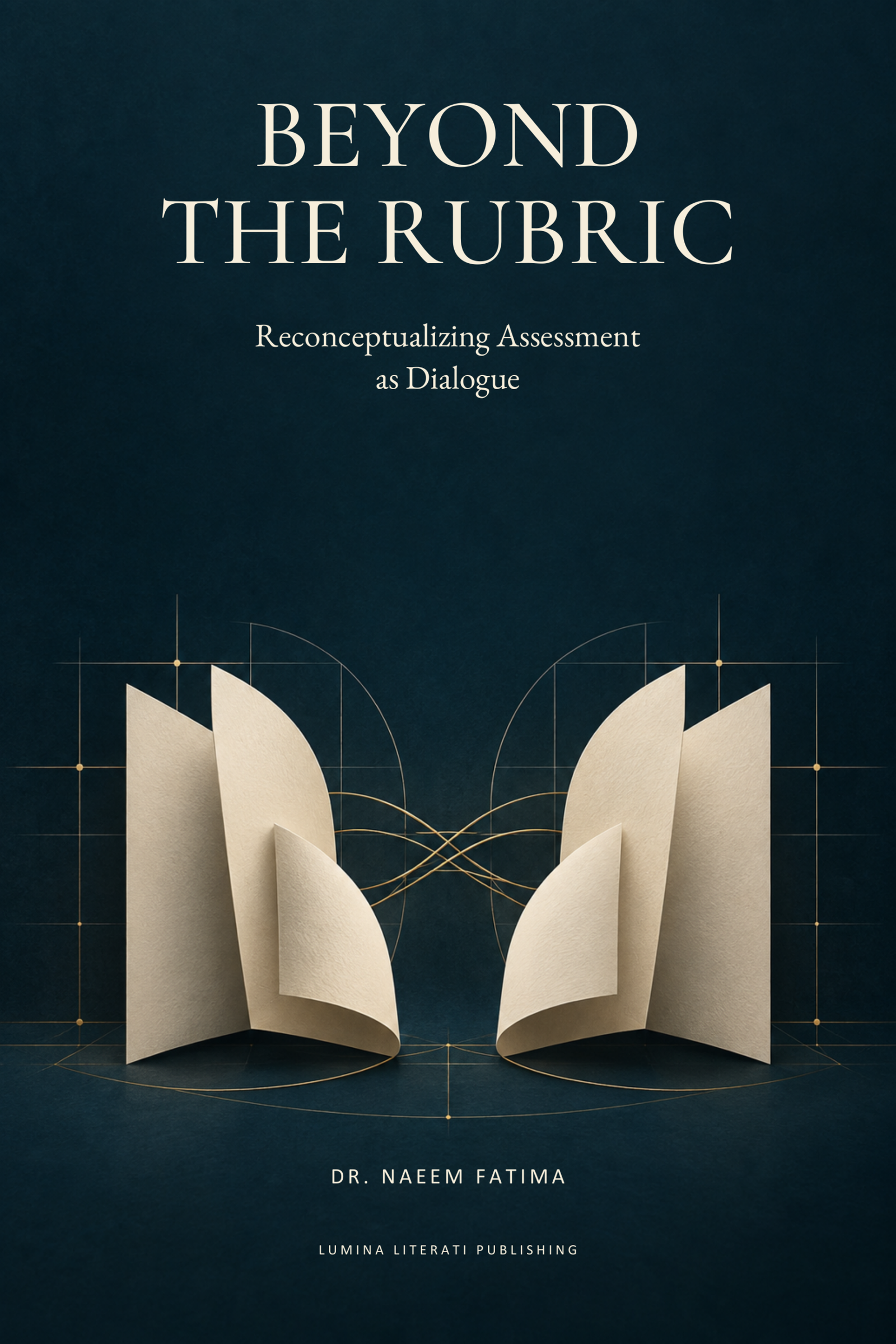
Beyond the Rubric: Reconceptualizing Assessment as Dialogue examines how assessment in higher education can become a continuing exchange through which students learn to interpret standards, use feedback, and develop evaluative judgement. Dr. Naeem Fatima brings together dialogic pedagogy, sociocultural theory, feedback literacy, and assessment scholarship to consider how teachers and students can share responsibility for understanding quality.
Across five chapters, the book moves from the limits and affordances of rubrics to the design of feedback conversations, peer review, co-constructed criteria, portfolios, and assessment across programmes. It examines the trust, power, emotion, and inclusion that shape participation, and proposes a Dialogic Assessment Framework as a conceptual synthesis for further research and educational design. The discussion draws on selected literature and illustrative designs; the framework is presented as a proposal requiring empirical evaluation.
The final chapter considers curriculum reform, faculty development, workload, quality assurance, and generative AI. Written for higher education educators, researchers, academic developers, and institutional leaders, the book invites a careful reconsideration of how assessment can support rigorous judgement, learner agency, and sustained learning.
Inside the book
- 01
Foundations and Framing
The Limits of the Rubric and the Case for Dialogue
- 02
The Architecture of Dialogic Assessment
Principles, Designs, and Enabling Conditions
- 03
Dialogue in Practice
Illustrative Designs for Assessment Reconceived
- 04
Mechanisms and Dynamics
A Theoretical Framework for Dialogic Assessment
- 05
Beyond the Rubric in Practice
Implications for Curriculum, Faculty, Policy, Technology, and Equity
Free to read
Read Beyond the Rubric
Open the cover to browse the complete book in the online reader, or download the PDF to read offline.
Download the complete PDF191 pages · English · PDF
© 2026 Dr. Naeem Fatima. The author retains full copyright ownership of this work. Published open access under the Creative Commons Attribution-NonCommercial-NoDerivatives 4.0 International (CC BY-NC-ND 4.0) licence. Sharing is permitted for noncommercial purposes with attribution; adapted versions may not be distributed under this licence.
Cite this book
Fatima, N. (2026). Beyond the rubric: Reconceptualizing assessment as dialogue. Lumina Literati Publishing. https://doi.org/10.65758/isbn.9786277813611
References
The complete bibliography from the book, with links to the cited sources.
View all 67 references
- Alexander, R. J. (2008). Towards dialogic teaching: Rethinking classroom talk (4th ed.). Dialogos.
- Anderson, G., Boud, D., & Sampson, J. (1996). Learning contracts: A practical guide. Routledge.
- Bakhtin, M. M. (1981). The dialogic imagination: Four essays (M. Holquist, Ed.; C. Emerson & M. Holquist, Trans.). University of Texas Press.
- Bakhtin, M. M. (1986). Speech genres and other late essays (C. Emerson & M. Holquist, Eds.; V. W. McGee, Trans.). University of Texas Press.
- Bakhtin, M. M. (1993). Toward a philosophy of the act (V. Liapunov, Trans.; V. Liapunov & M. Holquist, Eds.). University of Texas Press.
- Baume, D., & Yorke, M. (2002). The reliability of assessment by portfolio on a course to develop and accredit teachers in higher education. Studies in Higher Education, 27(1), 7–25. https://doi.org/10.1080/03075070120099340
- Beaumont, C., O’Doherty, M., & Shannon, L. (2011). Reconceptualising assessment feedback: A key to improving student learning? Studies in Higher Education, 36(6), 671–687. https://doi.org/10.1080/03075071003731135
- Black, P., & Wiliam, D. (1998). Assessment and classroom learning. Assessment in Education: Principles, Policy & Practice, 5(1), 7–74. https://doi.org/10.1080/0969595980050102
- Bloxham, S., & Price, M. (2015). External examining: Fit for purpose? Studies in Higher Education, 40(2), 195–211. https://doi.org/10.1080/03075079.2013.823931
- Boud, D. (2000). Sustainable assessment: Rethinking assessment for the learning society. Studies in Continuing Education, 22(2), 151–167. https://doi.org/10.1080/713695728
- Boud, D., & Dawson, P. (2023). What feedback literate teachers do: An empirically-derived competency framework. Assessment & Evaluation in Higher Education, 48(2), 158–171. https://doi.org/10.1080/02602938.2021.1910928
- Boud, D., & Molloy, E. (2013). Rethinking models of feedback for learning: The challenge of design. Assessment & Evaluation in Higher Education, 38(6), 698–712. https://doi.org/10.1080/02602938.2012.691462
- Bourdieu, P. (1986). The forms of capital. In J. G. Richardson (Ed.), Handbook of theory and research for the sociology of education (pp. 241–258). Greenwood Press.
- Bridgeman, A., Liu, D., & Weeks, R. (2024). Program level assessment design and the two-lane approach. Teaching@Sydney, University of Sydney. https://educational-innovation.sydney.edu.au/teaching%40sydney/program-level-assessment-two-lane/
- Buber, M. (1970). I and Thou (W. Kaufmann, Trans.). Charles Scribner’s Sons.
- Carless, D. (2006). Differing perceptions in the feedback process. Studies in Higher Education, 31(2), 219–233. https://doi.org/10.1080/03075070600572132
- Carless, D. (2007). Learning-oriented assessment: Conceptual bases and practical implications. Innovations in Education and Teaching International, 44(1), 57–66. https://doi.org/10.1080/14703290601081332
- Carless, D. (2009). Trust, distrust and their impact on assessment reform. Assessment & Evaluation in Higher Education, 34(1), 79–89. https://doi.org/10.1080/02602930801895786
- Carless, D., & Boud, D. (2018). The development of student feedback literacy: Enabling uptake of feedback. Assessment & Evaluation in Higher Education, 43(8), 1315–1325. https://doi.org/10.1080/02602938.2018.1463354
- Carless, D., & Winstone, N. (2023). Teacher feedback literacy and its interplay with student feedback literacy. Teaching in Higher Education, 28(1), 150–163. https://doi.org/10.1080/13562517.2020.1782372
- CAST. (2024). CAST Universal Design for Learning Guidelines version 3.0. https://udlguidelines.cast.org/
- Coleman, J. S. (1988). Social capital in the creation of human capital. American Journal of Sociology, 94(Supplement), S95–S120. https://doi.org/10.1086/228943
- Cook-Sather, A., Bovill, C., & Felten, P. (2014). Engaging students as partners in learning and teaching: A guide for faculty. Jossey-Bass.
- Dawson, P. (2021). Defending assessment security in a digital world: Preventing e-cheating and supporting academic integrity in higher education. Routledge.
- Foucault, M. (1977). Discipline and punish: The birth of the prison (A. Sheridan, Trans.). Allen Lane.
- Freire, P. (1970). Pedagogy of the oppressed (M. B. Ramos, Trans.). Herder and Herder.
- Gergen, K. J. (2009). Relational being: Beyond self and community. Oxford University Press.
- Handley, K., & Williams, L. (2011). From copying to learning: Using exemplars to engage students with assessment criteria and feedback. Assessment & Evaluation in Higher Education, 36(1), 95–108. https://doi.org/10.1080/02602930903201669
- Healey, M., Flint, A., & Harrington, K. (2014). Engagement through partnership: Students as partners in learning and teaching in higher education. Higher Education Academy. https://repository.londonmet.ac.uk/5176/
- Hill, J., & West, H. (2022). Dialogic feed-forward in assessment: Pivotal to learning but not unproblematic. Teaching & Learning Inquiry, 10. https://doi.org/10.20343/teachlearninqu.10.20
- Honneth, A. (1995). The struggle for recognition: The moral grammar of social conflicts (J. Anderson, Trans.). Polity Press.
- Hughes, G. (2014). Ipsative assessment: Motivation through marking progress. Palgrave Macmillan. https://doi.org/10.1057/9781137267221
- Jessop, T., & Tomas, C. (2017). The implications of programme assessment patterns for student learning. Assessment & Evaluation in Higher Education, 42(6), 990–999. https://doi.org/10.1080/02602938.2016.1217501
- Klenowski, V. (2002). Developing portfolios for learning and assessment: Processes and principles. Routledge. https://doi.org/10.4324/9780203825921
- Li, H., Xiong, Y., Zang, X., Kornhaber, M. L., Lyu, Y., Chung, K. S., & Suen, H. K. (2016). Peer assessment in the digital age: A meta-analysis comparing peer and teacher ratings. Assessment & Evaluation in Higher Education, 41(2), 245–264. https://doi.org/10.1080/02602938.2014.999746
- Littleton, K., & Mercer, N. (2013). Interthinking: Putting talk to work. Routledge.
- Loosveld, L. M., van Gerven, P. W. M., Vanassche, E., & Driessen, E. W. (2020). Mentors’ beliefs about their roles in health care education: A qualitative study of mentors’ personal interpretative framework. Academic Medicine, 95(10), 1600–1606. https://doi.org/10.1097/ACM.0000000000003159
- Mentzer, N., Lee, W., & Bartholomew, S. R. (2021). Examining the validity of adaptive comparative judgment for peer evaluation in a design thinking course. Frontiers in Education, 6, 772832. https://doi.org/10.3389/feduc.2021.772832
- Mercer, N. (2000). Words and minds: How we use language to think together. Routledge.
- Miao, F., & Holmes, W. (2023). Guidance for generative AI in education and research. UNESCO. https://doi.org/10.54675/EWZM9535
- Molloy, E., & Bearman, M. (2019). Embracing the tension between vulnerability and credibility: ‘Intellectual candour’ in health professions education. Medical Education, 53(1), 32–41. https://doi.org/10.1111/medu.13649
- Nicol, D. (2021). The power of internal feedback: Exploiting natural comparison processes. Assessment & Evaluation in Higher Education, 46(5), 756–778. https://doi.org/10.1080/02602938.2020.1823314
- Nicol, D. J., & Macfarlane-Dick, D. (2006). Formative assessment and self-regulated learning: A model and seven principles of good feedback practice. Studies in Higher Education, 31(2), 199–218. https://doi.org/10.1080/03075070600572090
- Nicol, D., Thomson, A., & Breslin, C. (2014). Rethinking feedback practices in higher education: A peer review perspective. Assessment & Evaluation in Higher Education, 39(1), 102–122. https://doi.org/10.1080/02602938.2013.795518
- Panadero, E., & Jonsson, A. (2013). The use of scoring rubrics for formative assessment purposes revisited: A review. Educational Research Review, 9, 129–144. https://doi.org/10.1016/j.edurev.2013.01.002
- Panadero, E., Jonsson, A., & Botella, J. (2017). Effects of self-assessment on self-regulated learning and self-efficacy: Four meta-analyses. Educational Research Review, 22, 74–98. https://doi.org/10.1016/j.edurev.2017.08.004
- Pitt, E., & Norton, L. (2017). ‘Now that’s the feedback I want!’ Students’ reactions to feedback on graded work and what they do with it. Assessment & Evaluation in Higher Education, 42(4), 499–516. https://doi.org/10.1080/02602938.2016.1142500
- Pollitt, A. (2012). The method of adaptive comparative judgement. Assessment in Education: Principles, Policy & Practice, 19(3), 281–300. https://doi.org/10.1080/0969594X.2012.665354
- Power, M. (1997). The audit society: Rituals of verification. Oxford University Press.
- Reddy, Y. M., & Andrade, H. (2010). A review of rubric use in higher education. Assessment & Evaluation in Higher Education, 35(4), 435–448. https://doi.org/10.1080/02602930902862859
- Rust, C., O’Donovan, B., & Price, M. (2005). A social constructivist assessment process model: How the research literature shows us this could be best practice. Assessment & Evaluation in Higher Education, 30(3), 231–240. https://doi.org/10.1080/02602930500063819
- Sadler, D. R. (2010). Beyond feedback: Developing student capability in complex appraisal. Assessment & Evaluation in Higher Education, 35(5), 535–550. https://doi.org/10.1080/02602930903541015
- Schut, S., Driessen, E., van Tartwijk, J., van der Vleuten, C., & Heeneman, S. (2018). Stakes in the eye of the beholder: An international study of learners’ perceptions within programmatic assessment. Medical Education, 52(6), 654–663. https://doi.org/10.1111/medu.13532
- Scoggins, J., & Winter, R. (1999). The patchwork text: A coursework format for education as critical understanding. Teaching in Higher Education, 4(4), 485–499. https://doi.org/10.1080/1356251990040405
- Shulman, L. S. (2005). Signature pedagogies in the professions. Daedalus, 134(3), 52–59. https://www.amacad.org/publication/daedalus/signature-pedagogies-professions
- Strathern, M. (Ed.). (2000). Audit cultures: Anthropological studies in accountability, ethics and the academy. Routledge.
- Tai, J., Ajjawi, R., Boud, D., Dawson, P., & Panadero, E. (2018). Developing evaluative judgement: Enabling students to make decisions about the quality of work. Higher Education, 76(3), 467–481. https://doi.org/10.1007/s10734-017-0220-3
- To, J., & Carless, D. (2016). Making productive use of exemplars: Peer discussion and teacher guidance for positive transfer of strategies. Journal of Further and Higher Education, 40(6), 746–764. https://doi.org/10.1080/0309877X.2015.1014317
- Torrance, H. (2007). Assessment as learning? How the use of explicit learning objectives, assessment criteria and feedback in post-secondary education and training can come to dominate learning. Assessment in Education: Principles, Policy & Practice, 14(3), 281–294. https://doi.org/10.1080/09695940701591867
- van der Vleuten, C. P. M., Schuwirth, L. W. T., Driessen, E. W., Dijkstra, J., Tigelaar, D., Baartman, L. K. J., & van Tartwijk, J. (2012). A model for programmatic assessment fit for purpose. Medical Teacher, 34(3), 205–214. https://doi.org/10.3109/0142159X.2012.652239
- Vygotsky, L. S. (1978). Mind in society: The development of higher psychological processes (M. Cole, V. John-Steiner, S. Scribner, & E. Souberman, Eds.). Harvard University Press. https://doi.org/10.2307/j.ctvjf9vz4
- Weber-Wulff, D., Anohina-Naumeca, A., Bjelobaba, S., Foltýnek, T., Guerrero-Dib, J., Popoola, O., Šigut, P., & Waddington, L. (2023). Testing of detection tools for AI-generated text. International Journal for Educational Integrity, 19, Article 26. https://doi.org/10.1007/s40979-023-00146-z
- Wegerif, R. (2013). Dialogic: Education for the Internet Age. Routledge.
- Wertsch, J. V. (1998). Mind as action. Oxford University Press. https://doi.org/10.1093/acprof:oso/9780195117530.001.0001
- Yang, M., & Carless, D. (2013). The feedback triangle and the enhancement of dialogic feedback processes. Teaching in Higher Education, 18(3), 285–297. https://doi.org/10.1080/13562517.2012.719154
- Yosso, T. J. (2005). Whose culture has capital? A critical race theory discussion of community cultural wealth. Race Ethnicity and Education, 8(1), 69–91. https://doi.org/10.1080/1361332052000341006
- Zimmerman, B. J. (2002). Becoming a self-regulated learner: An overview. Theory Into Practice, 41(2), 64–70. https://doi.org/10.1207/s15430421tip4102_2