
Open access · 2026
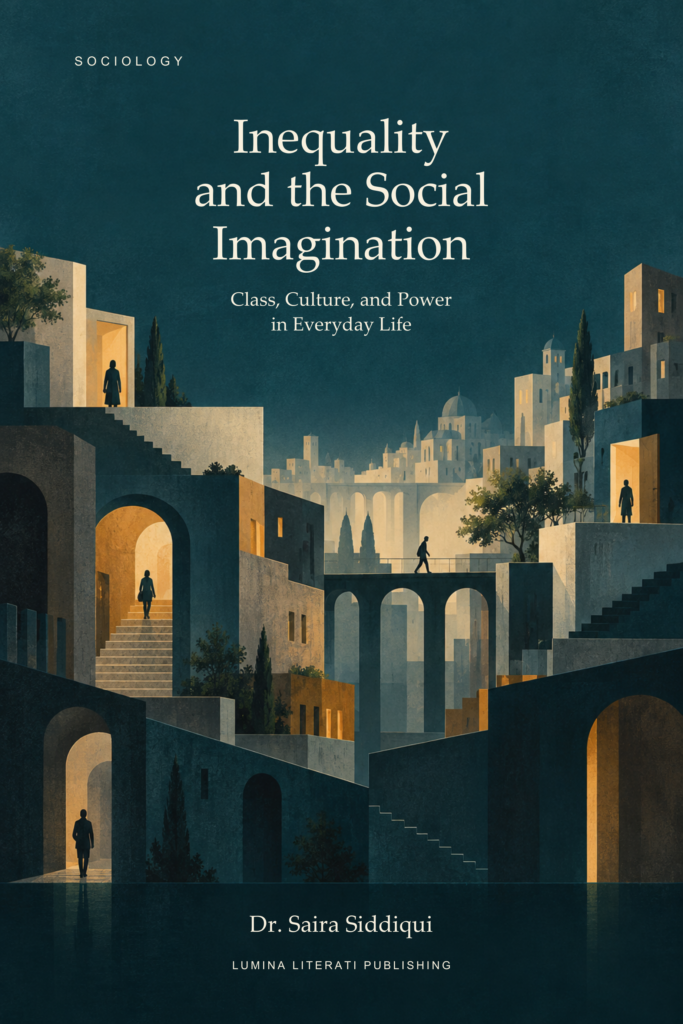
Inequality and the Social Imagination
Class, Culture, and Power in Everyday Life
Book overview
Inequality and the Social Imagination examines how class, culture, and power shape ordinary encounters and the possibilities people learn to imagine. Dr. Saira Siddiqui traces the social meanings attached to taste, language, respectability, and belonging, and considers how schools, workplaces, families, and the state reproduce unequal treatment.
Across five chapters, the book connects these everyday processes with the emotional experience of shame, dignity, desire, and resentment. It questions the promise that individual mobility alone can resolve structural inequality, then explores institutions, cultural democracy, and collective imagination as resources for a more equal social life. The discussion invites readers to connect personal experience with social relationships and to reconsider what equality requires in practice.
Inside the book
- 01
The Everyday Architecture of Inequality
How Social Difference Becomes Common Sense
- 02
Classed Culture
Taste, Respectability, Language, and the Politics of Belonging
- 03
Institutions of Everyday Power
Schools, Workplaces, Families, and the State
- 04
The Emotional Life of Inequality
Shame, Dignity, Desire, and Resentment
- 05
Reimagining Equality
From Private Aspiration to Collective Possibility
Free to read
Read Inequality and the Social Imagination
Open the cover to browse the complete book in the online reader, or download the PDF to read offline.
Download the complete PDF244 pages · English · PDF
© 2026 Dr. Saira Siddiqui. The author retains full copyright ownership of this work. Published open access under the Creative Commons Attribution-NonCommercial-NoDerivatives 4.0 International (CC BY-NC-ND 4.0) licence. Sharing is permitted for noncommercial purposes with attribution; adapted versions may not be distributed under this licence.
Cite this book
Siddiqui, S. (2026). Inequality and the social imagination: Class, culture, and power in everyday life. Lumina Literati Publishing. https://doi.org/10.65758/isbn.9786277813598
References
The complete bibliography from the book, with links to the cited sources.
View all 368 references
- Abrahams, J., & Ingram, N. (2013). The Chameleon Habitus: Exploring Local Students’ Negotiations of Multiple Fields. Sociological Research Online, 18(4), 213–226. https://doi.org/10.5153/sro.3189
- Ackers, G. K. (2020). The ‘dual tension’ created by negotiating upward social mobility and habitus: A generational study of skilled working-class men, their sons and grandsons following deindustrialization. Current Sociology, 68(7), 891–911. https://doi.org/10.1177/0011392119888563
- Adorno, T. W., Frenkel-Brunswik, E., Levinson, D. J., & Sanford, R. N. (1950). The authoritarian personality. Harper & Brothers.
- Agbaria, A. K., Mustafa, M., & Jabareen, Y. T. (2015). ‘In your face’ democracy: education for belonging and its challenges in Israel. British Educational Research Journal, 41(1), 143–175. https://doi.org/10.1002/berj.3133
- Agumba, H., & Simpson, Z. (2024). TOWARDS STUDENT ENGAGEMENT: RECOGNISING ALTERNATIVE FORMS OF CAPITAL AMONG STUDENTS FROM RURAL BACKGROUNDS. In Reimagining South African Higher Education: Towards a Student-Centred Learning and Teaching Future. African Sun Media. https://doi.org/10.52779/9781991260468/06
- Aho, T., & Peltola, M. (2023). Doing Respectable Heteromasculinities in Boys and Young Men’s Talk on Sexual Encounters. Men and Masculinities, 26(2), 210–228. https://doi.org/10.1177/1097184x221145959
- Alemán, S. M. (2023). Eroding Community Cultural Wealth: How Schooling Devalues Latina/o/x Students’ Identity, Pride, and Language. Association of Mexican American Educators Journal, 17(1), 1–31. https://doi.org/10.24974/amae.17.1.472
- Allport, G. W. (1979). The nature of prejudice (25th anniversary ed.). Basic Books. (Original work published 1954)
- Altermark, N. (2023). Crip Solidarity: Vulnerability as the Foundation of Political Alliances. International Journal of Disability and Social Justice, 3(3). https://doi.org/10.13169/intljofdissocjus.3.3.0027
- Alvarado-Urbina, A., Mondaca-Rojas, C., Bustos-González, R., & Sánchez-González, E. (2024). Social Boundaries and Stigmatization in a Border Territory: Experiences of Peruvian and Bolivian Students in the Northernmost Region of Chile. Sage Open, 14(2), 21582440241253421. https://doi.org/10.1177/21582440241253421
- Amis, J. M., Mair, J., & Munir, K. A. (2020). The Organizational Reproduction of Inequality. Academy of Management Annals, 14(1), 195–230. https://doi.org/10.5465/annals.2017.0033
- Amis, J. M., Munir, K. A., Lawrence, T. B., Hirsch, P., & McGahan, A. (2018). Inequality, Institutions and Organizations. Organization Studies, 39(9), 1131–1152. https://doi.org/10.1177/0170840618792596
- Anantharaman, M. (2022). Is it sustainable consumption or performative environmentalism? Consumption and Society, 1(1), 120–143. https://doi.org/10.1332/lttt8626
- Appadurai, A. (2004). The capacity to aspire: Culture and the terms of recognition. In V. Rao & M. Walton (Eds.), Culture and public action (pp. 59–84). Stanford University Press.
- Araya Anabalón, J. (2012). Una interpretación del conflicto Mapuche y el reconocimiento desde la perspectiva de Axel Honneth: Una concepción moral y ética. Revista Chilena de Derecho y Ciencia Política, 3(1), 131–146. https://doi.org/10.7770/rchdcp-v3n1-art91
- Atria, J., Castillo, J., Maldonado, L., & Ramirez, S. (2020). Economic Elites’ Attitudes Toward Meritocracy in Chile: A Moral Economy Perspective. American Behavioral Scientist, 64(9), 1219–1241. https://doi.org/10.1177/0002764220941214
- Au, A. (2024). Bourdieusian Boundary-Making, Social Networks, and Capital Conversion: Inequality among International Degree Holders in Hong Kong. Cultural Sociology, 18(4), 483–506. https://doi.org/10.1177/17499755231157115
- Auyero, J. (2012). Patients of the state: The politics of waiting in Argentina. Duke University Press. https://doi.org/10.1215/9780822395287
- Ayala, M. I., & Contreras, S. M. (2019). It’s Capital! Understanding Latina/o Presence in Higher Education. Sociology of Race and Ethnicity, 5(2), 229–243. https://doi.org/10.1177/2332649218757803
- Aziz, A. (2022). A History of Symbolic Violence: A Spatial Temporal Exploration of the Cultural Capital Legacy of Bengali Pedagogy. Sociological Bulletin, 71(1), 41–61. https://doi.org/10.1177/00380229211063151
- Babcock, R. D. (2014). Folk-Linguistic Attitudes in Eastern Massachusetts. Open Journal of Modern Linguistics, 04(03), 415–428. https://doi.org/10.4236/ojml.2014.43035
- Banjac, S., & Hanusch, F. (2022). Aspirational lifestyle journalism: The impact of social class on producers’ and audiences’ views in the context of socio-economic inequality. Journalism, 23(8), 1607–1625. https://doi.org/10.1177/1464884920956823
- Banting, K. G., & Kymlicka, W. (2015). The Political Sources of Solidarity in Diverse Societies. [Working paper]. SSRN. https://doi.org/10.2139/ssrn.2670696
- Batra, P. (2021). Re-imagining curriculum in India: Charting a path beyond the pandemic. PROSPECTS, 51(1-3), 407–424. https://doi.org/10.1007/s11125-020-09518-6
- Beckert, J. (2022). Durable Wealth: Institutions, Mechanisms, and Practices of Wealth Perpetuation. Annual Review of Sociology, 48(1), 233–255. https://doi.org/10.1146/annurev-soc-030320-115024
- Beck, U. (2011). Cosmopolitanism as Imagined Communities of Global Risk. American Behavioral Scientist, 55(10), 1346–1361. https://doi.org/10.1177/0002764211409739
- Belluigi, D. Z. (2023). 5. Why decolonising “knowledge” matters: Deliberations for educators on that made fragile. In Higher Education for Good (pp. 137–160). Open Book Publishers. https://doi.org/10.11647/obp.0363.05
- Benjamin, O. (2020). Shame and (“managed”) resentment: Emotion and entitlement among Israeli mothers living in poverty. The British Journal of Sociology, 71(4), 785–799. https://doi.org/10.1111/1468-4446.12753
- Berger, J., & Ward, M. (2010). Subtle Signals of Inconspicuous Consumption. Journal of Consumer Research, 37(4), 555–569. https://doi.org/10.1086/655445
- Bernstein, B. (1971). Class, codes and control: Vol. 1. Theoretical studies towards a sociology of language. Routledge & Kegan Paul.
- Bitenc, M. (2023). Variation of Spoken Slovene in the Case of Geographically Mobile Speakers. Slovenščina 2.0: empirične, aplikativne in interdisciplinarne raziskave, 11(2), 29–58. https://doi.org/10.4312/slo2.0.2023.2.29-58
- Bobić, A. (2024). Imagining transnational solidarity in the EU through Hegel’s idea of mutual recognition. Maastricht Journal of European and Comparative Law, 31(6), 676–690. https://doi.org/10.1177/1023263x251314443
- Bolívar, A. (2012). Justicia social y equidad escolar: Una revisión actual. Revista Internacional de Educación para la Justicia Social, 1(1), 9–45. https://doi.org/10.15366/riejs2012.1.1.001
- Born, A. M. (2024). The price of the ticket revised: Family members’ experiences of upward social mobility. The Sociological Review, 72(2), 394–411. https://doi.org/10.1177/00380261231167748
- Bourdieu, P. (1984). Distinction: A social critique of the judgement of taste (R. Nice, Trans.). Harvard University Press.
- Bourdieu, P. (1986). The forms of capital. In J. G. Richardson (Ed.), Handbook of theory and research for the sociology of education (pp. 241–258). Greenwood Press.
- Bourdieu, P. (1991). Language and symbolic power (J. B. Thompson, Ed.; G. Raymond & M. Adamson, Trans.). Harvard University Press.
- Bowles, S., & Gintis, H. (2011). Schooling in capitalist America: Educational reform and the contradictions of economic life. Haymarket Books. (Original work published 1976)
- Boyle, B., & De Keere, K. (2019). Aesthetic labour, class and taste: Mobility aspirations of middle-class women working in luxury-retail. The Sociological Review, 67(3), 706–722. https://doi.org/10.1177/0038026119827753
- Boyle, B., & Vandebroeck, D. (2025). The Labor of Distinction: Butlers, Service Work, and the Production of Elite Lifestyles. American Sociological Review, 90(1), 26–60. https://doi.org/10.1177/00031224241305357
- Brodkin, E. Z. (2012). Reflections on Street‐Level Bureaucracy: Past, Present, and Future. Public Administration Review, 72(6), 940–949. https://doi.org/10.1111/j.1540-6210.2012.02657.x
- Brosio, R. A. (1998). Diverse school populations and the corresponding need for multiple-identity coalitions: With a touch of class. Paideusis, 12(1), 23–36. https://doi.org/10.7202/1073094ar
- Bruni, L., & Santori, P. (2022). The Illusion of Merit and the Demons of Economic Meritocracy: Which are the Legitimate Expectations of the Market? Journal of Business Ethics, 176(3), 415–427. https://doi.org/10.1007/s10551-020-04727-7
- Bunting, I. (2019). Towards a Pan African political culture: Critical pedagogy, reparative justice and the end of global white supremacy. Contemporary Journal of African Studies, 6(1), 138–157. https://doi.org/10.4314/contjas.v6i1.8
- Burger, R., Louw, M., van der Berg, S., & Pegado, B. (2015). Understanding Consumption Patterns of the Established and Emerging South African Black Middle Class [Working paper]. SSRN. https://doi.org/10.2139/ssrn.2693652
- Burnell Reilly, I. (2024). Tales of the unexpected: The lives and experiences of working‐class academics. Higher Education Quarterly, 78(3), 1190–1201. https://doi.org/10.1111/hequ.12524
- Buvinić, M., & Mazza, J. (Eds.), with Deutsch, R. (2004). Social inclusion and economic development in Latin America. Inter-American Development Bank. https://doi.org/10.18235/0012583
- Campbell, J. L. (2018). ‘My teacher says I’m an overachiever, but I think he’s an overexpecter’: Teacher expectations, self-concept, and academic success [Master’s thesis, Portland State University]. https://doi.org/10.15760/etd.6431
- Carrera, L. (2025). Rethinking ressentiment: democratic and urban implications. Frontiers in Sociology, 10, 1573180. https://doi.org/10.3389/fsoc.2025.1573180
- Cartwright, R. L. (2022). Sissies, Loafers, and the Feebleminded. GLQ: A Journal of Lesbian and Gay Studies, 28(4), 515–540. https://doi.org/10.1215/10642684-9991313
- Casey, E. (2020). Gambling, Status Anxiety and Inter-Generational Social Mobility: Findings from the Mass Observation Archive. Sociology, 54(2), 380–396. https://doi.org/10.1177/0038038519874981
- Cebula, M. (2024). The Structure of Social Capital and Cultural Participation: A Cross-sectional Study. Sociological Perspectives, 67(1-3), 173–195. https://doi.org/10.1177/07311214241247794
- Cely Betancourt, B. L., & Abreus González, A. (2022). Retos y avances en educación inclusiva en Colombia: Un análisis comparativo. Revista Metropolitana de Ciencias Aplicadas, 5(2), 178–187. https://doi.org/10.62452/c0sf1740
- Chadwick, R. (2017). Ambiguous subjects: Obstetric violence, assemblage and South African birth narratives. Feminism & Psychology, 27(4), 489–509. https://doi.org/10.1177/0959353517692607
- Chan, Y. Y., & Tang, H.-H. H. (2025). Student Voices About Educational Inequalities and Justice: Problematizing a Neoliberal Education System. Education and Urban Society, 57(3), 299–322. https://doi.org/10.1177/00131245251314135
- Chaudhary, N. (2023). Statistically Left Outs and Socio-Historically Legitimized Groups in Nepal. Far Western Review, 1(1), 173–186. https://doi.org/10.3126/fwr.v1i1.58335
- Chavoshan, I., Kaloustian, T., & Wells, B. D. (2024). Teachers' perceptions and implementations of global Englishes and Frenches in language classrooms. Foreign Language Annals, 57(4), 921–943. https://doi.org/10.1111/flan.12786
- Choi, J. (2021). Generational status, social capital and family engagement in immigrant families [Doctoral dissertation, University of Missouri–Columbia]. https://doi.org/10.32469/10355/88046
- Clarke, J., Hurst, C., & Tomlinson, J. (2024). Maintaining the Meritocracy Myth: A critical discourse analytic study of leaders’ talk about merit and gender in academia. Organization Studies, 45(5), 635–660. https://doi.org/10.1177/01708406241236610
- Clycq, N. (2017). From ‘people just like us’ to the ‘fundamentally other’ in an era of antiracism: The instrumental use of religion to exclude the other while avoiding stigma. Current Sociology, 65(5), 717–734. https://doi.org/10.1177/0011392115583679
- Çolak, F. Z. (2025). Racialization and belonging in higher education: Counternarratives of Turkish Belgian students from a community cultural wealth perspective. Journal of Diversity in Higher Education, 18(Suppl 1), S269–S282. https://doi.org/10.1037/dhe0000563
- Coleman, J. S. (1988). Social capital in the creation of human capital. American Journal of Sociology, 94(Supplement), S95–S120. https://doi.org/10.1086/228943
- Cortés Gómez, I. (2012). La paz política: Una lectura desde la filosofía para la paz. Fòrum de Recerca, 17, 3–20. https://doi.org/10.6035/forumrecerca.2012.17.1
- Cox, A. (2012). Intergenerational transmission of wealth. In J. A. Banks (Ed.), Encyclopedia of diversity in education (pp. 1226–1228). SAGE. https://doi.org/10.4135/9781452218533.n388
- Craft, J. T., Wright, K. E., Weissler, R. E., & Queen, R. M. (2020). Language and Discrimination: Generating Meaning, Perceiving Identities, and Discriminating Outcomes. Annual Review of Linguistics, 6(1), 389–407. https://doi.org/10.1146/annurev-linguistics-011718-011659
- Curington, C. V. (2020). Reproducing the Privilege of White Femininity: An Intersectional Analysis of Home Care. Sociology of Race and Ethnicity, 6(3), 333–347. https://doi.org/10.1177/2332649219885980
- Curl, H., Lareau, A., & Wu, T. (2018). Cultural Conflict: The Implications of Changing Dispositions Among the Upwardly Mobile. Sociological Forum, 33(4), 877–899. https://doi.org/10.1111/socf.12461
- Currid‐Halkett, E., Lee, H., & Painter, G. D. (2019). Veblen goods and urban distinction: The economic geography of conspicuous consumption. Journal of Regional Science, 59(1), 83–117. https://doi.org/10.1111/jors.12399
- Da Costa, A. E. (2016). The significance of post-racial ideology, black political struggle, and racial literacy for Brazilian anti-racist education policy. Policy Futures in Education, 14(3), 345–359. https://doi.org/10.1177/1478210316631871
- Darab, S., & Hartman, Y. (2011). Psychic wounds and the social structure: An empirical investigation. Current Sociology, 59(6), 787–804. https://doi.org/10.1177/0011392111419751
- Daraio, C. (2021). In Defense of Merit to Overcome Merit. Frontiers in Research Metrics and Analytics, 5, 614016. https://doi.org/10.3389/frma.2020.614016
- Darvin, R., & Norton, B. (2015). Identity and a Model of Investment in Applied Linguistics. Annual Review of Applied Linguistics, 35, 36–56. https://doi.org/10.1017/s0267190514000191
- Darvin, R., & Norton, B. (2016). Investment and Language Learning in the 21st Century. Langage et société, 157(3), 19–38. https://doi.org/10.3917/ls.157.0019
- Davies, S., & Rizk, J. (2018). The Three Generations of Cultural Capital Research: A Narrative Review. Review of Educational Research, 88(3), 331–365. https://doi.org/10.3102/0034654317748423
- Dazey, M. (2021). Rethinking respectability politics. The British Journal of Sociology, 72(3), 580–593. https://doi.org/10.1111/1468-4446.12810
- de Andrade, L. A., & Pekkola, E. (2025). Understanding clerical decisions in granting social assistance: Insights from national social security officials in Brazil. International Social Security Review, 78(1), 29–56. https://doi.org/10.1111/issr.12381
- De Beer, S. F. (2014). Demythologising social cohesion: Towards a practical theological vision. Verbum et Ecclesia, 35(2). https://doi.org/10.4102/ve.v35i2.1344
- de la Maza, L. M. (2021). Reconocimiento e identidad de género. Veritas, 48, 103–120. https://doi.org/10.4067/s0718-92732021000100103
- Delanty, G. (2014). The prospects of cosmopolitanism and the possibility of global justice. Journal of Sociology, 50(2), 213–228. https://doi.org/10.1177/1440783313508478
- Dixon-Román, E. J. (2013). The Forms of Capital and the Developed Achievement of Black Males. Urban Education, 48(6), 828–862. https://doi.org/10.1177/0042085912463707
- Dobbernack, J. (2026). Why Neoliberalism Doesn't Spell the Death of Society: Commonality, Regulation, and the Politics of Social Cohesion. The British Journal of Sociology, 77(1), 19–29. https://doi.org/10.1111/1468-4446.70031
- Douglas, M. (1966). Purity and danger: An analysis of concepts of pollution and taboo. Routledge & Kegan Paul.
- Drouhot, L. G. (2024). Fitting in at the Top? Stigma and the Negotiation of Belonging Among the New Immigrant Elite in France. International Migration Review, 58(3), 1434–1461. https://doi.org/10.1177/01979183231172106
- Du Bois, W. E. B. (1903). The souls of black folk: Essays and sketches. A. C. McClurg & Co. https://www.loc.gov/item/03011173/
- Duesenberry, J. S. (1949). Income, saving, and the theory of consumer behavior. Harvard University Press.
- Duimich, L. F., & García Gualda, S. M. (2020). El debate reconocimiento-redistribución en dos casos “políticamente incorrectos”: Nueva Soberanía y Con Mis Hijos No Te Metas. Divulgatio. Perfiles académicos de posgrado, 5(13), 155. https://doi.org/10.48160/25913530di13.106
- Duque Acosta, C. A. (2008). Aproximación teórica al debate por el reconocimiento político, jurídico y social del sector LGTBIQ. Revista CS, 181–207. https://doi.org/10.18046/recs.i2.417
- Emery, J., Powell, R., & Crookes, L. (2023). Class, affect, margins. The Sociological Review, 71(2), 283–295. https://doi.org/10.1177/00380261221150076
- Englert, K., Gottwald, M., Globisch, C., & Kupka, P. (2026). Towards policies of dignity? The German Participation Opportunities Act as a response to long-term unemployment. Journal of Social Policy, 55(2), 587–603. https://doi.org/10.1017/s0047279424000370
- Evans, S., Whiting, R., & Mackenzie Davey, K. (2021). Struggles for distinction: Classing as discursive process in UK museum work. Gender, Work & Organization, 28(3), 992–1007. https://doi.org/10.1111/gwao.12433
- Fajardo, K. N., & Vargas Prieto, A. (2018). Reconocimiento social en el marco del posconflicto en Colombia: el caso de las zonas de reserva campesina. Cooperativismo & Desarrollo, 26(113). https://doi.org/10.16925/co.v26i113.2189
- Fargues, É., & Sredanovic, D. (2025). Introduction: The Dynamics of Migration Policy Implementation: The Frontline and Beyond. Social Policy & Administration, 59(4), 603–607. https://doi.org/10.1111/spol.13160
- Faria, A., Abdalla, M. M., & Guedes, A. L. (2021). Can We Co-Construct a Field of Management / Administration Engaged with the Majority? Organizações & Sociedade, 28(98), 549–581. https://doi.org/10.1590/1984-92302021v28n9804en
- Farrés Juste, O. (2023). Civic Solidarity and Public Health Ethics. Philosophies, 8(1), 11. https://doi.org/10.3390/philosophies8010011
- Fenigsen, J. (2003). Language ideologies in Barbados: Processes and paradigms. Pragmatics, 13(4), 457–481. https://doi.org/10.1075/prag.13.4.01fen
- Fercovic, M. (2024). ‘He is my refuge’: Upward mobility, class dislocation and romantic relationships. Sociology, 58(2), 507–526. https://doi.org/10.1177/00380385231189174
- Fleischmann, A., Holck, L., Liu, H., Muhr, S. L., & Murgia, A. (2022). Organizing solidarity in difference: Challenges, achievements, and emerging imaginaries. Organization, 29(2), 233–246. https://doi.org/10.1177/13505084221083907
- Forrest, J., McDonald, S., & Dodsworth, R. (2021). Linguistic Employment Niches: Southern Dialect across Industries. Socius: Sociological Research for a Dynamic World, 7, 2378023121999161. https://doi.org/10.1177/2378023121999161
- Franceschelli, M., Evans, K., & Schoon, I. (2016). ‘A fish out of water?’ The therapeutic narratives of class change. Current Sociology, 64(3), 353–372. https://doi.org/10.1177/0011392115595064
- Fraser, N. (2005). Reframing justice in a globalizing world. New Left Review, 36, 69–88.
- Fraser, N., & Honneth, A. (2004). Redistribution or recognition? A political-philosophical exchange (J. Golb, J. Ingram, & C. Wilke, Trans.). Verso.
- Freire, P. (2018). Pedagogy of the oppressed (M. B. Ramos, Trans.; 50th anniversary ed.). Bloomsbury Academic. (English translation originally published 1970). https://www.bloomsbury.com/us/pedagogy-of-the-oppressed-9781501314131/
- Friedman, S. (2012). Cultural omnivores or culturally homeless? Exploring the shifting cultural identities of the upwardly mobile. Poetics, 40(5), 467–489. https://doi.org/10.1016/j.poetic.2012.07.001
- Friedman, S. (2014). The Price of the Ticket: Rethinking the Experience of Social Mobility. Sociology, 48(2), 352–368. https://doi.org/10.1177/0038038513490355
- Friedman, S. (2016). Habitus Clivé and the Emotional Imprint of Social Mobility. The Sociological Review, 64(1), 129–147. https://doi.org/10.1111/1467-954x.12280
- Friedman, S., & Kuipers, G. (2013). The Divisive Power of Humour: Comedy, Taste and Symbolic Boundaries. Cultural Sociology, 7(2), 179–195. https://doi.org/10.1177/1749975513477405
- Friedman, S., O’Brien, D., & McDonald, I. (2021). Deflecting Privilege: Class Identity and the Intergenerational Self. Sociology, 55(4), 716–733. https://doi.org/10.1177/0038038520982225
- Friedman, S., & Reeves, A. (2020). From Aristocratic to Ordinary: Shifting Modes of Elite Distinction. American Sociological Review, 85(2), 323–350. https://doi.org/10.1177/0003122420912941
- Fromm, E. (1941). Escape from freedom. Farrar & Rinehart.
- Frost, L., & Hoggett, P. (2008). Human agency and social suffering. Critical Social Policy, 28(4), 438–460. https://doi.org/10.1177/0261018308095279
- García-González, D. E. (2023). A theoretical and action-oriented vindication of peace. In N. Chivasa (Ed.), Global peace and security. IntechOpen. https://doi.org/10.5772/intechopen.107000
- García-Granero, M. (2018). Injusticias de género en tiempos de neoliberalismo. El planteamiento de Nancy Fraser. Asparkía. Investigació feminista(33), 207–223. https://doi.org/10.6035/asparkia.2018.33.12
- García Montoya, J. M., & Motato Giraldo, L. R. (2023). Ventajas y limitaciones del modelo de lucha de Axel Honneth. Una puesta en práctica en Colombia. Poiésis(44), 105–119. https://doi.org/10.21501/16920945.3892
- Georgiou, M., & Titley, G. (2022). Publicness and commoning: Pandemic intersections and collective visions at times of crisis. International Journal of Cultural Studies, 25(3-4), 331–348. https://doi.org/10.1177/13678779211060363
- Gerdin, G., Philpot, R. A., Larsson, L., Schenker, K., Linnér, S., Moen, K. M., Westlie, K., Smith, W., & Legge, M. (2019). Researching social justice and health (in)equality across different school Health and Physical Education contexts in Sweden, Norway and New Zealand. European Physical Education Review, 25(1), 273–290. https://doi.org/10.1177/1356336x18783916
- Giazitzoglu, A. (2014). Qualitative Upward Mobility, the Mass-Media and ‘Posh’ Masculinity in Contemporary North-East Britain: A Micro Sociological Case-Study. Sociological Research Online, 19(2), 1–11. https://doi.org/10.5153/sro.3273
- Giazitzoglu, A., & Muzio, D. (2021). Learning the rules of the game: How is corporate masculinity learned and enacted by male professionals from nonprivileged backgrounds? Gender, Work & Organization, 28(1), 67–84. https://doi.org/10.1111/gwao.12561
- Giroux, H. A. (2017). Neoliberalism’s War against Higher Education and the Role of Public Intellectuals. In The Future of University Education (pp. 185–206). Springer International Publishing. https://doi.org/10.1007/978-3-319-46894-5_10
- Glass, C., & Cook, A. (2020). Performative contortions: How White women and people of colour navigate elite leadership roles. Gender, Work & Organization, 27(6), 1232–1252. https://doi.org/10.1111/gwao.12463
- Gofen, A. (2024). In the eye of the storm: Street‐level organizations in circumstances of democratic backsliding. Governance, 37(S1), 153–169. https://doi.org/10.1111/gove.12890
- Goffman, E. (1963). Stigma: Notes on the management of spoiled identity. Prentice-Hall.
- Gordon, H. R., & Levesque, A. (2025). School Cultures, Peer Cultures, and Inequality: Gender in K‐12 Schooling. Sociology Compass, 19(9), e70112. https://doi.org/10.1111/soc4.70112
- Goßmann, F. (2021). The acquisition of cultural capital and habitus and their impact on the academic achievement: A revised theory [Doctoral dissertation, Otto-Friedrich-Universität Bamberg]. https://doi.org/10.20378/irb-50390
- Govender, L. (2023). Crumbs from the rich man’s table?: Municipal labour market policies and recognition of welfare recipients in Sweden [Doctoral dissertation, Linnaeus University]. Linnaeus University Press. https://doi.org/10.15626/lud.490.2023
- Greenwood, K. (2022). Majoritarian Stories and Counterstories: Critical Race Theory Approaches for Countering Deficit Discourse in Higher Education [Preprint]. SAGE Publications. https://doi.org/10.31124/advance.19287566
- Guatieri, Q. (2026). Meritocracy as Seen by Young People Living in Poverty in Quebec, Canada. Canadian Review of Sociology/Revue canadienne de sociologie, 63(1), e70019. https://doi.org/10.1111/cars.70019
- Gubrium, E., & Pellissery, S. (2016). Antipoverty Measures: The Potential for Shaming and Dignity Building through Delivery Interactions. The International Journal of Social Quality, 6(2), 1–17. https://doi.org/10.3167/ijsq.2016.060202
- Guerci, M., Hauff, S., Panichella, N., & Radaelli, G. (2023). Sustainable HRM and class-based inequality. Personnel Review, 52(5), 1597–1613. https://doi.org/10.1108/pr-10-2021-0772
- Gupta, A. (2012). Red tape: Bureaucracy, structural violence, and poverty in India. Duke University Press. https://doi.org/10.1215/9780822394709
- Gurr, T. R. (1970). Why men rebel. Princeton University Press.
- Gyawali, S. (2023). Globalization, Citizenship and Subjectivity: An analysis of the changes in the last five generations in my family. Nepal Journal of Multidisciplinary Research, 6(4), 98–109. https://doi.org/10.3126/njmr.v6i4.62016
- Hall, S., Critcher, C., Jefferson, T., Clarke, J., & Roberts, B. (1978). Policing the crisis: Mugging, the state, and law and order. Macmillan.
- Hällsten, M. (2024). The intergenerational transmission of wealth [Preprint]. SocArXiv. https://doi.org/10.31235/osf.io/utbqe
- Hamann, J., & Beljean, S. (2023). Social inequality A neglected topic in Studies of Valuation and Evaluation? [Preprint]. SocArXiv. https://doi.org/10.31235/osf.io/7fu8x
- Hamdon, C. (2025). Deservingness on the Front Lines: How Volunteers Navigate Moral Judgments in Emergency Food Distribution. Canadian Review of Sociology/Revue canadienne de sociologie, 62(4), 324–334. https://doi.org/10.1111/cars.70011
- Hannon, C., Faas, D., & O'Sullivan, K. (2017). Widening the educational capabilities of socio‐economically disadvantaged students through a model of social and cultural capital development. British Educational Research Journal, 43(6), 1225–1245. https://doi.org/10.1002/berj.3309
- Hansen, A., & Nielsen, K. B. (2023). Consumption, Sustainability and Everyday Life. In Consumption, Sustainability and Everyday Life (pp. 3–26). Springer International Publishing. https://doi.org/10.1007/978-3-031-11069-6_1
- Hansen, M. N., & Toft, M. (2021). Wealth Accumulation and Opportunity Hoarding: Class-Origin Wealth Gaps over a Quarter of a Century in a Scandinavian Country. American Sociological Review, 86(4), 603–638. https://doi.org/10.1177/00031224211020012
- Harvey, A., & Mallman, M. (2019). Beyond cultural capital: Understanding the strengths of new migrants within higher education. Policy Futures in Education, 17(5), 657–673. https://doi.org/10.1177/1478210318822180
- Hashemi, M. (2025). “More Money, More Problems”: Poverty, Recognition, and the Reframing of Success in Iran. Journal of Contemporary Ethnography, 54(6), 757–787. https://doi.org/10.1177/08912416251372455
- Higginbotham, E. B. (1993). Righteous discontent: The women’s movement in the Black Baptist Church, 1880–1920. Harvard University Press.
- Higgins, K. (2022). Dynasties in the making: Family wealth and inheritance for the first-generation ultra-wealthy and their wealth managers. The Sociological Review, 70(6), 1267–1283. https://doi.org/10.1177/00380261211061931
- Hilmar, T. (2025). Narratives of Disruptive Economic Change: Claiming and Contesting the Social Order. Sociological Theory, 43(4), 309–334. https://doi.org/10.1177/07352751251362172
- Hjerm, M., & Schnabel, A. (2012). How much heterogeneity can the welfare state endure? The influence of heterogeneity on attitudes to the welfare state. Nations and Nationalism, 18(2), 346–369. https://doi.org/10.1111/j.1469-8129.2011.00523.x
- Hochschild, A. R. (2016). Strangers in their own land: Anger and mourning on the American right. The New Press. https://thenewpress.org/books/strangers-in-their-own-land/
- Holmes, M., & McKenzie, J. (2019). Relational happiness through recognition and redistribution: Emotion and inequality. European Journal of Social Theory, 22(4), 439–457. https://doi.org/10.1177/1368431018799257
- Honneth, A. (1995). The struggle for recognition: The moral grammar of social conflicts (J. Anderson, Trans.). Polity Press.
- Hopman, M., & Knijn, T. (2022). Understanding Solidarity in Society: Triggers and Barriers for In- and Outgroup Solidarity. In Solidarity and Social Justice in Contemporary Societies (pp. 29–39). Springer International Publishing. https://doi.org/10.1007/978-3-030-93795-9_3
- Horgan, M. (2020). Housing Stigmatization: A General Theory. Social Inclusion, 8(1), 8–19. https://doi.org/10.17645/si.v8i1.2345
- Hörnqvist, M. (2024). Recognition of struggle: Transcending the oppressive dynamics of desire. Constellations, 31(3), 414–427. https://doi.org/10.1111/1467-8675.12711
- Hörschelmann, K., & Schäfer, N. (2007). ‘Berlin is Not a Foreign Country, Stupid!’—Growing up ‘Global’ in Eastern Germany. Environment and Planning A: Economy and Space, 39(8), 1855–1872. https://doi.org/10.1068/a38384
- Hortúa Clavijo, A. (2021). Discusiones sobre igualdad y equidad en educación: Un análisis del sistema educativo de Bogotá [Doctoral dissertation, Universidad Nacional del Centro de la Provincia de Buenos Aires]. https://doi.org/10.52278/2999
- Houston, S. (2016). Empowering the ‘shamed’ self: Recognition and critical social work. Journal of Social Work, 16(1), 3–21. https://doi.org/10.1177/1468017314566789
- Huesmann, M., Calveley, M., Smith, P., Forson, C., & Rosenbaum, L. (2020). The sticky steps of the career ladder for engineers: the case of first-generation students in Germany. Work Organisation, Labour & Globalisation, 14(2). https://doi.org/10.13169/workorgalaboglob.14.2.0081
- Hull, M. S. (2012). Government of paper: The materiality of bureaucracy in urban Pakistan. University of California Press.
- Hung, A. T. W. (2025). A Case for Communitarian Meritocracy: A Critical Engagement with Michael Sandel. Fudan Journal of the Humanities and Social Sciences, 18(2), 241–263. https://doi.org/10.1007/s40647-023-00375-z
- Hupe, P. (2019). Contextualizing government-in-action. In Research Handbook on Street-Level Bureaucracy. Edward Elgar Publishing. https://doi.org/10.4337/9781786437631.00010
- Hyatt, D., Escott, H., & Bone, R. (2022). ‘Addressing’ language deficit: valuing children's variational repertories. Literacy, 56(3), 212–224. https://doi.org/10.1111/lit.12303
- Iglesias, C. (2013). Justicia como redistribución, reconocimiento y representación: Las reconciliaciones de Nancy Fraser. Investigaciones Feministas, 3, 251–269. https://doi.org/10.5209/rev_infe.2012.v3.41149
- Ignatyeva, E. (2020). Symbolic and social boundaries of the integration of Russian immigrants in Czechia. AUC GEOGRAPHICA, 55(2), 137–148. https://doi.org/10.14712/23361980.2020.10
- Ikhile, I. A., Mavhandu-Mudzusi, A. H., & Sinegugu, N. (2024). Addressing unique challenges and crafting inclusive policies for Queer living with disabilities. African Journal of Disability, 13(0), a1418. https://doi.org/10.4102/ajod.v13i0.1418
- Ingram, N., & Allen, K. (2019). ‘Talent-spotting’ or ‘social magic’? Inequality, cultural sorting and constructions of the ideal graduate in elite professions. The Sociological Review, 67(3), 723–740. https://doi.org/10.1177/0038026118790949
- Jack, A. A. (2019). The privileged poor: How elite colleges are failing disadvantaged students. Harvard University Press.
- Jackson, M., & Choi, J.-A. (2021). Turning Adversity into Capitals among Low Income First Generation Students of Color: Exploring Interdependence of Multiple Capitals. Journal of Education and Culture Studies, 5(6), p13. https://doi.org/10.22158/jecs.v5n6p13
- Jarness, V., & Flemmen, M. P. (2019). A struggle on two fronts: boundary drawing in the lower region of the social space and the symbolic market for ‘down‐to‐earthness’. The British Journal of Sociology, 70(1), 166–189. https://doi.org/10.1111/1468-4446.12345
- Jin, J. (2022). Class Identification, Deferred Elimination, and Social Reproduction in Education: ‘Ontological Ambivalences’ Experienced by Working-Class Students at Elite Universities in China. Sociological Research Online, 27(4), 896–913. https://doi.org/10.1177/13607804221104491
- Johannessen, L. E. F. (2019). Negotiated Discretion: Redressing the Neglect of Negotiation in “Street‐Level Bureaucracy”. Symbolic Interaction, 42(4), 513–538. https://doi.org/10.1002/symb.451
- Junge, S. Y. (2022). Administrative Groupings and Equality in Public Service Provision. Journal of Public Administration Research and Theory, 32(2), 252–268. https://doi.org/10.1093/jopart/muab031
- Jussim, L., & Harber, K. D. (2005). Teacher Expectations and Self-Fulfilling Prophecies: Knowns and Unknowns, Resolved and Unresolved Controversies. Personality and Social Psychology Review, 9(2), 131–155. https://doi.org/10.1207/s15327957pspr0902_3
- Kadiwal, L. (2021). Feminists against Fascism: The Indian Female Muslim Protest in India. Education Sciences, 11(12), 793. https://doi.org/10.3390/educsci11120793
- Kajta, J. (2023). Moving between the fields. On the role of family in the experiences of intergenerational upward mobility. Problemy Polityki Społecznej Studia i Dyskusje, 61(2), 1–22. https://doi.org/10.31971/pps/171623
- Karademir Hazır, I. (2014). Boundaries of Middle-Class Identities in Turkey. The Sociological Review, 62(4), 675–697. https://doi.org/10.1111/1467-954x.12114
- Kerswill, P. (2018). Language and Social Class. In English Language (pp. 291–304). Macmillan Education UK. https://doi.org/10.1057/978-1-137-57185-4_18
- Kleanthous, I. (2014). Indigenous and Immigrant Students in Transition to Higher Education and Perceptions of Parental Influence: A Bourdieusian Perspective. Policy Futures in Education, 12(5), 670–680. https://doi.org/10.2304/pfie.2014.12.5.670
- Kleeb, C., & Oyinlade, A. O. (2024). Unveiling Discriminatory Structures Against Social Minorities: An Examination of Some Governmental Structures of Discrimination and Abatement in the United States. Issues in Social Science, 12(2), 1. https://doi.org/10.5296/iss.v12i2.22115
- Kobakhidze, M. N., & Šťastný, V. (2023). Theoretical Perspectives on the Role of Parents in Shadow Education. Studia paedagogica, 28(2), 73–95. https://doi.org/10.5817/sp2023-2-4
- Kraus, M. W., Park, J. W., & Tan, J. J. X. (2017). Signs of Social Class: The Experience of Economic Inequality in Everyday Life. Perspectives on Psychological Science, 12(3), 422–435. https://doi.org/10.1177/1745691616673192
- Krstić, N. (2022). The concept of symbolic boundaries—characteristics and scope. Facta Universitatis, Series: Philosophy, Sociology, Psychology and History, 21(2), 61–72. https://doi.org/10.22190/FUPSPH2202061K
- Kumar, A. (2024). Aspirations for Higher Education among Mahadalit Students and Strategies for Overcoming Urban Marginalities in India. Asian Journal of Education and Social Studies, 50(6), 191–201. https://doi.org/10.9734/ajess/2024/v50i61405
- Kusow, A. M., & Eno, M. A. (2015). Formula Narratives and the Making of Social Stratification and Inequality. Sociology of Race and Ethnicity, 1(3), 409–423. https://doi.org/10.1177/2332649215574362
- Kwon, Y. J. (2007). Taste in appearance: Self, cultivated dispositions, and cultural capital [Doctoral dissertation, Iowa State University]. https://doi.org/10.31274/rtd-180813-17172
- Labov, W. (1972). Language in the inner city: Studies in the Black English vernacular. University of Pennsylvania Press.
- Laclau, E. (2005). On populist reason. Verso.
- Lahusen, C. (2020). European solidarity: an introduction to a multifaceted phenomenon. In Citizens’ Solidarity in Europe. Edward Elgar Publishing. https://doi.org/10.4337/9781789909500.00006
- Lamboy, L., Taylor, A., & Thompson, W. (2020). Paternalistic aims and (mis)attributions of agency: What the over-punishment of Black girls in US classrooms teaches us about just school discipline. Theory and Research in Education, 18(1), 59–77. https://doi.org/10.1177/1477878520912510
- Lamont, M. (2000). The dignity of working men: Morality and the boundaries of race, class, and immigration. Harvard University Press.
- Lamont, M. (2018). Addressing Recognition Gaps: Destigmatization and the Reduction of Inequality. American Sociological Review, 83(3), 419–444. https://doi.org/10.1177/0003122418773775
- Lamont, M., Beljean, S., & Clair, M. (2014). What is missing? Cultural processes and causal pathways to inequality. Socio-Economic Review, 12(3), 573–608. https://doi.org/10.1093/ser/mwu011
- Lamont, M., & Lareau, A. (1988). Cultural Capital: Allusions, Gaps and Glissandos in Recent Theoretical Developments. Sociological Theory, 6(2), 153–168. https://doi.org/10.2307/202113
- Lamont, M., & Molnár, V. (2002). The Study of Boundaries in the Social Sciences. Annual Review of Sociology, 28(1), 167–195. https://doi.org/10.1146/annurev.soc.28.110601.141107
- Lareau, A. (2011). Unequal childhoods: Class, race, and family life (2nd ed.). University of California Press.
- Law, A., & Mooney, G. (2012). Devolution in a ‘Stateless Nation’: Nation‐building and Social Policy in Scotland. Social Policy & Administration, 46(2), 161–177. https://doi.org/10.1111/j.1467-9515.2011.00829.x
- Law, G., Bloyce, D., & Waddington, I. (2021). Sporting celebrity and conspicuous consumption: A case study of professional footballers in England. International Review for the Sociology of Sport, 56(7), 923–942. https://doi.org/10.1177/1012690220968106
- Lee, A. H. (2011). Negotiating space: Critical race counterstories of first-generation college students of color [Doctoral dissertation, San Francisco State University]. https://doi.org/10.46569/10211.3/99360
- Lee, S. (2023). Leaving class behind?: Social mobility and meritocratic individualism in The Pale King. Orbis Litterarum, 78(2), 129–143. https://doi.org/10.1111/oli.12350
- Lee, Y., Mackenzie, M. J., & Lach, L. (2024). Toward a developmental transactional model of educational upward mobility. Review of Education, 12(3), e70007. https://doi.org/10.1002/rev3.70007
- Leonard, M., & Kelly, G. (2022). Constructing the “good” mother: pride and shame in lone mothers' narratives of motherhood. International Journal of Sociology and Social Policy, 42(9/10), 852–864. https://doi.org/10.1108/ijssp-06-2021-0151
- Levitats, Z. (2024). Emotionally Intelligent Street-Level Bureaucracies: Agenda Setting for Promoting Equity in Public Service Delivery. Review of Public Personnel Administration, 44(2), 191–214. https://doi.org/10.1177/0734371x221149165
- Liang, L. (2018). No Room for Respectability: Boundary Work in Interaction at a Shanghai Rental. Symbolic Interaction, 41(2), 185–209. https://doi.org/10.1002/symb.325
- Lierse, H., Sachweh, P., & Waitkus, N. (2022). Introduction: Wealth, Inequality and Redistribution in Capitalist Societies. Social Justice Research, 35(4), 367–378. https://doi.org/10.1007/s11211-022-00402-6
- Li, J. (2023). Between Wellness and Elegance: Yoga Consumption in China. Journal of Consumer Culture, 23(1), 104–121. https://doi.org/10.1177/14695405211062063
- Lillie, K., & Tisch, D. (2026). A ‘Self-Made’ Billionaire? Gender and the Myth of Meritocratic Wealth. Sociology, 60(1), 229–242. https://doi.org/10.1177/00380385251380755
- Lindell, J. (2022). Symbolic Violence and the Social Space: Self-imposing the Mark of Disgrace? Cultural Sociology, 16(3), 379–401. https://doi.org/10.1177/17499755221082375
- Lipsky, M. (2010). Street-level bureaucracy: Dilemmas of the individual in public services (30th anniversary expanded ed.). Russell Sage Foundation.
- Littler, J. (2018). Against meritocracy: Culture, power and myths of mobility. Routledge.
- Liu, T., & Li, M. (2020). Leisure & travel as class signifier: Distinction practices of China's new rich. Tourism Management Perspectives, 33, 100627. https://doi.org/10.1016/j.tmp.2019.100627
- Lizardo, O., & Skiles, S. (2012). Reconceptualizing and Theorizing “Omnivorousness”: Genetic and Relational Mechanisms. Sociological Theory, 30(4), 263–282. https://doi.org/10.1177/0735275112466999
- Lotta, G., Nieto‐Morales, F., & Peeters, R. (2023). “Nobody wants to be a dead hero”: Coping with precarity at the frontlines of the Brazilian and Mexican pandemic response. Public Administration and Development, 43(3), 232–244. https://doi.org/10.1002/pad.2014
- Luczaj, K. (2023). Social class as a blessing in disguise? Beyond the deficit model in working-class and higher education studies. Equality, Diversity and Inclusion: An International Journal, 42(2), 193–209. https://doi.org/10.1108/edi-02-2022-0040
- Lundberg, K. G., & Syltevik, L. J. (2016). Everyday interaction at the front-line: The case of the Norwegian all-in-one bureaucracy. Journal of Organizational Ethnography, 5(2), 152–166. https://doi.org/10.1108/joe-12-2015-0026
- Lynch, K. (2019). Inequality in Education: What Educators Can and Cannot Change. In The SAGE Handbook of School Organization (pp. 301–317). SAGE Publications Ltd. https://doi.org/10.4135/9781526465542.n18
- Mallman, M. (2017). The perceived inherent vice of working-class university students. The Sociological Review, 65(2), 235–250. https://doi.org/10.1111/1467-954x.12422
- Maluleke, L., Powell, L., & Pillay, S. (2022). Exploring the value of the sociological Careership Theory in the South African TVET context. Journal of Vocational, Adult and Continuing Education and Training, 5(1), 41–55. https://doi.org/10.14426/jovacet.v5i1.245
- Mandich, G. (2020). Modes of engagement with the future in everyday life. Time & Society, 29(3), 681–703. https://doi.org/10.1177/0961463x19883749
- Mangla, A. (2022). Making Bureaucracy Work: Norms, Education and Public Service Delivery in Rural India. Cambridge University Press. https://doi.org/10.1017/9781009258050
- Manojan, K. P. (2019a). Capturing the Gramscian project in critical pedagogy: Towards a philosophy of praxis in education. Review of Development and Change, 24(1), 123–145. https://doi.org/10.1177/0972266119831133
- Manojan, K. P. (2019b). Cultural democracy and schooling in India: A subaltern perspective. Journal of Pedagogy, 10(2), 101–121. https://doi.org/10.2478/jped-2019-0009
- Mao, J., & Xue, Y. A. (2022). Salvaging adulthood at youth work: Dignity, social disrespect, and the micro-politics of recognition in a polarized world. Organization, 29(6), 1056–1080. https://doi.org/10.1177/1350508420973335
- Margalit, A. (1996). The decent society (N. Goldblum, Trans.). Harvard University Press.
- Martín de la Rosa, V., & Lázaro, L. M. (2022). Legitimating meritocracy as part of the American Dream through the ritual of commencement speeches. Linguistics and Education, 72, 101117. https://doi.org/10.1016/j.linged.2022.101117
- Mason, K. (2013). Social Stratification and the Body: Gender, Race, and Class. Sociology Compass, 7(8), 686–698. https://doi.org/10.1111/soc4.12058
- Mathur, V. (2026). ‘Seen’, ‘Respected’ and ‘Empowered’: Exploring the Dignity Dividend of a Universal Basic Income. Progress in Development Studies, 26(1), 65–84. https://doi.org/10.1177/14649934261445713
- Matsuda, M. J. (1991). Voices of America: Accent, Antidiscrimination Law, and a Jurisprudence for the Last Reconstruction. The Yale Law Journal, 100(5), 1329. https://doi.org/10.2307/796694
- McAreavey, R., & Krivokapic‐Skoko, B. (2019). In or Out? Understanding How Social and Symbolic Boundaries Influence the Economic Integration of Transnational Migrants in Non‐Metropolitan Economies. Sociologia Ruralis, 59(2), 329–349. https://doi.org/10.1111/soru.12236
- McAvinue, L. P. (2026). Addressing language gaps to improve outcomes for students from low-SES backgrounds / Como abordar las brechas lingüísticas para mejorar el rendimiento de los estudiantes de NSE bajo. Journal for the Study of Education and Development: Infancia y Aprendizaje, 49(1), 3–28. https://doi.org/10.1177/02103702251406626
- McDonough, P., & Abrica, E. J. (2023). Toward a (Re)Integrated Application of Bourdieuan Theory. Urban Education, 58(7), 1489–1511. https://doi.org/10.1177/00420859211016517
- McFarland, A., Hill, I., Doden, W., & Benassi, C. (2026). The Equality of Life Game: Examining Class-Based Privilege and Inequality in Workforce Entry Through Experiential Learning. Journal of Management Education, 50(1), 71–101. https://doi.org/10.1177/10525629251374683
- Méndez, M. L. (2008). Middle class identities in a neoliberal age: Tensions between contested authenticities. The Sociological Review, 56(2), 220–237. https://doi.org/10.1111/j.1467-954X.2008.00785.x
- Meroe, A. S. (2014). Democracy, Meritocracy and the Uses of Education. The Journal of Negro Education, 83(4), 485. https://doi.org/10.7709/jnegroeducation.83.4.0485
- Millar, J. (2021). The gilded path: capital, habitus and illusio in the fund management field. Accounting, Auditing & Accountability Journal, 34(8), 1906–1931. https://doi.org/10.1108/aaaj-12-2019-4320
- Mills, C. W. (1959). The sociological imagination. Oxford University Press.
- Mohamadi Turkmani, E., Safari Jafarloo, H. R., & Dehghan Ghahfarokhi, A. (2022). Elite athletes’ lifestyles: Consumerism to professionalism. PLOS ONE, 17(9), e0269287. https://doi.org/10.1371/journal.pone.0269287
- Moodley, K., April, K., & Erbil, C. (2026). Intersectional Passing and the Costs of Conditional Inclusion: The Embodied Survival of South African Indian Women Leaders. Gender, Work & Organization, 33(3), 768–788. https://doi.org/10.1111/gwao.70081
- Mora, C., & Blanco, O. (2018). The Gender Deficit: Everyday Practices of Differentiation in the Chilean Labour Market. Bulletin of Latin American Research, 37(3), 291–305. https://doi.org/10.1111/blar.12672
- Morales, E. (2021). “Beasting” at the battleground: Black students responding to racial microaggressions in higher education. Journal of Diversity in Higher Education, 14(1), 72–83. https://doi.org/10.1037/dhe0000168
- Moreira, M. A. (2022). Social justice teacher education and culturally democratic Pedagogy: el camino se hace caminando. Aula de Encuentro, 192–214. https://doi.org/10.17561/ae.vextra1.7344
- Morris, E. W. (2012). Repelling the “Rutter”: Social Differentiation Among Rural Teenagers. Symbolic Interaction, 35(3), 301–320. https://doi.org/10.1002/symb.26
- Mose Brown, T., & Masi de Casanova, E. (2014). Representing the language of the ‘other’: African American Vernacular English in ethnography. Ethnography, 15(2), 208–231. https://doi.org/10.1177/1466138112471110
- Mosquera Morales, A. (2014). El reconocimiento y el derecho a la ciudad en los desplazados por el conflicto armado en Colombia. Nova et Vetera, 23(67), 56–71. https://doi.org/10.22431/25005103.25
- Muhammad, F. I. (2023). relationship between “consumerism” and “religiosity” among Kurdistan Region youth: A field study in the Kurdistan Region. Koya University Journal of Humanities and Social Sciences, 6(1), 197–211. https://doi.org/10.14500/kujhss.v6n1y2023.pp197-211
- Nedbálková, K. (2023). ‘I have to like it’: Working-class awareness among workers at a Bata shoe factory. Thesis Eleven, 175(1), 108–125. https://doi.org/10.1177/07255136231165803
- Nisar, M. A., & Masood, A. (2020). Dealing with disgust: Street-level bureaucrats as agents of Kafkaesque bureaucracy. Organization, 27(6), 882–899. https://doi.org/10.1177/1350508419883382
- Nova, M. (2016). La categoría de género y las distintas formas de injusticia: Una invitación a repensar los “quiénes” de la justicia. Estudios Socio-Jurídicos, 18(2), 87–114. https://doi.org/10.12804/esj18.02.2016.03
- Nyachae, T. M., & Ohito, E. O. (2023). No Disrespect: A Womanist Critique of Respectability Discourses in Extracurricular Programming for Black Girls. Urban Education, 58(5), 743–773. https://doi.org/10.1177/0042085919893733
- Nyírő, Z. (2022). The effect of educational upward mobility on habitus: The subjective experience of mobility among first-in-family graduates in Hungary [Doctoral dissertation, Corvinus University of Budapest]. https://doi.org/10.14267/phd.2022040
- Nyírő, Z., & Durst, J. (2021). Racialisation rules: The effect of educational upward mobility on habitus. Szociológiai szemle, 31(3), 21–50. https://doi.org/10.51624/szocszemle.2021.3.2
- Okech, A. (2021). Feminist Digital Counterpublics: Challenging Femicide in Kenya and South Africa. Signs: Journal of Women in Culture and Society, 46(4), 1013–1033. https://doi.org/10.1086/713299
- Oliver, R., & Haig, Y. (2005). Teacher perceptions of student speech: A quantitative study. Australian Review of Applied Linguistics, 28(2), 44–59. https://doi.org/10.1075/aral.28.2.04oli
- O’Shea, S. (2016). Avoiding the manufacture of ‘sameness’: first-in-family students, cultural capital and the higher education environment. Higher Education, 72(1), 59–78. https://doi.org/10.1007/s10734-015-9938-y
- Owens, T. L., Ruggs, E. N., Marshburn, C. K., & Smith, S. G. (2026). Thriving while Black: A systematic review of Black employee workplace experiences across the career life cycle. Applied Psychology, 75(3), e70103. https://doi.org/10.1111/apps.70103
- Paiba Alzate, N. (2022). La esencia multidimensional del reconocimiento: Fraser y Honneth. Revista Boletín Redipe, 11(3), 72–81. https://doi.org/10.36260/rbr.v11i3.1707
- Palacio Avendaño, M. (2012). La teoría crítica de la justicia de género de Nancy Fraser. Arenal. Revista de historia de las mujeres, 19(2), 287–311. https://doi.org/10.30827/arenal.v19i2.1418
- Paraskeva, J. M. (2022). critique of the white reason. Antonia Darder: the fearless roaring of a sublime freirean-neogramscian voice. Aula de Encuentro, 238–275. https://doi.org/10.17561/ae.vextra1.7346
- Parkin, J. (2015). Sam Friedman: Comedy and Distinction; the Cultural Currency of a ‘Good’ Sense of Humour. HUMOR, 28(1). https://doi.org/10.1515/humor-2014-0138
- Patsiaouras, G., & Fitchett, J. A. (2012). The evolution of conspicuous consumption. Journal of Historical Research in Marketing, 4(1), 154–176. https://doi.org/10.1108/17557501211195109
- Peacock, M., Bissell, P., & Owen, J. (2014). Shaming Encounters: Reflections on Contemporary Understandings of Social Inequality and Health. Sociology, 48(2), 387–402. https://doi.org/10.1177/0038038513490353
- Peeters, R. (2020). The Political Economy of Administrative Burdens: A Theoretical Framework for Analyzing the Organizational Origins of Administrative Burdens. Administration & Society, 52(4), 566–592. https://doi.org/10.1177/0095399719854367
- Peeters, R., Trujillo Jiménez, H., O'Connor, E., Ogarrio Rojas, P., González Galindo, M., & Morales Tenorio, D. (2018). Low‐trust bureaucracy: Understanding the Mexican bureaucratic experience. Public Administration and Development, 38(2), 65–74. https://doi.org/10.1002/pad.1824
- Pereira Fredes, E. (2014). Reconocimiento y responsabilidad moral. A propósito de la teoría del reconocimiento de Charles Taylor. Revista de Ciencias Sociales(65). https://doi.org/10.22370/rcs.2014.65.191
- Perna, R., & Vandermeerschen, H. (2023). CONCEPTUALISING IMMIGRANTS’ ACCESS TO SOCIAL ASSISTANCE AND THEIR INTERACTION WITH STREET-LEVEL BUREAUCRATS. In Newcomers Navigating the Welfare State (pp. 17–38). Universitaire Pers Leuven. https://doi.org/10.2307/jj.4953548.4
- Pierzchalski, F. (2021). Class Resentment and Leadership: Manipulation of Negative Emotions in Political Leadership Practices. Politeja, 17(5 (68)), 63–83. https://doi.org/10.12797/politeja.17.2020.68.03
- Pinto Troncoso, F., & Valdés Torres, J. (2022). El trabajo de cuidados y doméstico no remunerado: entre reconocimiento y redistribución. Revista de Derecho Público(96), 43–74. https://doi.org/10.5354/0719-5249.2022.67802
- Piven, F. F., & Cloward, R. A. (1993). Regulating the poor: The functions of public welfare (Updated ed.). Vintage.
- Portillo, S., & Rudes, D. S. (2014). Construction of Justice at the Street Level. Annual Review of Law and Social Science, 10(1), 321–334. https://doi.org/10.1146/annurev-lawsocsci-102612-134046
- Pott, A., Crul, M., & Schneider, J. (2022). Producing Pathways to Success: New Perspectives on Social Mobility. In New Social Mobility (pp. 1–20). Springer International Publishing. https://doi.org/10.1007/978-3-031-05566-9_1
- Powell, F., Scanlon, M., Leahy, P., Jenkinson, H., & Byrne, O. (2024). Introduction: Aristotle’s curse. In The Making of a Left-Behind Class (pp. 1–34). Policy Press. https://doi.org/10.51952/9781447367970.ch001
- Prinos, I., & Manley, J. (2023). The Preston Model: Economic Democracy, Cooperation, and Paradoxes in Organisational and Social Identification. Sociological Research Online, 28(3), 627–643. https://doi.org/10.1177/13607804211069398
- Quaresma, M. L., Villalobos, C., Fergnani, M., & Diaz, B. (2024). I Justify Myself, Therefore I am. Regimes Of Justification In Chilean Elite Universities. International Journal of Sociology of Education, 1–19. https://doi.org/10.17583/rise.7851
- Radcliffe, S. A., & Webb, A. J. (2015). Subaltern Bureaucrats and Postcolonial Rule: Indigenous Professional Registers of Engagement with the Chilean State. Comparative Studies in Society and History, 57(1), 248–273. https://doi.org/10.1017/s0010417514000668
- Radoynovska, N. M. (2018). Working within Discretionary Boundaries: Allocative Rules, Exceptions, and the Micro-Foundations of Inequ(al)ity. Organization Studies, 39(9), 1277–1298. https://doi.org/10.1177/0170840617717544
- Ratzmann, N. (2022). “No German, No Service”: EU Migrants’ Unequal Access to Welfare Entitlements in Germany. Social Inclusion, 10(1), 227–238. https://doi.org/10.17645/si.v10i1.4647
- Ratzmann, N., & Sahraoui, N. (2021). Conceptualising the Role of Deservingness in Migrants’ Access to Social Services. Social Policy and Society, 20(3), 440–451. https://doi.org/10.1017/s1474746421000117
- Ray, L. (2014). Shame and the City – ‘Looting’, Emotions and Social Structure. The Sociological Review, 62(1), 117–136. https://doi.org/10.1111/1467-954x.12136
- Ream, R. K., & Gottfried, M. A. (2019). Household wealth and adolescents' social-emotional functioning in schools. Social Science Research, 83, 102316. https://doi.org/10.1016/j.ssresearch.2019.06.007
- Reay, D. (2018). Review: Jo Littler, Against Meritocracy: Culture, Power, and Myths of Mobility. Theory, Culture & Society, 35(7-8), 325–330. https://doi.org/10.1177/0263276418799866
- Reay, D. (2022). ‘The more things change the more they stay the same’: The continuing relevance of Bourdieu and Passeron’s Reproduction in Education, Society and Culture. Revista Española de Sociología, 31(3), a116. https://doi.org/10.22325/fes/res.2022.116
- Reay, D., Crozier, G., & Clayton, J. (2009). “Strangers in paradise”?: Working-class students in elite universities. Sociology, 43(6), 1103–1121. https://doi.org/10.1177/0038038509345700
- Reeves, A., & de Vries, R. (2019). Can cultural consumption increase future earnings? Exploring the economic returns to cultural capital. The British Journal of Sociology, 70(1), 214–240. https://doi.org/10.1111/1468-4446.12374
- Rios-Aguilar, C., Kiyama, J. M., Gravitt, M., & Moll, L. C. (2011). Funds of knowledge for the poor and forms of capital for the rich? A capital approach to examining funds of knowledge. Theory and Research in Education, 9(2), 163–184. https://doi.org/10.1177/1477878511409776
- Rivera, L. A. (2012). Hiring as Cultural Matching: The Case of Elite Professional Service Firms. American Sociological Review, 77(6), 999–1022. https://doi.org/10.1177/0003122412463213
- Rivera, L. A. (2020). Employer Decision Making. Annual Review of Sociology, 46(1), 215–232. https://doi.org/10.1146/annurev-soc-121919-054633
- Romito, M. (2025). ‘A little one among giants’: First-generation students transitioning to university in Italy, before and beyond the pandemic. European Educational Research Journal, 24(6), 738–756. https://doi.org/10.1177/14749041241306459
- Rosenthal, R., & Jacobson, L. (1968). Pygmalion in the classroom. The Urban Review, 3, 16–20. https://doi.org/10.1007/BF02322211
- Rothschild, K. (2018). What not to wear: Policing the body through fashion criticism [Master’s research paper, Ryerson University]. https://doi.org/10.32920/ryerson.14646150
- Sallaz, J. J., & Zavisca, J. (2007). Bourdieu in American Sociology, 1980–2004. Annual Review of Sociology, 33(1), 21–41. https://doi.org/10.1146/annurev.soc.33.040406.131627
- Salman, A. (2024). Negotiating class, religion, and residential segregation: Aspirations of Muslim middle‐class women in Delhi. Sociology Compass, 18(5), e13216. https://doi.org/10.1111/soc4.13216
- Salmela, M., & von Scheve, C. (2017). Emotional roots of right-wing political populism. Social Science Information, 56(4), 567–595. https://doi.org/10.1177/0539018417734419
- Sandel, M. J. (2020). The tyranny of merit: What’s become of the common good? Farrar, Straus and Giroux.
- Sanghera, B. (2016). Charitable Giving and Lay Morality: Understanding Sympathy, Moral Evaluations and Social Positions. The Sociological Review, 64(2), 294–311. https://doi.org/10.1111/1467-954x.12332
- Satybaldieva, E. (2018). Working Class Subjectivities and Neoliberalisation in Kyrgyzstan: Developing Alternative Moral Selves. International Journal of Politics, Culture, and Society, 31(1), 31–47. https://doi.org/10.1007/s10767-016-9251-5
- Sayer, A. (2005). The moral significance of class. Cambridge University Press. https://doi.org/10.1017/CBO9780511488863
- Sayer, A. (2007). Dignity at Work: Broadening the Agenda. Organization, 14(4), 565–581. https://doi.org/10.1177/1350508407078053
- Scheff, T. (2014). The ubiquity of hidden shame in modernity. Cultural Sociology, 8(2), 129–141. https://doi.org/10.1177/1749975513507244
- Scheff, T. J. (2000). Shame and the social bond: A sociological theory. Sociological Theory, 18(1), 84–99. https://doi.org/10.1111/0735-2751.00089
- Scheff, T. J., & Retzinger, S. M. (1991). Emotions and violence: Shame and rage in destructive conflicts. Lexington Books.
- Scheler, M. (1998). Ressentiment (L. A. Coser, Trans.). Marquette University Press.
- Schofield, L. M., Takriti, R., & Atkinson, S. (2023). Higher Education, Social Mobility and Social Class: Importance of Habitus and Capitals when Analysing Student Choice and Transitions. International Journal of Educational and Life Transitions, 2(1), 6. https://doi.org/10.5334/ijelt.45
- Schrage, D. (2012). The Domestication of Luxury in Social Theory. Social Change Review, 10(2), 177–193. https://doi.org/10.2478/scr-2013-0017
- Sennett, R., & Cobb, J. (1972). The hidden injuries of class. Knopf.
- Shan, C. (2022). The Effect of Teacher Expectation to Students’ Intrinsic Motivation. In Proceedings of the 2021 International Conference on Education, Language and Art (ICELA 2021). Atlantis Press. https://doi.org/10.2991/assehr.k.220131.027
- Shapiro, A. J. (2022). On Power’s Doorstep: Gays, Jews, and Liminal Complicity in Reproducing Masculine Domination. Men and Masculinities, 25(5), 743–764. https://doi.org/10.1177/1097184x221098365
- Sherif, M., Harvey, O. J., White, B. J., Hood, W. R., & Sherif, C. W. (1961). Intergroup conflict and cooperation: The Robbers Cave experiment. University Book Exchange.
- Simbre, A. P., Palad, I. A., & Salazar, C. A. (2021). How Protected are Teachers and School Personnel?: Critical Analysis of The Teacher Protection Act (Senate Bill 956). International Journal of Social Learning (IJSL), 1(3), 333–355. https://doi.org/10.47134/ijsl.v1i3.36
- Simmel, G. (1957). Fashion. American Journal of Sociology, 62(6), 541–558. https://doi.org/10.1086/222102
- Simmons, L. M. (2012). ‘To Lay Aside All Morals’: Respectability, Sexuality and Black College Students in the United States in the 1930s. Gender & History, 24(2), 431–455. https://doi.org/10.1111/j.1468-0424.2012.01690.x
- Simpson, R., Hughes, J., Slutskaya, N., & Balta, M. (2014). Sacrifice and distinction in dirty work: men’s construction of meaning in the butcher trade. Work, Employment and Society, 28(5), 754–770. https://doi.org/10.1177/0950017013510759
- Sim, S. S. L. (2024). It’s not the end: Destigmatising education-based stigma in Singapore [Master’s thesis, Nanyang Technological University]. https://doi.org/10.32657/10356/173797
- Singh, A. (2025a). Managing Risk & Seeking Dignity: Working‐Class Perceptions of University in London, Rochdale & Morecambe. The British Journal of Sociology, 76(5), 1027–1039. https://doi.org/10.1111/1468-4446.70021
- Singh, A. (2025b). University and the Pursuit of a ‘Career’ for Working-Class Youth in Deindustrial Rochdale. Sociology, 59(3), 424–441. https://doi.org/10.1177/00380385241289297
- Skeggs, B. (1997). Formations of class & gender: Becoming respectable. SAGE.
- Sølvberg, L. M. (2023). Constructions of the ideal elite employee: A content analysis of job advertisements for positions in the Norwegian upper class. Current Sociology, 71(7), 1199–1216. https://doi.org/10.1177/00113921211059218
- Sølvberg, L. M. B., & Rivera, L. A. (2025). Physical Fit: The Role of Sports in Elite Hiring in Norway. The British Journal of Sociology, 76(3), 590–604. https://doi.org/10.1111/1468-4446.13197
- Sølvberg, L. M., & Jarness, V. (2019). Assessing Contradictions: Methodological Challenges when Mapping Symbolic Boundaries. Cultural Sociology, 13(2), 178–197. https://doi.org/10.1177/1749975518819907
- Soss, J. (2000). Unwanted claims: The politics of participation in the U.S. welfare system. University of Michigan Press. https://doi.org/10.3998/mpub.16475
- Späth, S. (2022). Social Entitlements in Habermas’s Discourse Theory of Law: Welfare State Regulations as Legitimizing Institutions. Ratio Juris, 35(3), 273–289. https://doi.org/10.1111/raju.12357
- Stahl, G. (1999). Still “Winning Space?”: Updating subcultural theory. InVisible Culture, 2. https://doi.org/10.47761/494a02f6.50e53be5
- Stahl, G., & Asplund, S.-B. (2025). Beyond Mental and Manual: Investigating the Historical and Contemporary Borderlands Between Working-Class and Middle-Class Masculinities. Sociological Research Online, 30(3), 611–628. https://doi.org/10.1177/13607804241285620
- Stanković, B., & Stefanović, M. (2019). Peeling the onion top-down: Language policy in Serbia between power and myth. Aegean Working Papers in Ethnographic Linguistics, 2(1), 17–41. https://doi.org/10.12681/awpel.20022
- Stempel, C. (2018). Sport, Social Class, and Cultural Capital: Building on Bourdieu and His Critics [Preprint]. SocArXiv. https://doi.org/10.31219/osf.io/5np83
- Stempel, C. (2020). Sport as high culture in the USA. International Review for the Sociology of Sport, 55(8), 1167–1191. https://doi.org/10.1177/1012690219870067
- Stevenson, N. (2026). Moral Socialism and Liberal Citizenship. Critical Sociology, 52(2), 323–335. https://doi.org/10.1177/08969205241311503
- Stillerman, J. (2010). The contested spaces of Chile's middle classes. In Political Power and Social Theory (pp. 209–238). Emerald Group Publishing Limited. https://doi.org/10.1108/s0198-8719(2010)0000021013
- Ströbele-Gregor, J. (2012). Movimientos indígenas – ¿motor de la democratización de las sociedades andinas? In Democracia y reconfiguraciones contemporáneas del derecho en América Latina (pp. 277–296). Iberoamericana Vervuert. https://doi.org/10.31819/9783865279866-013
- Sun, X., & Shi, L. (2025). A qualitative study of Chinese teacher’s perceptions and practices of meritocracy. PLOS ONE, 20(4), e0321424. https://doi.org/10.1371/journal.pone.0321424
- Swauger, S., & Kalir, R. (2023). Learning Analytics and the Abolitionist Imagination. Journal of Learning Analytics, 10(1), 101–112. https://doi.org/10.18608/jla.2023.7813
- Tajfel, H., & Turner, J. C. (1979). An integrative theory of intergroup conflict. In W. G. Austin & S. Worchel (Eds.), The social psychology of intergroup relations (pp. 33–47). Brooks/Cole.
- Tašner, V., & Gaber, S. (2022). Is it time for a new meritocracy? Theory and Research in Education, 20(2), 182–192. https://doi.org/10.1177/14778785221113619
- Tian, X. (2020). The Allure of Being Modern: Personal Quality as Status Symbol Among Migrant Families in Shanghai [Preprint]. SocArXiv. https://doi.org/10.31235/osf.io/3p6xg
- Trappmann, V., Seehaus, A., Mrozowicki, A., & Krasowska, A. (2021). The Moral Boundary Drawing of Class: Social Inequality and Young Precarious Workers in Poland and Germany. Sociology, 55(3), 451–468. https://doi.org/10.1177/0038038520985791
- Trevisan, F., Rusconi, P., Hanna, P., & Hegarty, P. (2022). Psychologising meritocracy: A historical account of its many guises. Theory & Psychology, 32(2), 221–242. https://doi.org/10.1177/09593543211057098
- Vaamonde Gamo, M. (2019). La paridad participativa propuesta por Nancy Fraser: ¿Una radicalización de la democracia? RECERCA. Revista de Pensament i Anàlisi, 24(2), 129–150. https://doi.org/10.6035/recerca.2019.24.2.7
- Välimäki, V., Aaltonen, S., & Honkatukia, P. (2023). A need to be recognised: On the importance of shared semantics for young adults while not in education or employment. Acta Sociologica, 66(4), 421–434. https://doi.org/10.1177/00016993221145350
- Vallas, S., & Cummins, E. (2014). Relational Models of Organizational Inequalities: Emerging Approaches and Conceptual Dilemmas. American Behavioral Scientist, 58(2), 228–255. https://doi.org/10.1177/0002764213503327
- van Gerven, M., & Ruckenstein, M. (2026). The unhappy marriage of standardization and activation policy: Welfare bureaucracy and service professionalism in delivering digital social assistance in Finland. Journal of European Social Policy, 36(3), 270–284. https://doi.org/10.1177/09589287251390177
- Van Hear, N., Barbelet, V., Bennett, C., & Lutz, H. (2018). Refugia Roundtable. Migration and Society, 1(1), 175–194. https://doi.org/10.3167/arms.2018.010116
- Vargas del Carpio Ribert, O. (2023). Reflexiones sobre la redistribución y el reconocimiento. Temas Sociales, 52, 155–170. https://doi.org/10.53287/sgni7293jn93b
- Varghese, C. (2026). Hierarchy, Stigma and Construction of Marginal Citizenship in Everyday Schooling. Journal of Asian and African Studies, 61(2), 1544–1556. https://doi.org/10.1177/00219096251318235
- Varul, M. Z. (2011). Veblen in the (Inner) City: On the Normality of Looting. Sociological Research Online, 16(4), 205–209. https://doi.org/10.5153/sro.2555
- Vasil, M., & McCall, J. M. (2018). The Perspectives of Two First-Generation College Students Pursuing Doctoral Degrees in Music Education. Journal of Music Teacher Education, 27(2), 67–81. https://doi.org/10.1177/1057083717717464
- Vassenden, A. (2025). Elites and ordinariness in cross-status encounters: Adding Goffman's ritual interaction order to sociological interpretations. Acta Sociologica, 68(2), 127–144. https://doi.org/10.1177/00016993241288074
- Vassenden, A., Handulle, A., & Orupabo, J. (2025). To confront or not to confront? Seeing minorities’ responses to ethnoracial stigmatisation through Goffman’s ritual interaction order. The Sociological Review, 73(1), 216–234. https://doi.org/10.1177/00380261241258613
- Vassenden, A., & Jonvik, M. (2019). Cultural Capital as a Hidden Asset: Culture, Egalitarianism and Inter-Class Social Encounters in Stavanger, Norway. Cultural Sociology, 13(1), 37–56. https://doi.org/10.1177/1749975518782244
- Vassenden, A., & Jonvik, M. (2023). Live and let live? Morality in symbolic boundaries across different cultural areas. Current Sociology, 71(3), 450–469. https://doi.org/10.1177/00113921211034892
- Vassenden, A., & Rusnes, I. (2022). “I Say I Work at the University:” Norwegian Professors and Passing as Interaction Ritual. Symbolic Interaction, 45(3), 327–355. https://doi.org/10.1002/symb.583
- Veblen, T. (1899). The theory of the leisure class: An economic study in the evolution of institutions. Macmillan.
- Voronin, Y., & Lutter, M. (2026). Educational Mobility and Cultural Omnivorousness in Germany. Cultural Sociology, 20(1), 25–53. https://doi.org/10.1177/17499755241247991
- Wadams, M. L. (2022). Exploring Moral Categorizations and Symbolic Boundaries Around People Living With HIV in a Correctional Setting. Journal of Forensic Nursing, 18(4), 214–220. https://doi.org/10.1097/jfn.0000000000000393
- Waithaka, E. N. (2014). Family Capital: Conceptual Model to Unpack the Intergenerational Transfer of Advantage in Transitions to Adulthood. Journal of Research on Adolescence, 24(3), 471–484. https://doi.org/10.1111/jora.12119
- Wang, S., Chen, J., & Zhou, L. (2024). After Admission: The Emotional Suffering of Students Enrolled Through the Rural Students Quota Plan in China's Elite Universities. European Journal of Education, 59(4), e12774. https://doi.org/10.1111/ejed.12774
- Wang, W.-N. (2023). Comparing Theory of Bourdieu on Cultural Capital and Field and Theory of Nussbaum on Capabilities Approach to Understand Higher Education. SHS Web of Conferences, 158, 02014. https://doi.org/10.1051/shsconf/202315802014
- Warikoo, N., & Carter, P. (2009). Cultural Explanations for Racial and Ethnic Stratification in Academic Achievement: A Call for a New and Improved Theory. Review of Educational Research, 79(1), 366–394. https://doi.org/10.3102/0034654308326162
- Warikoo, N. K., & Fuhr, C. (2014). Legitimating status: perceptions of meritocracy and inequality among undergraduates at an elite British university. British Educational Research Journal, 40(4), 699–717. https://doi.org/10.1002/berj.3108
- Waterfield, B., Beagan, B. L., & Mohamed, T. (2019). “You Always Remain Slightly an Outsider”: Workplace Experiences of Academics from Working‐Class or Impoverished Backgrounds. Canadian Review of Sociology/Revue canadienne de sociologie, 56(3), 368–388. https://doi.org/10.1111/cars.12257
- Weber, M. (1978). Economy and society: An outline of interpretive sociology (G. Roth & C. Wittich, Eds.). University of California Press.
- Wells, C. L. (2017). Understanding issues of control in top-down management pedagogies. Power and Education, 9(3), 192–201. https://doi.org/10.1177/1757743817737334
- Wherry, F. F. (2008). The Social Characterizations of Price: The Fool, the Faithful, the Frivolous, and the Frugal. Sociological Theory, 26(4), 363–379. https://doi.org/10.1111/j.1467-9558.2008.00334.x
- Wilkens, J. (2019). All change please: education, mobility and habitus dislocation. In Intersections of Ageing, Gender and Sexualities (pp. 119–136). Policy Press. https://doi.org/10.51952/9781447354710.ch008
- Willis, P. (1977). Learning to labour: How working class kids get working class jobs. Saxon House.
- Wolgast, S. N., & Wolgast, M. (2025). Preserving white privileges in organizations: white fragility, white counterreactions, and institutional resistance. Analyses of Social Issues and Public Policy, 25(1), e12433. https://doi.org/10.1111/asap.12433
- World Bank (2013). Inclusion Matters:The Foundation for Shared Prosperity. The World Bank. https://doi.org/10.1596/9781464800108
- World Bank Group (2018). Economic Inclusion of LGBTI Groups in Thailand. World Bank, Washington, DC. https://doi.org/10.1596/29632
- Wrigley, T. (2005). Inclusive pedagogies—restoring agency and voice to the learner. REICE. Revista Iberoamericana sobre Calidad, Eficacia y Cambio en Educación, 3(1), 297–315. https://doi.org/10.15366/reice2005.3.1.027
- Wu, Y., & Wang, J. (2025). The Tension between Money and Culture: Inequality, Economic Capital, Cultural Capital, and High School Students’ Educational Achievements from a Comparative Perspective. American Educational Research Journal, 62(3), 540–571. https://doi.org/10.3102/00028312241308548
- Young, M. (1958). The rise of the meritocracy, 1870–2033: An essay on education and equality. Thames and Hudson.
- Yu, K.-H. (2016). Immigrant workers’ responses to stigmatized work: Constructing dignity through moral reasoning. Journal of Industrial Relations, 58(5), 571–588. https://doi.org/10.1177/0022185615609204
- Zhai, Y., Wu, Q., & Lu, Y. (2023). Cultural values, system justification, meritocratic beliefs, and evaluations of governments' performance in handling the COVID-19 crisis. Asian Journal of Social Psychology, 26(3), 374–384. https://doi.org/10.1111/ajsp.12565
- Zhang, X., & Deguilhem, T. (2022). Climbing the social ladder: Does intergenerational solidarity matter? [Working paper]. SSRN. https://doi.org/10.2139/ssrn.4266096
- Zhao, Y., & Zhong, R. (2026). From Meritocracy to Human Interdependence: Redefining the Purpose of Education. ECNU Review of Education, 9(2), 20965311251351988. https://doi.org/10.1177/20965311251351988