
Open access · 2026
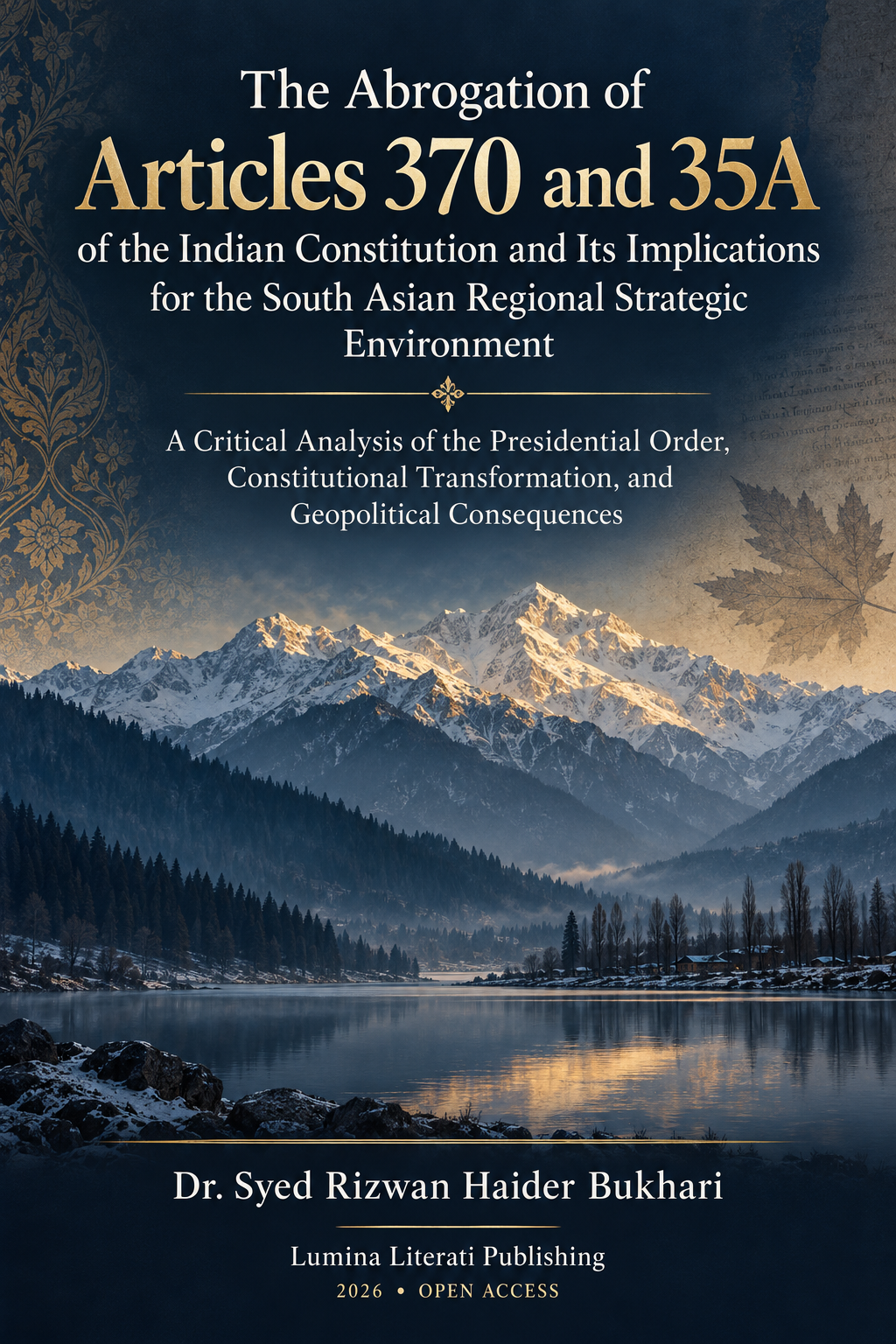
The Abrogation of Articles 370 and 35A of the Indian Constitution and Its Implications for the South Asian Regional Strategic Environment
A Critical Analysis of the Presidential Order, Constitutional Transformation, and Geopolitical Consequences
Book overview
The Abrogation of Articles 370 and 35A of the Indian Constitution and Its Implications for the South Asian Regional Strategic Environment examines the constitutional changes concerning Jammu and Kashmir in August 2019 and their implications for regional politics and security. The book connects the history of the Kashmir dispute with debates about constitutional authority, autonomy, sovereignty, and the strategic relationships among India, Pakistan, and China.
Across seven chapters, Dr. Syed Rizwan Haider Bukhari considers developments following the withdrawal of the provisions, Pakistan’s responses, and the wider implications for diplomacy, deterrence, and regional stability. Drawing on securitization theory, deterrence theory, and regional security complex theory, the study discusses survey material and elite interviews alongside historical, constitutional, and geopolitical analysis. A dedicated chapter explores Pakistani strategic perspectives on the changes.
Written for students, researchers, policy analysts, diplomats, and readers of South Asian politics, the book concludes with discussion of possible approaches to dialogue and de-escalation. Bibliographical sources and ten appendices provide supporting material, including constitutional provisions, agreements, presidential orders, legislation, and the study questionnaire.
Inside the book
- 01
Introduction to Study
Page 1
- 02
Brief Historical Study of Kashmir
Page 51
- 03
IoK in Post withdrawal of Article 370 & 35 (A)
Page 87
- 04
Indian’s Abrogation of Article 370/35(A): A Pakistan Perspective
Page 105
- 05
The Implications of the Abrogation of Article 370/35 (A)
Page 127
- 06
Elite Perceptions on the Geopolitical Implications of the Abrogation of Article 370 and 35A: A Pakistani Strategic Perspective
Page 155
- 07
Indian Held Kashmir: A Way Forward
Page 207
Free to read
Read the book
Open the cover to browse the complete book in the online reader, or download the PDF to read offline.
Download the complete PDF311 pages · English · PDF
© 2026 Dr. Syed Rizwan Haider Bukhari. Copyright is retained by the author. Published open access under the Creative Commons Attribution-NonCommercial-NoDerivatives 4.0 International (CC BY-NC-ND 4.0) licence. Sharing is permitted for noncommercial purposes with attribution; adapted versions may not be distributed under this licence.
Cite this book
Bukhari, S. R. H. (2026). The abrogation of Articles 370 and 35A of the Indian Constitution and its implications for the South Asian regional strategic environment. Lumina Literati Publishing. https://doi.org/10.65758/isbn.9786277813642
References
The bibliography from the book, with links where provided in the source. Bibliographical sources begin on printed page 233 (PDF page 246).
View the complete bibliography
- Amir Ullah Khan and Zafar Nawaz Jaspal, “Health Security Governance and Zoonotic Diseases in Pakistan: The International Health Regulations (2005) Angle,” IPRI Journal XVII, no. 1 (Winter 2017): 122–145, http://www.ipripak.org/wp-content/uploads/2017/04/Article-No.-6w17.pdf
- Hijab Shah and Melissa Dalton, “Indian Revocation of Kashmir’s Special Status,” Center for Strategic and International Studies, August 12, 2019, https://www.csis.org/analysis/indian-revocation-kashmirs-special-status
- Syed Rizwan Haider Bukhari, “Navigating the Digital Divide: The Strategic Implications of Social Media in Future Conflicts Between India and Pakistan,” Spry Contemporary Educational Practices 3, no. 1 (2024): 521–41, https://www.sprypublishers.com/admin/uploads/article/664b96ee75986.pdf.
- Barry Buzan, Ole Wæver, and Jaap de Wilde, Security: A New Framework for Analysis (Boulder: Lynne Rienner Publishers, 1998).
- Amir Ullah Khan et al., “Islamic Concept of Global Human Health Security and Zoonosis: A Case Study of Corona and Hanta Viruses,” PalArch’s Journal of Archaeology of Egypt/Egyptology 18, no. 10 (2021): 2161–2183, https://archives.palarch.nl/index.php/jae/article/download/10137/9310/19890
- Zafar Nawaz Jaspal and Amir Ullah Khan, “Plant Biosecurity Governance Dilemma in Pakistan: The Case Study of Khyber Pakhtunkhwa,” Journal of Political Studies 24, no. 1 (2017): 245–274, https://pu.edu.pk/images/journal/pols/pdf-files/15_v24_1_16.pdf.
- Sumantra Bose, Kashmir: Roots of Conflict, Paths to Peace (Harvard University Press, 2003), 18-45.
- Christopher Snedden, Understanding Kashmir and Kashmiris (Hurst, 2015), 62-89.
- Mridu Rai, Hindu Rulers, Muslim Subjects (Princeton University Press, 2004), 114-131.
- Vivekananda International Foundation, “India’s Security Strategy and Kashmir,” Observer Research Foundation, January 2020.
- Supreme Court of India, Dr Raja Lanoo Rishi v. Union of India (2023).
- Hasan Askari Rizvi, Pakistan’s Strategic Vision (Lahore: Vanguard, 2017), 101-123.
- Moeed Yusuf, Pakistan’s Security and Foreign Policy (Karachi: Oxford University Press, 2019), 78-102.
- A. G. Noorani, Article 370: A Constitutional History of Jammu and Kashmir (New Delhi: Oxford University Press, 2011)
- A. G. Noorani, The Kashmir Dispute 1947–2012, 2 vols. (New Delhi: Oxford University Press, 2011)
- Alastair Lamb, Kashmir: A Disputed Legacy 1846–1990 (Karachi: Oxford University Press, 2003).
- A. G. Noorani, Article 370: A Constitutional History of Jammu and Kashmir (New Delhi: Oxford University Press, 2011), 35–98.
- Ibid., 110–145.
- Ibid., 210–235; see also “From Partition to Abrogation: Tracing the History of Article 370,” International Journal of Financial and Management Research 7, no. 3 (2024): 1–15.
- A. G. Noorani, The Kashmir Dispute 1947–2012, 2 vols. (New Delhi: Oxford University Press, 2011), introduction and 1:1–100.
- Ibid., 2: conclusion.
- A. G. Noorani, Article 370: A Constitutional History of Jammu and Kashmir; and “A Critical Examination of Article 370 and 35(A) and Their Geopolitical Dynamics,” Remittances Review18, (1) 2024: 1–22.
- Alastair Lamb, Kashmir: A Disputed Legacy 1846–1990 (Karachi: Oxford University Press, 2003), 1–120.
- Ibid., 120–150.
- Ibid., 150–320.
- Rahul Pandita, Our Moon Has Blood Clots: The Exodus of the Kashmiri Pandits (New Delhi: Penguin India, 2013), 1–300.
- Werner F. Menski and Muneeb Yousuf, Kashmir after 2019: Abrogation of Article 370 and Completing the Partition (Abingdon: Routledge, 2025)
- Badri Maharaj, Indian Nuclear Strategy: Confronting the Potential Threat from both China and Pakistan (London: Bloomsbury, 2024)
- Stella A. Ogunleye and Michael Lyons, Jammu and Kashmir: Changing Dynamics (New Delhi: R.K. Singh & Co., 2023).
- Maqsood Hussain, Jammu and Kashmir: Combustible Region—Abrogation of Article 370 & 35-A and the South Asian Security Environment (Rawalpindi: Institute of Policy Studies, 2023)
- Frederick Noronha, Werner F. Menski, and Muneeb Yousuf, eds., Kashmir after 2019: Abrogation of Article 370 and Completing the Partition (Abingdon: Routledge, 2025).
- Rahul Pandita, Our Moon Has Blood Clots: The Exodus of the Kashmiri Pandits (New Delhi: Random House India, 2013).
- Tariq Ali, Kashmir: A Case of Freedom (London: Verso, 2011).
- Piotr Balcerowicz and Beata Kuszewska, Kashmir in India and Pakistan: Policies and Politics (New Delhi: Routledge India, 2010).
- Venkata R. Indurthy, India–Pakistan Wars and the Kashmir Crisis (New Delhi: Mittal Publications, 2005).
- Robert G. Wirsing, India, Pakistan and the Kashmir Dispute: On Regional Conflict and Its Resolution (New York: St. Martin’s Press, 1994).
- Sugata Bose and Ayesha Jalal, eds., Kashmir and the Future of South Asia (London: Routledge, 2007)
- Larry P. Goodson et al., Perspectives on Kashmir: The Roots of Conflict in South Asia (Boulder, CO: Westview Press, 2000).
- Victoria Schofield, Kashmir in Conflict: India, Pakistan and the Unending War, 2nd ed. (London: I.B. Tauris, 2003)
- Hamza Rehman, Dr. Tayba Anwar, and Rizwan Haider, “Abrogation of Article 370: Impacts on India Pakistan Relations,” 2025, Journal of Development & Social Sciences (JDSS), 6 (1), 258-268, 2025. Accessed on https://ojs.jdss.org.pk/journal/article/view/1310.
- Asad Ullah Khan, “Abrogation of Article 370 and 35-A: Policy Options for Pakistan”, Strategic Perspectives, II (1), Winter 2024. Accessed on https://strategicperspectives.cissajk.org.pk/abrogation-of-article-370-and-35-a-policy-options-for-pakistan/
- Seema Irshad, Fazlur Rahman, and Sajid Anwar, “The Revocation of Articles 370 and 35A in the Constitution of India and Pakistan’s Response,” Pakistan, 65 (1), 2021, 164-185. Accessed on https://pscjournal.pk/index.php/pakistan/article/view/191/131
- Asia Maqsood, “China-Pakistan Strategic Partnership and India’s Regional Ambitions in South Asia,” Strategic Studies, 41 (3), October 29, 2021, https://issi.org.pk/china-pakistan-strategic-partnership-and-indias-regional-ambitions-in-south-asia/.
- Ms. Monika Sharma and Ms. Shikha Gupta, “Impact of Abrogation of Article 370 on the Jammu and Kashmir Economy,” International Journal of Engineering Development and Research, 13 (2), 2025, 307-312. Accessed on https://rjwave.org/ijedr/papers/IJEDR2502156.pdf.
- Raghunandan M.C. and Anashwara Ashok, Assessment of ‘Non-Quantifiable Parameters of Security and Governance’ in Kashmir Post Abrogation of Article 370: Based on Field Study Tour, Centre for Land Warfare Studies (CLAWS), 2025, https://claws.co.in/wp-content/uploads/2025/01/Non-Quantifiable-Parameters-of-Security-Governance-In-Kashmir-Post-Abrogation-Of-Article-370-1.pdf.
- Javed Iqbal, Shamim Ali, and Rozina Bibi, “Abrogation of Article 370 of Kashmir: A Comparative Analysis of English Newspaper Editorials,” The Dialogue, 19 (1), 2024, 33-45. Accessed on https://journals.qurtuba.edu.pk/ojs/index.php/thedialogue/article/view/8597/353
- Ayesha Siddiqua and Muhammad Zubair Iqbal, “Media Discourse on the Kashmir Conflict after Abrogation of Article 370,” Strategic Studies, 43 92), 2023, 45-58. https://issi.org.pk/wp-content/uploads/2024/01/Ayesha_Siddiqua_and_Muhammad_Zubair_Iqbal_SS_No_2_2023.pdf.
- Mohammad Amin Mir and Adil Hussain Bhat, “The Abrogation of Article 370: Emerging Political Dynamics and Implications for Jammu and Kashmir,” Taylor & Francis, 2024, https://www.tandfonline.com/doi/full/10.1080/09584935.2024.2413641.
- Sahar Khan, “From Domicile to Dominion: India’s Settler Colonial Agenda in Kashmir,” Harvard Law Review, 134 (7), May 2021, 2530-2551. https://harvardlawreview.org/print/vol-134/from-domicile-to-dominion-indias-settler-colonial-agenda-in-kashmir/.
- Muslim Khan, “Issues and Challenges of Regional Integration in South Asia,” UCP Journal of Humanities & Social Sciences, 1 (1), July-December, 2024, 73-85. https://ojs.ucp.edu.pk/index.php/jhss/article/download/6/5/30.
- Syed Rizwan Haider Bukhari et al., “Redefining Boundaries: A Critical Examination of Article 370 and 35(A) and Their Impact on South Asia’s Strategic Landscape,” Remittances Review, 9 (3), 2024, 1158-1172. https://remittancesreview.com/menu-script/index.php/remittances/article/download/2306/1780/5278.
- Mohmad Aabid Bhat, “Preventive Detention in Counter-insurgencies: The Case of Kashmir,” Insight Turkey, 21 (4), 2019, 53-68. https://www.insightturkey.com/file/1199/preventive-detention-in-counter-insurgencies-the-case-of-kashmir.
- Munazza Khalid, “Kashmir Issue and South Asian Strategic Stability Post-Abrogation of Article 370 and 35-A,” Journal of Humanities, Social & Management Sciences, 2 (1), Jan-June, 2021, 166-175. https://ideapublishers.org/index.php/jhsms/article/view/447.
- I.S. Kishore, “Abrogation of Article 370 Impact on Jammu and Kashmir,” IJFMR, 7 (1), Jan-Feb, 2025, 1-8.https://www.ijfmr.com/papers/2025/1/30110.pdf.
- Amir Ullah Khan and Zafar Nawaz Jaspal, “Health Security Governance and Zoonotic Diseases in Pakistan: The International Health Regulations (2005) Angle,” IPRI Journal XVII, no. 1 (Winter 2017): 122–145, http://www.ipripak.org/wp-content/uploads/2017/04/Article-No.-6w17.pdf
- Hunter, J. D. “Matplotlib: A 2D Graphics Environment.” Computing in Science & Engineering 9, no. 3 (2007): 90-95. https://doi.org/10.1109/MCSE.2007.55
- Hijab Shah and Melissa Dalton, “Indian Revocation of Kashmir’s Special Status,” Center for Strategic and International Studies, August 12, 2019, https://www.csis.org/analysis/indian-revocation-kashmirs-special-status.
- Syed Rizwan Haider Bukhari, “Navigating the Digital Divide: The Strategic Implications of Social Media in Future Conflicts Between India and Pakistan,” Spry Contemporary Educational Practices 3, no. 1 (2024): 521–41, https://www.sprypublishers.com/admin/uploads/article/664b96ee75986.pdf.
- Barry Buzan, Ole Wæver, and Jaap de Wilde, Security: A New Framework for Analysis (Boulder: Lynne Rienner Publishers, 1998).
- Amir Ullah Khan et al., “Islamic Concept of Global Human Health Security and Zoonosis: A Case Study of Corona and Hanta Viruses,” PalArch’s Journal of Archaeology of Egypt/Egyptology 18, no. 10 (2021): 2161–2183, https://archives.palarch.nl/index.php/jae/article/download/10137/9310/19890
- Zafar Nawaz Jaspal and Amir Ullah Khan, “Plant Biosecurity Governance Dilemma in Pakistan: The Case Study of Khyber Pakhtunkhwa,” Journal of Political Studies 24, no. 1 (2017): 245–274, https://pu.edu.pk/images/journal/pols/pdf-files/15_v24_1_16.pdf.
- A. G. Noorani, Article 370: A Constitutional History of Jammu and Kashmir (New Delhi: Oxford University Press, 2011); Badri Maharaj, Indian Nuclear Strategy: Confronting the Potential Threat from both China and Pakistan (London: Bloomsbury, 2024).
- Werner F. Menski and Muneeb Yousuf, Kashmir after 2019: Abrogation of Article 370 and Completing the Partition (Abingdon: Routledge, 2025); Maqsood Hussain, Jammu and Kashmir: Combustible Region—Abrogation of Article 370 & 35-A and the South Asian Security Environment (Rawalpindi: Institute of Policy Studies, 2023).
- Robert G. Wirsing, India, Pakistan and the Kashmir Dispute: On Regional Conflict and Its Resolution (New York: St. Martin’s Press, 1994); Asia Maqsood, “China-Pakistan Strategic Partnership and India’s Regional Ambitions in South Asia,” 2021.
- Rahul Pandita, Our Moon Has Blood Clots: The Exodus of the Kashmiri Pandits (New Delhi: Random House India, 2013); Sahar Khan, “From Domicile to Dominion: India’s Settler Colonial Agenda in Kashmir,” Harvard Law Review 134, no. 7 (2021).
- Raghunandan M.C. and Anashwara Ashok, “Assessment of Non-Quantifiable Parameters of Security and Governance in Kashmir Post Abrogation of Article 370,” Centre for Land Warfare Studies (CLAWS), 2025.
- Javed Iqbal, Shamim Ali, and Rozina Bibi, “Abrogation of Article 370: A Comparative Analysis of English Newspaper Editorials,” The Dialogue, 2024; Ayesha Siddiqua and Muhammad Zubair Iqbal, “Media Discourse on the Kashmir Conflict after Abrogation of Article 370,” Strategic Studies, 2023.
- Muslim Khan, “Issues and Challenges of Regional Integration in South Asia,” Journal of Humanities & Social Sciences, 2024.
- Syed Rizwan Haider Bukhari et al., “Redefining Boundaries: A Critical Examination of Article 370 and 35(A) and Their Impact on South Asia’s Strategic Landscape,” Remittances Review, 2024.
- William Gemmell Cochran, Sampling Techniques, 3rd ed. (New York: John Wiley & Sons, 1977), https://ia801501.us.archive.org/15/items/in.ernet.dli.2015.141123/2015.141123.Sampling-Techniques.pdf
- R. Burke Johnson and Anthony J. Onwuegbuzie, “Mixed Methods Research: A Research Paradigm Whose Time Has Come,” Educational Researcher 33, no. 7 (2004): 14–26.
- Ananda Narasiman, “A Geopolitical Analysis of Kashmir Part 1: The Geographic Strategic Significance,” Atlas Institute for International Affairs, June 20, 2025, https://atlasinstitute.org/a-geopolitical-analysis-of-kashmir-part-1-the-geographic-strategic-significance-of-kashmir/.
- K Blue, “Geopolitical Importance of Jammu and Kashmir in South Asia,” March 11, 2024, https://www.jkblue.info/post/geopolitical-importance-of-jammu-and-kashmir-in-south-asia.
- United States, Central Intelligence Agency, Cartography Center, Kashmir Region, map (Washington, DC: Central Intelligence Agency, 2004), Library of Congress Geography and Map Division, https://www.loc.gov/item/2004626116/.
- Planning and Development Department, Government of Azad Jammu and Kashmir, Azad Jammu & Kashmir at a Glance 2023 (Muzaffarabad: PND AJK, 2023), https://www.pndajk.gov.pk/uploadfiles/downloads/AJK%20at%20a%20Glance%202023.pdf.
- Saurav Ranjan, “Demographic Changes in Ladakh After De-operationalizing Article 370,” International Journal of Creative Research Thoughts 11, no. 5 (2023), https://ijcrt.org/papers/IJCRT2305655.pdf.
- Centre for Policy Studies, “Religion Data of Census 2011: Jammu and Kashmir,” CPS Blog, February 2016, https://blog.cpsindia.org/2016/02/religion-data-of-census-2011-xv-jammu.html.
- Christopher Snedden, The Untold Story of the People of Azad Kashmir (New York: Columbia University Press, 2013), accessed February 21, 2026, https://books.google.com.pk/books/about/The_Untold_Story_of_the_People_of_Azad_K.html?id=autVo01f2AsC.
- Adnan Abadi, “Conflict Between India and Pakistan,” Global Conflict Tracker, Centre for Preventive Action, Council on Foreign Relations, 2026, https://www.cfr.org/global-conflict-tracker/conflict/conflict-between-india-and-pakistan.
- BYJU’S IAS, “Jammu & Kashmir – Instrument of Accession Signed,” 2022, https://byjus.com/free-ias-prep/this-day-in-history-oct26.
- United Nations Security Council, Resolution 47 (1948): The India-Pakistan Question, adopted April 21, 1948, S/RES/47(1948), https://digitallibrary.un.org/record/111955/files/S_RES_47%281948%29-EN.pdf.
- Sumit Ganguly, Conflict Unending: India-Pakistan Tensions since 1947 (New York: Columbia University Press, 2001).
- Srinath Raghavan, 1971: A Global History of the Creation of Bangladesh (Cambridge, MA: Harvard University Press, 2013).
- “Agreement on Bilateral Relations between the Government of India and the Government of the Islamic Republic of Pakistan (Simla Agreement),” Security Council Report, July 2, 1972, https://www.securitycouncilreport.org/atf/cf/%7B65BFCF9B-6D27-4E9C-8CD3-CF6E4FF96FF9%7D/simla_agreement_1972.pdf.
- .Faiza Bashir and Mian Rifat Ullah Khan, “Revocation of Kashmir Special Status in Indian Constitution: Distortion of Simla Agreement,” The Dialogue 18, (2), 2023.
- Izzat Raazia, Saqib Ur Rehman, and Rabia Aslam, “A Historical and Political Analysis of Kashmir Conflict: From Past to Present,” Journal of Development and Social Sciences 2, (4) (2021), https://jdss.org.pk/issues/v2/4/a-historical-and-political-analysis-of-kashmir-conflict-from-past-to-present.pdf
- Vhowkat Ahmad Dar, “Human Rights Crisis in Jammu and Kashmir: A Comprehensive Analysis of Systematic Abuses and Urgent Call for Action,” Journal of Government and Political Issues 3, no. 1 (2023): 1–9, https://journal.mengeja.id/index.php/JGPI/article/download/62/66/467.
- Sumit Ganguly, Conflict Unending: India-Pakistan Tensions Since 1947 (New York: Columbia University Press, 2001).
- Amnesty International India, Situation Update and Analysis: Jammu and Kashmir after One Year of Abrogation of Article 370 (August 5, 2020), https://www.amnesty.be/IMG/pdf/jammu_and_kashmir_after_one_year_of_abrogation_of_article_370.pdf.
- K. Subrahmanyam, chair, From Surprise to Reckoning: The Kargil Review Committee Report (New Delhi: Sage Publications, 2000).
- Ashley J. Tellis, India’s Emerging Nuclear Posture: Between Recessed Deterrent and Ready Arsenal (Santa Monica, CA: RAND Corporation, 2001), https://www.rand.org/pubs/monograph_reports/MR1127.html.
- Barnett Riedel, American Diplomacy and the 1999 Kargil Summit at Blair House (Philadelphia: Center for the Advanced Study of India, University of Pennsylvania, 2002),
- Sumantra Bose, Kashmir at the Crossroads: Inside a 21st-Century Conflict (New Haven, CT: Yale University Press, 2021).
- P. R. Chari, Pervaiz I. Cheema, and Stephen P. Cohen, Perception, Politics, and Security in South Asia: The Compound Crisis of 1990 (New York: Routledge, 2007).
- C. Christine Fair, Fighting to the End: The Pakistan Army’s Way of War (Oxford: Oxford University Press, 2014).
- Sumit Ganguly and S. Paul Kapur, India, Pakistan, and the Bomb: Debating Nuclear Stability in South Asia (New York: Columbia University Press, 2010),
- Bruce Riedel, Deadly Embrace: Pakistan, America, and the Future of Global Jihad (Washington, DC: Brookings Institution Press, 2011).
- Zahid Shahab Ahmed, “India-Pakistan: Can Dialogue Work?,” Asialink Diplomacy, May 13, 2025, https://asialink.unimelb.edu.au/diplomacy/india-pakistan-can-dialogue-work/.
- Kyra Kocis, Nidhi Upadhyaya, and Irfan Nooruddin, Repeal of Article 370: Implications for India, Pakistan, and the United States (Washington, DC: Atlantic Council, August 21, 2019).
- A. G. Noorani, Article 370: A Constitutional History of Jammu and Kashmir (Oxford: Oxford University Press, 2011).
- Ankit Panda, “China Issues Statement Condemning Indian Decision to Bifurcate Kashmir,” The Diplomat, August 7, 2019.
- Jeff M. Smith, “China–India Border Crisis,” Indo-Pacific Perspectives, no. 7 (June 2021): 31–33, https://www.airuniversity.af.edu/Portals/10/JIPA/IndoPacificPerspectives/June%202021/07%20Smith.pdf.
- Syed Rizwan Haider Bukhari, Amir Ullah Khan, and Inam Ul Haq, “Babari Masjid Chronicles: Modi’s Ideology Not Embracing Ayodhya Spirit and India’s Future,” Spry Contemporary Educational Practices 3, no. 1 (2024): 67–82, https://www.sprypublishers.com/admin/uploads/article/65be67323f6ce.pdf.
- Narendra Damodardas Modi, “PM’s Address to the Nation from the Ramparts of the Red Fort on the 73rd Independence Day,” Press Information Bureau, 2019, https://www.pmindia.gov.in/en/news_updates/pm-addressed-the-nation-from-the-ramparts-of-the-red-fort-on-the-73rd-independence-day/.
- Narendra Damodardas Modi, “Defends Article 370 Move, Says Decision Necessary for India’s Unity,” Times of India, 2019, https://tribune.com.pk/story/2449655/indian-sc-upholds-modis-suspension-of-special-status-to-kashmir
- Narendra Modi, “PM’s Address to the Nation from the Ramparts of the Red Fort on the 73rd Independence Day,” Prime Minister’s Office, August 15, 2019, https://www.pmindia.gov.in/en/news_updates/pm-addressed-the-nation-from-the-ramparts-of-the-red-fort-on-the-73rd-independence-day/
- Narendra Modi, “PM Modi Challenges Congress to Announce Bringing Back Article 370,” YouTube video, posted by Aaj Tak, October 14, 2019, 0:59, https://www.youtube.com/watch?v=NS3qes0hTmc
- Ministry of Foreign Affairs, Government of Pakistan, “Jammu and Kashmir Dispute,” August 5, 2019, https://mofa.gov.pk/jammu-and-kashmir-dispute
- Central Intelligence Agency, Jammu and Kashmir (Washington, DC: Central Intelligence Agency, 2010), https://www.cia.gov/library/abbottabad-compound/37/374CB8CF12C9742A9133BE7CEED44E13_%D9%83%D8%B4%D9%85%D9%8A%D8%B1.doc.pdf.
- Midhat Shahzad, Sabahat Akram, and Saadia Bano Hashmi, “Azad Jammu and Kashmir and Gilgit-Baltistan: Administrative Setup and Political Status,” Journal of Current Studies 1, no. 1 (2020): 1–20, https://jcs.ndu.edu.pk/site/article/download/67/37.
- Christian Wagner, “Redrawing the Maps in Kashmir: New Geopolitical Realities in the Conflict between China, India, and Pakistan,” SWP Comment, no. 52 (Stiftung Wissenschaft und Politik, October 2020), https://www.swp-berlin.org/10.18449/2020C52.
- Newlines Institute for Strategy and Policy, “China Joins India and Pakistan in the Kashmir Battlespace,” June 22, 2020, https://newlinesinstitute.org/middle-east-center/china-joins-india-and-pakistan-in-the-kashmir-battlespace/.
- European Foundation for South Asian Studies (EFSAS), “Ethnic, Cultural and Religious Diversity in Jammu & Kashmir,” n.d., PDF, https://www.efsas.org/EFSAS-October-Ethnic,%20Cultural%20and%20Religious%20Diversity%20in%20Jammu%20&%20Kashmir-Paper.pdf.
- IndiaCensus.net, “Jammu and Kashmir Population 2025,” 2025, https://www.indiacensus.net/states/jammu-and-kashmir.
- Peace Insight, “Inter-Religious Dialogue in Kashmir,” May 15, 2025, https://www.peaceinsight.org/en/articles/inter-religious-dialogue-kashmir/.
- Gadyal Kashmir, “Jammu and Kashmir’s Journey to Peace amid Religious Harmony,” December 17, 2024, https://gadyalkashmir.com/2024/12/17/jammu-and-kashmirs-journey-to-peace-amid-religious-harmony/.
- Census of India 2011, “Demography,” JK Open Board, accessed March 8, 2025, https://www.jkopenboard.com/demography/.
- Bilal Kuchay, “India Revokes Kashmir’s Special Status,” Al Jazeera, September 4, 2019, accessed June 26, 2024, https://www.aljazeera.com/news/2019/9/4/india-revokes-kashmirs-special-status.
- “Pakistan to Downgrade Ties with India over Kashmir Move,” Al Jazeera, August 7, 2019, https://www.aljazeera.com/news/2019/8/7/pakistan-to-downgrade-ties-with-india-over-kashmir-move.
- United Nations, “Secretary-General’s Statement on Jammu and Kashmir,” August 8, 2019, https://press.un.org/en/2019/sgsm19696.doc.htm.
- Anthony Wanis-St. John, “Third Party Mediation over Kashmir: A Modest Proposal,” International Peacekeeping 4, no. 4 (1997): 133–152, https://www.american.edu/sis/faculty/upload/wanis-third-party-mediation-over-kashmir.pdf.
- Aakar Patel, “India: Protection of the Human Rights of the People of Jammu and Kashmir Must Guide the Way Forward,” Amnesty International, December 11, 2023, https://www.amnesty.org/en/latest/news/2023/12/india-protection-of-the-human-rights-of-the-people-of-jammu-and-kashmir-must-guide-the-way-forward/.
- Saqib Majeed, “India: Free Kashmiris Arbitrarily Detained,” Human Rights Watch, September 16, 2019, https://www.hrw.org/news/2019/09/16/india-free-kashmiris-arbitrarily-detained.
- Irfan Mehraj, “Kashmir, World’s Most Militarized Zone, Re-Militarized as India Deploys More Troops,” Kashmir Action, January 9, 2023, https://www.kashmiraction.org/kashmir-worlds-most-militarized-zone-in-the-world-re-militarized-as-india-deploys-more-troops/.
- Praveen Donthi, “Flare-Ups and Frustration as Kashmir Waits for a Vote,” International Crisis Group, March 8, 2024, https://www.crisisgroup.org/asia/south-asia/india-pakistan-kashmir-india-pakistan/flare-ups-and-frustration-kashmir-waits-vote.
- Stephen P. Cohen, “Kashmir: The Roads Ahead,” Commentary, March 1995, 44–48, https://www.brookings.edu/articles/kashmir-the-roads-ahead/.
- Asif Shahzad and Devjyot Ghoshal, “Pakistan Expels Indian Ambassador as Kashmir Dispute Escalates,” Reuters, August 7, 2019, https://www.reuters.com/article/world/pakistan-expels-indian-ambassador-as-kashmir-dispute-escalates-idUSKCN1UX0YO/.
- Kenneth N. Waltz, Man, the State, and War: A Theoretical Analysis (New York: Columbia University Press, 1959).
- Robert G. Wirsing, India, Pakistan, and the Kashmir Dispute: On Regional Conflict and Its Resolution (New York: St. Martin’s Press, 1994).
- Mona Bhan, Haley Duschinski, and Deepti Misri, eds., Routledge Handbook of Critical Kashmir Studies (London: Routledge, 2022), https://doi.org/10.4324/9780429330810.
- John Smith, “Imperialism and the Law of Value,” Global Discourse 1 (2011): 1–36, https://globaldiscourse.wordpress.com/wp-content/uploads/2011/05/john-smith.pdf.
- Suhasini Haidar, “Two Days Before Royal Visit, Sweden Sends Tough Statement on Kashmir,” The Hindu, November 28, 2019, https://www.suhasinihaidar.com/two-days-before-royal-visit-sweden-sends-tough-statement-on-kashmir/.
- Ainslie T. Embree, “Kashmir: Has Religion a Role in Making Peace?” in Faith-Based Diplomacy: Trumping Realpolitik, ed. Douglas M. Johnston (Oxford: Oxford University Press, 2003), 33–75, https://academic.oup.com/book/10415/chapter/158234383.
- Sima Kotecha, “General Election 2019: Labour Seeks to Calm Hindu Voters’ Kashmir Fears,” BBC News, November 12, 2019, https://www.bbc.com/news/election-2019-50382791.
- K. Alan Kronstadt, Kashmir: Background, Recent Developments, and U.S. Policy, Congressional Research Service Report R45877 (Washington, DC: Congressional Research Service, January 13, 2020), https://www.everycrsreport.com/files/20200113_R45877_4be8539e882a4f23da3730135b3237da64989990.pdf.
- I-wei Jennifer Chang, “China’s Kashmir Policies and Crisis Management in South Asia,” Peace Brief 217, United States Institute of Peace, February 9, 2017, PDF, https://www.usip.org/sites/default/files/PB217-China-s-Kashmir-Policies-and-Crisis-Management-in-South-Asia.pdf.
- Unsa Jamshad, Muhammad Abdullah, and Amar Jahangir, “Chinese Stance on Kashmir Dispute: An Overview,” Journal of Development and Social Sciences 3, no. 4 (2022): 322–329, https://doi.org/10.47205/jdss.2022(3-IV)31.
- Vivek Kumar Mishra, “The Abrogation of Article 370: International Reactions,” Indian Journal of Asian Affairs 33, no. 1 (June–December 2020): 120–129, accessed June 26, 2024, https://www.jstor.org/stable/27003440.
- Sameer P. Lalwani and Gillian Gayner, India’s Kashmir Conundrum: Before and After the Abrogation of Article 370, USIP Special Report No. 473 (Washington, DC: United States Institute of Peace, August 5, 2020), PDF, https://www.usip.org/sites/default/files/2020-08/sr_473-indias_kashmir_conundrum_before_and_after_the_abrogation_of_article_370-sr.pdf.
- Ammara Tariq Cheema, “Title of Article,” Journal of Political Stability Archive 3, no. 3 (2025), https://journalpsa.com.pk/index.php/JPSA/article/download/256/272/1262.
- Majid Alam, “Pakistan’s Kashmir Policy Post-Article 370,” The Diplomat, July 9, 2020, accessed June 26, 2024, https://thediplomat.com/2020/07/pakistans-kashmir-policy-post-article-370/.
- Smruti S. Pattanaik, “Pakistan’s Kashmir Policy: Objectives and Approaches,” Strategic Analysis: A Monthly Journal of the IDSA 26, no. 2 (April–June 2002), accessed June 26, 2024, https://ciaotest.cc.columbia.edu/olj/sa/sa_apr02pas01.html.
- Rabiya Aamir, “Impasse of Kashmir and Recurring Pretexts: A Historiographical Analysis,” Policy Perspectives 17, no. 1 (2020): 83–104, https://doi.org/10.13169/polipers.17.1.0083.
- Munazza Khalid, “Abrogation of Article 370 and 35-A, Human Rights Situation in Indian Occupied Kashmir and Response Options for Pakistan,” Journal of Humanities, Social and Management Sciences (JHSMS) 2, no. 1 (2021): 166–175, https://doi.org/10.47264/idea.jhsms/2.1.14.
- Ali Abbas Zuriah Ahmad Hazrat Umar and Rubab Arshad, Strategic Shifts in India-Pakistan Relations: Pulwama Attack and Abrogation of Article 370, (pdf), https://nspp.gov.pk/wp-content/uploads/2025/02/Strategic-Shifts%20in-India-Pakistan-Relations.pdf.
- Syed Rizwan Haider Bukhari et al., “Advancements in Missile Technology and Nuclear Deterrence — A Critical Examination of the Indo-Pak Strategic Equilibrium,” Research Journal 9, no. 2 (2024), https://researchsci.net/index.php/view/article/download/22/22/67.
- Aaron T. Wolf, Hydropolitics along the Indus River Basin, Special Report 261 (Washington, DC: United States Institute of Peace, 2009).
- Fakiha Mahmood, “Kashmir Dispute at the United Nations Security Council,” Parliamentary Research Digest 6, no. 9 (September 2019): 1–9 (Islamabad: Pakistan Institute for Parliamentary Services, 2019), https://www.pips.gov.pk/wp-content/uploads/2020/08/09_PIPS_Parliamentary_Research_Digest_Sept_2019.pdf.
- Ministry of Foreign Affairs, Government of Pakistan, “Jammu and Kashmir Dispute,” mofa.gov.pk, https://mofa.gov.pk/jammu-and-kashmir-dispute.
- Flora Drury, “What We Know About India’s Strikes on Pakistan and Pakistan’s Response,” BBC News, May 6, 2025, https://www.bbc.com/news/articles/cj6868pdpw4o.
- Gagan Nayar, “India,” in World Report 2025 (New York: Human Rights Watch, January 15, 2025), https://www.hrw.org/world-report/2025/country-chapters/india.
- Aman Thakker, “Sino-Indian Border Clashes: Implications for U.S.-India Ties,” Center for Strategic and International Studies, July 15, 2020, https://www.csis.org/analysis/sino-indian-border-clashes-implications-us-india-ties.
- Andrew Small, The China-Pakistan Axis: Asia’s New Geopolitics (New York: Oxford University Press, 2015), accessed March 8, 2026, https://sanipanhwar.com/uploads/books/2024-08-28_13-13-44_7b5d180f329ca8d283936dc2e10a9009.pdf.
- Amnesty International, Three Years of Abrogation of Article 370 in Jammu & Kashmir, ASA 20/5959/2022 (London: Amnesty International, 2022), https://www.amnesty.org/en/documents/asa20/5959/2022/en/.
- Muhammad Aziz, “Muslim Population in Jammu and Kashmir: District-Wise Analysis (2011 Census),” Data Player, August 2025, https://data-player.com/muslim-population-in-jammu-and-kashmir-2024-update-district-wise-data-percentage-analysis/.
- Nisar A. Malik and Abdul Majid, “Kashmir: In Historical Perspective,” Journal of the Punjab University Historical Society 29, no. 2 (2016).
- Syed Rizwan Haider Bukhari, “Comparative Assessment of Defence Industrial Capabilities Of Pakistan and India: Indigenous Production, Technological Innovation, and Strategic Autonomy in South Asia,” A5 Journal of Defense Industry 1, no. 1 (2026): https://doi.org/10.71350/a5journal.2
- Maharaja Hari Singh, Instrument of Accession of Jammu and Kashmir State, October 26, 1947, https://cjp.org.in/wp-content/uploads/2019/08/instrument_of_accession_of_jammu_and_kashmir_state.pdf.
- Government of India, Ministry of Law and Justice, The Constitution of India (as on 26 January 2019) (New Delhi: Legislative Department, 2019), https://faolex.fao.org/docs/pdf/ind132810.pdf.
- Rekha Chowdhary, Jammu and Kashmir: Politics of Identity and Separatism (London: Routledge, 2015).
- A. G. Noorani, Article 370: A Constitutional History of Jammu and Kashmir (New Delhi: Oxford University Press, 2011).
- Sheikh Altaf Bhat, Kashmir: Constitutional Dilemmas and the Future of Autonomy (London: Routledge, 2020).
- A G. Noorani, Article 370: A Constitutional History of Jammu and Kashmir (New Delhi: Oxford University Press, 2011).
- Syed Rizwan Haider Bukhari, Nasir Iqbal, Anjum Mumtaz, Amir Ullah Khan, and Inam Ul Haq, “A Critical Examination of Article 370 and 35(A) and Their Impact on South Asia’s Strategic Landscape,” Remittances Review 9, no. 1 (2024), https://remittancesreview.com/menu-script/index.php/remittances/article/download/2306/1780.
- Supreme Court Observer, “Abrogation of Article 370 | Judgement Summary,” 2023, https://www.scobserver.in/wp-content/uploads/2023/07/Judgement-Abrogation-of-Article-370.pdf.
- Adnan Abidi, “At Least 2,300 Detained in Locked-Down Indian-Ruled Kashmir,” NBC News, August 20, 2019, https://www.nbcnews.com/news/world/least-2-300-detained-locked-down-indian-ruled-kashmir-n1044696
- Amnesty International, Three Years of Abrogation of Article 370 in Jammu & Kashmir, ASA 20/5959/2022, September 5, 2022, https://www.amnesty.org/en/documents/asa20/5959/2022/en/.
- Tirana Hassan, foreword to World Report 2025 (New York: Human Rights Watch, 2025), https://www.hrw.org/world-report/2025/country-chapters/india.
- Syed Muhammad Saad Zaidi and Muhammad Taimur Fahad Khan, “Analyzing the Convoluted Kashmir Dispute: A Retrospective Analysis,” NUST Journal of International Peace & Stability 8, no. 1 (2025): 45–67, https://njips.nust.edu.pk/index.php/njips/article/download/203/169/750
- Animesh Roul, “Militant Violence in Jammu and Kashmir Post-Abrogation of Article 370,” Combating Terrorism Center at West Point, September 25, 2025, https://ctc.westpoint.edu/militant-violence-in-jammu-and-kashmir-post-abrogation-of-article-370/.
- Barry Buzan, Ole Wæver, and Jaap de Wilde, Security: A New Framework for Analysis (Boulder: Lynne Rienner Publishers, 1998).
- Hijab Shah and Melissa Dalton, “Indian Revocation of Kashmir’s Special Status,” Center for Strategic and International Studies, August 12, 2019, https://www.csis.org/analysis/indian-revocation-kashmirs-special-status
- Syed Rizwan Haider Bukhari, “Navigating the Digital Divide: The Strategic Implications of Social Media in Future Conflicts Between India and Pakistan,” Spry Contemporary Educational Practices 3, no. 1 (2024): 521–41, https://www.sprypublishers.com/admin/uploads/article/664b96ee75986.pdf
- Anonymous author, “Revisiting Jammu & Kashmir Six Years After the Revocation of Article 370,” OffBeat Research, January 5, 2026, https://offbeatresearch.com/2026/01/revisiting-jammu-kashmir-six-years-after-the-revocation-of-article-370/
- P. K. Rajagopal, “Beyond Article 370: Examining the Social and Political Dimensions of Abrogation,” Society and Culture Development in India 5, no. 1 (2025), https://www.arfjournals.com/image/catalog/Journals%20Papers/SCDI/2025/No%201%20(2025)/7_Rajagopal-new.pdf
- Humera Malik, “Revocation of Article 370 and Digital Media: Unveiling Human Rights Violations in Kashmir,” Pakistan Vision 25, no. 1 (June 2024): 76.
- Rekha Chowdhary, Jammu and Kashmir: Politics of Identity and Separatism (London: Routledge, 2019; relevance through 2024).
- Shabir Ahmad Hajam and Saroj Billore, “Understanding the Implications of Abrogation of Article 370 on Mainstreaming Kashmiri Population,” International Journal of Engineering Development and Research (IJEDR) 14, no. 1 (February 2026).
- Mehr un Nisa, Human Rights Report (Islamabad: Kashmir Institute of International Relations, 2025), https://www.kiir.org.pk/reports/human-rights-report-1490.
- Mir Aiyaz, “Kashmir’s Residents Are Living under the Watchful Eye of Surveillance,” Index on Censorship, May 9, 2025, https://www.indexoncensorship.org/2025/05/kashmir-residents-living-under-watchful-eye-surveillance-india-pakistan/.
- Reporters Without Borders (RSF), “Indian Police Campaign of Harassment of Journalists in Kashmir,” April 23, 2020, https://rsf.org/en/india-history-s-longest-ever-e-curfew-continues-kashmir.
- Human Rights Watch, “India: Repression Persists in Jammu and Kashmir,” July 31, 2024, https://www.hrw.org/news/2024/07/31/india-repression-persists-jammu-and-kashmir.
- Amnesty International, A “Lawless Law”: Detentions under the Jammu and Kashmir Public Safety Act (New York: Amnesty International USA, 2011), 22, https://www.amnestyusa.org/wp-content/uploads/2017/04/asa200012011en_11.pdf.
- Committee to Protect Journalists, “Jammu and Kashmir Archives,” accessed February 25, 2026, https://cpj.org/tags/jammuandkashmir/.
- Amnesty International, “India: Authorities Must End Repression of Dissent in Jammu and Kashmir,” September 17, 2024, https://www.amnesty.org/en/latest/news/2024/09/india-authorities-must-end-repression-of-dissent-in-jammu-and-kashmir/.
- Animesh Roul, “Militant Violence in Jammu and Kashmir Post-Abrogation of Article 370,” CTC Sentinel 18, no. 9 (September 2025), https://ctc.westpoint.edu/militant-violence-in-jammu-and-kashmir-post-abrogation-of-article-370/.
- Reuters, “Around 300 Militants Active in Indian Kashmir,” November 22, 2022, https://www.reuters.com/world/india/around-300-militants-active-indian-kashmir-indian-military-official-2022-11-22/.
- Dr. I. S. Kishore Mathew Arnold, “Abrogation of Article 370 Impact on Jammu and Kashmir,” International Journal of Frontier Mission Research, 2025, https://www.ijfmr.com/papers/2025/1/30110.pdf.
- Mary Hunter, “Indian Legalisation of Demographic Change in Kashmir,” Centre for Strategic and Contemporary Research, November 13, 2020, https://cscr.pk/explore/themes/politics-governance/indian-legalisation-of-demographic-change-in-kashmir/.
- Animesh Roul, “Militant Violence in Jammu and Kashmir Post-Abrogation of Article 370,” CTC Sentinel 18, no. 9 (September 2025): 1–15, https://ctc.westpoint.edu/wp-content/uploads/2025/09/CTC-SENTINEL-092025_article-4.pdf.
- Syed Rizwan Haider Bukhari, Prof. Dr. Amir Ullah Khan, Dr. Shabana Noreen, Mr. Tehsin Ullah Khan, Mr. Nasir Khan & Mr. Inam Ul Haq, “Ukraine and Russia: A Historical Analysis of Geopolitical Dynamics, National Identity, and Conflict Escalation Leading to the PresentDay Crisis,” Kurdish Studies 12, (2) 2024): 5803–5824, https://kurdishstudies.net/menuscript/index.php/KS/article/view/2760
- Dalbir Ahlawat, “Jammu and Kashmir: Six Years After Revocation of Article 370,” Australian Institute of International Affairs, August 11, 2025, https://www.internationalaffairs.org.au/australianoutlook/jammu-and-kashmir-six-years-after-revocation-of-article-370.
- Pakistan, “Letter to the United Nations Security Council,” S/2019/944, December 2019, https://www.securitycouncilreport.org/atf/cf/%7B65BFCF9B-6D27-4E9C-8CD3-CF6E4FF96FF9%7D/s_2019_944.pdf.
- Anshul Agarwal and Goldie Osuri, “The Distinct Dispossessions of Indian Settler Colonialism in Kashmir,” Development and Change 54, (2) 2023 : 219–245.
- Baba Tamim, “Kashmiris Equate India’s New Domicile Law with Israel’s ‘Settler-Colonial’ Project,” Middle East Eye, April 1, 2020, https://www.middleeasteye.net/news/indias-kashmir-domicile-order-equated-settler-colonial-project.
- Muhammad Imran et al., “The Revocation of Articles 370 and 35A in Indian Occupied Kashmir: Implications for Pakistan,” Pakistan Journal of International Affairs 8, (3) 2025: 191–210.
- Syed Rizwan Haider Bukhari and Ghulam Mujaddid, “Hindutva and Zionism: Parallel Nationalist Ideologies and the Global Fallout of Religious Supremacism in South Asia and the Middle East,” International Journal of Politics & Social Sciences Review 4, no. 2 (2025): 148–155, https://doi.org/10.5281/zenodo.15721840
- Muhammad Ahsan, “Abrogation of Article 370: Impacts on India-Pakistan Relations,” Journal of Development and Social Sciences 6, (1) 2025 : 1–15.
- Muhammad Faisal Khan, “Rise of Hindutva and Its Impact on the Kashmir Conflict” (Islamabad: Institute of Policy Research, 2019), https://ipr.org.pk/wp-content/uploads/2019/08/Rise-of-Hindutva-and-its-Impact-on-the-Kashmir-Conlfict-IPR-Revised.pdf
- Agha Ahmad, “Indian Legalisation of Demographic Change in Kashmir,” Centre for Strategic and Contemporary Research, 2024, https://cscr.pk/explore/themes/politics-governance/indian-legalisation-of-demographic-change-in-kashmir/
- Tahira Batool, “Right of Self-Determination and Kashmiris: A Conceptual Analysis” (Sialkot: Government College Women University, 2021), https://www.gcwus.edu.pk/wp-content/uploads/2021/06/1.-Right-of-Self-Determination-and-Kashmiris.pdf.
- Sajjad Hussain, “Abrogation of Article 370 and 35-A: Policy Options for Pakistan,” Strategic Perspectives (Centre for International Strategic Studies, Azad Jammu & Kashmir, 2024), https://strategicperspectives.cissajk.org.pk/wp-content/uploads/2025/01/Abrogation-of-Article-370-and-35-A-Policy-Options-for-Pakistan.pdf.
- Haris Zargar and Goldie Osuri, “The Distinct Dispossessions of Indian Settler Colonialism in Kashmir: Land, Narrative and Indigeneity,” Development and Change 54, (6) 2023 : 1399–1424.
- Mah-Nashit Uzma, “Dominating Demography, Altering Destiny: India’s Settler-Colonialism in Kashmir,” Asian-Pacific Journal of International Humanitarian Law 2, (1)2024: 1–25.
- International Committee of the Red Cross, The Geneva Conventions of 1949 and Their Additional Protocols (Geneva: International Committee of the Red Cross, 2020), https://www.icrc.org/en/document/geneva-conventions-1949-additional-protocols.
- Maj. Gen. Deepak K. Mehta, “Pak View of Emerging Geopolitical Scenario Post Article 370 Abrogation,” Institute of Mainline Relations, May 19, 2020, https://imrmedia.in/pak-view-of-emerging-geopolitical-scenario-post-article-370-abrogation/.
- Ibrar Shehzad et al., “Impact of China Pakistan Economic Corridor (CPEC) on Dynamics of the Kashmir Conflict between India and Pakistan,” Social Science Review Archives 3, no. 1 (January–March 2025): 1884–1890, https://policyjournalofms.com/index.php/6/article/download/496/506.
- Hamza Rehman, Tayba Anwar, and Rizwan Haider, “Abrogation of Article 370: Impacts on India–Pakistan Relations,” Journal of Development and Social Sciences 6, no. 1 (January–March 2025): 258–268, https://ojs.jdss.org.pk/journal/article/download/1310/1230/2086.
- Dr. Ali Abbas Zuriah Ahmad, Hazrat Umar, and Rubab Arshad, Strategic Shifts in India-Pakistan Relations: Pulwama Attack and Article 370 Abrogation (Islamabad: National Security Policy Platform (NSPP), 2025), https://nspp.gov.pk/wp-content/uploads/2025/02/Strategic-Shifts%20in-India-Pakistan-Relations.pdf.
- Research Society of International Law Pakistan (RSIL), “Statement: The Palestinian and Kashmiri Struggle for Self-Determination,” April 27, 2022, https://rsilpak.org/2021/palestinian-kashmiri-struggle-for-self-determination.
- Eman Arshad, “From Diplomacy to Advocacy: Pakistan’s Role in the Kashmir Struggle,” Kashmir Media Service, February 8, 2025, https://kmsnews.org/kms/2025/02/08/from-diplomacy-to-advocacy-pakistans-role-in-the-kashmir-struggle.html.
- Ministry of Foreign Affairs, Pakistan. (2024). Pakistan’s position on Jammu and Kashmir: Latest developments and diplomatic efforts. Retrieved from https://mofa.gov.pk/kashmir-updates-2024/.
- United Nations. (2023). UN Secretary-General calls for restraint and respect for human rights in Jammu and Kashmir. Retrieved from https://www.un.org/press/en/2023/sgsm21453.doc.htm.
- Organization of Islamic Cooperation. (2024). OIC reiterates support for Kashmir cause amid ongoing tensions. Retrieved from https://www.oic-oci.org/topic/kashmir-2024.
- Khan, Asad Ullah. “Abrogation of Article 370 and 35-A: Policy Options for Pakistan.” Strategic Perspectives. Islamabad: Institute of Strategic Studies Islamabad (ISSI), January 2025. https://strategicperspectives.cissajk.org.pk/wp-content/uploads/2025/01/Abrogation-of-Article-370-and-35-A-Policy-Options-for-Pakistan.pdf.
- Zunaira Inam, “Lawfare Options on Kashmir Dispute,” Regional Studies 38, no. 2 (2024): 87–104, https://irs.org.pk/paper/4.%20LAWFARE%20OPTIONS%20ON%20KASHMIR%20-%20Zunaira%20Inam.pdf.
- Barry Buzan, Ole Wæver, and Jaap de Wilde, Security: A New Framework for Analysis (Boulder: Lynne Rienner Publishers, 1998).
- Hijab Shah and Melissa Dalton, “Indian Revocation of Kashmir’s Special Status,” Center for Strategic and International Studies, August 12, 2019, https://www.csis.org/analysis/indian-revocation-kashmirs-special-status.
- Syed Rizwan Haider Bukhari, “Navigating the Digital Divide: The Strategic Implications of Social Media in Future Conflicts Between India and Pakistan,” Spry Contemporary Educational Practices 3, no. 1 (2024): 521–41, https://www.sprypublishers.com/admin/uploads/article/664b96ee75986.pdf
- Zafar Nawaz Jaspal and Amir Ullah Khan, “Plant Biosecurity Governance Dilemma in Pakistan: The Case Study of Khyber Pakhtunkhwa,” Journal of Political Studies 24, no. 1 (2017): 245–274, https://pu.edu.pk/images/journal/pols/pdf-files/15_v24_1_16.pdf.
- Zafar Haider, “Kashmir’s Right to Self Determination: UNSC Resolutions, International Law and India’s Policies,” Athens Journal of Law 9, no. 1 (2023): 123–140, https://www.athensjournals.gr/law/2023-9-1-7-Haider.pdf.
- Saira Bano and Muhammad Khan, “Impact Analysis of Rising Strategic Instability on Nuclear Deterrence Dynamics in South Asia,” Pakistan Horizon 77, no. 3 (2024): 455–472, https://www.pakistan-horizon.piia.org.pk/index.php/pakistan-horizon/article/download/11/6.
- Hijab Shah and Melissa Dalton, “Indian Revocation of Kashmir’s Special Status,” Center for Strategic and International Studies, August 12, 2019, https://www.csis.org/analysis/indian-revocation-kashmirs-special-status
- Barry Buzan, Ole Wæver, and Jaap de Wilde, Security: A New Framework for Analysis (Boulder: Lynne Rienner Publishers, 1998).
- Hijab Shah and Melissa Dalton, “Indian Revocation of Kashmir’s Special Status,” Center for Strategic and International Studies, August 12, 2019, https://www.csis.org/analysis/indian-revocation-kashmirs-special-status.
- Syed Rizwan Haider Bukhari, “Navigating the Digital Divide: The Strategic Implications of Social Media in Future Conflicts Between India and Pakistan,” Spry Contemporary Educational Practices 3, no. 1 (2024): 521–41, https://www.sprypublishers.com/admin/uploads/article/664b96ee75986.pdf.
- Zafar Nawaz Jaspal and Amir Ullah Khan, “Plant Biosecurity Governance Dilemma in Pakistan: The Case Study of Khyber Pakhtunkhwa,” Journal of Political Studies 24, no. 1 (2017): 245–274, https://pu.edu.pk/images/journal/pols/pdf-files/15_v24_1_16.pdf.
- Amir Ullah Khan et al., “Islamic Concept of Global Human Health Security and Zoonosis: A Case Study of Corona and Hanta Viruses,” PalArch’s Journal of Archaeology of Egypt/Egyptology 18, no. 10 (2021): 2161–2183, https://archives.palarch.nl/index.php/jae/article/download/10137/9310/19890
- Victoria Schofield, “The Plebiscite Conundrum in Jammu and Kashmir (1947 to 2022),” Strategic Studies 42, no. 1 (2022): 1–18, https://issi.org.pk/wp-content/uploads/2022/09/2_SS_Victoria_Schofield_No-1_2022.pdf.
- Rabia Akhtar, “Media Discourse on the Kashmir Conflict after Abrogation of Article 370,” Strategic Studies 43, no. 2 (2023): 45–62, https://issi.org.pk/wp-content/uploads/2024/01/Ayesha_Siddiqua_and_Muhammad_Zubair_Iqbal_SS_No_2_2023.pdf.
- Zubair Qaddous, “Perceptions, Options, Strategic Objectives of India and China in Ladakh,” Despardes, June 1, 2020, https://despardes.com/perceptions-options-strategic-objectives-india-china-ladakh/.
- Sren Yuanzhe, “Article 370: A Chinese Perspective,” ISAS Briefs, no. 687 (Singapore: Institute of South Asian Studies, National University of Singapore, August 20, 2019), https://www.isas.nus.edu.sg/wp-content/uploads/2019/08/ISAS-Briefs-687_Ren-Yuanzhe.pdf.
- Sumeera Imran and Lubna Abid Ali, “Sino-US Kashmir Policy: Analyzing the Bilateral Approach,” Pakistan Journal of Political Science 27,(2) 2020: 27–42.
- Human Rights Watch, “India: Basic Freedoms at Risk in Kashmir,” August 6, 2019, https://www.hrw.org/news/2019/08/06/india-basic-freedoms-risk-kashmir.
- Human Rights Watch, “India: Repression Persists in Jammu and Kashmir,” July 31, 2024, https://www.hrw.org/news/2024/07/31/india-repression-persists-jammu-and-kashmir.
- Kashmir Media Service, “Kashmir under Siege: Years of Repression since Article 370’s Revocation,” August 6, 2025, https://kmsnews.org/kms/2025/08/06/kashmir-under-siege-years-of-repression-since-article-370s-revocation.html.
- Freedom House, “Kashmir’s Unseen Battle: The Aftermath of Article 370 Abrogation,” accessed via KIIR, 2023, https://www.kiir.org.pk/blogs/kashmirs-unseen-battle-the-aftermath-of-article-370-abrogation-1924.
- Tariq Fatemi, “Pakistan Pushes UNSC for ‘Just and Lasting’ Settlement of Kashmir Dispute,” Dawn, March 24, 2025, https://www.dawn.com/news/1900227/pakistan-pushes-unsc-for-just-and-lasting-settlement-of-kashmir-dispute.
- Ministry of Foreign Affairs, Government of Pakistan, “Pakistan Welcomes Reaffirmation of Principled Stance of OIC Human Rights Commission in Support of Self-Determination of Kashmiris and Call for End to the Ongoing Human Rights Violations in IIOJK,” https://mofa.gov.pk/pakistan-welcomes-reaffirmation-of-principled-stance-of-oic-human-rights-commission-in-support-of-self-determination-of-kashmiris-and-call-for-end-to-the-ongoing-human-rights-violations-in-iojk.
- Randhir Jaiswal, “India Protests China’s Inclusion of Ladakh Land Areas in Two New Xinjiang Counties,” Tibetan Review, January 4, 2025, https://www.tibetanreview.net/india-protests-chinas-inclusion-of-ladakh-land-areas-in-two-new-xinjiang-counties/.
- Sudha Ramachandran, “India-China Border Agreement: A Tactical Step, No Strategic Reset,” Geopolitical Monitor, March 27, 2025, https://www.geopoliticalmonitor.com/india-china-border-agreement-tactical-step-no-strategic-reset.
- Human Rights Watch, “India: Repression Persists in Jammu and Kashmir,” July 31, 2024, https://www.hrw.org/news/2024/07/31/india-repression-persists-jammu-and-kashmir.
- Organization of Islamic Cooperation. (2023). OIC reiterates support for the Kashmiri people. Retrieved from https://www.oic-oci.org.
- Kashmir Media Service, “Kashmir under Siege: Years of Repression since Article 370’s Revocation,” August 6, 2025, https://kmsnews.org/kms/2025/08/06/kashmir-under-siege-years-of-repression-since-article-370s-revocation.html.
- Jonathan Fulton, “India-Gulf Relations Are Muted—But Mobilizing,” Atlantic Council, MENASource, July 14, 2025, https://www.atlanticcouncil.org/blogs/menasource/india-gulf-relations-are-muted-but-mobilizing/.
- Meenakshi Ganguly, “India: Repression Persists in Jammu and Kashmir,” Human Rights Watch, July 31, 2024, https://www.hrw.org/news/2024/07/31/india-repression-persists-jammu-and-kashmir.
- Saroj Kumar Aryal and Sania Muneer, “Geopolitics, Conflict and Narratives: An Assessment of Kashmir Conflict after the Abrogation of Article 370,” Journal of Developing Societies 60, no. 2 (2024), https://doi.org/10.1177/00219096231192318.
- Prashant Divakar Satpute, “India-Pakistan Conflict: A Case Study of the Pahalgam Attack and Operation Sindoor,” International Journal of Political Science and Governance 7, no. 7 (2025): 29–32, https://doi.org/10.33545/26646021.2025.v7.i7a.583.
- Organization of Islamic Cooperation and Ministry of Foreign Affairs, Government of Pakistan, “Joint Communiqué of the OIC Contact Group on Jammu and Kashmir,” https://mofa.gov.pk/joint-communique-of-the-oic-contact-group-on-jammu-and-kashmir.
- Aakar Patel, “India: The Government Must End the Repression of Rights in Jammu & Kashmir,” Amnesty International, September 5, 2022, https://www.amnesty.org/en/latest/news/2022/09/india-the-government-must-end-the-repression-of-rights-in-jammu-and-kashmir
- Seyyed Abbas Mousavi, “Spokesman Urges India-Pakistan Dialogue over Jammu and Kashmir,” Ministry of Foreign Affairs of the Islamic Republic of Iran, August 7, 2019, https://en.mfa.ir/portal/newsview/48308/Spokesman-Urges-India-Pakistan-Dialogue-over-Jammu-and-Kashmir.
- Aqsa Amjad, “India-Saudi Arabia Relations and Its Impact on Pakistan,” Journal of Indian Studies 11, no. 2 (2025): 118–128, https://pu.edu.pk/images/journal/indianStudies/PDF/3_v11_2_25.pdf.
- “Bahrain Confers ‘Order of the Renaissance’ on Modi,” The News International, August 26, 2019, https://www.thenews.com.pk/print/517666-bahrain-confers-order-of-the-renaissance-on-modi.
- Bilal Tariq, “China’s Interest in Kashmir: Geostrategic Implications of Sino-India Conflict on the IIOJK Dispute,” KIIR Research Paper, accessed January 27, 2026, https://kiir.org.pk/Research-Paper/chinas-interest-in-kashmir-geostrategic-implications-of-sino-india-conflict-on-the-iiojk-dispute-2452
- Marie Pegu, “Russia’s Policy on the Kashmir Issue and Its Relation with India,” Inclusive 1, no. 17 (2023), https://inclusivejournal.in/wp-content/uploads/2023/05/inclusive-vol-I-no-17.pdf.
- Pramila Jayapal, “Jayapal Celebrates Kashmiri Dr. Mubeen Shah’s Permanent Release, Calls on India to End All Arbitrary Detentions,” Office of Congresswoman Pramila Jayapal, December 9, 2019, https://jayapal.house.gov/2019/12/09/jayapal-celebrates-kashmiri-dr-mubeen-shahs-permanent-release-calls-on-india-to-end-all-arb.
- Enrico D’Ambrogio, “India-Administered Kashmir: Current Situation,” European Parliamentary Research Service, September 2019, https://www.europarl.europa.eu/RegData/etudes/ATAG/2019/640157/EPRS_ATA(2019)640157_EN.pdf.
- Tytti Tuppurainen, “Verbatim Report of Proceedings: Situation in Kashmir (Debate),” European Parliament, September 17, 2019, https://www.europarl.europa.eu/doceo/document/CRE-9-2019-09-17-ITM-018_EN.html.
- Atika Rehman, “UK Parliament Urges Renewed Talks on Kashmir,” Dawn, May 19, 2025, https://www.dawn.com/news/1911856.
- Shairee Malhotra, “Britain’s Kashmir Conundrum: Poetic Justice?” The Diplomat, December 6, 2019, https://thediplomat.com/2019/12/britains-kashmir-conundrum-poetic-justice/.
- “Erdogan Conveys Turkey’s Solidarity with Pakistan PM amid Crisis with India,” Reuters, May 7, 2025, https://www.reuters.com/world/erdogan-conveys-turkeys-solidarity-pakistan-pm-amid-crisis-with-india-2025-05-07/.
- Cherylann Mollan, “India Refuses to Sign Joint Statement at Defence Summit over Kashmir,” BBC News, June 27, 2025, https://www.bbc.com/news/articles/czxe48njkxwo.
- Hari Prasad, “India-GCC Relations: More Than Just Economics,” South Asian Voices, September 20, 2019, https://southasianvoices.org/india-gcc-relations-more-than-just-economics/.
- “Pakistan’s Diplomatic Offensive at UN: Bilawal Leads Efforts to Resolve Kashmir Dispute, Address Regional Tensions,” Pakistan Today, June 3, 2025, https://www.pakistantoday.com.pk/2025/06/03/pakistans-diplomatic-offensive-at-un-bilawal-leads-efforts-to-resolve-kashmir-dispute-address-regional-tensions.
- Barry Buzan, Ole Wæver, and Jaap de Wilde, Security: A New Framework for Analysis (Boulder: Lynne Rienner Publishers, 1998).
- Hijab Shah and Melissa Dalton, “Indian Revocation of Kashmir’s Special Status,” Center for Strategic and International Studies, August 12, 2019, https://www.csis.org/analysis/indian-revocation-kashmirs-special-status
- Syed Rizwan Haider Bukhari, “Navigating the Digital Divide: The Strategic Implications of Social Media in Future Conflicts Between India and Pakistan,” Spry Contemporary Educational Practices 3, no. 1 (2024): 521–41, https://www.sprypublishers.com/admin/uploads/article/664b96ee75986.pdf
- Interview with Mr. X, senior ambassador, December 5, 2024.
- Interview with Senior Diplomat, December 12, 2024
- Interview with Mr. W, retired corps commander, July 12, 2024.
- Interview with senior bureaucrat, May 17, 2024.
- Interview with senior parliamentarian, February 24, 2025.
- Interview with high-level serving diplomat, June 7, 2024.
- Interview with retired army general, January 4, 2025.
- Interview with elderly civil servant, August 27, 2024.
- Interview with elderly civil servant, August 2, 2024.
- Interview with Mr. W, senior retired intelligence officer, September 14, 2024.
- Interview with Ammar Khan, Ministry of Foreign Affairs, January 2, 2026
- Interview with senior bureaucrat, January 6, 2026.
- Interview with senior parliamentarian, June 13, 2025.
- Interview with Mr. Y, February 7, 2026.
- Interview with Mr. Z, retired general, September 14, 2024.
- Interview with senior bureaucrat, July 30, 2025.
- Interview with Mr. Sheraz, Ministry of Foreign Affairs, February 10, 2026.
- Interview with retired brigadier, December 25, 2025.
- Interview with senior retired bureaucrat, November 10, 2025.
- Interview with senior parliamentarian, September 15, 2025.
- Interview with Sunny Shah, senior parliamentarian, December 5, 2025.
- Interview with Senior Military Officer Mr. X, Octobar 1, 2025.
- Interview with senior bureaucrat, October 4, 2025.
- Interview with senior parliamentarian, December 25, 2024.
- Barry Buzan, Ole Wæver, and Jaap de Wilde, Security: A New Framework for Analysis (Boulder: Lynne Rienner Publishers, 1998).
- Hijab Shah and Melissa Dalton, “Indian Revocation of Kashmir’s Special Status,” Center for Strategic and International Studies, August 12, 2019, https://www.csis.org/analysis/indian-revocation-kashmirs-special-status
- Syed Rizwan Haider Bukhari, “Navigating the Digital Divide: The Strategic Implications of Social Media in Future Conflicts Between India and Pakistan,” Spry Contemporary Educational Practices 3, no. 1 (2024): 521–41, https://www.sprypublishers.com/admin/uploads/article/664b96ee75986.pdf
- National Security Policy Program (NSPP), Strategic Shifts in India-Pakistan Relations: Pulwama, Balakot and Article 370 (February 2025), https://nspp.gov.pk/wp-content/uploads/2025/02/Strategic-Shifts%20in-India-Pakistan-Relations.pdf.
- Hamza Rehman, Tayba Anwar, and Rizwan Haider, “Abrogation of Article 370: Impacts on India-Pakistan Relations,” Journal of Development and Social Sciences 6, no. 1 (2025): 258–268, https://doi.org/10.47205/jdss.2025(6-I)23.
- Asad Ullah Khan, Abrogation of Article 370 and 35-A: Policy Options for Pakistan (Muzaffarabad, Azad Jammu and Kashmir: Centre for International Strategic Studies, 2025), https://strategicperspectives.cissajk.org.pk/wp-content/uploads/2025/01/Abrogation-of-Article-370-and-35-A-Policy-Options-for-Pakistan.pdf.
- Ian Hall, “India’s China Strategy after Galwan: Minilateral and Multilateral Soft Balancing in the Indo-Pacific,” International Affairs 101, no. 5 (September 2025): 1815–1832, https://doi.org/10.1093/ia/iiaf069.
- Ministry of Foreign Affairs, Government of Pakistan, “Pakistan Expresses Concern with UN over Indian Move to Violate UNSC Resolutions on Kashmir,” press release, April 23, 2025, https://mofa.gov.pk/pakistan-expresses-concern-with-un-over-indian-move-to-violate-unsc-resolutions-on-kas.
- Institute for Policy Studies, Pakistan’s Relations with Iran, Saudi Arabia, the UAE, Turkey & Malaysia, Foreign Policy Brief 8 (Islamabad: Institute for Policy Studies, February 2022), https://www.ips.org.pk/wp-content/uploads/2022/02/06-Foreign-policy-Brief-8-Pakistans-Relations-with-Iran-Saudi-Arabia-UAE-Turkey-Malaysia.pdf.
- Amnesty International, “India: Protection of the Human Rights of the People of Jammu and Kashmir Must Guide the Way Forward,” Amnesty International, December 11, 2023, https://www.amnesty.org/en/latest/news/2023/12/india-protection-of-the-human-rights-of-the-people-of-jammu-and-kashmir-must-guide-the-way-forward/
- Al Jazeera. (2021, February 25). India and Pakistan agree to observe 2003 Kashmir ceasefire pact. Retrieved from https://www.aljazeera.com/news/2021/2/25/india-and-pakistan-agree-to-observe-2003-kashmir-ceasefire-pact
- Observer Research Foundation. (2023, September 18). SCO’s role in regional stability: Prospects for India-Pakistan dialogue. Retrieved from https://www.orfonline.org/research/scos-role-in-regional-stability-prospects-for-india-pakistan-dialogue/
- Kashmir Institute of International Relations, “5 Years after Revocation of Article 370/35-A,” December 11, 2025, https://kiir.org.pk/Reports/5-years-after-revocation-of-article-37035-a-4558
- President of the Islamic Republic of Pakistan, “First Lady Highlights Resilience of Kashmiri Women and Youth on Kashmir Solidarity Day,” press release, February 4, 2026, https://president.gov.pk/first-lady-highlights-resilience-of-kashmiri-women-and-youth-on-kashmir-solidarity-day-2
- Fakhar Hussain, Muhammad Ikramullah Khan, Sarfraz Hussain, and Saadat Nawaz, “CPEC-An Economic Engine for Peace and Its Impact on Kashmir Disagreement,” Humanities & Social Sciences Reviews 9, no. 3 (2021): 724–31, https://doi.org/10.18510/hssr.2021.9371
- Vera Gowlland-Debbas, “Enforcement Mechanisms under the UN Charter and International Human Rights Law,” course outline, European University Institute, n.d., https://www.eui.eu/Documents/DepartmentsCentres/AcademyofEuropeanLaw/CourseMaterialsHR/HR2009/GowllandOutline.pdf.
- Human Rights Watch, “India: Repression Persists in Jammu and Kashmir,” Human Rights Watch, July 31, 2024, https://www.hrw.org/news/2024/07/31/india-repression-persists-jammu-and-kashmir
Selected Sources by Category
Primary Sources
- Interviews with senior government officials, military officers, diplomats, and others involved in the Kashmir issue.
- Official documents, reports, and statements by the Indian and Pakistani governments regarding the abrogation.
Secondary Sources
Main Books
- Sumantra Bose, Kashmir: Roots of Conflict, Paths to Peace (Harvard University Press, 2003).
- Christopher Snedden, Understanding Kashmir and Kashmiris (Hurst, 2015).
- Mridu Rai, Hindu Rulers, Muslim Subjects (Princeton University Press, 2004).
- A. G. Noorani, Article 370: A Constitutional History of Jammu and Kashmir (New Delhi: Oxford University Press, 2011).
- A. G. Noorani, The Kashmir Dispute 1947–2012, 2 vols. (New Delhi: Oxford University Press, 2011).
- Alastair Lamb, Kashmir: A Disputed Legacy 1846–1990 (Karachi: Oxford University Press, 2003).
- Badri Maharaj, Indian Nuclear Strategy: Confronting the Potential Threat from Both China and Pakistan (London: Bloomsbury, 2024).
- Victoria Schofield, Kashmir in Conflict: India, Pakistan, and the Unending War, 2nd ed. (London: I.B. Tauris, 2003).
Main Articles
- Amir Ullah Khan and Zafar Nawaz Jaspal, “Health Security Governance and Zoonotic Diseases in Pakistan: The International Health Regulations (2005) Angle,” IPRI Journal XVII, no. 1 (Winter 2017): 122–145.
- Hijab Shah and Melissa Dalton, “Indian Revocation of Kashmir’s Special Status,” Center for Strategic and International Studies, August 12, 2019.
- Syed Rizwan Haider Bukhari, “Navigating the Digital Divide: The Strategic Implications of Social Media in Future Conflicts Between India and Pakistan,” Spry Contemporary Educational Practices 3, no. 1 (2024): 521–41.
- Zafar Nawaz Jaspal and Amir Ullah Khan, “Plant Biosecurity Governance Dilemma in Pakistan: The Case Study of Khyber Pakhtunkhwa,” Journal of Political Studies 24, no. 1 (2017): 245–274.
Main Reports and Documents
- United Nations Security Council, “UNSC Resolutions on Kashmir,” 2020.
- Supreme Court of India, Dr Raja Lanoo Rishi v. Union of India (2023).
- Organization of Islamic Cooperation, “OIC Reiterates Support for Kashmir Cause Amid Ongoing Tensions,” 2024.
Main Websites
- Amnesty International, “India: Protection of the Human Rights of the People of Jammu and Kashmir Must Guide the Way Forward,” December 11, 2023.
- Ministry of Foreign Affairs, Government of Pakistan, “Jammu and Kashmir Dispute,” August 5, 2019.