
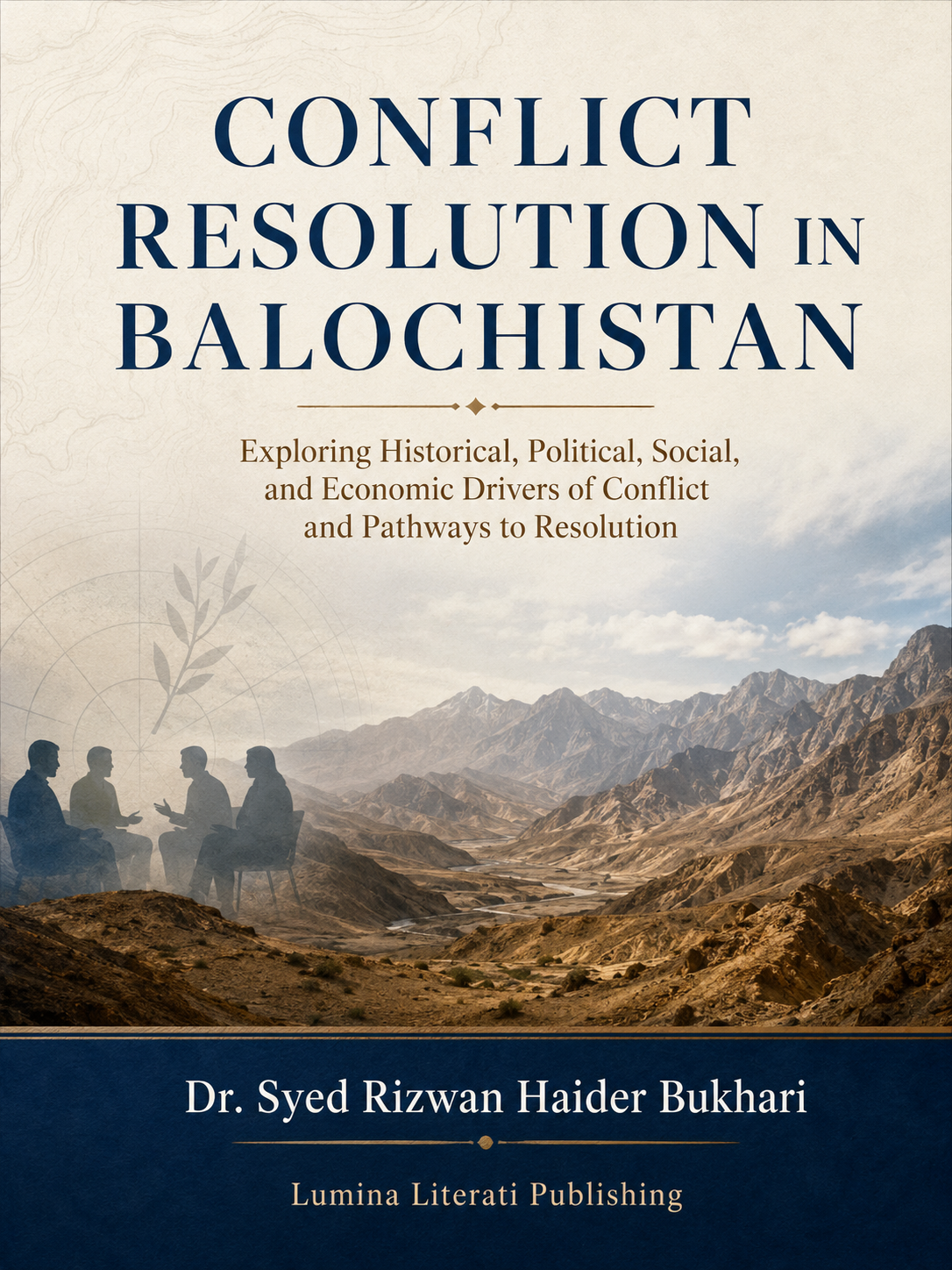
Conflict Resolution in Balochistan
Exploring Historical, Political, Social, and Economic Drivers of Conflict and Pathways to Resolution
Book Overview
Conflict Resolution in Balochistan: Exploring Historical, Political, Social, and Economic Drivers of Conflict and Pathways to Resolution offers a comprehensive study of one of Pakistan’s most complex and enduring regional challenges. It examines Balochistan’s strategic position, historical experience, political contestation, socio-economic inequalities, competing demands for provincial autonomy, and the relationship between local communities and state institutions.
The book argues that the conflict cannot be understood, managed, or resolved through a single political, military, or developmental intervention. Sustainable peace requires coordinated reforms involving democratic governance, federal–provincial cooperation, inclusive economic development, fair resource governance, human security, constitutional participation, institutional accountability, and public trust. Its interdisciplinary analysis draws on Political Science, Strategic Studies, Peace and Conflict Studies, Governance, Development Studies, Security Studies, Comparative Politics, and Public Policy.
Across nine chapters, the volume traces the historical evolution of the conflict, explains its theoretical and institutional foundations, evaluates governance and federalism, examines natural-resource management and inclusive growth, analyses security and human-security concerns, and draws carefully adapted lessons from international conflict-resolution experiences. It then brings these dimensions together in an integrated framework in which constitutional governance, inclusive development, reconciliation, public participation, and institutional trust reinforce one another.
Written for researchers, policymakers, students, diplomats, security scholars, practitioners, and readers seeking to understand Balochistan beyond headlines and simplifications, the book presents conflict resolution as a continuing process of institutional reform rather than a single settlement. Its central contribution is a practical and multidisciplinary pathway toward sustainable peace, stability, and regional integration.
About the Author
Dr. Syed Rizwan Haider Bukhari
Dr. Syed Rizwan Haider Bukhari is a distinguished scholar and researcher in the social sciences, specialising in Political Science and Strategic Studies. His work covers strategic analysis, international relations, South Asian security, constitutional politics, regional conflict, policy research, and emerging geopolitical issues.
He is the author of more than 120 research papers and five books. His scholarship addresses the Muslim world, the South Asian strategic environment, Kashmir studies, national integration, security policy, and the changing dynamics of the global order. His research has received more than 400 citations and over 1.7 million global reads.
Dr. Bukhari has completed more than twenty reviews for twelve international journals and maintains an active academic presence on ORCID, Google Scholar, LinkedIn, Academia.edu, Web of Science, Scopus, and ResearchGate. His ResearchGate Research Interest Score exceeds 1,700, and he has more than 17,000 followers across academic and professional platforms.
Endorsements
Historical and Political Foundations
The book traces Balochistan’s institutional and political development from the pre-independence period through state formation, centre–province relations, constitutional change, political participation, and the evolution of Baloch nationalism.
Governance, Resources, and Inclusive Development
It examines how institutional capacity, federalism, public-service delivery, natural-resource governance, employment, infrastructure, Gwadar, CPEC, and unequal access to development shape grievances as well as opportunities for peacebuilding.
Human Security and Sustainable Peace
The book integrates public safety, rule of law, education, healthcare, livelihoods, political inclusion, reconciliation, comparative international lessons, and institutional accountability into a multidimensional framework for sustainable conflict resolution.
Free & Open Access
This scholarly work is available to everyone. Click the cover to start reading our new publication without barriers.
References
Showing 10 of 120 referencesShowing all 120 references