
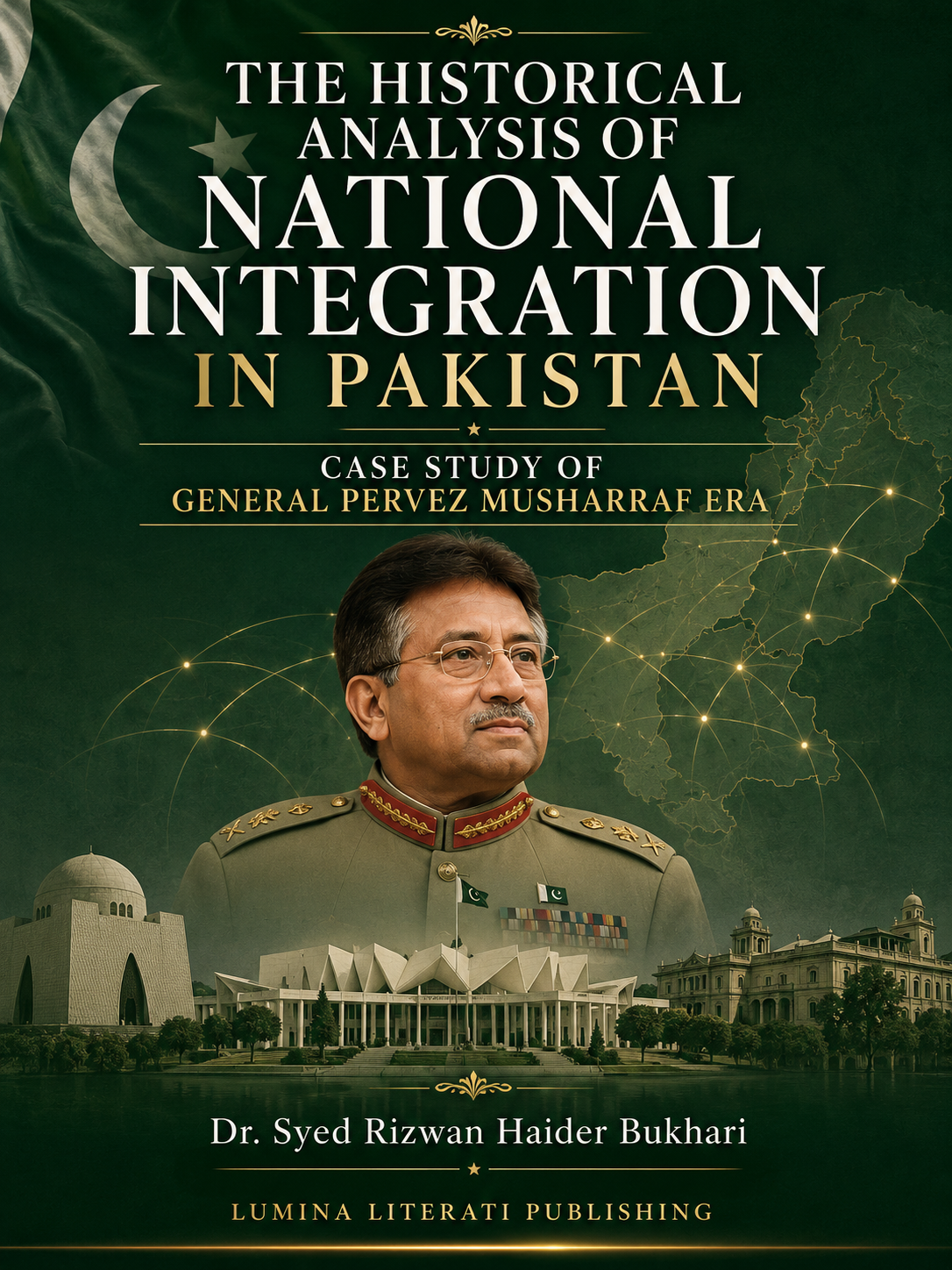
The Historical Analysis of National Integration in Pakistan: A Case Study of the General Pervez Musharraf Era – Lumina Literati Publishing
The Historical Analysis of National Integration in Pakistan: A Case Study of the General Pervez Musharraf Era book cover

The Historical Analysis of National Integration in Pakistan

A Case Study of the General Pervez Musharraf Era

By

Published by Lumina Literati Publishing
Publication Year:
ISBN: 978-627-7813-55-0

Book Overview

The Historical Analysis of National Integration in Pakistan: A Case Study of the General Pervez Musharraf Era begins from a question that has shadowed the Pakistani state since its birth in 1947: how does a country forged from many peoples — multi-ethnic, multilingual, multi-religious, and multi-sectarian — become, and remain, a single nation? National cohesion, the book argues, is not a slogan but a process that must be continually achieved across the political, social, cultural, and economic life of the federation. Where that process falters, the threat to the state comes not from beyond its borders but from within.

Grounding its inquiry in a careful conceptual framework, the volume distinguishes the functional integration of shared resources and institutions from the deeper psychological integration of loyalty, emotion, and common purpose, and weighs the competing strategies of assimilation and unity-in-diversity. From this foundation it traces the long arc of national integration through Pakistan’s constitutional and political history — the ideological origins in the Two-Nation Theory and the vision of the Quaid-e-Azam, the troubled democratic interlude of 1947–58, the cycles of martial law, the dismemberment of 1971, and the post-Zia order — before turning its central case study to the regime of General Pervez Musharraf and its devolution experiment.

The book confronts the divisive forces directly and without euphemism: strained centre–province relations and the unfinished promise of provincial autonomy under the 1973 Constitution; the recurring quarrels over the NFC Award, water distribution, Kalabagh Dam, and the royalty of natural resources; the politics of ethnicity, the quota system, and unemployment in the smaller provinces; sectarian violence, the War on Terror, and the strains they placed on the federation; and the contested promise of Gwadar and the demand for new provinces. Drawing on a qualitative, historical, and analytical method — supported by a questionnaire and the testimony of political actors and analysts — it reads these grievances not as isolated complaints but as symptoms of an incomplete national settlement.

Its closing movement is constructive. Rather than cataloguing failure, the study advances a wide-ranging program for strengthening the federation: confidence-building between the centre and the provinces, the faithful implementation of the 1973 Constitution, fiscal devolution, the empowerment of the Senate and the Council of Common Interests, an independent judiciary, electoral reform, and the revival of an inclusive ideological orientation capable of holding diverse communities together.

The central argument is at once a diagnosis and a call to action: national integration in Pakistan is neither a finished inheritance nor a lost cause, but a continuous undertaking — one that can be secured only by honouring the constitutional rights of the federating units, distributing power and resources justly, and rebuilding the sense of shared destiny on which the federation was founded.

About the Author

Dr. Syed Rizwan Haider Bukhari

Ph.D. in Political Science (Strategic Studies) · Researcher in the Social Sciences · Reviewer for 12 international journals

Dr. Syed Rizwan Haider Bukhari is a distinguished researcher in the social sciences whose work has made an influential and sustained contribution to the field. Holding a Ph.D. in Political Science (Strategic Studies), he is a dedicated scholar committed to advancing knowledge through rigorous academic research and to bringing the perspectives of several disciplines to bear on the questions he studies. He is the author of more than 110 research papers and five books.

Through his intellectual range and his engagement with the world affairs of his time, Dr. Bukhari reflects the scholarly strength of the Muslim world and its participation in the contemporary international order. His research has proven both relevant and far-reaching: it has attracted more than 356 citations and over 1.6 million global reads. He serves as a reviewer for twelve leading international journals, playing an active part in upholding academic quality and scholarly excellence. His expertise spans strategic analysis, policy research, and the emerging socio-political challenges of the Islamic world and their implications for the new world order.

Dr. Bukhari maintains an active scholarly presence across ORCID, Google Scholar, LinkedIn, Academia.edu, Web of Science, and Scopus, fostering collaboration with researchers worldwide and broadening the reach of his work. With a following of more than 16,000, he continues to inspire researchers, students, and policymakers alike. His output reflects a steadfast commitment to innovation, academic leadership, and meaningful contributions to global discourse in the social sciences.

Endorsements & Reviews

“A rigorous and timely contribution. Dr. Bukhari moves beyond the familiar grievances of centre–province politics to show how Pakistan’s struggle for national integration is rooted in its constitutional history and its unfinished federal settlement. Lucid, deeply researched, and quietly urgent.”

“Rare is the study that speaks fluently to political science, federalism, and the history of the state at once. By reading the Musharraf era through the long arc of national integration — and that arc through the prism of a single decisive decade — this volume reframes a debate too often reduced to blame. Essential for students of Pakistani politics and South Asian federalism.”

“The concluding recommendations are the most constructive I have read on this subject. Rather than mourning the fragility of the federation, Dr. Bukhari shows how it can be strengthened — through fiscal devolution, an empowered Senate, and a renewed sense of shared destiny. A vital book for scholars, policymakers, and every citizen who cares about the unity of Pakistan.”

Open Access Promotion – Final Design

Free & Open Access

This scholarly work is available to everyone. Click the cover to start reading our new publication without barriers.

The Historical Analysis of National Integration in Pakistan: A Case Study of the General Pervez Musharraf Era

References

Showing 10 of 144 referencesShowing all 144 references

1
Shamila Tabassum, Dr. Ghulam Mustafa & Dr. Muhammad Nawaz Bhatti, “Issues of NIP with Reference to Balochistan”, Pakistan Social Sciences Review, March 2020, (4) 1, 204
2
Syed Jawad Shah & Waseem Ishaque, “Challenges Of NIP And Strategic Response”, ISSRA Papers 2017
3
United Nations Development Programme Report, 1994.
4
Shamila Tabassum, Dr. Ghulam Mustafam & Dr. Muhammad Nawaz Bhatti, “Issues of NIP with Reference to Balochistan”, Pakistan Social Sciences Review, March 2020, (4) 1, 204-215
5
Gulshan Majeed, “Problems of NIP”. Journal of Political Studies, 21(2), 2014
6
Syed Jawad Shah & Waseem Ishaque, “Challenges Of NIP And Strategic Response”, ISSRA Papers 2017
7
Swarna Rajagopalan, “National Integration in India, Sri Lanka and Pakistan: Constitutional and élite visions”, Nationalism and Ethnic Politics, 3 (4), 2007, 1-38
8
Rounaq Jahan, Pakistan Failure in National Integration. New York: Colombia University Press, 1972
9
Kavita R. Khory, “National Integration and the Politics of Identity in Pakistan”, Nationalism and Ethnic Politics, 1 (4), 2007, 23-43
10
Theodore P. Wright Jr, “Can there be a melting pot in Pakistan? Interprovincial marriage and National Integration’ Contemporary South Asia, 3 (2), 131-144
11
Challenges to Political Stability, “The Dawn”, 9 June 2000.
12
Microsoft Encarta 2006.
13
Jinnah’s Vision of Pakistan, “The Dawn”, 11 September 2006.
14
Before and After 1971”, “The Dawn”, 15 December 2006.
16
Political Philosophy by Richard-J-Arneson article 2000
17
The Oxford Encyclopedia of the Islamic World – Edited by John L. Esposito
18
The Concept of Integration as an Analytical Tool and as a Policy Concept By Rinus Penninx
19
James Coleman and Carl Rosenburg – International Political Science Abstract-2020
20
Pattern of National Integration 1967 by Weiner
21
National Integration by by N BOSE · 1991
22
The Idea of Pakistan by Stephen Philip Cohen
23
Reassessing Pakistan: Role of Two-Nation Theory by Verma, Anand K
24
Indian Rebellion of 1857. The Indian War of Independence. by Vinayak Damodar Savarkar.
25
Sir Sayyid Ahmad Khan, 1817 1898: A Prominent Muslim- M. Ikram Chaghatai 2005
26
Economic Vision of Allama Iqbal -by FM Chaudhri · 2002
27
Fulfilling the Pakistan Vision of Quaid-i-Azam by A Hussain · 2015
28
Jinnah of Pakistan by Stanley Wolpert
29
A Political History of Pakistan, 1947-2007 by V. Y. Belokrenitsky and V. N. Moscalenko
30
Pakistan’s First Military Coup: Why Did the First Pakistani Coup Occur and Why Does it Matter? Chaudhry, Naghman Mar 2012
31
Pakistan in 1969 Once Again at the Starting Point by Wayne Wilcox
32
Zulfikar Ali Bhutto and Pakistan 1967-1977 by Raza, Rafi
33
Gen (Retd) Khalid Mehmud Arif, in his book Working with Zia
34
Dawn Article -v A leaf from history: The Prime Minister is Hanged written by Shaikh Aziz Published Feb1, 2015 (For his last 323 ref Col Rufi)
35
Whither Pakistan: Dictatorship or Democracy? Author: Benazir Bhutto; Iqbal Narejo 2007
36
The Musharraf Regime and the Governance Crisis: A Case Study of the Government of Pakistan Sohail Mahmood Nova Publishers, 2001
37
M Asghar Khan, We’ve Learnt Nothing from History. (London: Oxford, 2005). P.255.
38
Musharraf Era performance: Pakistan Flourishes (Musa Khan, Lahore)
39
Economic Survey 2005
40
Economic Survey of Pakistan 2006 and UN Human Resource Development Report 2007/2008
41
Understanding Federalism and Federation By Alain-G. Gagnon, Soeren Keil- 2015
42
The Price of Federalism By Paul E Peterson
43
Federalist Government in Principle and Practice- 2001 Editors: Racheter, Donald P., Wagner, Richard E. (Eds.)
44
Financial Federalism in Pakistan: Implications for Centre-Province Relations
45
Citation metadata Authors: Iram Khalid and Nusrat Hussain Date: June 30, 2018
46
The Constitution of Pakistan 1973
47
Federal List (for Centre, with 59 items), Provincial List (for provinces, with 54 items) Part V: Relations between Federation and Provinces Chapter 1: Distribution of Legislative Powers 141
48
Role of Senate Empowerment through 18 Constitutional Amendment
49
The Constitution of Pakistan under Article 153-155
50
The Constitution of Pakistan Article 89 and 128
51
The Constitution of Pakistan articles 232-237
52
The Constitution of Pakistan Part VII: The Judicature Chapter 1: The Courts 175
53
Centre-Province Relations: A Historical Perspective Dr. Farzana Arshad Muhammad Arif Khan June 2019
54
NFC Award: Devising formula for horizontal distribution By: Sajid Amin Javed, Vaqar Ahmed
55
Water Crisis in Pakistan: A Book on Informatic Material Paperback – 2010 by Khurshed Ahmed
56
Natural Resources: Blessing or Curse by Abid Suleri, Babar Shahbaz, Meezan Z. Khwaja Jul. 1, 2010
57
How Pakistan Became an Asian Tiger by Nadeem ul Haque
58
Ethnicity and Politics in Pakistan by Feroz Ahmed
59
Devolution Plan 2000: dictatorship, democracy, and the politics of institutional change in Pakistan Sajjad Ali Khan
60
Dimensions and Spread of Unemployment Spell in Pakistan Kulsom Zulifquar and M. Aslam Chaudhary
61
Economic prospects of Bangladesh – by A Robinson
62
Issues in Monetary Management in Pakistan – by MA Janjua
63
Islam and Sectarian Violence in Pakistan
64
The Terror Within By Eamon Murphy
65
In the Line of Fire by Pervez Musharraf
66
Education System in Pakistan: Issues and Problems by R.A. Farooq
67
Contemporary Problems Of Pakistan Edited By J. Henry Korson Copyright Year 1993
68
Time for Islamabad to Correct its Stance, “The Dawn”, 29 January 2007.
69
Political Development in Pakistan by Karl von Vorys 1965
70
Democracy in Muslim Lands “The Dawn”, 30 January 2007.
71
Governance and Poverty in Pakistan: Some Reflections 2000 by SM Khan · 2008
72
Mirza Arshad Ali, Democracy displaced in Pakistan.(Karachi: R&D Publications,1998).p.95.
73
Transparency International Report 2006.
74
Human Development Report 2006.
75
World Bank Report 2006.
76
Craig Baxter, Pakistan on the Brink politics, economics and society. (Karachi: Oxford, 2005).p.131.
77
State Bank of Pakistan Report 2005-06.
78
Polarized Politics – by N Akhtar · 2009 ·
79
Mirza Arshad Ali, Democracy Displaced in Pakistan.(Karachi: R&D Publications,1998).p.95.
80
Hamid Yusuf, Pakistan a Study of Political Developments.(Maktaba: Jadeed,1998).p.245.
81
The Dynamics of Pakistan’s Intra-national Security – by M Ahmar
82
Demand For New Provinces In Pakistan – by MU Asghar
83
The Creation Of New Provinces In Pakistan And Its Implications For An Integrated Countr by Syed Hussain Shaheed Soherwordi and Shahid Ali Khattak
84
The Dawn – The Pakistan Ideology: History of a grand concoction 29-Aug-2013
85
Policy Perspectives by Abdullah – Ideology and State Vol. 7, No. 2 (July – December 2010
86
Pakistan: Nationalism without a Nation Paperback – April 1, 2002 by Christophe Jaffrelot
87
Pakistan: Unity, Faith And Discipline: Do we live up to Jinnah’s expectations? by Waqar Ahmed Siddiqui
88
Pakistan’s Crisis in Leadership. By Fazal Muqueem Khan. 1973
89
Political System and State Structure of Pakistan. By Pakistan Ministry Of Finance, 2011. Economic Survey 2010-2011.
90
Accountability In Pakistan – NDU By E Ahmed
91
Sectarianism in Pakistan: Causes & Remedies, December 2009 by Farman Ullah
92
Education System Reform in Pakistan: Why, When, and How? by M Aziz · 2014
93
Asian Development Bank Poverty In Pakistan Issues, Causes and Institutional Responses July 2002
94
Fiscal Federalism in Pakistan -by U Mustafa
95
Narratives of the War on Terror Global Perspectives Edited By Michael C. Frank, Pavan Kumar Malreddy Copyright Year 2020
96
Improving the Judicial System of Pakistan: A Probe by Muhammad Irshad Ijaz
97
Politico-Economic Significance Of Gwadar Port: Implications For Regional Integration by Sajid Hussain
98
China-Pakistan Economic Corridor A Game Changer Edited by Minhas Majeed Khan, Ahmad Rashid Mali
99
Creating New Provinces in Pakistan: A Print Media Analysis 27 Feb, 2012 By Priyanka Dutta Chowdhury
100
Crisis Prevention, Confidence Building, and Reconciliation Between India and Pakistan Hardcover by Michael & Amirt Sevak Krepon (Author)
101
Other References
102
Ali, Mehrunisa. Politics of Federalism in Pakistan, Karachi: Royal Book
103
ompany, 1996
104
Balochi, S. Balochistan National Party, the Political Parties of Pakistan. Karachi: Royal Book Company, 2002
105
Hameed, R. M. Comparative and Development Politics. Lahore, Aziz Publishers, 1989
106
Jahan, Rounaq. Pakistan Failure in National Integration. New York: Colombia University Press, 1972
107
Khan, Z. National Integration in India Issues and Dimensions. New Delhi: Associated Publishing House, 1983.
108
Sodaro, J, Michael. Comparative Politics A Global Introduction. New York: McGraw-Hill Company Inc, 2001
109
Ziring, Lawrence. Pakistan the Enigma of Political Development. Boulder: Westview, 1980
110
Journals’ Articles
111
Ahmad, Feroze. “Ethnicity, State and National Integration”. Asian Survey, Vol. XX, 1984
112
Habib A. Mufti, “Institutional Barriers in the Path of NIP – A Note”, Pakistan Economic and Social Review, 23 (1), (Summer 1985), 85-93
113
Khory, Kavita R. “National Integration and the Politics of Identity in Pakistan”, Nationalism and Ethnic Politics, 1 (4), 2007, 23-43
114
Majeed, Gulshan. “Problems of NIP”. Journal of Political
115
Studies, 21(2), 2014
116
Moonis Ahmar, “The Dynamics of Pakistan’s Intra-national Security: The Role of the New Provinces”, India Quarterly, 2016. 72(1) 16–29
117
Naz, A. “Ethno-National Movements and National integrity in Pakistan”. International Journal of Social Sciences, Humanities and Education, 3(1), 2017, 150-160.
118
Rajagopalan, Swarna. “National integrationin India, Sri Lanka and Pakistan: Constitutional and élite visions”, Nationalism and Ethnic Politics, 3 (4), 2007, 1-38
119
Syed Jawad Shah & Waseem Ishaque, “Challenges Of NIP And Strategic Response”, ISSRA Papers 2017
120
Tabassum, Shamila. Mustafam Dr. Ghulam & Bhatti, Dr. Muhammad Nawaz. “Issues of NIP with Reference to Balochistan”, Pakistan Social Sciences Review, March 2020, (4) 1, 204-215
121
Talukder Maniruzzaman, “National Integration and Political Development in Pakistan”, Asian Survey, 7 (12), (December, 1967), 876-885
122
Tariq, M., Malik, M. S., & Qumber, G. “Prospects of Federalism in Pakistan”. Global Social Sciences Review, 3(2), 2018, 358-370.
123
Wright Jr, Theodore P. “Can there be a melting pot in Pakistan? Interprovincial marriage and National Integration’ Contemporary South Asia, 3 (2), 131-144
124
Ahmad, Mushtaq. Politics of crisis, Karachi: Royal book company,1987.
125
Ahsan, Aitzaz. Divided by Democracy, New Dehli: Roli, 2005.
126
Arshad, Mirza. Democracy displaced in Pakistan, Karachi: R&D Publications,1998.
127
Askari, Hasan. Military, State and society in Pakistan, Lahore: Sang-e-Meel, 2003.
128
Askari, Hasan. The Military &Politics in Pakistan 1947-1997, Lahore: Sang-e-Meel,2000.
129
Baxter, Craig. Pakistan on the Brink, Politics, Economics, and Society, Karachi: Oxford, 2005.
130
Haqqani, Hussain. Pakistan between Mosque and Military, Karachi: Vangaurd,2005.
131
Khan, Asghar. We’ve Learnt Nothing from History, London: Oxford, 2005.
132
Mahmood, Safdar. The Constitution of Pakistan, Lahore: Macmillan 2000.
133
Yusuf, Hamid. Pakistan a study of political developments, Karachi: Maktaba Jadeed,1998
134
Newspapers
135
Business Recorder
136
Daily Pakistan
137
Dawn
138
Khalsa Akhbar Lahore
139
Pakistan Observer
140
The Friday Times
141
The Frontier Post
142
The Nation
143
The News International
144
The Star
Scroll to Top