
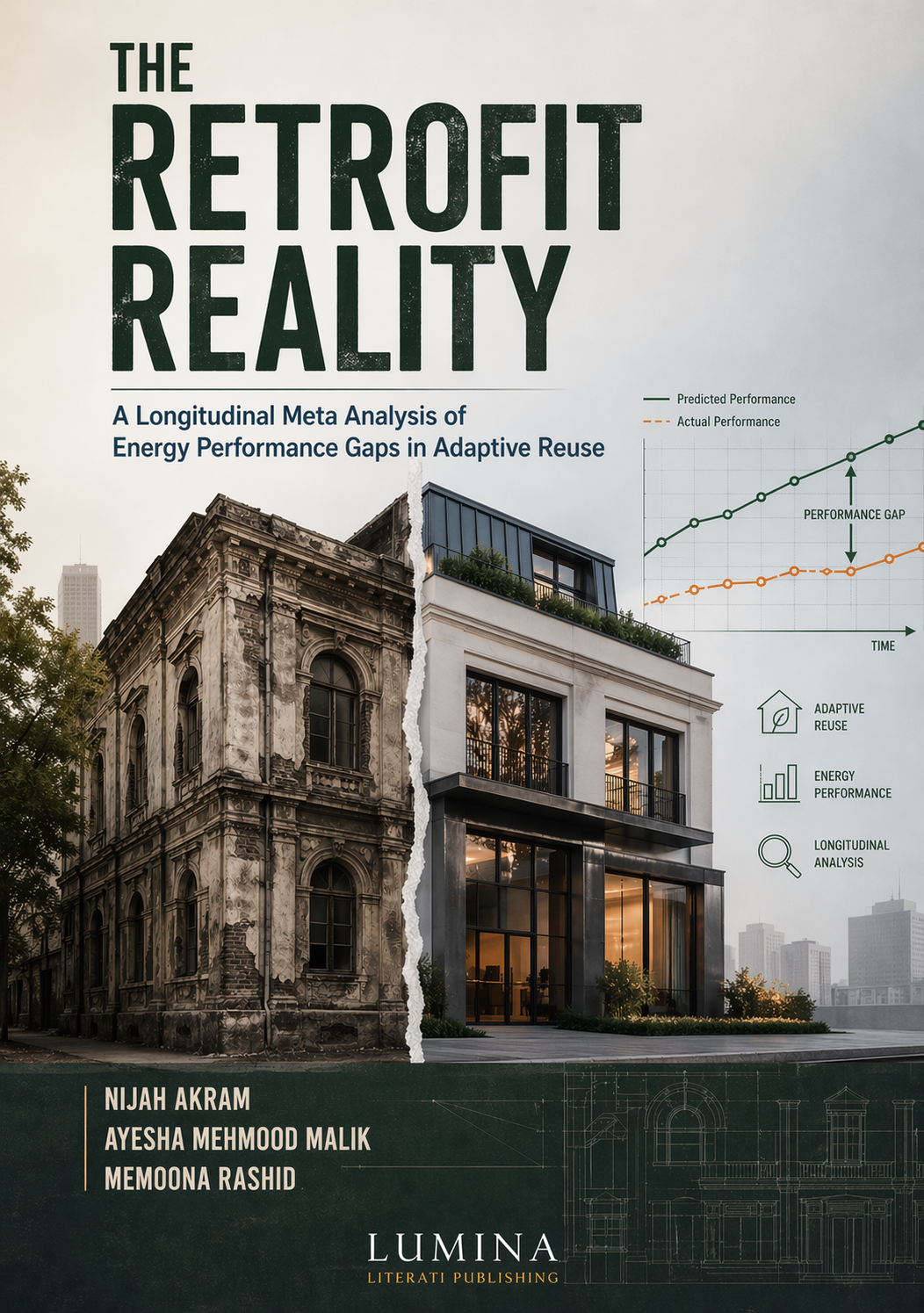
The Retrofit Reality
A Longitudinal Meta Analysis of Energy Performance Gaps in Adaptive Reuse
Book Overview
The Retrofit Reality: A Longitudinal Meta Analysis of Energy Performance Gaps in Adaptive Reuse emerges from the urgent global conversation surrounding urban growth, resource depletion, and heritage. While adaptive reuse is widely celebrated for preserving embodied carbon and cultural heritage, far less attention has been given to the operational realities that unfold after renovation. This monograph investigates whether retrofitted buildings truly perform as predicted and if design promises translate into measurable energy efficiency over time.
Moving beyond symbolic sustainability claims, this work meticulously explores the measurable gap between intended and actual performance through a rigorous, forward-looking lens. By focusing on longitudinal evidence, the authors illuminate how retrofitted buildings behave not only at handover but throughout years of occupation. This essential volume provides clarity to researchers, policymakers, architects, engineers, and facility managers, emphasizing that sustainable futures require honest buildings, not merely beautiful intentions.
About the Authors
Dr. Nijah Akram
Dr. Nijah Akram is an academic and architectural engineering professional with over sixteen years of experience in higher education, research, academic leadership, and professional practice. She holds a Ph.D. in Architectural Engineering from UET Lahore, specializing in integrated lighting systems, human-centric design, and energy-economic efficiency in healthcare buildings. She currently serves as Head of the Department of Architectural Engineering Technology at Punjab Tianjin University of Technology, Lahore.
Dr. Ayesha Mehmood Malik
Dr. Ayesha Mehmood Malik is an accomplished academic, researcher, and architectural professional with more than twenty years of experience in teaching, research, academic leadership, and professional practice. She holds a Ph.D. in Architecture and is currently Head of the School of Architecture at the University of Lahore. She is Editor-in-Chief of the Journal of Architecture and Built Environment Research and serves on advisory boards of several national and international journals.
Memoona Rashid
Memoona Rashid is Associate Professor at the School of Architecture, Faculty of Arts and Architecture, The University of Lahore, Pakistan. She possesses fifteen years of professional and academic experience, including fourteen years in higher education. A proud graduate of UET Lahore, she completed her Master of Architecture in 2021 from the Department of Architecture, University of the Punjab. Since 2016, she has been actively engaged in research on Sustainable Architecture, with a focus on energy-efficient buildings, climate-responsive architecture, and sustainable development.
Endorsements & Reviews
“This book addresses that gap with clarity and academic seriousness. The authors examine retrofit practice through the important lens of energy performance, exposing how assumptions made during design stages may diverge from lived building outcomes.”
“Their work is especially valuable because it recognizes that buildings are social systems as much as technical systems. Occupants, management cultures, maintenance regimes, institutional priorities, and user expectations all shape performance trajectories.”
“I commend the authors for producing a timely and meaningful contribution to the built environment literature. This publication therefore contributes not only to architecture and engineering, but also to wider interdisciplinary scholarship.”
— Dr. Saira Siddiqui, Assistant Professor, Department of Sociology, Government College University Faisalabad
— Dr. Basharat Ali, Assistant Professor and Focal Person, Department of Sociology, Government College University Faisalabad
— Dr. Muhammad Atif, Assistant Professor, Department of Rural Sociology, University of Agriculture Faisalabad
Free & Open Access
This scholarly work is available to everyone. Click the cover to start reading our new publication without barriers.
References
Showing 10 of 335 referencesShowing all 335 references