
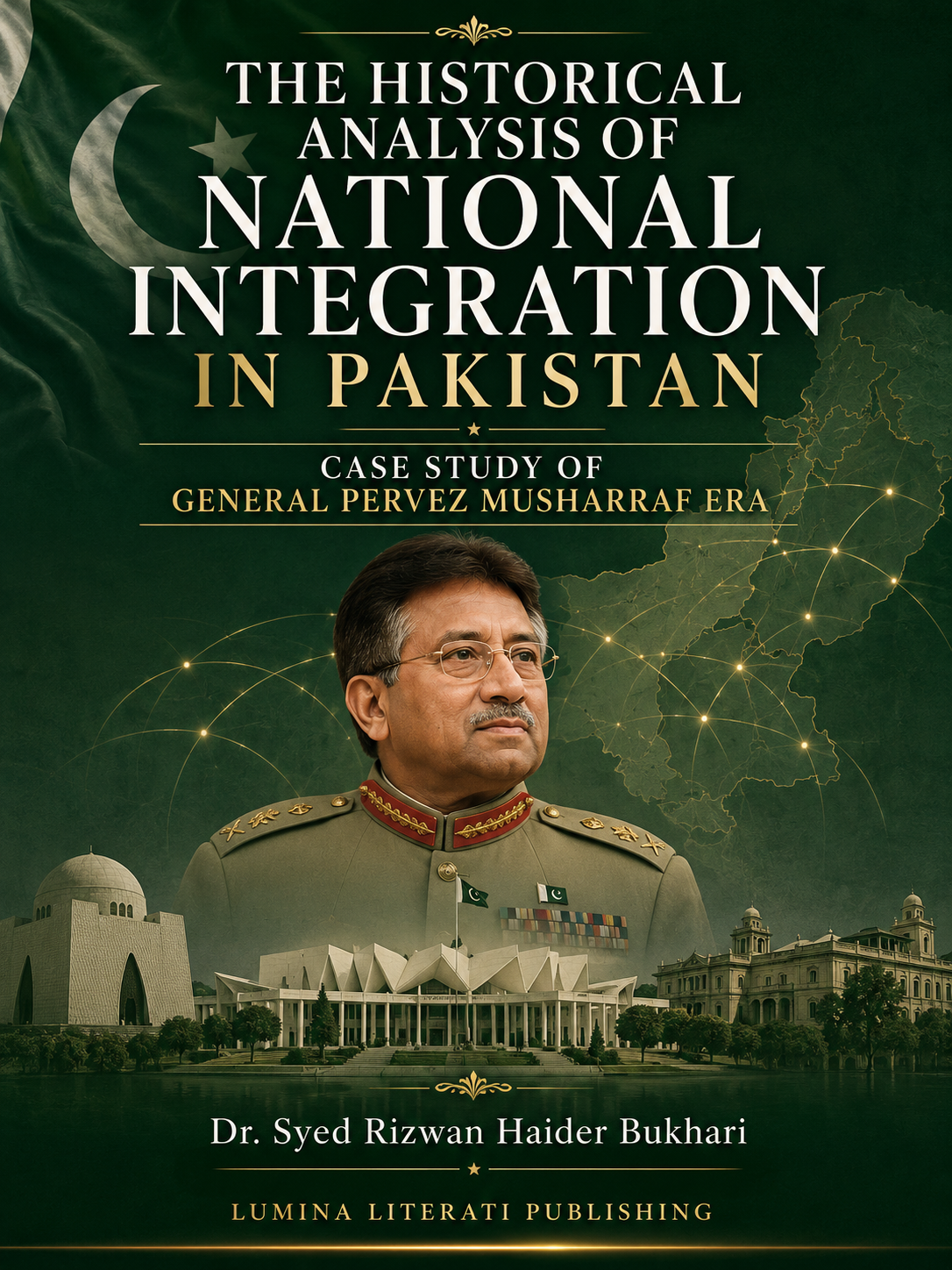
The Historical Analysis of National Integration in Pakistan
A Case Study of the General Pervez Musharraf Era
Book Overview
The Historical Analysis of National Integration in Pakistan: A Case Study of the General Pervez Musharraf Era begins from a question that has shadowed the Pakistani state since its birth in 1947: how does a country forged from many peoples — multi-ethnic, multilingual, multi-religious, and multi-sectarian — become, and remain, a single nation? National cohesion, the book argues, is not a slogan but a process that must be continually achieved across the political, social, cultural, and economic life of the federation. Where that process falters, the threat to the state comes not from beyond its borders but from within.
Grounding its inquiry in a careful conceptual framework, the volume distinguishes the functional integration of shared resources and institutions from the deeper psychological integration of loyalty, emotion, and common purpose, and weighs the competing strategies of assimilation and unity-in-diversity. From this foundation it traces the long arc of national integration through Pakistan’s constitutional and political history — the ideological origins in the Two-Nation Theory and the vision of the Quaid-e-Azam, the troubled democratic interlude of 1947–58, the cycles of martial law, the dismemberment of 1971, and the post-Zia order — before turning its central case study to the regime of General Pervez Musharraf and its devolution experiment.
The book confronts the divisive forces directly and without euphemism: strained centre–province relations and the unfinished promise of provincial autonomy under the 1973 Constitution; the recurring quarrels over the NFC Award, water distribution, Kalabagh Dam, and the royalty of natural resources; the politics of ethnicity, the quota system, and unemployment in the smaller provinces; sectarian violence, the War on Terror, and the strains they placed on the federation; and the contested promise of Gwadar and the demand for new provinces. Drawing on a qualitative, historical, and analytical method — supported by a questionnaire and the testimony of political actors and analysts — it reads these grievances not as isolated complaints but as symptoms of an incomplete national settlement.
Its closing movement is constructive. Rather than cataloguing failure, the study advances a wide-ranging program for strengthening the federation: confidence-building between the centre and the provinces, the faithful implementation of the 1973 Constitution, fiscal devolution, the empowerment of the Senate and the Council of Common Interests, an independent judiciary, electoral reform, and the revival of an inclusive ideological orientation capable of holding diverse communities together.
The central argument is at once a diagnosis and a call to action: national integration in Pakistan is neither a finished inheritance nor a lost cause, but a continuous undertaking — one that can be secured only by honouring the constitutional rights of the federating units, distributing power and resources justly, and rebuilding the sense of shared destiny on which the federation was founded.
About the Author
Dr. Syed Rizwan Haider Bukhari
Dr. Syed Rizwan Haider Bukhari is a distinguished researcher in the social sciences whose work has made an influential and sustained contribution to the field. Holding a Ph.D. in Political Science (Strategic Studies), he is a dedicated scholar committed to advancing knowledge through rigorous academic research and to bringing the perspectives of several disciplines to bear on the questions he studies. He is the author of more than 110 research papers and five books.
Through his intellectual range and his engagement with the world affairs of his time, Dr. Bukhari reflects the scholarly strength of the Muslim world and its participation in the contemporary international order. His research has proven both relevant and far-reaching: it has attracted more than 356 citations and over 1.6 million global reads. He serves as a reviewer for twelve leading international journals, playing an active part in upholding academic quality and scholarly excellence. His expertise spans strategic analysis, policy research, and the emerging socio-political challenges of the Islamic world and their implications for the new world order.
Dr. Bukhari maintains an active scholarly presence across ORCID, Google Scholar, LinkedIn, Academia.edu, Web of Science, and Scopus, fostering collaboration with researchers worldwide and broadening the reach of his work. With a following of more than 16,000, he continues to inspire researchers, students, and policymakers alike. His output reflects a steadfast commitment to innovation, academic leadership, and meaningful contributions to global discourse in the social sciences.
Endorsements & Reviews
“A rigorous and timely contribution. Dr. Bukhari moves beyond the familiar grievances of centre–province politics to show how Pakistan’s struggle for national integration is rooted in its constitutional history and its unfinished federal settlement. Lucid, deeply researched, and quietly urgent.”
“Rare is the study that speaks fluently to political science, federalism, and the history of the state at once. By reading the Musharraf era through the long arc of national integration — and that arc through the prism of a single decisive decade — this volume reframes a debate too often reduced to blame. Essential for students of Pakistani politics and South Asian federalism.”
“The concluding recommendations are the most constructive I have read on this subject. Rather than mourning the fragility of the federation, Dr. Bukhari shows how it can be strengthened — through fiscal devolution, an empowered Senate, and a renewed sense of shared destiny. A vital book for scholars, policymakers, and every citizen who cares about the unity of Pakistan.”
Free & Open Access
This scholarly work is available to everyone. Click the cover to start reading our new publication without barriers.
References
Showing 10 of 144 referencesShowing all 144 references