
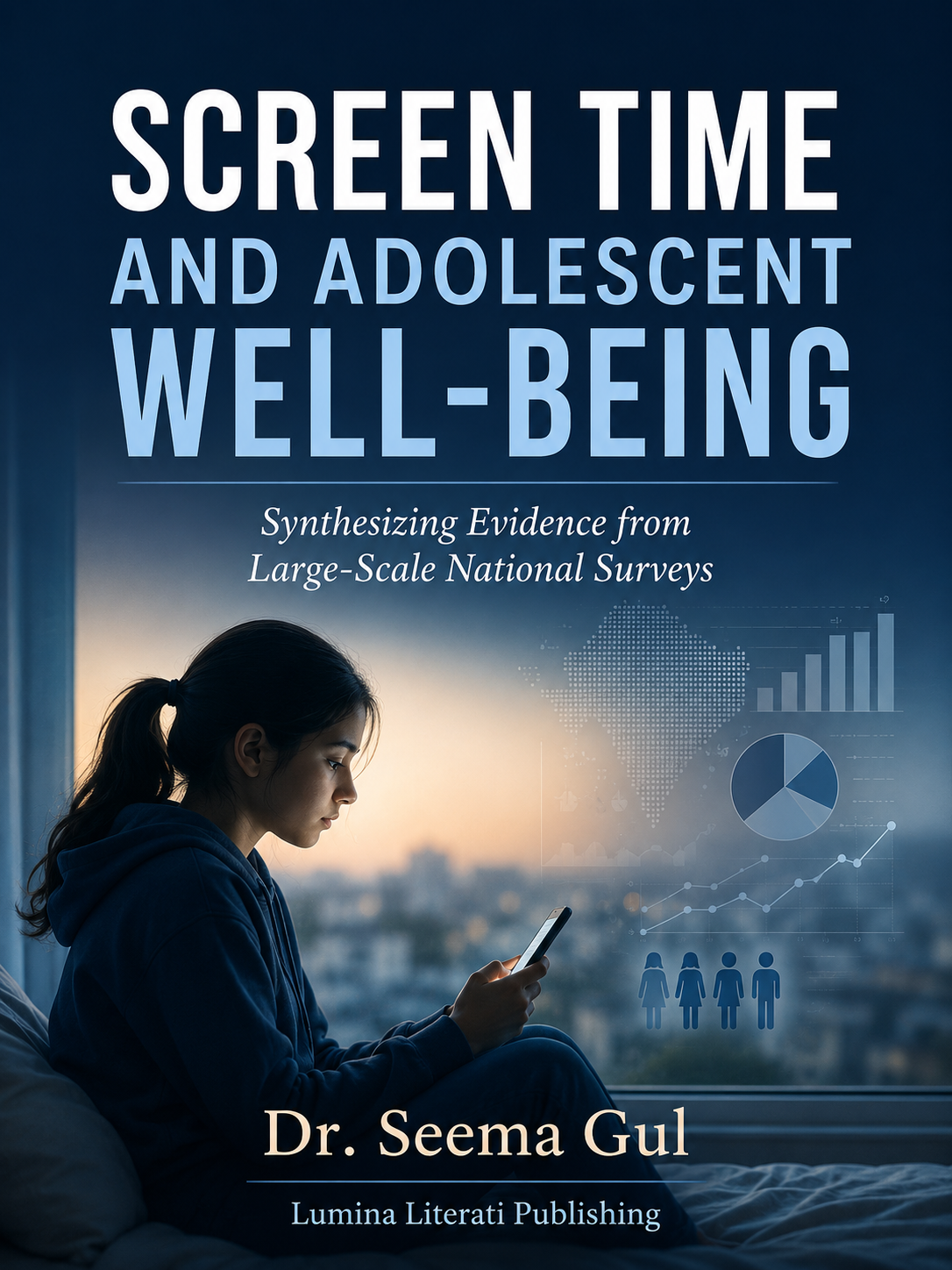
Screen Time and Adolescent Well-being
Synthesizing Evidence from Large-Scale National Surveys
Book Overview
Screen Time and Adolescent Well-being: Synthesizing Evidence from Large-Scale National Surveys begins from a single, clarifying premise: the question of whether screens are harming young people deserves better science than it has so far received. Every year, new headlines proclaim a crisis of adolescent mental health driven by smartphones and social media, yet the empirical record underlying these claims remains riddled with measurement error, confounding variables, and reverse-causal traps that conventional analyses can only partially address. This volume offers a rigorous, methodologically transparent synthesis of what large-scale national survey data actually reveal — and what they do not.
The book opens with a sustained examination of the methodological paradigms that have shaped the field, exposing how recall bias, social desirability distortion, and the consistent overestimation of self-reported screen time have compromised decades of survey evidence. It traces the transition from subjective measurement to passive telemetry and device-logged metrics, while interrogating what it means to operationalize “well-being” across cultures and instruments — from the PHQ-9 and RCADS to flourishing scales and relational metrics of peer attachment and family cohesion.
Moving from method to theory, the volume deconstructs the “dose-response” fallacy that has dominated public discourse, re-examining the displacement hypothesis and demonstrating why linear models of screen-time harm fail to capture the non-linear, context-dependent realities of adolescent digital engagement. Subsequent chapters address the sociological dimensions of stratification and the new digital divide, propose a nuanced typology that differentiates screen use by content, context, and connection, and close with evidence-based policy recommendations and future research directions.
The central argument is neither alarmist nor dismissive: forward causation from screen time to depression is consistently weak once properly disentangled from reverse causation, stable individual differences, and shared external shocks — and the field must move from blanket reduction mandates toward precision, developmentally attuned guidance.
About the Author
Dr. Seema Gul
Dr. Seema Gul is an Assistant Professor of Psychology at Prince Sultan University, Riyadh, Kingdom of Saudi Arabia. She holds a Ph.D. in Psychology and possesses extensive experience in teaching, research, and academic leadership.
Her research interests include Psychological Testing, Clinical Psychology, Social Psychology, Educational Psychology, and Family Psychology, with a particular emphasis on adolescent family adjustment, mental health and well-being. Dr. Gul has made significant academic contributions through the presentation of research papers at national and international conferences and through publications in peer-reviewed international journals.
Prior to her appointment at Prince Sultan University, Dr. Gul served as Chair of the Department of Psychology at the International Islamic University, Islamabad, Pakistan, where she also held the administrative role of Provost of the Girls’ Hostel. Her academic and administrative career reflects a sustained commitment to higher education, research excellence, and institutional development.
Endorsements & Reviews
“A masterclass in methodological honesty. Dr. Gul dismantles the moral panic surrounding adolescent screen time with the precision of a careful scientist and the clarity of a gifted communicator. This is the synthesis the field has been waiting for.”
“By exposing the recall biases, reverse-causal traps, and dose-response fallacies that have distorted public discourse, this volume sets a new standard for how population-level evidence on digital media and youth well-being should be evaluated. Essential reading for researchers, policymakers, and educators alike.”
“Dr. Gul’s nuanced typology of content, context, and connection offers a genuinely useful alternative to the blunt instrument of total screen time. The closing chapters on evidence-based policy are among the most responsible and actionable I have encountered in this literature.”
Free & Open Access
This scholarly work is available to everyone. Click the cover to start reading our new publication without barriers.
References
Showing 10 of 292 referencesShowing all 292 references