
Language, Power and Digital Society: Sociolinguistic Perspectives on Online Communication – Lumina Literati Publishing
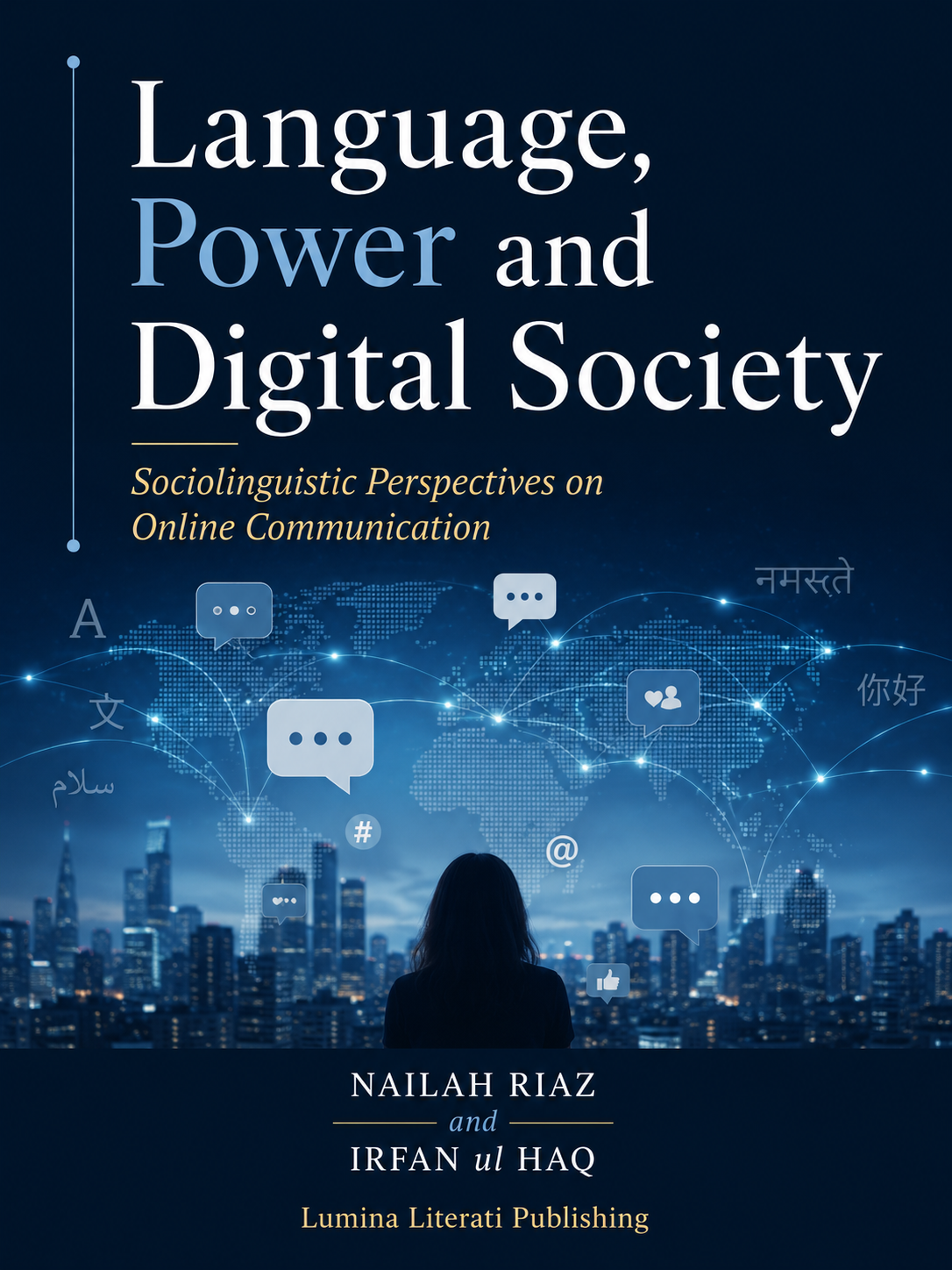
Language, Power and Digital Society: Sociolinguistic Perspectives on Online Communication book cover

Language, Power and Digital Society

Sociolinguistic Perspectives on Online Communication

By &

Published by Lumina Literati Publishing
Publication Year:
ISBN: 978-627-7813-49-9

Book Overview

Language, Power and Digital Society: Sociolinguistic Perspectives on Online Communication begins from a single, urgent conviction: the language we use online is no longer a private or trivial matter. Every post, comment, share, and silence is now embedded within sociotechnical architectures that determine whose voice carries, whose voice is muted, and whose voice is monetized. Questions that once belonged primarily to sociolinguists, critical theorists, and media scholars have become questions of everyday civic life.

Developed as a sustained dialectical inquiry, the book offers a sociolinguistically grounded account of how communicative power is generated, distributed, and contested in digitally mediated environments. Drawing on Bourdieu’s notion of the linguistic marketplace, the empirical traditions of Critical Discourse Analysis, and recent work on platform affordances and algorithmic governance, the authors trace how offline hierarchies are imported into digital spaces and then reconfigured by the architectures that host them. The argument refuses the comfort of either techno-utopia or techno-dystopia, holding the emancipatory and the extractive together.

Organized to move from theoretical foundations toward empirical and applied terrain, the volume first establishes the conceptual vocabulary — power, habitus, symbolic violence, affordance, gatekeeping — required to read digital discourse critically, before turning to polarization, networked counterpublics, the algorithmic encoding of standard language ideologies, and the asymmetric governance of speech by platform corporations. Closing chapters ask what a more equitable digital linguistic marketplace might look like, and what forms of literacy, regulation, and design would be required to build it.

Students of linguistics will find a careful engagement with variationist, interactional, and third-wave sociolinguistic traditions. Scholars of media and communication will encounter familiar debates about the public sphere recast through the lens of algorithmic governance and platform political economy. Practitioners in education, policy, and digital advocacy will find both diagnostic tools and a vocabulary for naming the new asymmetries that structure online life. The central claim is straightforward, even if its consequences are not: platforms are not neutral conduits, and language online is never just language.

About the Authors

Professor Dr. Nailah Riaz

Head, Department of English Language and Literature, The University of Faisalabad (TUF), Pakistan · ORCID: 0000-0002-2054-2232

Professor Dr. Nailah Riaz is a proficient researcher at The University of Faisalabad (TUF), Pakistan. As the Head of the Department of English Language and Literature, she brings a wealth of interdisciplinary expertise to the intersections of education, linguistics, literature, and socio-economic studies. Her prolific scholarship includes numerous research articles across diverse themes, such as teacher training programs in ELT, the role of student organizations in fostering civic engagement, and the globalization of ELT education.

Dr. Riaz is deeply committed to addressing critical issues in higher education and their socio-economic implications in Pakistan. Her research contributions are published in renowned national and international journals, often in lead-author or corresponding-author roles.

Her innovative approach blends data analysis with an eye for policy implications, enabling her to give voice to educational and economic research in the region. Her recent article, “Exploring the Relationship between Higher Education and Economic Growth in Pakistan: A Time Series Analysis,” exemplifies her dedication to generating evidence-based insights to inform policy and practice in the dynamic landscape of higher education.


Squadron Leader (Retd) Irfan-Ul-Haq

MBA, MCS — Pakistan Air Force (Retired), Faisalabad, Pakistan

Squadron Leader (Retd) Irfan-Ul-Haq brings to this volume a rare combination of military, technological, and educational leadership spanning more than four decades. A graduate of Hailey College of Commerce (B.Com, First Division, 1978), he earned an MBA from the University of the Punjab in 1982 with a perfect grade point average, and later a Master of Computer Science from Preston University in 2000.

His professional trajectory traces the arc of Pakistan’s own digital transformation. Commissioned in the Pakistan Air Force as a systems analyst and programmer, he designed and deployed operations and human-resource management systems and established a country-wide network supporting real-time information availability during Exercise High Mark in 1986, 1987, and 1989. From 1991 to 1994 he was seconded to the Ministry of Interior, Saudi Arabia, where he led the design and implementation of a national Human Resource Management System, and subsequently served as Officer Incharge for the processing and interpretation of satellite imagery at the Directorate General of Inter-Services Intelligence (1995–1999).

A founder of digital-education infrastructure in Pakistan, he established the Fizaia College of Information Technology (FCIT), Islamabad in 2000 — a project later absorbed by the Pakistan Air Force and reconstituted as Air University. As Manager Software at OGDCL (Grade 20) he authored the organization’s IT usage and security policies, designed its Human Resource Information System, and developed its first corporate website. His honours include the Chief of the Air Staff Commendation Certificate (1987) for software development and Honour Graduate at the United States Air Force’s Maintenance Data Systems Analysis Course (1990).

A life member of the Computer Society of Pakistan, he also holds memberships in the Australian Computer Society, the Project Management Institute (USA), and the Pakistan Society for GIS. His contribution to the present volume draws on this lived experience at the intersection of technology infrastructure, institutional governance, and educational reform — perspectives that complement the sociolinguistic and pedagogical orientation of his co-author.

Endorsements & Reviews

“A genuinely dialectical account of online communication. Riaz and Irfan-Ul-Haq refuse the easy consolations of techno-utopia and techno-dystopia alike, showing instead how the same architectures that amplify marginalized voices also extract, sort, and silence them. This is sociolinguistics with its critical edge restored.”

“By reading Bourdieu’s linguistic marketplace through the logic of algorithmic governance, this volume supplies the vocabulary the field has been missing. Its treatment of symbolic violence, platform affordances, and the asymmetric governance of speech will reshape how we teach digital discourse.”

“Rigorous, lucid, and politically serious. The authors move from theoretical foundations to questions of literacy, regulation, and design without ever losing analytical precision. Essential reading for linguists, media scholars, and anyone concerned with the conditions of voice in networked publics.”

Open Access Promotion – Final Design

Free & Open Access

This scholarly work is available to everyone. Click the cover to start reading our new publication without barriers.

Language, Power and Digital Society: Sociolinguistic Perspectives on Online Communication

References

Showing 10 of 301 referencesShowing all 301 references

1
Berg, S., & Hofmann, J. (2021). Digital democracy. Internet Policy Review, 10(4). https://doi.org/10.14763/2021.4.1612
2
Christensen, B., & Groshek, J. (2019). Emerging media, political protests, and government repression in autocracies and democracies from 1995 to 2012. International Communication Gazette, 82(8), 685–704. https://doi.org/10.1177/1748048518825323
3
Gerbaudo, P. (2022). Theorizing Reactive Democracy. Democratic Theory, 9(2), 120–138. https://doi.org/10.3167/dt.2022.090207
4
Hodson, J. (2019). Don?t Trust #CDNMedia: Twitter Posts From Eight Canadian Communities During #elxn42. Ieee Technology and Society Magazine, 38(1), 64–71. https://doi.org/10.1109/mts.2019.2894473
5
Jackson, S. J., & Welles, B. F. (2015). Hijacking #myNYPD: Social Media Dissent and Networked Counterpublics. Journal of Communication, 65(6), 932–952. https://doi.org/10.1111/jcom.12185
6
Johannessen, M. R., & Følstad, A. (2014). Political Social Media Sites as Public Sphere: A Case Study of the Norwegian Labour Party. Communications of the Association for Information Systems, 34. https://doi.org/10.17705/1cais.03456
7
Mathe, L., & Motsaathebe, G. (2024). Play on Twitter During Health Crisis in Non-Democratic Context: Gratification or Dissent? Social Media + Society, 10(1). https://doi.org/10.1177/20563051231224404
8
Ojala, M. (2021). The role of networked publics in immigration debates. 330–343. https://doi.org/10.4337/9781839100611.00035
9
Okten, A. (2022). On Commemorating Hrant Dink: Affective Nationalism, Hate Speech, and Digital News Media Users. Journalism & Mass Communication Quarterly, 102(2), 500–522. https://doi.org/10.1177/10776990221093920
10
Ramírez, M. G., Rojas, R. G. de T., & Martínez, A. A. (2021). Political debate on YouTube: revitalization or degradation of democratic deliberation? El Profesional De La Información. https://doi.org/10.3145/epi.2020.nov.38
11
Rasmussen, T. (2014). Internet and the Political Public Sphere. Sociology Compass, 8(12), 1315–1329. https://doi.org/10.1111/soc4.12228
12
Roberts, J. M. (2024). Outline of a critical sociology of free speech in everyday life: Beyond liberal approaches. The Sociological Review, 73(3), 697–713. https://doi.org/10.1177/00380261241232529
13
Salma, A. N. (2019). Defining Digital Literacy in the Age of Computational Propaganda and Hate Spin Politics. Kne Social Sciences. https://doi.org/10.18502/kss.v3i20.4945
14
Salter, M. (2013). Justice and revenge in online counter-publics: Emerging responses to sexual violence in the age of social media. Crime Media Culture an International Journal, 9(3), 225–242. https://doi.org/10.1177/1741659013493918
15
Sevinç, B. (2025). Activist Muslim Students’ Perspectives on Digital Public Sphere and the Power of Activism in the USA. Sociology Lens. https://doi.org/10.1111/johs.70012
16
Smith, S. P. (2021). Tourism and symbolic power: Leveraging social media with the stance of disavowal. Journal of Sociolinguistics, 25(4), 578–595. https://doi.org/10.1111/josl.12484
17
Williams, M. G., Mukherjee, I., & Utsey, C. (2019). Mobility and affect in the #deleteuber mo(ve)ment. Convergence the International Journal of Research Into New Media Technologies, 27(1), 85–102. https://doi.org/10.1177/1354856519883739
18
Akkaya, A. H. (2014). Language, Discourse, and New Media: A Linguistic Anthropological Perspective. Language and Linguistics Compass, 8(7), 285–300. https://doi.org/10.1111/lnc3.12082
19
Darvin, R., & Norton, B. (2016). Investment and Language Learning in the 21 st Century. Langage Et Société, N° 157(3), 19–38. https://doi.org/10.3917/ls.157.0019
20
Hillewaert, S. (2015). Writing with an Accent: Orthographic Practice, Emblems, and Traces on Facebook. Journal of Linguistic Anthropology, 25(2), 195–214. https://doi.org/10.1111/jola.12079
21
Leppänen, S., Møller, J. S., Nørreby, T. R., Stæhr, A. C., & Kytölä, S. (2015). Authenticity, normativity and social media. Discourse Context & Media, 8, 1–5. https://doi.org/10.1016/j.dcm.2015.05.008
22
Li, L., & Huang, J. (2024). Online discourse and chronotopic identity work: A longitudinal digital ethnography on WeChat. New Media & Society, 27(6), 3596–3617. https://doi.org/10.1177/14614448241228809
23
Mills, K. A. (2010). A Review of the “Digital Turn” in the New Literacy Studies. Review of Educational Research, 80(2), 246–271. https://doi.org/10.3102/0034654310364401
24
Mohr, S. (2022). Investigating English in Multilingual Contexts Online: Identity Construction in Geotagged Instagram Data. Frontiers in Communication, 6. https://doi.org/10.3389/fcomm.2021.778050
25
Nakassis, C. V. (2016). Linguistic Anthropology in 2015: Not the Study of Language. American Anthropologist, 118(2), 330–345. https://doi.org/10.1111/aman.12528
26
Ntouvlis, V., & Geenen, J. (2023). “Ironic memes” and digital literacies: Exploring identity through multimodal texts. New Media & Society, 27(2), 1193–1211. https://doi.org/10.1177/14614448231189801
27
Procházka, O. (2019). Making Sense of Facebook’s Content Moderation: A Posthumanist Perspective on Communicative Competence and Internet Memes. Signs and Society, 7(3), 362–397. https://doi.org/10.1086/704763
28
Tagata, W. M., & Ribas, F. C. (2021). Rethinking Digital Literacy Practices and Educational Agendas in Times of Covid-19 Uncertainty. Revista Brasileira De Linguística Aplicada, 21(2), 399–431. https://doi.org/10.1590/1984-6398202117285
29
Thorne, S. L., & Black, R. W. (2007). LANGUAGE AND LITERACY DEVELOPMENT IN COMPUTER-MEDIATED CONTEXTS AND COMMUNITIES. Annual Review of Applied Linguistics, 27, 133–160. https://doi.org/10.1017/s0267190508070074
30
Thorne, S. L., Sauro, S., & Smith, B. (2015). Technologies, Identities, and Expressive Activity. Annual Review of Applied Linguistics, 35, 215–233. https://doi.org/10.1017/s0267190514000257
31
Thurlow, C., & Dürscheid, C. (2020). Introduction: Turning to the visual in digital discourse studies. 1–18. https://doi.org/10.1515/9781501510113-001
32
Zidjaly, N. A. (2019). Society in digital contexts: New modes of identity and community construction. Multilingua, 38(4), 357–375. https://doi.org/10.1515/multi-2018-0042
33
Aguilar, J. M. G., Segado‐Boj, F., & Makhortykh, M. (2023). Populist Right Parties on TikTok: Spectacularization, Personalization, and Hate Speech. Media and Communication, 11(2). https://doi.org/10.17645/mac.v11i2.6358
34
Cabbuag, S. I., & Abidin, C. (2024). TikTok ‘dogshows’ and the amplification of online incivility among Gen Z influencers in the Philippines. International Journal of Cultural Studies, 28(5), 947–965. https://doi.org/10.1177/13678779241302826
35
Chaudhry, I., & Gruzd, A. (2019). Expressing and Challenging Racist Discourse on Facebook: How Social Media Weaken the “Spiral of Silence” Theory. Policy & Internet, 12(1), 88–108. https://doi.org/10.1002/poi3.197
36
Ekman, M. (2019). Anti-immigration and racist discourse in social media. European Journal of Communication, 34(6), 606–618. https://doi.org/10.1177/0267323119886151
37
Giraud, E. H., Poole, E., Quincey, E. de, & Richardson, J. (2025). Learning from online hate speech and digital racism: From automated to diffractive methods in social media analysis. The Sociological Review, 73(6), 1388–1407. https://doi.org/10.1177/00380261241305260
38
Jordan, L. S. (2024). Problematizing platform use in qualitative inquiry: a postdigital, anti/colonial critique. Qualitative Research. https://doi.org/10.1177/14687941241306235
39
Lim, S. S. (2020). Manufacturing Hate 4.0: Can Media Studies Rise to the Challenge? Television & New Media, 21(6), 602–607. https://doi.org/10.1177/1527476420918825
40
Matamoros-Fernández, A., & Farkas, J. (2021). Racism, Hate Speech, and Social Media: A Systematic Review and Critique. Television & New Media, 22(2), 205–224. https://doi.org/10.1177/1527476420982230
41
Matamoros-Fernández, A., & Jude, N. (2025). The importance of centering harm in data infrastructures for ‘soft moderation’: X’s Community Notes as a case study. New Media & Society, 27(4), 1986–2011. https://doi.org/10.1177/14614448251314399
42
Matamoros-Fernández, A., Bartolo, L., & Alpert, E. (2024). Acting like a bot as a defiance of platform power: Examining YouTubers’ patterns of ‘inauthentic’ behaviour on Twitter during COVID-19. New Media & Society, 26(3), 1290–1314. https://doi.org/10.1177/14614448231201648
43
McSwiney, J., & Sengul, K. (2023). Humor, Ridicule, and the Far Right: Mainstreaming Exclusion Through Online Animation. Television & New Media, 25(4), 315–333. https://doi.org/10.1177/15274764231213816
44
Munk, A. K., & Olesen, A. G. (2020). Beyond issue publics? Curating a corpus of generic Danish debate in the dying days of the Facebook API. STS Encounters, 11(1). https://doi.org/10.7146/stse.v11i1.135275
45
Nikunen, K. (2021). Ghosts of white methods? The challenges of Big Data research in exploring racism in digital context. Big Data & Society, 8(2). https://doi.org/10.1177/20539517211048964
46
Schmid, U. K., Kümpel, A. S., & Rieger, D. (2022). How social media users perceive different forms of online hate speech: A qualitative multi-method study. New Media & Society, 26(5), 2614–2632. https://doi.org/10.1177/14614448221091185
47
Aminu, P. (2023). Digital resistance: Discursive construction of polarization and otherness in Oduduwa secessionists’ social media discourse. Discourse & Society, 35(1), 27–47. https://doi.org/10.1177/09579265231194171
48
Bhatia, K. V., & Arora, P. (2022). Discursive Toolkits of Anti-Muslim Disinformation on Twitter. The International Journal of Press/Politics, 29(1), 253–272. https://doi.org/10.1177/19401612221084633
49
Chin, Y. C., Park, A., & Li, K. (2022). A comparative study on false information governance in Chinese and American social media platforms. Policy & Internet, 14(2), 263–283. https://doi.org/10.1002/poi3.301
50
Cowls, J., & Ma, C. (2023). The Internet’s Town Square? A Critical Discourse Analysis of Parler’s “Past Imaginary.” Social Media + Society, 9(2). https://doi.org/10.1177/20563051231181099
51
Harracá, M., Castelló, I., & Gawer, A. (2023). How Digital Platforms Organize Immaturity: A Sociosymbolic Framework of Platform Power. Business Ethics Quarterly, 33(3), 440–472. https://doi.org/10.1017/beq.2022.40
52
KhosraviNik, M., & Esposito, E. (2018). Online hate, digital discourse and critique: Exploring digitally-mediated discursive practices of gender-based hostility. Lodz Papers in Pragmatics, 14(1), 45–68. https://doi.org/10.1515/lpp-2018-0003
53
Li, Y. (2024). Resistant discourse strategies in social media in China’s epidemic prevention context. Discourse & Society, 36(2), 226–247. https://doi.org/10.1177/09579265241257950
54
Mitchell, S. S., & Lim, M. (2018). Too Crowded for Crowdsourced Journalism: Reddit, Portability, and Citizen Participation in the Syrian Crisis. Canadian Journal of Communication, 43(3). https://doi.org/10.22230/cjc.2019v44n3a3377
55
Morrison, R. (2023). Making the invisible visible: Critical discourse analysis as a tool for search engine research. Journal of the Association for Information Science and Technology, 75(5), 600–612. https://doi.org/10.1002/asi.24859
56
Onoja, I. B., Bebenimibo, P., & Onoja, N. M. (2022). Critical Discourse Analysis of Online Audiences’ Comments: Insights From The Channels TV’s Facebook Audiences’ Comments On Farmers-Herders Conflicts News Stories in Nigeria. Sage Open, 12(3). https://doi.org/10.1177/21582440221119470
57
Rathnayake, C., Smith, A., & Higgins, M. (2023). Emergent Twitter publics through political scandal. Journal of Language and Politics, 22(4), 458–484. https://doi.org/10.1075/jlp.22028.rat
58
Sarkhoh, N., & KhosraviNik, M. (2020). Social media discourses of Arabism and the negotiation of Self in the Middle East. World Englishes, 39(4), 609–622. https://doi.org/10.1111/weng.12502
59
Smith, G. (2018). Data doxa: The affective consequences of data practices. Big Data & Society, 5(1). https://doi.org/10.1177/2053951717751551
60
Uzunoğlu, S. (2025). Digital Voices, Discursive Power: The Siege of Turkey’s Digital News Media by Interpretive Journalism. Electronic News, 19(4), 233–259. https://doi.org/10.1177/19312431251342809
61
Beneito-Montagut, R. (2020). Qualitative Analysis of Social Media Data. https://doi.org/10.4135/9781526421036840280
62
Brock, A. (2016). Critical technocultural discourse analysis. New Media & Society, 20(3), 1012–1030. https://doi.org/10.1177/1461444816677532
63
Constantinou, O. (2005). Multimodal Discourse Analysis: Media, modes and technologies. Journal of Sociolinguistics, 9(4), 602–618. https://doi.org/10.1111/j.1360-6441.2005.00310.x
64
Feng, H. (2024). Exploring the Identity of Chinese Cultural Relics on British Museum Websites Through Multimodal Discourse Analysis: A Case Study of the Official Website. Communications in Humanities Research, 40(1), 50–60. https://doi.org/10.54254/2753-7064/40/20242219
65
Liu, H., Liu, L., & Li, H. (2024). Multimodal Discourse Studies in the International Academic Community (1997–2023): A Bibliometric Analysis. Sage Open, 14(4). https://doi.org/10.1177/21582440241305454
66
Mu, J., & Ma, R. (2022). A CiteSpace-based analysis of the application of Critical Discourse Analysis in news discourse. Discourse & Communication, 16(4), 403–425. https://doi.org/10.1177/17504813211070670
67
O’Halloran, K. L., Tan, S., Pham, D.-S., Bateman, J., & Moere, A. V. (2016). A Digital Mixed Methods Research Design: Integrating Multimodal Analysis With Data Mining and Information Visualization for Big Data Analytics. Journal of Mixed Methods Research, 12(1), 11–30. https://doi.org/10.1177/1558689816651015
68
Riyanti, E. D. (2023). THE PHILOSOPHICAL BASIS OF CRITICAL DISCOURSE ANALYSIS. Kanz Philosophia a Journal for Islamic Philosophy and Mysticism, 9(2). https://doi.org/10.20871/kpjipm.v9i2.293
69
Sun, Y., Wang, G., & Feng, H. (2021). Linguistic Studies on Social Media: A Bibliometric Analysis. Sage Open, 11(3). https://doi.org/10.1177/21582440211047572
70
Tamássy, R., & Géring, Z. (2021). Rich variety of DA approaches applied in social media research: A systematic scoping review. Discourse & Communication, 16(1), 93–109. https://doi.org/10.1177/17504813211043722
71
Tan, B. U. (2023). Through the looking glass: Making sense of a disrupted world. European Journal of Communication, 38(6), 625–632. https://doi.org/10.1177/02673231231211656
72
Wang, G., Wu, X., & Li, Q. (2021). A bibliometric study of news discourse analysis (1988‒2020). Discourse & Communication, 16(1), 110–128. https://doi.org/10.1177/17504813211043725
73
Wilson, A., Wilkes, S., Teramoto, Y., & Hale, S. A. (2023). Multimodal analysis of disinformation and misinformation. Royal Society Open Science, 10(12). https://doi.org/10.1098/rsos.230964
74
Winahyu, S. K. (2021). GOFOOD AND GOJEK APP: FORM OF TRAVERSAL WORLD DOMINATION. Ijlecr – International Journal of Language Education and Culture Review, 7(1), 90–101. https://doi.org/10.21009/ijlecr.071.09
75
Abidin, C., & Seta, G. de. (2020). Private messages from the field: Confessions on digital ethnography and its discomforts. Journal of Digital Social Research, 2(1), 1–19. https://doi.org/10.33621/jdsr.v2i1.35
76
Bolander, B., & Locher, M. A. (2014). Doing sociolinguistic research on computer-mediated data: A review of four methodological issues. Discourse Context & Media, 3, 14–26. https://doi.org/10.1016/j.dcm.2013.10.004
77
Cleland, J., & MacLeod, A. (2022). Disruption in the space–time continuum: why digital ethnography matters. Advances in Health Sciences Education, 27(3), 877–892. https://doi.org/10.1007/s10459-022-10101-1
78
Coombes, P., & Jones, S. C. (2020). Toward auto-netnography in consumer studies. International Journal of Market Research, 62(6), 658–665. https://doi.org/10.1177/1470785320923502
79
Costello, L., McDermott, M., & Wallace, R. (2017). Netnography. International Journal of Qualitative Methods, 16(1). https://doi.org/10.1177/1609406917700647
80
Discetti, R., & Anderson, V. (2022). The Value of Netnography for Research in HRD. Human Resource Development Review, 22(1), 59–83. https://doi.org/10.1177/15344843221137506
81
Heinonen, K., & Medberg, G. (2018). Netnography as a tool for understanding customers: implications for service research and practice. Journal of Services Marketing, 32(6), 657–679. https://doi.org/10.1108/jsm-08-2017-0294
82
Hetland, P., & Mørch, A. I. (2016). ETHNOGRAPHY FOR INVESTIGATING THE INTERNET. Seminar Net, 12(1). https://doi.org/10.7577/seminar.2335
83
Kessler, M., Costa, P. I. D., Isbell, D. R., & Gajasinghe, K. (2021). Conducting a Netnography in Second Language Acquisition Research. Language Learning, 71(4), 1122–1148. https://doi.org/10.1111/lang.12456
84
Kozinets, R. V. (2022). Immersive netnography: a novel method for service experience research in virtual reality, augmented reality and metaverse contexts. Journal of Service Management, 34(1), 100–125. https://doi.org/10.1108/josm-12-2021-0481
85
Leppänen, S., Møller, J. S., Nørreby, T. R., Stæhr, A. C., & Kytölä, S. (2015). Authenticity, normativity and social media. Discourse Context & Media, 8, 1–5. https://doi.org/10.1016/j.dcm.2015.05.008
86
Lester, J. N. (2020). Going Digital in Ethnography: Navigating the Ethical Tensions and Productive Possibilities. Culture Studies ↔ Critical Methodologies, 20(5), 414–424. https://doi.org/10.1177/1532708620936995
87
Mohamad, N. H. S., Rosly, N., Johari, N. L., Jaafar, N. S., & Soopar, A. A. (2022). Moving Ethnography Online: Analysing the Social Meaning of Manglish in Youth WhatsApp Chats. International Journal of Academic Research in Business and Social Sciences, 12(8). https://doi.org/10.6007/ijarbss/v12-i8/14410
88
Pahlevansharif, S., Mura, P., & Wijesinghe, S. N. R. (2019). Qualitative online research in tourism – a systematic review of the literature. Tourism Review, 75(2), 448–465. https://doi.org/10.1108/tr-02-2019-0072
89
Paoli, A. D., & D’Auria, V. (2025). The Digitalization of Ethnography: A Scoping Review of Methods in Netnography. Journal of Contemporary Ethnography, 54(4), 559–587. https://doi.org/10.1177/08912416251342795
90
Rynarzewska, A. I., & Giunipero, L. C. (2024). Netnography: a research method to study supply chain members’ interactions in online communities. International Journal of Physical Distribution & Logistics Management, 54(7/8), 705–729. https://doi.org/10.1108/ijpdlm-05-2023-0193
91
Sadat, A. (2025). Utilization of Netnography as a Health Care Research Methodology: Scoping Review. Journal of Medical Internet Research, 27, e78025. https://doi.org/10.2196/78025
92
Whalen, E. (2018). Understanding a shifting methodology. International Journal of Contemporary Hospitality Management, 30(11), 3423–3441. https://doi.org/10.1108/ijchm-08-2017-0536
93
Zhao, Y. (2024). TikTok and Researcher Positionality: Considering the Methodological and Ethical Implications of an Experimental Digital Ethnography. International Journal of Qualitative Methods, 23. https://doi.org/10.1177/16094069231221374
94
Ziglioli, G., & Alhassan, A. Y. (2021). Nethnography and Social Network Analysis for Studying Online Social Space. 227–247. https://doi.org/10.4018/978-1-7998-8473-6.ch015
95
Bae, C. L., Hankour, K., Williamson, K., & DeBusk‐Lane, M. (2025). Middle School Science Talk: Coupling Natural Language Processing With Classroom Video Analyses to Explore Discursive Resources in Hybrid Spaces. Aera Open, 11. https://doi.org/10.1177/23328584251371049
96
Borenstein, N., Stańczak, K., Rolskov, T., Käfer, N. K., Perez, N. da S., & Augenstein, I. (2023). Measuring Intersectional Biases in Historical Documents. 2711–2730. https://doi.org/10.18653/v1/2023.findings-acl.170
97
Cui, X. (2025). Bias in, Bias out: Annotation Bias in Multilingual Large Language Models. https://doi.org/10.48550/arxiv.2511.14662
98
Dayanık, E., Vu, N. T., & Padó, S. (2022). Analysis of Bias in NLP Models With Regression and Effect Sizes. Northern European Journal of Language Technology, 8(1). https://doi.org/10.3384/nejlt.2000-1533.2022.3505
99
Ferrer, X., Nuenen, T. van, Such, J. M., & Criado, N. (2021). Discovering and Categorising Language Biases in Reddit. Proceedings of the International Aaai Conference on Web and Social Media, 15, 140–151. https://doi.org/10.1609/icwsm.v15i1.18048
100
Field, A., Blodgett, S. L., Waseem, Z., & Tsvetkov, Y. (2021). A Survey of Race, Racism, and Anti-Racism in NLP. https://doi.org/10.48550/arxiv.2106.11410
101
Ghafouri, V., Such, J. M., & Suárez‐Tangil, G. (2024). A Holistic Indicator of Polarization to Measure Online Sexism. https://doi.org/10.22541/au.171611754.40474969/v1
102
Giraud, E. H., Poole, E., Quincey, E. de, & Richardson, J. (2025). Learning from online hate speech and digital racism: From automated to diffractive methods in social media analysis. The Sociological Review, 73(6), 1388–1407. https://doi.org/10.1177/00380261241305260
103
Goldfarb-Tarrant, S., Marchant, R., Sanchez, R. M., Pandya, M., & Lopez, A. (2020). Intrinsic Bias Metrics Do Not Correlate with Application Bias. https://doi.org/10.48550/arxiv.2012.15859
104
Jin, X., Barbieri, F., Kennedy, B., Davani, A. M., Neves, L., & Ren, X. (2021). On Transferability of Bias Mitigation Effects in Language Model Fine-Tuning. 3770–3783. https://doi.org/10.18653/v1/2021.naacl-main.296
105
Laaksonen, S.-M., Haapoja, J., Kinnunen, T., Nelimarkka, M., & Pöyhtäri, R. (2020). The Datafication of Hate: Expectations and Challenges in Automated Hate Speech Monitoring. Frontiers in Big Data, 3. https://doi.org/10.3389/fdata.2020.00003
106
Lewis, M. C. (2018). A critique of the principle of error correction as a theory of social change. Language in Society, 47(3), 325–346. https://doi.org/10.1017/s0047404518000258
107
Maronikolakis, A., Baader, P., Schütze, H., Mitchell, M., Wu, S., Zaldivar, A., Li, J., Zhu, S., Liu, Y., Liu, P., & Eckert, P. (2022). Proceedings of the 4th Workshop on Gender Bias in Natural Language Processing (GeBNLP). https://doi.org/10.18653/v1/2022.gebnlp-1
108
May, C., Wang, A., Bordia, S., Bowman, S. R., & Rudinger, R. (2019). On Measuring Social Biases in Sentence Encoders. 622–628. https://doi.org/10.18653/v1/n19-1063
109
Mayfield, E., Madaio, M., Prabhumoye, S., Gerritsen, D., McLaughlin, B., Dixon‐Román, E., & Black, A. W. (2019). Equity Beyond Bias in Language Technologies for Education. 444–460. https://doi.org/10.18653/v1/w19-4446
110
Montiel, C. J., & Uyheng, J. (2021). Foundations for a decolonial big data psychology. Journal of Social Issues, 78(2), 278–297. https://doi.org/10.1111/josi.12439
111
Mourad, A., Salem, F. K. A., & Elbassuoni, S. (2025). Detecting gender bias in Arabic text through word embeddings. Plos One, 20(3), e0319301. https://doi.org/10.1371/journal.pone.0319301
112
Roock, R. S. de. (2024). To Become an Object Among Objects: Generative Artificial “Intelligence,” Writing, and Linguistic White Supremacy. Reading Research Quarterly, 59(4), 590–608. https://doi.org/10.1002/rrq.569
113
Silva, A., Tambwekar, P., & Gombolay, M. (2021). Towards a Comprehensive Understanding and Accurate Evaluation of Societal Biases in Pre-Trained Transformers. https://doi.org/10.18653/v1/2021.naacl-main.189
114
Song, H., & Song, Y. (2021). Knowledge Mapping of Text Linguistics: Discourse Analysis, Text Analysis and Social Media. Scientific and Social Research, 3(6), 50–64. https://doi.org/10.36922/ssr.v3i6.1278
115
Chu, R.-X., & Huang, C.-T. (2019). Indigenous peoples in public media: A critical discourse analysis of the human zoo case. Discourse & Society, 30(4), 395–411. https://doi.org/10.1177/0957926519837392
116
Akinade, I., Alabi, J. O., Adelani, D. I., Odoje, C., Klakow, D., Fan, A., Kreutzer, J., Shen, X., Reid, M., Ruiter, D., Nabende, P., Chang, E., Gwadabe, T.-D., Sackey, F., Dossou, B. F. P., Emezue, C. C., Leong, C., Man, M. B.-, Muhammad, S. H., … Patti, V. (2023). Proceedings of the First Workshop on Cross-Cultural Considerations in NLP (C3NLP). https://doi.org/10.18653/v1/2023.c3nlp-1
117
Andrade, G., Nery, L. F., Benevenuto, F., Figueiredo, F., & Zannettou, S. (2024). Comprehensive View of the Biases of Toxicity and Sentiment Analysis Methods Towards Utterances with African American English Expressions. 1–10. https://doi.org/10.5753/webmedia.2024.243106
118
Dacon, J. (2022). Towards a Deep Multi-layered Dialectal Language Analysis: A Case Study of African-American English. 55–63. https://doi.org/10.18653/v1/2022.hcinlp-1.8
119
Dorn, R. (2025). Reinforcing Stereotypes of Anger: Emotion AI on African American Vernacular English. https://doi.org/10.48550/arxiv.2511.10846
120
Field, A., Blodgett, S. L., Waseem, Z., & Tsvetkov, Y. (2021). A Survey of Race, Racism, and Anti-Racism in NLP. https://doi.org/10.48550/arxiv.2106.11410
121
Ilbury, C. (2019). “Sassy Queens”: Stylistic orthographic variation in Twitter and the enregisterment ofAAVE. Journal of Sociolinguistics, 24(2), 245–264. https://doi.org/10.1111/josl.12366
122
Kiritchenko, S., Nejadgholi, I., & Fraser, K. (2021). Confronting Abusive Language Online: A Survey from the Ethical and Human Rights Perspective. Journal of Artificial Intelligence Research, 71, 431–478. https://doi.org/10.1613/jair.1.12590
123
Klassen, S., Kingsley, S., McCall, K., Weinberg, J., & Fiesler, C. (2021). More than a Modern Day Green Book: Exploring the Online Community of Black Twitter. Proceedings of the Acm on Human-Computer Interaction, 5(CSCW2), 1–29. https://doi.org/10.1145/3479602
124
Nee, J., Smith, G., Sheares, A., & Rustagi, I. (2022). Linguistic justice as a framework for designing, developing, and managing natural language processing tools. Big Data & Society, 9(1). https://doi.org/10.1177/20539517221090930
125
Proceedings of the 2nd International Workshop on Fairness, Accountability, Transparency and Ethics in Multimedia. (2020). https://doi.org/10.1145/3422841
126
Proceedings of the Sixth Workshop on Online Abuse and Harms (WOAH). (2022). https://doi.org/10.18653/v1/2022.woah-1
127
Udupa, S., Maronikolakis, A., & Wisiorek, A. (2023). Ethical scaling for content moderation: Extreme speech and the (in)significance of artificial intelligence. Big Data & Society, 10(1). https://doi.org/10.1177/20539517231172424
128
Webster, J.-L., Lakamana, S., Ge, Y., & Sarker, A. (2024). “I Been Taking Adderall Mixing it With Lean, Hope I Don’t Wake Up Out My Sleep”: Harnessing Twitter to Understand Nonmedical Prescription Stimulant Use among Black Women and Men Subscribers. https://doi.org/10.1101/2024.12.03.24318408
129
Ahmad, M. S., Nawaz, S., Khan, S., & Bukhari, Z. (2023). Digital Pakistan in COVID-19: rethinking language use at social media platforms. Frontiers in Education, 8. https://doi.org/10.3389/feduc.2023.967148
130
Fu, X., & Zhang, L. J. (2025). Translanguaging Space Construction in Five Chinese EFL Learners’ Collaborative English-Language Culture-Introduction Videos: Patterns and Influential Factors. Written Communication, 42(2), 333–370. https://doi.org/10.1177/07410883241303921
131
Jaworska, S. (2014). Playful language alternation in an online discussion forum: The example of digital code plays. Journal of Pragmatics, 71, 56–68. https://doi.org/10.1016/j.pragma.2014.07.009
132
Kim, S., & Song, K. (2019). Designing a Community Translanguaging Space Within a Family Literacy Project. The Reading Teacher, 73(3), 267–279. https://doi.org/10.1002/trtr.1820
133
Mendoza, A., Hamman‐Ortiz, L., Tian, Z., Rajendram, S., Tai, K. W. H., Ho, W. Y. J., & Sah, P. K. (2023). Sustaining Critical Approaches to Translanguaging in Education: A Contextual Framework. Tesol Quarterly, 58(2), 664–692. https://doi.org/10.1002/tesq.3240
134
Pedagogical Translanguaging. (2021). https://doi.org/10.21832/9781788927383
135
Pennington, V., Howell, E., Kaminski, R., Ferguson‐Sams, N., Gazioglu, M., Mittapalli, K., & Banerjee, A. (2024). Translanguaging with Digital, Collaborative Writing: Early Multilingual Composers. The Reading Teacher, 78(1), 27–36. https://doi.org/10.1002/trtr.2344
136
Rajendram, S., Burton, J., & Wong, W. (2022). Online translanguaging and multiliteracies strategies to support K‐12 multilingual learners: Identity texts, linguistic landscapes, and photovoice. Tesol Journal, 13(4). https://doi.org/10.1002/tesj.685
137
Rowe, L. W. (2024). Interactions with new-to-teacher language resources: Supporting translingual composing in a multilingual elementary classroom. Journal of Early Childhood Literacy, 24(3), 692–711. https://doi.org/10.1177/14687984241276315
138
Rowe, L. W. (2025). Language Histories, Community Translanguaging, and Collective Repertoires: Multilingual Language Learning Interactions in a Second‐Grade Writing Workshop. Reading Research Quarterly, 60(4). https://doi.org/10.1002/rrq.70050
139
Tang, X., Rousse-Malpat, A., & Duarte, J. (2024). Implementing translanguaging strategies in the English writing classroom in higher education. Aila Review. https://doi.org/10.1075/aila.23018.tan
140
Waluyo, B. (2025). Beyond Teacher-Led Approaches: Student-Initiated Translanguaging With Artificial Intelligence Tools in Foreign Language Acquisition. Sage Open, 15(3). https://doi.org/10.1177/21582440251362998
141
Wang, D. (2024). Digital multimodal composing as a translanguaging space. Chinese Language and Discourse an International and Interdisciplinary Journal, 15(2), 164–187. https://doi.org/10.1075/cld.24016.wan
142
Yoon, Y., & Dong, P. I. (2024). Cultivating translanguaging spaces: Young emergent bilingual children’s toy unboxing play. Journal of Early Childhood Literacy, 24(3), 551–577. https://doi.org/10.1177/14687984241276316
143
Zhang, Q. (2024). Introduction. Chinese Language and Discourse an International and Interdisciplinary Journal, 15(2), 155–163. https://doi.org/10.1075/cld.24020.zha
144
Askanius, T., Brock, M., Kaun, A., & Larsson, A. O. (2024). “Time to Abandon Swedish Women”: Discursive Connections Between Misogyny and White Supremacy in Sweden. https://doi.org/10.31219/osf.io/ty5m7
145
Bogetić, K. (2022). Race and the language of incels. English Today, 39(2), 89–99. https://doi.org/10.1017/s0266078422000153
146
Bogetić, K., Heritage, F., Koller, V., & McGlashan, M. (2023). Landwhales, femoids and sub-humans. Metaphor and the Social World, 13(2), 178–196. https://doi.org/10.1075/msw.23005.bog
147
Demir, Y., & Tiryaki, S. (2024). “We Are Enemies of Law and Women”: The Manosphere and Victimized Masculinity on Twitter (Now X). The Journal of Men S Studies, 33(2), 231–251. https://doi.org/10.1177/10608265241279841
148
Frey, T., Fernández, M., Novotný, J., & Alani, H. (2019). Exploring Misogyny across the Manosphere in Reddit. 87–96. https://doi.org/10.1145/3292522.3326045
149
Gerrand, V., Ging, D., Roose, J. M., & Flood, M. (2025). Mapping the Neo-Manosphere(s): New Directions for Research. Men and Masculinities, 28(5), 443–464. https://doi.org/10.1177/1097184×251350277
150
Kelly, C. R., & Aunspach, C. (2020). Incels, Compulsory Sexuality, and Fascist Masculinity. Feminist Formations, 32(3), 145–172. https://doi.org/10.1353/ff.2020.0044
151
Leger, E. C. (n.d.). “Misogyny is Self Defense”: A Critical Analysis of Incel Discourse and Belief on Incels.is. https://doi.org/10.22215/etd/2023-15491
152
Lindsay, A. (2022). Swallowing the Black Pill: Involuntary Celibates’ (Incels) Anti Feminism within Digital Society. International Journal for Crime Justice and Social Democracy, 11(1), 210–224. https://doi.org/10.5204/ijcjsd.2138
153
Lindsay, A. (n.d.). Swallowing the Black Pill: A Qualitative Exploration of Incel Antifeminism within Digital Society. https://doi.org/10.26686/wgtn.17145704
154
Pettersson, K., Marveggio, M. D., Callaghan, P., & Augoustinos, M. (2025). Fatalism, Evolution, and Interpersonal Attractiveness: Psychological Theories and Emotions in Incels’ Constructions of Ingroup Identity and Outgroup Hate. European Journal of Social Psychology, 55(2), 342–356. https://doi.org/10.1002/ejsp.3145
155
Sugiura, L. (2021a). Legitimising Misogyny. 97–115. https://doi.org/10.1108/978-1-83982-254-420211008
156
Sugiura, L. (2021b). The Emergence and Development of the Manosphere. 15–36. https://doi.org/10.1108/978-1-83982-254-420211004
157
Sunderland, J. (2022). Fighting for Masculine Hegemony: Contestation between Alt-Right and White Nationalist Masculinities on Stormfront. Men and Masculinities, 26(1), 3–23. https://doi.org/10.1177/1097184×221120664
158
Yoder, M. M., Perry, C., Brown, D. W., Carley, K. M., & Pruden, M. L. (2023). Identity Construction in a Misogynist Incels Forum. 1–13. https://doi.org/10.18653/v1/2023.woah-1.1
159
Ahmad, R., & Hillman, S. (2020). Laboring to communicate: Use of migrant languages in COVID-19 awareness campaign in Qatar. Multilingua, 40(3), 303–337. https://doi.org/10.1515/multi-2020-0119
160
Altohami, W. M. A., & Omar, A. (2025). Class Identity Signaling through the Strategic Rebranding of Traditional Egyptian Food-Related Terms on Digital Platforms. International Journal of Arabic-English Studies, 25(1), 125–152. https://doi.org/10.33806/ijaes.v25i1.597
161
Androutsopoulos, J., & Lexander, K. V. (2021). Digital polycentricity and diasporic connectivity: A Norwegian‐Senegalese case study. Journal of Sociolinguistics, 25(5), 720–736. https://doi.org/10.1111/josl.12518
162
Blommaert, J. (2021). Sociolinguistic Restratification in the Online-Offline Nexus: Trump’s Viral Errors. 7–24. https://doi.org/10.1007/978-3-030-88723-0_2
163
Bridges, J. (2021). Explaining “-splain” in digital discourse. Language Under Discussion, 6(1). https://doi.org/10.31885/lud.6.1.253
164
Canagarajah, S. (2020). Transnational work, translingual practices, and interactional sociolinguistics. Journal of Sociolinguistics, 24(5), 555–573. https://doi.org/10.1111/josl.12440
165
Curran, N. M., & Jenks, C. J. (2022). Gig Economy Teaching: On the Importance and Dangers of Self-branding in Online Markets. Applied Linguistics, 44(3), 442–461. https://doi.org/10.1093/applin/amac019
166
Inoue, M. (2018). Word for Word: Verbatim as Political Technologies. Annual Review of Anthropology, 47(1), 217–232. https://doi.org/10.1146/annurev-anthro-102116-041654
167
Nakassis, C. V. (2016). Linguistic Anthropology in 2015: Not the Study of Language. American Anthropologist, 118(2), 330–345. https://doi.org/10.1111/aman.12528
168
Percio, A. D. (2025). Technofuturist Registers for AI and the Future of Work. Journal of Sociolinguistics, 29(5), 319–331. https://doi.org/10.1111/josl.12714
169
Sugandi, Y. S., Luckyardi, S., Kurnia, D., & Khairusy, M. A. (2024). Linguistic Technopreneurship in Business Success Digitalization for Small Medium Enterprises in West Java: Implication for Language Education. International Journal of Language Education, 8(2). https://doi.org/10.26858/ijole.v8i2.64117
170
Várnai, Z., & Hámori, Á. (2021). “Сувениры Севера” Minority identity and discourse. 54, 201–227. https://doi.org/10.14232/sua.2021.54.201-227
171
Weninger, C., & Li, D. (2022). Performing microcelebrity: Analyzing Papi Jiang’s online persona through stance and style. Language in Society, 52(2), 263–294. https://doi.org/10.1017/s0047404521001020
172
Yin, Y., & Xie, Z. (2021). Playing platformized language games: Social media logic and the mutation of participatory cultures in Chinese online fandom. New Media & Society, 26(2), 619–641. https://doi.org/10.1177/14614448211059489
173
Couldry, N., Rodríguez, C., Bolin, G., Cohen, J. E., Goggin, G., Kraidy, M. M., Iwabuchi, K., Lee, K.-S., Qiu, J. L., Volkmer, I., Wasserman, H., Zhao, Y., Koltsova, O., Rakhmani, I., Rincón, Ó., Blanco, C. M., & Thomas, P. N. (n.d.). Media and Communications*. 523–562. https://doi.org/10.1017/9781108399647.006
174
Couldry, N., Rodríguez, C., Bolin, G., Cohen, J. E., Volkmer, I., Goggin, G., Kraidy, M. M., Iwabuchi, K., Qiu, J. L., Wasserman, H., Zhao, Y., Rincón, Ó., Blanco, C. M., Thomas, P. N., Koltsova, O., Rakhmani, I., & Lee, K.-S. (2018). Media, communication and the struggle for social progress. Global Media and Communication, 14(2), 173–191. https://doi.org/10.1177/1742766518776679
175
DeCook, J. R., Cotter, K., Kanthawala, S., & Foyle, K. (2022). Safe from “harm”: The governance of violence by platforms. Policy & Internet, 14(1), 63–78. https://doi.org/10.1002/poi3.290
176
Fasel, M., & Weerts, S. (2024). Can Facebook’s community standards keep up with legal certainty? Content moderation governance under the pressure of the Digital Services Act. Policy & Internet, 16(3), 588–606. https://doi.org/10.1002/poi3.391
177
Gregorio, G. D., & Stremlau, N. (2023). Inequalities and content moderation. Global Policy, 14(5), 870–879. https://doi.org/10.1111/1758-5899.13243
178
Haskell, C., & Clark, S. L. (2025). Leadership in AI Terminology Governance: From Anomia to Agency. Journal of Leadership Studies, 18(4), 55–66. https://doi.org/10.1002/jls.70002
179
Hosny, R., & Nasef, M. A. (2025). Lexical algorithmic resistance: Tactics of deceiving Arabic content moderation algorithms on Facebook. Big Data & Society, 12(2). https://doi.org/10.1177/20539517251318277
180
Jereza, R. (2022). “I’m not this Person”: Racism, content moderators, and protecting and denying voice online. New Media & Society, 26(8), 4454–4470. https://doi.org/10.1177/14614448221122224
181
Mahl, D., Zeng, J., & Schäfer, M. S. (2023). Conceptualizing platformed conspiracism: Analytical framework and empirical case study of BitChute and Gab. New Media & Society, 26(12), 6938–6957. https://doi.org/10.1177/14614448231160457
182
Martín, P. S. (2023). Meta’s Oversight Board. Erasmus Law Review, 16(2), 124–139. https://doi.org/10.5553/elr.000253
183
Peterson‐Salahuddin, C. (2024). Repairing the harm: Toward an algorithmic reparations approach to hate speech content moderation. Big Data & Society, 11(2). https://doi.org/10.1177/20539517241245333
184
Pierson, J., Kerr, A., Robinson, S. C., Fanni, R., Steinkogler, V. E., Milan, S., & Zampedri, G. (2023). Governing artificial intelligence in the media and communications sector. Internet Policy Review, 12(1). https://doi.org/10.14763/2023.1.1683
185
Huang, H. V. (2025). Chinese Digital Feminism Growing in a New Digital Soil: A Mixed-Method Study of the Transnational Construction of Gendered Collective Memory of Chinese Women on Instagram. Social Media + Society, 11(2). https://doi.org/10.1177/20563051251339487
186
Jones, R. H., & Chau, D. (2021). Metalinguistic tactics in the Hong Kong protest movement. Journal of Language and Politics, 21(1), 143–172. https://doi.org/10.1075/jlp.21017.jon
187
Morris, C. (2022). Digital displacement: The spatialities of contentious politics in China’s digital territory. Transactions of the Institute of British Geographers, 47(4), 1075–1089. https://doi.org/10.1111/tran.12559
188
Ng, K. Y., Feldman, A., & Peng, J. (2020). Linguistic Fingerprints of Internet Censorship: The Case of Sina Weibo. Proceedings of the Aaai Conference on Artificial Intelligence, 34(01), 446–453. https://doi.org/10.1609/aaai.v34i01.5381
189
Peng, A. Y., Sun, Y., & Wu, C. (2025). Countering Nationalist Politics Through Distant Witnessing: An Affective-Discursive Approach. Social Media + Society, 11(2). https://doi.org/10.1177/20563051251337221
190
Wang, X., Juffermans, K., & Du, C. (2015). Harmony as language policy in China: an Internet perspective. Language Policy, 15(3), 299–321. https://doi.org/10.1007/s10993-015-9374-y
191
Wu, X. (2024). Passing on the “whistle”: Users’ creative engagement with platform censorship in an online relay campaign in China. Media Culture & Society, 46(5), 905–924. https://doi.org/10.1177/01634437231219132
192
Wu, X., & Fitzgerald, R. (2020). ‘Hidden in plain sight’: Expressing political criticism on Chinese social media. Discourse Studies, 23(3), 365–385. https://doi.org/10.1177/1461445620916365
193
Yang, F. (2014). Rethinking China’s Internet censorship: The practice of recoding and the politics of visibility. New Media & Society, 18(7), 1364–1381. https://doi.org/10.1177/1461444814555951
194
Zhang, X. (2013). Censorship and Digital Games Localisation in China. Meta Journal Des Traducteurs, 57(2), 338–350. https://doi.org/10.7202/1013949ar
195
Zhao, Y., & Lin, Z. (2020). Political irony as self-censorship practice? Examining dissidents’ use of Weibo in the 2017 Hong Kong Chief Executive Election. Discourse & Communication, 14(5), 512–532. https://doi.org/10.1177/1750481320917578
196
Blomberg, H., & Stier, J. (2019). Flashback as a Rhetorical Online Battleground: Debating the (Dis)guise of the Nordic Resistance Movement. Social Media + Society, 5(1). https://doi.org/10.1177/2056305118823336
197
Domínguez-García, R., Molpeceres, A. M. V., & Curiel, C. P. (2024). Disinformation in the Spanish public debate: an analysis of political speeches in the Congress of Deputies. Frontiers in Communication, 9. https://doi.org/10.3389/fcomm.2024.1363941
198
Hameleers, M. (2020). Populist Disinformation: Exploring Intersections between Online Populism and Disinformation in the US and the Netherlands. Politics and Governance, 8(1), 146–157. https://doi.org/10.17645/pag.v8i1.2478
199
Hayden, C., Waisanen, D., & Osipova, Y. (2013). Facilitating the Conversation. American Behavioral Scientist, 57(11), 1623–1642. https://doi.org/10.1177/0002764213505365
200
Luengo, M., & García-Marín, D. (2020). The performance of truth: politicians, fact-checking journalism, and the struggle to tackle COVID-19 misinformation. American Journal of Cultural Sociology, 8(3), 405–427. https://doi.org/10.1057/s41290-020-00115-w
201
Musi, E., & Reed, C. (2022). From fallacies to semi-fake news: Improving the identification of misinformation triggers across digital media. Discourse & Society, 33(3), 349–370. https://doi.org/10.1177/09579265221076609
202
Oliveira, A., Alexandre, G. G., Komesu, F., Assis, J. A., & Fluckiger, C. (2024). Discursive authority in COVID-19 vaccination fact-checking: the case of @butantanoficial on Instagram. Revista Do Gel, 20(3), 213–236. https://doi.org/10.21165/gel.v20i3.3584
203
Pérez, C. R., Rojano, F. J. P., & Rosa, R. M. (2021). Debunking Political Disinformation through Journalists’ Perceptions: An Analysis of Colombia’s Fact-Checking News Practices. Media and Communication, 9(1), 264–275. https://doi.org/10.17645/mac.v9i1.3374
204
Rivas-de-Roca, R., & Curiel, C. P. (2023). Global political leaders during the COVID-19 vaccination: Between propaganda and fact-checking. Politics and the Life Sciences, 42(1), 104–119. https://doi.org/10.1017/pls.2023.4
205
Sousa‐Silva, R. (2022). Fighting the Fake: A Forensic Linguistic Analysis to Fake News Detection. International Journal for the Semiotics of Law – Revue Internationale De Sémiotique Juridique, 35(6), 2409–2433. https://doi.org/10.1007/s11196-022-09901-w
206
Tsang, N. L. T., Feng, M., & Lee, F. (2022). How fact-checkers delimit their scope of practices and use sources: Comparing professional and partisan practitioners. Journalism, 24(10), 2232–2251. https://doi.org/10.1177/14648849221100862
207
Vu, H. T., & Saldaña, M. (2021). Chillin’ Effects of Fake News: Changes in Practices Related to Accountability and Transparency in American Newsrooms Under the Influence of Misinformation and Accusations Against the News Media. Journalism & Mass Communication Quarterly, 98(3), 769–789. https://doi.org/10.1177/1077699020984781
208
Ampuja, M., Koivisto, J., & Väliverronen, E. (2014). Strong and Weak Forms of Mediatization Theory: A Critical Review. Nordicom Review, 35(s1), 111–124. https://doi.org/10.2478/nor-2014-0107
209
Andersen, J. (2018). Archiving, ordering, and searching: search engines, algorithms, databases, and deep mediatization. Media Culture & Society, 40(8), 1135–1150. https://doi.org/10.1177/0163443718754652
210
Bengtsson, S., Fast, K., Jansson, A., & Lindell, J. (2020). Media and basic desires: An approach to measuring the mediatization of daily human life. Communications, 46(2), 275–296. https://doi.org/10.1515/commun-2019-0122
211
Chan, N. K., & Humphreys, L. (2018). Mediatization of Social Space and the Case of Uber Drivers. Media and Communication, 6(2), 29–38. https://doi.org/10.17645/mac.v6i2.1316
212
Goldman, I., Davis, C. H., & Clark, R. A. (2023). Exploring subjective sociocultural understandings of “fear of missing out” (FoMO) and the unsettled self in a time of deep mediatization. New Media & Society, 27(1), 480–501. https://doi.org/10.1177/14614448231177966
213
Johansson, M. (2017). Everyday opinions in news discussion forums: Public vernacular discourse. Discourse Context & Media, 19, 5–12. https://doi.org/10.1016/j.dcm.2017.03.001
214
Nagy, Z. (2019). “Sorry about our Prime Minister” – Social movement responses to governmental anti-refugee discourse in Hungary. https://doi.org/10.15476/elte.2019.261
215
Nim, E. G. (2021). Deep Mediatization: Rethinking a Figurational Approach. Rudn Journal of Studies in Literature and Journalism, 26(4), 664–671. https://doi.org/10.22363/2312-9220-2021-26-4-664-671
216
Ouyang, F., Ling, T., & Jiao, P. (2021). Development of Group Cognition in Online Collaborative Problem-Solving Processes. Journal of Educational Computing Research, 60(3), 599–630. https://doi.org/10.1177/07356331211047784
217
Sawchuk, K. (2013). Tactical mediatization and activist ageing: pressures, push-backs, and the story of RECAA. Mediekultur Journal of Media and Communication Research, 29(54). https://doi.org/10.7146/mediekultur.v29i54.7313
218
Schrøder, K. C. (2017). Communicative Figurations and Cross-Media Research. 407–424. https://doi.org/10.1007/978-3-319-65584-0_17
219
Wang, J. (2022). Framing and the Media Field: A Critical Discourse Analysis of News Stories on the Internet Giant Alibaba in China. Journal of Humanities and Social Sciences Studies, 4(3), 260–267. https://doi.org/10.32996/jhsss.2022.4.3.29
220
Wojtkowski, Ł. (2017). The present tense of mediatization studies. Mediatization Studies, 1(1), 9. https://doi.org/10.17951/ms.2017.1.9
221
Awal, A. (2023). The evolution of linguistic rights throughout history and the major milestones. Indonesian Journal of Advanced Research, 2(9), 1317–1334. https://doi.org/10.55927/ijar.v2i9.5619
222
Civico, M., Gialdini, C., Gazzola, M., & Marnoch, G. (2021). Emergency Language Policy: Principles and Lessons from the Covid-19 Pandemic. European Yearbook of Minority Issues Online, 20(1), 1–31. https://doi.org/10.1163/22116117-02001002
223
Giustini, D. (2024). Women’s challenges and gender inequality implications in the UK Home Office’s streamlined asylum process. Just Journal of Language Rights & Minorities Revista De Drets Lingüístics I Minories, 3(2). https://doi.org/10.7203/just.3.28153
224
Hadfi, R., Okuhara, S., Haqbeen, J., Sahab, S., Ohnuma, S., & Itō, T. (2023). Conversational agents enhance women’s contribution in online debates. Scientific Reports, 13(1). https://doi.org/10.1038/s41598-023-41703-3
225
Higgins, N., Ferri, D., & Donnellan, K. (2022). Enhancing Access to Digital Culture for Vulnerable Groups: The Role of Public Authorities in Breaking Down Barriers. International Journal for the Semiotics of Law – Revue Internationale De Sémiotique Juridique, 36(5), 2087–2114. https://doi.org/10.1007/s11196-022-09959-6
226
Imtiaz, M., & Murshed, S. M. (2020). Academic Partnership Building in Indigenous Education Through Social Media and Digital Contents in Bangladesh. Destech Transactions on Social Science Education and Human Science, (ICEdDE). https://doi.org/10.12783/dtssehs/icedde2019/33706
227
Khanna, S. (2025). Invisible Languages of the LLM Universe. https://doi.org/10.48550/arxiv.2510.11557
228
Kim, H. (2023). “Equitable multilingualism” for equitable access to learning. Working Papers in Applied Linguistics and Linguistics at York, 3. https://doi.org/10.25071/2564-2855.29
229
Kukulska‐Hulme, A., Dawadi, S., Giri, R. A., Devkota, K. R., Khan, R., & Gaved, M. (2023). Roles of Languages and Technology in Teaching in Marginalised Communities: Perspectives and Practices. Prima Educatione, 7, 103–121. https://doi.org/10.17951/pe.2023.7.103-121
230
Liu, G., & Darvin, R. (2023). From Rural China to the Digital Wilds: Negotiating Digital Repertoires to Claim the Right to Speak. Tesol Quarterly, 58(1), 334–362. https://doi.org/10.1002/tesq.3233
231
Láncos, P. L. (2021). The Role of Language Technologies in Promoting the Participation of Linguistic Minorities in Social, Political and Economic Life. Foreign Policy Review, 14(2), 73–87. https://doi.org/10.47706/kkifpr.2021.2.73-87
232
McEntee-Atalianis, L. (2017). “Leave no one behind.” Language Problems & Language Planning, 41(2). https://doi.org/10.1075/lplp.41.2.02mce
233
Reda, J. (2020). Geoblocking: At Odds with the EU Single Market and Consumer Expectations. 81–99. https://doi.org/10.1007/978-3-030-44850-9_5
234
Shin, T. M., Ortega, P., & Hardin, K. (2021). Educating Clinicians to Improve Telemedicine Access for Patients with Limited English Proficiency. Challenges, 12(2), 34. https://doi.org/10.3390/challe12020034
235
Smith, M. (2022). Rejecting instrumental-deterministic CALL: Towards a critical reading of power in online English education. Power and Education, 14(1), 50–65. https://doi.org/10.1177/17577438211058964
236
Uyheng, J., & Montiel, C. J. (2021). Populist polarization in postcolonial Philippines: Sociolinguistic rifts in online drug war discourse. European Journal of Social Psychology, 51(1), 84–99. https://doi.org/10.1002/ejsp.2716
237
Yusra, K. (2022). SWITCHING LANGUAGES FOR POLITICAL FEAR, POWER AND ANGER IN DIGITALLY-SURVEILLANCED MULTILINGUAL FACEBOOK INTERACTION IN INDONESIA. Linguistik Indonesia, 40(2), 179–196. https://doi.org/10.26499/li.v40i2.345
238
Zhozhikov, A. V. (2022). Digitalization Of The Cultural Heritage Of The Indigenous Peoples Of The Arctic. 947–956. https://doi.org/10.15405/epsbs.2022.03.113
239
Alvermann, D. E. (2017). The M Word: Dare We Use It? Journal of Adolescent & Adult Literacy, 61(1), 99–102. https://doi.org/10.1002/jaal.665
240
Brown, C. W., & Alford, J. (2023). Critical literacy in the language classroom: Possibilities for intercultural learning through symbolic competence. Intercultural Communication Education, 6(2), 36–52. https://doi.org/10.29140/ice.v6n2.1020
241
Cotnam-Kappel, M. (2014). Reflexive Graffiti Remixing: Curriculum, Corsican Language, and Critical Pedagogy. Journal of the Canadian Association for Curriculum Studies, 11(2), 44–74. https://doi.org/10.25071/1916-4467.36768
242
Dąbrowska, I. (2019). Diverse nature of literacy: The sociocultural perspective. Lublin Studies in Modern Languages and Literature, 43(3), 33. https://doi.org/10.17951/lsmll.2019.43.3.33-43
243
Iyer, R. (2007). Negotiating critical, postcritical literacy: the problematic of text analysis. Literacy, 41(3), 161–168. https://doi.org/10.1111/j.1467-9345.2007.00451.x
244
Jones, S., & Chapman, K. (2017). Telling stories: engaging critical literacy through urban legends in an English secondary school. English Teaching Practice & Critique, 16(1), 85–96. https://doi.org/10.1108/etpc-02-2016-0031
245
Kaya, J., Dressler, R., & Lenters, K. (2022). Critical Literacy in Canada: A Systematic Review of Curricula and Literature. Language and Literacy, 24(2), 25–61. https://doi.org/10.20360/langandlit29606
246
Kersch, D. F., & Lesley, M. (2019). Hosting and healing: A framework for critical media literacy pedagogy. Journal of Media Literacy Education, 11(3), 37–48. https://doi.org/10.23860/jmle-2019-11-3-4
247
Lloyd, G. (2016). Are we teaching critical literacy? Reading practices in a township classroom. Reading & Writing, 7(1). https://doi.org/10.4102/rw.v7i1.97
248
McNeil, L. (2019). Implementing digital game-enhanced pedagogy: Supportive and impeding language awareness and discourse participation phenomena. Recall, 32(1), 106–124. https://doi.org/10.1017/s095834401900017x
249
Mills, K. A. (2010). A Review of the “Digital Turn” in the New Literacy Studies. Review of Educational Research, 80(2), 246–271. https://doi.org/10.3102/0034654310364401
250
Oikonomakou, M., & Papakitsos, E. C. (2021). Language teaching and critical literacy curriculum in Greek primary education: implementation and perspectives. L1 Educational Studies in Language and Literature, 21, Running Issue(Running issue), 1–15. https://doi.org/10.17239/l1esll-2021.21.01.14
251
Reinhardt, J. (2018). Social media in second and foreign language teaching and learning: Blogs, wikis, and social networking. Language Teaching, 52(1), 1–39. https://doi.org/10.1017/s0261444818000356
252
Sibanda, R. (2021). Beyond the written word: Newspapers as critical literacy teaching tools in the South African classroom. English Language Teaching Educational Journal, 4(3), 174–186. https://doi.org/10.12928/eltej.v4i3.4904
253
Sibanda, R. (2022). Learners’ reading between the signs in the English second language classroom. Reading & Writing, 13(1). https://doi.org/10.4102/rw.v13i1.328
254
Takaki, N. H. (2021). Critical Literacy with (Freire) and for the Other (Levinas): Ethics/Social Justice as Enigmatic Becoming. Revista Brasileira De Linguística Aplicada, 21(2), 627–655. https://doi.org/10.1590/1984-6398202117392
255
Yeh, E., & Swinehart, N. (2019). Social Media for Social Inclusion: Barriers to Participation in Target-Language Online Communities. Tesl Canada Journal, 36(3), 154–172. https://doi.org/10.18806/tesl.v36i3.1325
256
Aboh, S. C. (2023). ‘It will never be well with SARS’: A discourse analytic study of the #EndSARS protests on social media. Discourse & Society, 35(2), 153–173. https://doi.org/10.1177/09579265231200994
257
Amoedo, L. H. (2021). Kuchu Counterpublic on Facebook: Gay Men’s Challenge to Heterosexist Policies in Uganda. Anthropology & Humanism, 46(1), 21–37. https://doi.org/10.1111/anhu.12318
258
Chartrand, A., & Duguay, S. (2024). Sexual and geocultural algorithmic imaginaries: Examining approaches of participatory resignation among LGBTQ+ Instagrammers in Berlin and Montreal. International Journal of Cultural Studies, 28(1), 241–259. https://doi.org/10.1177/13678779241267292
259
Chen, S. X. (2020). Relational interaction and embodiment: Conceptualizing meanings of LGBTQ+ activism in digital China. Communication and the Public, 5(3–4), 134–148. https://doi.org/10.1177/2057047320969438
260
Chen, Z. T., Whyke, T. W., López-Múgica, J., & Peng, A. Y. (2023). Cashing the pink RMB through docile bodies: queering paradox of erotic entrepreneurs on Chinese social media platforms. Humanities and Social Sciences Communications, 10(1). https://doi.org/10.1057/s41599-023-02006-0
261
Duguay, S. (2016). Lesbian, Gay, Bisexual, Trans, and Queer Visibility Through Selfies: Comparing Platform Mediators Across Ruby Rose’s Instagram and Vine Presence. Social Media + Society, 2(2). https://doi.org/10.1177/2056305116641975
262
Huang, B. (2025). A Chinese queer subtitling community’s digital visibility management: An alternative approach. Convergence the International Journal of Research Into New Media Technologies, 31(3), 898–916. https://doi.org/10.1177/13548565251335414
263
Jenzen, O. (2022). LGBTQ Youth Cultures and Social Media. https://doi.org/10.1093/acrefore/9780190228613.013.1363
264
Liu, J. (2025). Disposable counterpublics: Women, queers, and Uyghurs in the White Paper Movement. International Journal of Cultural Studies, 28(6), 1041–1061. https://doi.org/10.1177/13678779251323925
265
Liu, J., & Miao, W. (2024). Platformized production of homonationalism: An ethnography of queer media production in China. Sexualities, 28(7), 2140–2158. https://doi.org/10.1177/13634607241287944
266
Lo, I. P. Y. (2021). (Dis)Engagement with queer counterpublics: Exploring intimate and family lives in online and offline spaces in China. British Journal of Sociology, 73(1), 139–153. https://doi.org/10.1111/1468-4446.12913
267
Myles, D., Duguay, S., & Echaiz, L. F. (2023). Mapping the social implications of platform algorithms for LGBTQ+ communities. Journal of Digital Social Research, 5(4), 1–30. https://doi.org/10.33621/jdsr.v5i4.162
268
Tomasev, N. (2021). Fairness for Unobserved Characteristics: Insights from Technological Impacts on Queer Communities. https://doi.org/10.48550/arxiv.2102.04257
269
Zheng, X. (2024). Chinese media production and fandom between queerbaiting and “survival instincts.” Media Culture & Society, 46(7), 1437–1453. https://doi.org/10.1177/01634437241241964
270
Öz, M., Yanık, A., & Batu, M. (2023). Under the Shadow of Culture and Politics: Understanding LGBTQ Social Media Activists’ Perceptions, Concerns, and Strategies. Social Media + Society, 9(3). https://doi.org/10.1177/20563051231196554
271
Bao, K. (2024). Comparative Analysis of Representations of Feminism Across Chinese Social Media: A Corpus-Based Study of Weibo and Zhihu. Social Media + Society, 10(3). https://doi.org/10.1177/20563051241274688
272
Chen, A. S. (2023). Unveiling Gender Power Dynamics in Chinese Digital Discourse: A Case Study of the Discourse of Mutual Accusations in Allegations of Sexual Harassment. Journal of Education Humanities and Social Sciences, 23, 669–683. https://doi.org/10.54097/ehss.v23i.13140
273
Critical perspectives on gender, politics and violence. (2021). Journal of Language Aggression and Conflict, 9(1). https://doi.org/10.1075/jlac.9.1
274
Dy, A. M., Martin, L., & Marlow, S. (2018). Emancipation through digital entrepreneurship? A critical realist analysis. Organization, 25(5), 585–608. https://doi.org/10.1177/1350508418777891
275
Harinangoni, R., Zihanzu, M., Mateveke, P., Coordinators, K., Jowah, E., Cross, R., Nzula, N., Chikafa-Chipiro, R., Mukandabvute, A., & Otieno, B. (2023). Untitled. AJIS, 3(1). https://doi.org/10.59186/si.drspszul
276
Huang, Q. (2023). The Discursive Construction of Populist and Misogynist Nationalism: Digital Vigilantism Against Unpatriotic Intellectual Women in China. Social Media + Society, 9(2). https://doi.org/10.1177/20563051231170816
277
Jang, H. (2025). Echo Chambers of Digital Harm: Insights Into Layered Affordances From India and South Korea. Social Media + Society, 11(4). https://doi.org/10.1177/20563051251383528
278
Kharel, A. B. (2024). Cyber-Politics: Social Media’s Influence on Political Mobilization. Journal of Political Science, 103–115. https://doi.org/10.3126/jps.v24i1.62857
279
Lawrence, S., & Hylton, K. (2022). Critical Race Theory, Methodology, and Semiotics: The Analytical Utility of a “Race” Conscious Approach for Visual Qualitative Research. Culture Studies ↔ Critical Methodologies, 22(3), 255–265. https://doi.org/10.1177/15327086221081829
280
Mainardi, A. (2022). The Mediated Experience of Girls of Muslim Culture in the French Context as a Challenge to Gender Stereotypes and Islamophobia: An Intersectional Perspective. Journalism and Media, 3(3), 557–567. https://doi.org/10.3390/journalmedia3030038
281
Maragh, R. S. (2016). “Our Struggles Are Unequal.” Journal of Communication Inquiry, 40(4), 351–369. https://doi.org/10.1177/0196859916664082
282
Montiel, C. J., & Uyheng, J. (2021). Foundations for a decolonial big data psychology. Journal of Social Issues, 78(2), 278–297. https://doi.org/10.1111/josi.12439
283
Sobande, F. (2024). White and gendered aesthetics and attitudes of #pandemicbaking and #quarantinebaking. European Journal of Cultural Studies, 27(3), 389–407. https://doi.org/10.1177/13675494231222855
284
Alì, N. (2022). What can we still learn from the Rawls-Habermas debate? A paradigm of political philosophy for liberal democracies. Voluntas Revista Internacional De Filosofia, 13(1), e04. https://doi.org/10.5902/2179378667864
285
Bonotti, M., & Stojanović, N. (2022). Multilingual Parties and the Ethics of Partisanship. The Journal of Politics, 84(1), 470–482. https://doi.org/10.1086/715167
286
Boutieri, C., Everett, S., & Weiss, E. (2025). Introduction: Beyond public reason. Journal of the Royal Anthropological Institute. https://doi.org/10.1111/1467-9655.14318
287
Buschman, J. (2007). Democratic theory in library information science: Toward an emendation. Journal of the American Society for Information Science and Technology, 58(10), 1483–1496. https://doi.org/10.1002/asi.20634
288
Codó, E., & Gil, E. R. (2022). The value(s) of English as global linguistic capital: a dialogue between linguistic justice and sociolinguistic approaches. International Journal of the Sociology of Language, 2022(277), 95–119. https://doi.org/10.1515/ijsl-2021-0076
289
Coeckelbergh, M. (2024). Democracy as Communication: Towards a Normative Framework for Evaluating Digital Technologies. Contemporary Pragmatism, 21(2), 217–235. https://doi.org/10.1163/18758185-bja10088
290
Davidson, S. (2016). Public relations theory: An agonistic critique of the turns to dialogue and symmetry. Public Relations Inquiry, 5(2), 145–167. https://doi.org/10.1177/2046147×16649007
291
Doerr, N. (2012). Translating democracy: how activists in the European Social Forum practice multilingual deliberation. European Political Science Review, 4(3), 361–384. https://doi.org/10.1017/s1755773911000312
292
Doğanay, Ü. (2004). Rethinking Democratic Procedures: Democracy and Deliberative Experiences in Turkey’s LA21 Process. Political Studies, 52(4), 728–744. https://doi.org/10.1111/j.1467-9248.2004.00505.x
293
Farr, E. R. (n.d.). Compromise and Dissent: Toward a Model of Imperfect Legitimacy. https://doi.org/10.18130/v3q23n
294
Lepoutre, M. (2021). Democratic Speech in Divided Times. https://doi.org/10.1093/oso/9780198869757.001.0001
295
Markovits, E. K. (2006). The Trouble with Being Earnest: Deliberative Democracy and the Sincerity Norm*. Journal of Political Philosophy, 14(3), 249–269. https://doi.org/10.1111/j.1467-9760.2006.00240.x
296
Min, S. J. (2009). Deliberation, East meets West: Exploring the cultural dimension of citizen deliberation. Acta Politica, 44(4), 439–458. https://doi.org/10.1057/ap.2009.10
297
Palacios, J. M. (2016). Equality and diversity in democracy: how can we democratize inclusively? Equality Diversity and Inclusion an International Journal, 35(5/6), 350–363. https://doi.org/10.1108/edi-04-2016-0030
298
Peled, Y., & Bonotti, M. (2016). Tongue-Tied: Rawls, Political Philosophy and Metalinguistic Awareness. American Political Science Review, 110(4), 798–811. https://doi.org/10.1017/s0003055416000393
299
Setälä, M. (2009). Rhetoric and Deliberative Democracy. Redescriptions Political Thought Conceptual History and Feminist Theory, 13(1), 61–82. https://doi.org/10.7227/r.13.1.4
300
Tunen, M. V. (2022). Propaganda, Politics, Philosophy: A Critical Review of Jason Stanley’s How Propaganda Works. Krisis | Journal for Contemporary Philosophy, 42(1), 144–152. https://doi.org/10.21827/krisis.42.1.37980
301
Williams, M. S., & Warren, M. E. (2013). A Democratic Case for Comparative Political Theory. Political Theory, 42(1), 26–57. https://doi.org/10.1177/0090591713507934
Scroll to Top