
Free to read · 2026
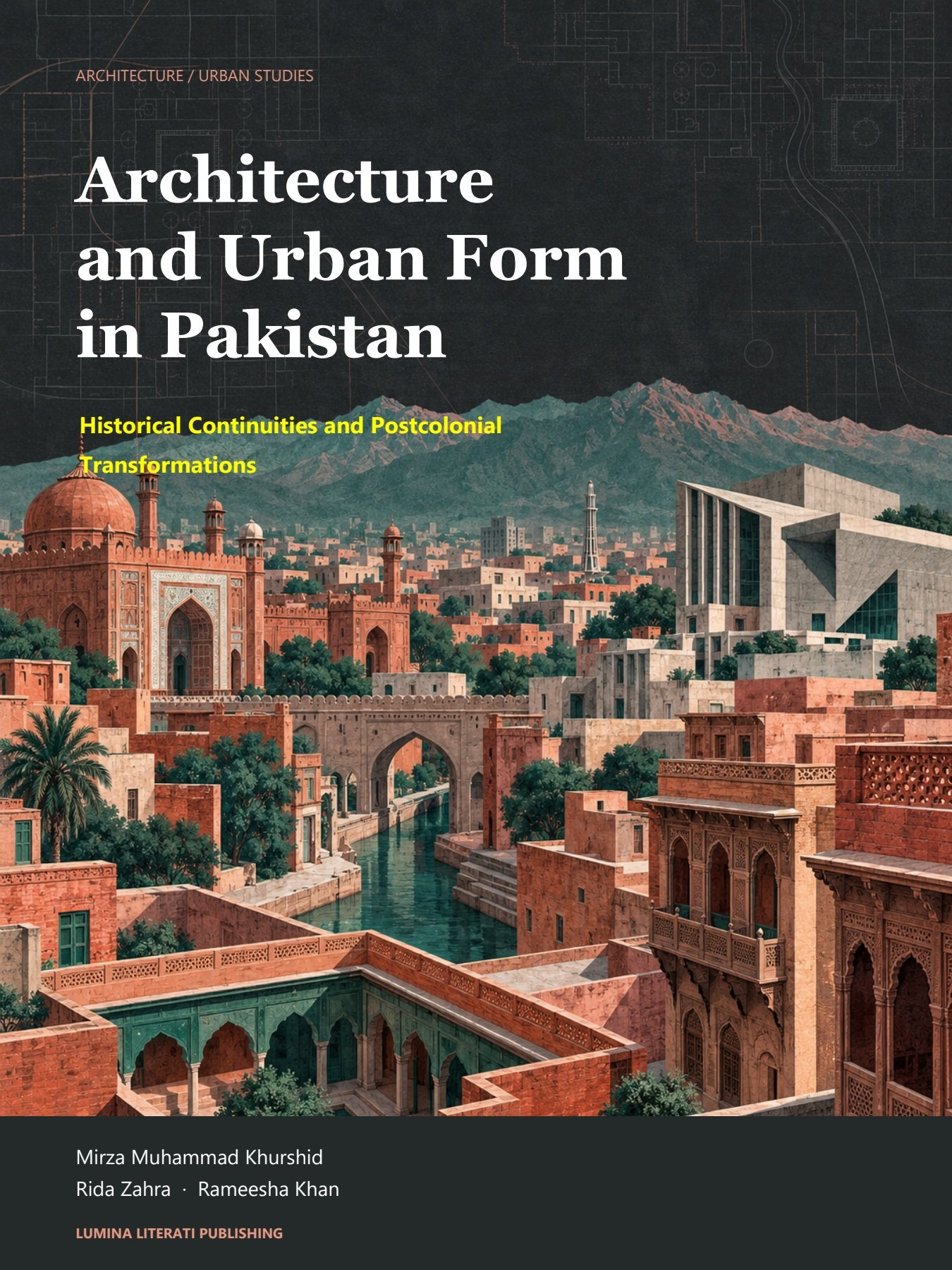
Architecture and Urban Form in Pakistan
Historical Continuities and Postcolonial Transformations
Book overview
Architecture and Urban Form in Pakistan examines how settlement patterns, buildings, and metropolitan landscapes have been shaped by changing relationships between land, water, mobility, institutions, and everyday life. Across five chapters, it traces regional building practices, colonial land administration, Partition and postcolonial construction, housing markets, and contemporary conservation and environmental management.
The book brings historic precincts and ordinary neighbourhoods into the same discussion. Case studies range from Harappa, Taxila, Lahore, and Hunza to Karachi, Islamabad, Peshawar, and Quetta. Courtyard houses, cantonments, public buildings, incremental housing, transport systems, and service networks reveal how urban form develops through design decisions, property arrangements, public investment, construction work, and residents’ adaptations.
A central concern is the meaning of continuity: the survival of a wall, street, plot, or institution does not necessarily preserve its earlier use or social relationships. The authors connect physical change to the decisions and unequal conditions that produce it, while distinguishing documented outcomes from proposals and wider interpretations.
The final chapter considers adaptive reuse, resident retention, thermal comfort, drainage, seismic risk, and institutional responsibilities. With 30 tables, 11 chapter figures, and 90 references, this volume offers a comparative resource for students, researchers, architects, planners, and readers interested in Pakistan’s built environment and urban development.
Inside the book
- 01
Regional Settlement Patterns and Building Practices
Examines settlement sites, market and religious precincts, courtyard houses, regional materials, and adaptive reuse to explain how inherited urban form connects physical fabric with changing social practices.
- 02
Colonial Land Administration and Urban Development
Traces how property surveys, municipal boundaries, cantonments, transport infrastructure, and public building programmes shaped colonial urban development and subsequent institutional change.
- 03
Partition and Postcolonial Architectural Production
Explores migration and property reallocation after Partition, capital planning, national representation, housing implementation, and the roles of institutions, professionals, builders, and residents in producing architecture.
- 04
Housing Markets and Metropolitan Expansion
Connects incremental housing, rental subdivision, private development, agricultural land conversion, transport access, and neighbourhood services to the conditions of metropolitan expansion.
- 05
Conservation and Urban Environmental Management
Assesses adaptive reuse, resident retention, thermal retrofit, environmental hazards, development control, and implementation priorities through documented cases and their stated evidence limits.
Free to read
Read Architecture and Urban Form in Pakistan
Open the cover to browse the complete book in the online reader, or download the PDF to read offline.
Download the complete PDF130 pages · English · PDF
© 2026 Mirza Muhammad Khurshid, Rida Zahra, and Rameesha Khan. The authors retain copyright in their original content.
Cite this book
Khurshid, M. M., Zahra, R., & Khan, R. (2026). Architecture and urban form in Pakistan: Historical continuities and postcolonial transformations. Lumina Literati Publishing. https://doi.org/10.65758/isbn.9786277813697
References
The complete bibliography from the book, with links to the cited sources.
View all 90 references
- Abbas, M., & Wakil, I. (2023). Exploring and analysing the drivers of urban sprawl in Pakistan: A case study of Lahore [Unedited author’s report, CGP 04-049]. Research for Social Transformation and Advancement, Pakistan Institute of Development Economics. https://rasta.pide.org.pk/wp-content/uploads/Mazhar_Abbass_Research_Paper.pdf
- Aga Khan Award for Architecture. (n.d.-a). Khuda-ki-Basti incremental development scheme [Award project record, 1993–1995 cycle]. Aga Khan Development Network. https://the.akdn/en/how-we-work/our-agencies/aga-khan-trust-culture/akaa/khuda-ki-basti-incremental-development-scheme
- Aga Khan Award for Architecture. (n.d.-b). National Assembly Building, Dhaka [Award project record, 1987–1989 cycle]. Aga Khan Development Network. https://the.akdn/en/how-we-work/our-agencies/aga-khan-trust-culture/akaa/national-assembly-building
- Aga Khan Cultural Services–Pakistan. (2012). Conservation of the Wazir Khan Mosque Lahore: Preliminary report on condition and risk assessment. Aga Khan Trust for Culture. Executive summary consulted. https://s3.amazonaws.com/media.archnet.org/system/publications/contents/6585/original/DPC3347.pdf
- Aga Khan Development Network. (n.d.). Pakistan: Walled City of Lahore conservation. Retrieved October 23, 2026, from https://the.akdn/en/where-we-work/south-asia/pakistan/walled-city-of-lahore-conservation-pakistan
- Aga Khan Trust for Culture. (n.d.). Conservation and development projects. Historic Cities Support Programme. https://s3.us-east-1.amazonaws.com/media.archnet.org/system/publications/contents/4929/original/DPC1642.pdf
- Ahmed, N., and Sohail, M. (2003). Alternate water supply arrangements in peri-urban localities: Awami (people’s) tanks in Orangi Township, Karachi. Environment and Urbanization, 15(2), 33–42. https://doi.org/10.1177/095624780301500218
- Ahmed, N., Sohail, M., and Ekwam, J. (2024). Investigating alternative water supply in settlements: Cases from Turkana County in Kenya and Orangi in Karachi, Pakistan. Sustainability, 16(19), 8725. https://doi.org/10.3390/su16198725
- Akhtar, S. (2020). Home-based workers in Pakistan: A statistical profile. WIEGO Statistical Brief No. 26. https://www.wiego.org/research-library-publications/home-based-workers-pakistan-statistical-profile/
- Anbrine, S. (2014). The Co-operative Model Town Society: History, planning, architecture and social character of an indigenous garden suburb in colonial Lahore [Doctoral thesis, University of Liverpool]. https://livrepository.liverpool.ac.uk/2010879/1/AnbrineSha_Dec2014_2010879.pdf
- Anwar, N. H., Sawas, A., and Mustafa, D. (2020). “Without water, there is no life”: Negotiating everyday risks and gendered insecurities in Karachi’s informal settlements. Urban Studies, 57(6), 1320–1337. https://doi.org/10.1177/0042098019834160
- Asian Development Bank (ADB). (2021, 18 January). A newly completed bus rapid transit system is transforming lives of people in Peshawar, Pakistan. Project result/case study. https://www.adb.org/results/newly-completed-bus-rapid-transit-system-transforming-lives-peshawar-pakistan
- Asian Development Bank (ADB). (2026). Pakistan: Peshawar Sustainable Bus Rapid Transit Corridor Project. Completion report, project 48289-002, May. https://www.adb.org/sites/default/files/project-documents/48289/48289-002-pcr-1155131-en.pdf
- Auditor-General of Pakistan. (n.d.). Special audit report on rain emergency in Karachi, 2020–21. See findings on drain cleaning and sewage discharge. https://agp.gov.pk/SiteImage/Policy/Special%20Audit%20on%20Rain%20Emergency%20in%20Karachi%202020-21.pdf
- Ayaz, A., Saleem, H., Ayyub, M. U. B., and Qadeer, A. (2024). Mobility challenges for women: A case study of bus rapid transit Peshawar. Transportation Engineering, 18, 100285. https://doi.org/10.1016/j.treng.2024.100285
- Bahria Town publicity. (2017, 25 March). Bahria Town hands over apartments’ keys to owners. Business Recorder, PR report. https://www.brecorder.com/news/4488690
- Bahria Town. (n.d.). Bahria Town Karachi. Developer project description. Accessed 23 October 2026. https://bahriatown.com/bahria-town-karachi/
- Bangladesh Parliament. (n.d.). History. https://www.parliament.gov.bd/about/history
- Bokhari, M. H. (1971). Growth and development of Lyallpur city. Pakistan Geographical Review, 26(2), 1–15. https://pu.edu.pk/images/journal/geography/pdf/Pakistan%20Geographical%20Review%201971%20Vol.%2026%20No.%202.pdf
- Campion, M. J. (Interviewer). (2016, December 13). [Interview with Arif Hasan on Karachi’s post-Partition development]. South Asia @ LSE. https://blogs.lse.ac.uk/southasia/2016/12/13/if-you-look-at-karachi-and-who-plans-it-the-decisions-are-made-by-those-who-do-not-understand-the-problems-of-the-ordinary-people-arif-hasan/
- Daechsel, M. (2011). Sovereignty, governmentality and development in Ayub’s Pakistan: The case of Korangi Township. Modern Asian Studies, 45(1), 131–157. https://doi.org/10.1017/S0026749X1000034X
- Da’wah Academy. (n.d.-a). Introduction and history [Faisal Masjid]. International Islamic University Islamabad. https://dawah.iiu.edu.pk/the-masjid/introduction-history/
- Da’wah Academy. (n.d.-b). Features of Masjid. International Islamic University Islamabad. https://dawah.iiu.edu.pk/the-masjid/info-features-of-masjid/
- Department of Archaeology and Museums. (2004a, January 30). Archaeological Site of Harappa [Tentative List submission]. UNESCO World Heritage Centre. https://whc.unesco.org/en/tentativelists/1878/
- Department of Archaeology and Museums. (2004b, January 30). Baltit Fort [Tentative List submission]. UNESCO World Heritage Centre. https://whc.unesco.org/en/tentativelists/1882/
- Doxiadis Archives. (1959a). The development of the Korangi area: Final master plan, proposals for the issue of an ordinance, project PH 403, periodical report no. 8, DOX-PA 36 [Catalogue description, ref. 36383; September 30]. Constantinos and Emma Doxiadis Foundation. https://www.doxiadis.org/ViewDocument.aspx?Id=2328457
- Doxiadis Archives. (1959b). Pakistan reports R-PKH 45–80, July–December 1959 [Catalogue description, ref. 23578]. Constantinos and Emma Doxiadis Foundation. https://www.doxiadis.org/ViewDocument.aspx?Id=2325895
- Doxiadis Associates. (n.d.-a). Islamabad, the capital of Pakistan [Project publication]. Constantinos and Emma Doxiadis Foundation. https://www.doxiadis.org/Downloads/Islamabad_project_publ.pdf
- Doxiadis Associates. (n.d.-b). University of the Punjab [Project publication]. Constantinos and Emma Doxiadis Foundation. https://www.doxiadis.org/Downloads/Punjab_proj.pdf
- Doxiadis, C. A. (1965). Islamabad: The creation of a new capital. The Town Planning Review, 36(1), 1–28. Digitized illustrated version: https://www.doxiadis.org/Downloads/islamabad_the_capital_of_pakistan.pdf
- Farah, N., Khan, I. A., Manzoor, A., and Shahbaz, B. (2016). Changing land ownership patterns and agricultural activities in the context of urban expansion in Faisalabad, Pakistan. Pakistan Journal of Life and Social Sciences, 14(3), 183–188. https://www.pjlss.edu.pk/pdf_files/2016_3/183-188.pdf
- Giosan, L., Clift, P. D., Macklin, M. G., Fuller, D. Q., Constantinescu, S., Durcan, J. A., Stevens, T., Duller, G. A. T., Tabrez, A. R., Gangal, K., Adhikari, R., Alizai, A., Filip, F., VanLaningham, S., & Syvitski, J. P. M. (2012). Fluvial landscapes of the Harappan civilization. Proceedings of the National Academy of Sciences, 109(26), E1688–E1694. https://doi.org/10.1073/pnas.1112743109
- Government College University Lahore. (n.d.). History of the building. Retrieved October 23, 2026, from https://gcu.edu.pk/about.php?pg=building-history
- Government of Sindh. (1987). The Sind Katchi Abadis Act, 1987, Sind Act No. II of 1987. Sindh Code. https://sindhlaws.gov.pk/setup/publications_SindhCode/PUB-15-000776.pdf
- Government of Sindh. (2013). Sindh Local Government Act, 2013. Schedule II; official consolidated text with amendment annotations. https://www.sindhlaws.gov.pk/setup/publications_SindhCode/PUB-NEW-18-000156.pdf
- Government of Sindh. (2023). Karachi Water and Sewerage Corporation Act, 2023. Sindh Act XVIII of 2023, gazette dated 6 July; especially sections 2–4, 24, 32–33, and 49. https://sindhlaws.gov.pk/Setup/Publications_SindhCode/PUB-NEW-25-000100.pdf
- Hasan, A. (1990, September 30). Evaluation of the HDA’s Khuda-ki-Basti incremental housing scheme [Report for the House Building Finance Corporation]. Arif Hasan and Associates. https://arifhasan.org/wp-content/uploads/2012/09/AH18_HADs-KKB-scheme.pdf
- Hasan, A. (2015). Land contestation in Karachi and the impact on housing and urban development. Environment and Urbanization, 27(1), 217–230. https://doi.org/10.1177/0956247814567263
- Hasan, A., Pervaiz, A., and Raza, M. (2017). Drivers of climate change vulnerability at different scales in Karachi. International Institute for Environment and Development. https://www.iied.org/10805iied
- Hasan, A., Sadiq, A., and Ahmed, S. (2010). Planning for high density in low-income settlements: Four case studies from Karachi. International Institute for Environment and Development and United Nations Population Fund. https://www.iied.org/10582iied
- Hughes, R. (2005). Vernacular architecture and construction techniques in the Karakoram. In S. Bianca (Ed.), Karakoram: Hidden treasures in the Northern Areas of Pakistan (pp. 99–132). Umberto Allemandi & C. for the Aga Khan Trust for Culture. https://s3.amazonaws.com/media.archnet.org/system/publications/contents/4872/original/DPC1585.pdf
- Human Rights Watch. (2024, 28 May). “I escaped with only my life”: Abusive forced evictions in Pakistan. https://www.hrw.org/report/2024/05/28/i-escaped-only-my-life/abusive-forced-evictions-pakistan
- Imperial Gazetteer of India. (1908). Volume 16: Kotchandpur to Mahavinyaka. Clarendon Press. Lahore and Lyallpur entries, pp. 105–115, 222–224. Digitized copy: https://library.bjp.org/jspui/bitstream/123456789/1906/1/The%20Imperial%20Gazetteer%20of%20India%20Vol-16%20%28Katchandpur%20to%20Mahavingaka%29.pdf
- International Islamic University Islamabad. (n.d.). Location. https://www.iiu.edu.pk/about-iiu/location/
- Islamabad High Court. (2021, June 14). Noman Ahmed and 14 others v. Capital Development Authority, etc., W.P. No. 244 of 2018 and connected petitions [Judgment of Athar Minallah, C.J.]. https://mis.ihc.gov.pk/attachments/judgements/84476/1/w.p._no._244-2018._final._637598862108727049.pdf
- Javaid, H. (2023). Can money compensate? Gain and loss accounts from urbanizing villages of south-eastern Lahore, Pakistan. In J. Müller, J. Dame, S. Sharma, and C. Butsch (Eds.), Aktuelle Forschungsbeiträge zu Südasien: 12. Jahrestagung des AK Südasien, 21./22. Januar 2022, Bonn/online (Geographien Südasiens, Vol. 14, pp. 6–9). Heidelberg Asian Studies Publishing. https://doi.org/10.11588/hasp.1166.c16858
- Karachi Port Trust. (n.d.-a). KPT history. Retrieved October 23, 2026, from https://kpt.gov.pk/pages/42/kpt-history
- Karachi Port Trust. (n.d.-b). Chairman history. Retrieved October 23, 2026, from https://kpt.gov.pk/pages/43/chairman-history
- Karachi Urban Lab. (2021, December). Land, governance and the gendered politics of displacement in urban Pakistan (Policy Brief 01). Institute of Business Administration, Karachi. https://karachiurbanlab.com/assets/downloads/English_Policy_Brief_01.pdf
- Khalid, H., Thaheem, M. J., Malik, M. S. A., Musarat, M. A., and Alaloul, W. S. (2021). Reducing cooling load and lifecycle cost for residential buildings: A case of Lahore, Pakistan. The International Journal of Life Cycle Assessment, 26, 2355–2374. https://doi.org/10.1007/s11367-021-02000-1
- Lacheret, C. (1994, July). Housing development scheme, Khuda Ki Basti, Pakistan [Edited account from ESCAP, Guidelines on community-based housing finance and innovative credit systems for low-income households]. DPH. https://dph.ritimo.org/en/fiches/premierdph/fiche-premierdph-1387.html
- Lari Archive. (n.d.). Kurrachee city survey, Civil Lines, sheet F-12, 1874 [Catalogue entry, KMR.LAD.CiQ.1874.F12]. https://www.lariarchive.com/Object/8150/city-survey-ref-no-kmr-lad-ciq-1874-f-12-kurrachee-city-survey-civil-lines-sheet-no-f-12-1874-this-m
- Mahar, W. A., Verbeeck, G., Singh, M. K., and Attia, S. (2019). An investigation of thermal comfort of houses in dry and semi-arid climates of Quetta, Pakistan. Sustainability, 11(19), 5203. https://doi.org/10.3390/su11195203
- Malik, A. M., & Rashid, M. (2016). Islamic ideology and the evolution of courtyard: A case study of a havili, old city Lahore. Journal of Islamic Thought and Civilization, 6(1), 77–84. https://doi.org/10.32350/jitc.61.06
- Meadow, R. H., & Kenoyer, J. M. (2001). Recent discoveries and highlights from excavations at Harappa: 1998–2000. Indo-Koko-Kenkyu [Indian Archaeological Studies], 22, 19–36. Authorised online reproduction: https://www.harappa.com/content/recent-indus-discoveries-and-highlights-excavations-harappa-1998-2000
- Ministry of Foreign Affairs, Government of Pakistan. (n.d.). History. https://mofa.gov.pk/history
- Model Town Society. (n.d.). Introduction. https://mts.com.pk/Introduction.php
- National Assembly of Pakistan. (n.d.). Parliamentary history. https://na.gov.pk/en/content.php?id=75
- Nazir, H., and Yousuf, M. S. (2021). Bahria Town Karachi: A case study in urban development. Journal of Research in Architecture and Planning, 30(1), 51–61. https://doi.org/10.53700/jrap3012021_6
- Office of the United Nations High Commissioner for Human Rights (OHCHR). (2021, 25 June). Pakistan: UN experts demand halt to mass evictions along Karachi’s watercourses. Statement reproduced by ecoi.net. https://www.ecoi.net/en/document/2054750.html
- Orangi Pilot Project–Research and Training Institute (OPP-RTI). (2016, December). 148th quarterly progress report. Housing programme, pp. 52–53. https://www.opp.org.pk/wp-content/uploads/2017/03/QPR-148th.pdf
- Pakistan Engineering Council (PEC). (2021). Building Code of Pakistan (2021). Official-hosted edition. Applicable adoption and requirements must be checked for the proposed work. https://www.pec.org.pk/wp-content/uploads/2024/09/BCP2021-Final-Draft-dated-26.10.2021.pdf
- Pakistan. (1924, as amended). The Cantonments Act, 1924 (Act II of 1924) [Consolidated text]. Ministry of Defence. https://www.mod.gov.pk/SiteImage/Misc/files/Cantonement%20Act(1).pdf
- Pakistan. (1957, as amended). The Pakistan (Administration of Evacuee Property) Act, 1957 (Act XII of 1957) [Consolidated text]. Board of Revenue, Punjab. Sections 7–8 and 18 discussed as historical provisions. https://bor.punjab.gov.pk/system/files/The%20Pakistan%20Administration%20of%20Evacuee%20Property%20Act%2C%201957_0.pdf
- Pakistan. (1974). Karachi Port Trust (Amendment) Act, 1974. Gazette of Pakistan, Extraordinary, Part I, pp. 361–362. https://www.na.gov.pk/uploads/documents/1491807451_988.pdf
- Pakistan. (2015). The Cantonments (Amendment) Act, 2015 (Act XX of 2015). Gazette of Pakistan, Extraordinary, December 9. https://www.na.gov.pk/uploads/documents/1452577357_217.pdf
- Permanent Delegation of Pakistan to UNESCO. (2026, May 11). Archaeological Complex of Gor Khatri [Tentative List submission]. UNESCO World Heritage Centre. https://whc.unesco.org/en/tentativelists/7035/
- Pervaiz, A., Rahman, P., with Hasan, A. (2008). Lessons from Karachi: The role of demonstration, documentation, mapping and relationship building in advocacy for improved urban sanitation and water services. Human Settlements Discussion Paper, Water 6. International Institute for Environment and Development. https://www.iied.org/10560iied
- Punjab. (1975, as amended). The Lahore Development Authority Act, 1975 (Act XXX of 1975) [Consolidated text with amendment annotations]. FAOLEX reproduction. Sections 47–48 consulted; subsection 48(3) is marked as substituted by the 1976 amendment, effective 12 February 1976. https://faolex.fao.org/docs/pdf/pak87764.pdf
- Quaid-i-Azam Mazar Management Board. (n.d.). Mausoleum complex. Government of Pakistan. https://qmmb.gov.pk/mausoleum-1.html
- Rahman, P. (2005). Strengthening community initiatives, building partnerships: OPP-RTI sanitation and housing programme, Pakistan. Open House International, 30(4), 51–55. https://doi.org/10.1108/OHI-04-2005-B0012
- Ramzan, M., Saqib, Z. A., Hussain, E., Khan, J. A., Nazir, A., Dasti, M. Y. S., Ali, S., and Niazi, N. K. (2022). Remote sensing-based prediction of temporal changes in land surface temperature and land use-land cover (LULC) in urban environments. Land, 11(9), 1610. https://doi.org/10.3390/land11091610
- Saif, B., Tahir, M., Shah, M. A., Mushtaq, M. N., Khan, M. Y., Azad, A., and Iqbal, T. (2024). An updated and gridded probabilistic seismic hazard assessment of Quetta city, Pakistan using multiple source models. Journal of Asian Earth Sciences, 272, 106245. https://doi.org/10.1016/j.jseaes.2024.106245
- Salman, M., Malik, S., Tariq, F., and Khilat, F. (2018). Conservation analysis of Gali Surjan Singh: A study of architectural and social aspects. Journal of Architectural Conservation, 24(2), 134–151. https://doi.org/10.1080/13556207.2018.1488203
- Shah, N. (2021). Radical resistance or active agency—The case of Korangi Town. Prometheus, 5, 68–72. https://prometheus.library.iit.edu/index.php/journal/article/download/26/13
- Sheikh, M. (2018). Public health and sanitation in colonial Lahore, 1849–1910 [Doctoral thesis, University of Waterloo]. https://uwspace.uwaterloo.ca/items/d084c10e-cb8a-4a5b-a382-7eae92318734
- Sindh Solid Waste Management Board (SSWMB). (2023). Environmental and Social Management Framework: Solid Waste Emergency and Efficiency Project. Updated framework, revision 07; project P173021. https://documents1.worldbank.org/curated/en/099092223101098550/pdf/P1730210d7104f020a9400150a42b249b2.pdf
- Smyth, J. W. (1919). Gazetteer of the Province of Sind, B volume I: Karachi district. Government Central Press, Bombay. https://irrigation.sindh.gov.pk/files/Books/156.pdf
- Supreme Court of Pakistan. (2019). Implementation of judgment dated 4 May 2018 in C.M. No. 376-K of 2014. Order of 21 March 2019, C.M.A. No. 8758 of 2018; 2019 SCMR 703. Judgment text reproduced at https://pakistancaselaw.com/case/171825/implementation-of-judgment-dated-4-5-2018-in-c-m-no-376-k-of-2014-in-the-matter
- Supreme Court of Pakistan. (2023). Jahanzaib Kalmaty v. Province of Sindh through Board of Revenue. Order of 23 November 2023; reported as PLD 2024 Supreme Court 88. Judgment text reproduced at https://pakistancaselaw.com/case/188203/jahanzaib-kalmaty-vs-province-of-sindh-through-board-of-revenue-2024-pld
- Tan, L. L. (n.d.). Baltit Fort, Karimabad, Pakistan: Restoration and adaptive re-use. Aga Khan Program for Islamic Architecture, Massachusetts Institute of Technology. https://web.mit.edu/akpia/www/AKPsite/4.239/baltit/baltit.html
- UNESCO World Heritage Centre. (n.d.-a). Fort and Shalamar Gardens in Lahore. Retrieved October 23, 2026, from https://whc.unesco.org/en/list/171/
- UNESCO World Heritage Centre. (n.d.-b). Taxila. Retrieved October 23, 2026, from https://whc.unesco.org/en/list/139/
- United Nations Office for Disaster Risk Reduction (UNDRR). (2017). Disaster risk. Sendai Framework terminology on disaster risk reduction. https://www.undrr.org/terminology/disaster-risk
- United States Department of Energy (US DOE). (2011). Guide to cool roofs. Building Technologies Program. Technical principles used here; United States prices and savings are not transferred to Pakistan. https://energy.gov/sites/prod/files/guide_to_cool_roofs.pdf
- University of the Punjab. (n.d.). Department of Botany prospectus. https://pu.edu.pk/images/file/Prospectuses/Prospectus-Botany.pdf
- World Bank. (2020). Pakistan: Solid Waste Emergency and Efficiency Project. Project appraisal document, 11 November; project P173021. Read with the subsequent funding-scope revision in SSWMB (2023). https://documents1.worldbank.org/curated/en/513151607742095471/pdf/Pakistan-Solid-Waste-Emergency-and-Efficiency-Project.pdf
- World Habitat. (1994). Khuda-Ki-Basti project [World Habitat Awards finalist record]. https://world-habitat.org/awards/winners/khuda-ki-basti-project/
- Wright, R. P., Shuldenrein, J., & Mughal, M. R. (n.d.). Introduction to the Beas research. Beas Landscape and Settlement Survey. Harappa.com. https://www.harappa.com/beas/chronology
- Yamane, S., Funo, S., Ara, H., Numata, N., & Osamura, H. (1999). Traditional urban houses of Lahore: A study on the urban quarter of the walled city of Lahore, Pakistan. Journal of Architecture and Planning (Transactions of AIJ), 64(521), 219–226. https://doi.org/10.3130/aija.64.219_3