
Open access · 2025
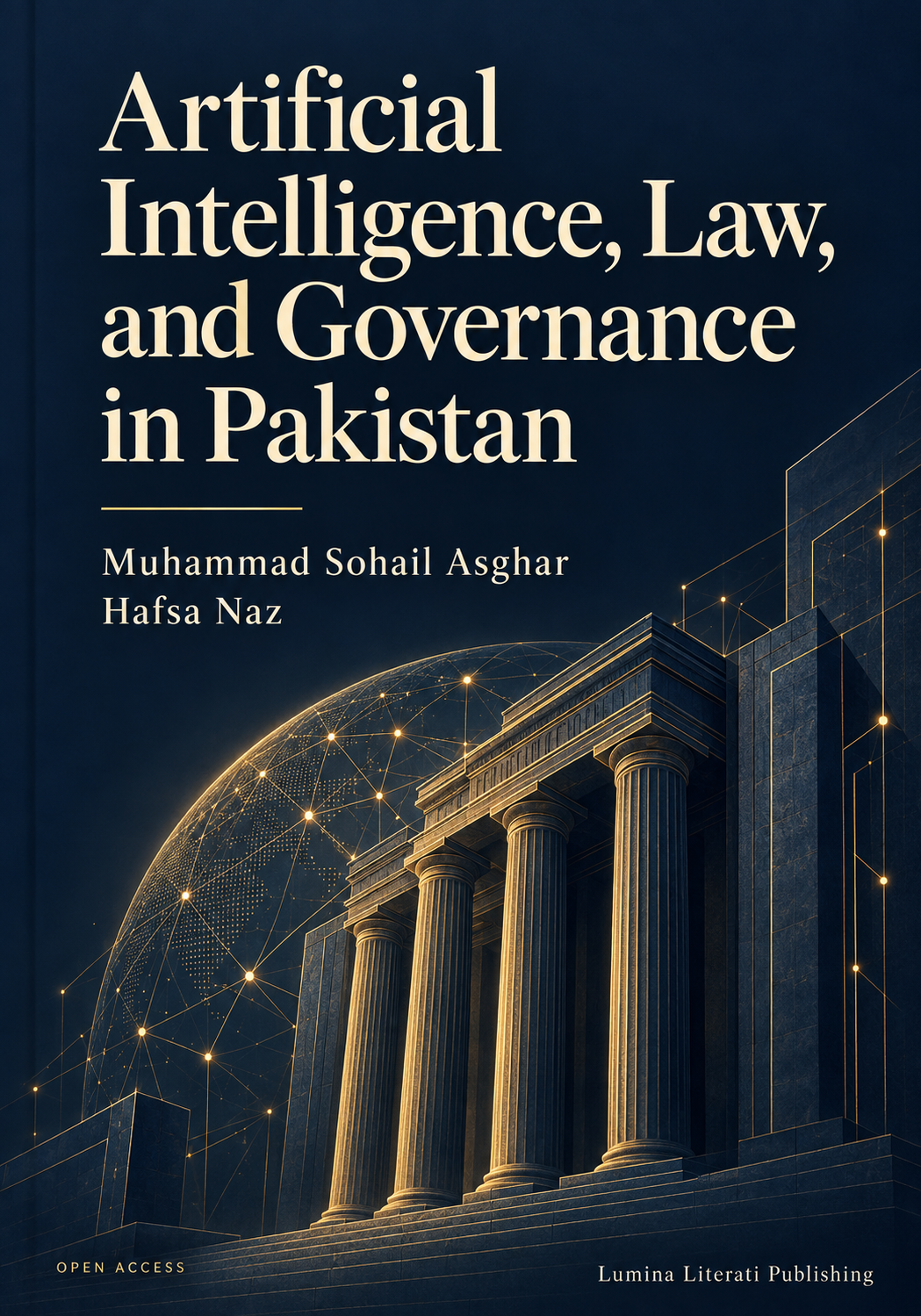
Artificial Intelligence, Law, and Governance in Pakistan
Book overview
Artificial Intelligence, Law, and Governance in Pakistan examines how AI systems interact with constitutional authority, public administration, and individual rights. It brings legal and technological perspectives together to explore who may authorise, procure, deploy, supervise, and review consequential uses of AI within Pakistan’s federal legal order.
Across five chapters, the book considers constitutional competence and institutional mandates; public data infrastructures, digital identity, procurement, and administrative capacity; neural networks, cybersecurity, and data governance; automated decision-making, fundamental rights, legal responsibility, and judicial control; and regulatory coordination throughout the system lifecycle.
The book develops practical frameworks for tracing responsibility, assessing institutional readiness, documenting system decisions, managing risks, and providing routes for oversight and redress. Written for legal scholars, technology researchers, policymakers, public administrators, and students, it connects responsible AI deployment with lawful authority, meaningful human oversight, and reviewable decisions.
Inside the book
- 01
Constitutional Competence and Institutional Authority over Artificial Intelligence
Page 1
- 02
Public Data Infrastructures, Procurement, and Administrative Capacity
Page 37
- 03
Neural Networks, Cybersecurity, and Data Governance in Pakistan
Page 79
- 04
Automated Decision-Making, Fundamental Rights, Legal Responsibility, and Judicial Control
Page 135
- 05
Regulatory Coordination and Lifecycle Oversight in a Federal Legal Order
Page 191
Free to read
Read Artificial Intelligence, Law, and Governance in Pakistan
Open the cover to browse the complete book in the online reader, or download the PDF to read offline.
Download the complete PDF265 pages · English · PDF
© 2025 Muhammad Sohail Asghar and Hafsa Naz. The authors retain full copyright ownership of this work. Published open access under the Creative Commons Attribution-NonCommercial-NoDerivatives 4.0 International (CC BY-NC-ND 4.0) licence. Sharing is permitted for noncommercial purposes with attribution; adapted versions may not be distributed under this licence.
Cite this book
Asghar, M. S., & Naz, H. (2025). Artificial intelligence, law, and governance in Pakistan. Lumina Literati Publishing. https://doi.org/10.65758/isbn.9786277813635
References
The complete bibliography from the book, with links to the cited sources.
View all 258 references
- Aas, K., Jullum, M., & Løland, A. (2021). Explaining individual predictions when features are dependent: More accurate approximations to Shapley values. Artificial Intelligence, 298, 103502. https://doi.org/10.1016/j.artint.2021.103502
- Abadi, M., Chu, A., Goodfellow, I., McMahan, H. B., Mironov, I., Talwar, K., & Zhang, L. (2016). Deep learning with differential privacy. In Proceedings of the 2016 ACM SIGSAC Conference on Computer and Communications Security (pp. 308–318). Association for Computing Machinery. https://doi.org/10.1145/2976749.2978318
- Abbas, A. (2024). Urban Pakistan and women’s mobility in securitised Lahore. Gender & Development, 32(1–2), 511–521. https://doi.org/10.1080/13552074.2024.2348385
- Adebayo, J., Gilmer, J., Muelly, M., Goodfellow, I., Hardt, M., & Kim, B. (2018). Sanity checks for saliency maps. In S. Bengio, H. Wallach, H. Larochelle, K. Grauman, N. Cesa-Bianchi, & R. Garnett (Eds.), Advances in Neural Information Processing Systems 31 (pp. 9505–9515). Curran Associates. https://proceedings.neurips.cc/paper/8160-sanity-checks-for-saliency-maps
- Ahmad, Z., Shah, I., Alam, A., & Khan, H. (2025). Quality education in post-devolution scenario in Pakistan: Evidence from Khyber Pakhtunkhwa province. Development in Practice. Advance online publication. https://doi.org/10.1080/09614524.2025.2558748
- Ahmed, I., Mustafa, U., & Khalid, M. (2007). National Finance Commission awards in Pakistan: A historical perspective (PIDE Working Papers 2007:33). Pakistan Institute of Development Economics. https://pide.org.pk/research/national-finance-commission-awards-in-pakistan-a-historical-perspective/
- Ahmed, S., Yaakub, A. N., & Javed, A. (2025). Artificial intelligence in Pakistan’s cyberspace: Governance gaps, dual-use dilemmas, and strategic vulnerabilities. Obrana a strategie, 25(2), 3–23. https://doi.org/10.3849/1802-7199.25.2025.02.3-23
- American Bar Association Standing Committee on Ethics and Professional Responsibility. (2024, July 29). Formal Opinion 512: Generative artificial intelligence tools [Comparative professional guidance; not Pakistani law]. https://www.americanbar.org/content/dam/aba/administrative/professional_responsibility/ethics-opinions/aba-formal-opinion-512.pdf
- Ara, I., & Sabir, M. (2010). Decentralisation of GST services and vertical imbalances in Pakistan. The Pakistan Development Review, 49(4, Part II), 479–495. https://doi.org/10.30541/v49i4IIpp.479-495
- Arif, S., Azeemi, A. H., Raza, A. A., & Athar, A. (2024). Generalists vs. specialists: Evaluating large language models for Urdu. In Y. Al-Onaizan, M. Bansal, & Y.-N. Chen (Eds.), Findings of the Association for Computational Linguistics: EMNLP 2024 (pp. 7263–7280). Association for Computational Linguistics. https://doi.org/10.18653/v1/2024.findings-emnlp.426
- Askari Bank Ltd. v A.H. International (Pvt) Ltd. and others, 2025 SHC KHI 2590 (Sindh High Court, Execution No. 25 of 2012, order of 23 September 2025). https://caselaw.shc.gov.pk/caselaw/view-file/MjgzNTczY2Ztcy1kYzgz
- Auditor-General of Pakistan. (2012). Financial Audit Manual (Rev. ed.). https://agp.gov.pk/SiteImage/Misc/files/Revised%20FAM%20Book%281%29.pdf
- Auditor-General of Pakistan. (n.d.). Performance Audit Wing [Official institutional description; not evidence of specialist AI-audit capacity]. https://www.agp.gov.pk/Detail/MjE4MWE0OTYtMzQzNC00MDVlLWIyYjEtMzY0MDVkY2YyN2Uw
- Auditor-General’s (Functions, Powers and Terms and Conditions of Service) Ordinance, 2001 (Ordinance XXIII of 2001; 17 May 2001; commenced 1 July 2001), as amended/current at the cut-off. Pakistan Code, official text. https://pakistancode.gov.pk/pdffiles/administratord2a43e2e40d8af8e23fd95cba332137b.pdf
- Axelsson, S. (2000). The base-rate fallacy and the difficulty of intrusion detection. ACM Transactions on Information and System Security, 3(3), 186–205. https://doi.org/10.1145/357830.357849
- Aziz, S. (2018). The constitution of Pakistan: A contextual analysis. Hart Publishing. https://doi.org/10.5040/9781509995424
- Bagdasaryan, E., Veit, A., Hua, Y., Estrin, D., & Shmatikov, V. (2020). How to backdoor federated learning. In Proceedings of the Twenty Third International Conference on Artificial Intelligence and Statistics (Proceedings of Machine Learning Research, Vol. 108, pp. 2938–2948). PMLR. https://proceedings.mlr.press/v108/bagdasaryan20a.html
- Balochistan Public Procurement Regulatory Authority Act, 2009 (Balochistan Act VIII of 2009), as amended/current at the cut-off. Balochistan Code, official text. https://balochistancode.gob.pk/Document.aspx?docc=1918&docid=2053&wise=opendoc
- Banking Companies Ordinance, 1962 (Ordinance LVII of 1962), as amended/current at the cut-off. Pakistan Code, official text. https://pakistancode.gov.pk/english/index.php/UY2FqaJw1-apaUY2Fqa-cJ%2BV-sg-jjjjjjjjjjjjj
- Barocas, S., & Selbst, A. D. (2016). Big data’s disparate impact. California Law Review, 104(3), 671–732. https://doi.org/10.15779/Z38BG31
- Benazir Income Support Programme Act, 2010 (Act XVIII of 2010; 18 August 2010), as amended/current at the cut-off. Pakistan Code, official text. https://pakistancode.gov.pk/english/UY2FqaJw1-apaUY2Fqa-apaUY2Npa5pjZg%3D%3D-sg-jjjjjjjjjjjjj
- Benazir Income Support Programme. (n.d.-a). 8171 web portal [Operational public query channel; not proof of merits review in each case]. https://8171.bisp.gov.pk/
- Benazir Income Support Programme. (n.d.-b). Benazir Kafaalat programme [Official programme description]. https://bisp.gov.pk/Detail/YTgzNjkxM2YtN2ViMC00MjA5LWI0MDMtNzM4ZWJmMGVlNzc5
- Benazir Income Support Programme. (n.d.-c). Benazir National Socio-Economic Registry (NSER) [Official registry description; not evidence of a neural-network eligibility model]. https://bisp.gov.pk/Detail/NzI5YTMyYTMtYjE1My00NGUwLTgwYTItZWUwYTZkYWZjYmNj
- Benazir Income Support Programme. (n.d.-d). BISP–NADRA sign MoU for new survey under Dynamic Registry [Official institutional announcement]. https://bisp.gov.pk/NewsDetail/MGJjYmY5YjAtM2IwZS00ZTVmLWE5ZGQtNWM0MzNmMWNlZTlm
- Benazir Income Support Programme. (n.d.-e). Complaint redressal [Official complaint route; existence does not establish accessibility or outcome in every case]. https://bisp.gov.pk/Detail/ZDk4ZWViMTUtZWQ4ZS00ZjM4LTk3ZGYtYzlkOTAwMGVkOWY4
- Berman, D. S., Buczak, A. L., Chavis, J. S., & Corbett, C. L. (2019). A survey of deep learning methods for cyber security. Information, 10(4), Article 122. https://doi.org/10.3390/info10040122
- Binns, R. (2022). Human judgment in algorithmic loops: Individual justice and automated decision-making. Regulation & Governance, 16(1), 197–211. https://doi.org/10.1111/rego.12358
- Bonawitz, K., Ivanov, V., Kreuter, B., Marcedone, A., McMahan, H. B., Patel, S., Ramage, D., Segal, A., & Seth, K. (2017). Practical secure aggregation for privacy-preserving machine learning. In Proceedings of the 2017 ACM SIGSAC Conference on Computer and Communications Security (pp. 1175–1191). Association for Computing Machinery. https://doi.org/10.1145/3133956.3133982
- Buiten, M. C., de Streel, A., & Peitz, M. (2023). The law and economics of AI liability. Computer Law & Security Review, 48, Article 105794. https://doi.org/10.1016/j.clsr.2023.105794
- Buolamwini, J., & Gebru, T. (2018). Gender shades: Intersectional accuracy disparities in commercial gender classification. In S. A. Friedler & C. Wilson (Eds.), Proceedings of the 1st Conference on Fairness, Accountability and Transparency (Proceedings of Machine Learning Research, Vol. 81, pp. 77–91). PMLR. https://proceedings.mlr.press/v81/buolamwini18a.html
- Butt, S. A., Pappel, I., & Oolu, K. (2021). Implementation of electronic records management systems: Potential and challenges a case study of the Water and Power Development Authority (WAPDA) in Pakistan. In S. Fong, N. Dey, & A. Joshi (Eds.), ICT analysis and applications: Proceedings of ICT4SD 2020, volume 2 (Lecture Notes in Networks and Systems, Vol. 154, pp. 629–639). Springer Singapore. https://doi.org/10.1007/978-981-15-8354-4_63
- Carlini, N., Tramèr, F., Wallace, E., Jagielski, M., Herbert-Voss, A., Lee, K., Roberts, A., Brown, T., Song, D., Erlingsson, Ú., Oprea, A., & Raffel, C. (2021). Extracting training data from large language models. In 30th USENIX Security Symposium (USENIX Security 21) (pp. 2633–2650). USENIX Association. https://www.usenix.org/conference/usenixsecurity21/presentation/carlini-extracting
- Centre for Labour Research. (n.d.). Fairwork Pakistan [Project page]. https://clr.org.pk/fairwork-pakistan/
- Chandra, B., Dunietz, J., Roberts, K., Lee, Y., Fontana, P., & Awad, G. (2024). Reducing risks posed by synthetic content: An overview of technical approaches to digital content transparency (NIST AI 100-4) [Comparative technical guidance; not Pakistani evidence law]. National Institute of Standards and Technology. https://doi.org/10.6028/NIST.AI.100-4
- Chouldechova, A. (2017). Fair prediction with disparate impact: A study of bias in recidivism prediction instruments. Big Data, 5(2), 153–163. https://doi.org/10.1089/big.2016.0047
- Clark, J. M., Haseeb, M., Jalal, U. E. A., Siddiqi, B. M., & Vyborny, K. H. (2022). Using biometrics to deliver cash payments to women: Early results from an impact evaluation in Pakistan (ID4D Evidence Note). World Bank. https://documents.worldbank.org/en/publication/documents-reports/documentdetail/099155004142238180
- Cobbe, J., Lee, M. S. A., & Singh, J. (2021). Reviewable automated decision-making: A framework for accountable algorithmic systems. In Proceedings of the 2021 ACM Conference on Fairness, Accountability, and Transparency (pp. 598–609). Association for Computing Machinery. https://doi.org/10.1145/3442188.3445921
- Code of Civil Procedure, 1908 (Act V of 1908), as amended/current at the cut-off, especially s. 9 and Orders XI and XXXIX. Pakistan Code, official text. https://pakistancode.gov.pk/pdffiles/administrator6598dabbad120033d4d42d717dcf9755.pdf
- Coglianese, C. (2024). Procurement and artificial intelligence. In R. Paul, E. Carmel, & J. Cobbe (Eds.), Handbook on public policy and artificial intelligence (pp. 235–248). Edward Elgar Publishing. https://doi.org/10.4337/9781803922171.00026
- Companies Act, 2017, as amended/current at the cut-off. Pakistan Code, official text. https://pakistancode.gov.pk/english/UY2FqaJw1-apaUY2Fqa-apaUY2Npa5Zm-sg-jjjjjjjjjjjjj
- Competition Act, 2010 (Act XIX of 2010), as amended/current at the cut-off. Pakistan Code, official text. https://pakistancode.gov.pk/english/UY2FqaJw1-apaUY2Fqa-apaUY2FsbJk%3D-sg-jjjjjjjjjjjjj
- Computer Emergency Response Team Rules, 2023 (S.R.O. 1394(I)/2023; notification dated 26 September 2023; Gazette publication 3 October 2023) [Rule 1(3) requires a further commencement notification; applicability requires confirmation]. National CERT, official Gazette copy. https://pkcert.gov.pk/uploads/2023/10/GAZETTE-CERT-Rules-2023.pdf
- Constitution of the Islamic Republic of Pakistan, 1973, as amended through 21 November 2025, incorporating the Constitution (Twenty-seventh Amendment) Act, 2025. National Assembly of Pakistan, official consolidated text. https://na.gov.pk/uploads/documents/6926e060076ed_467.pdf (Official searchable Pakistan Code text: https://pakistancode.gov.pk/pdffiles/administrator9d8e2ecc414c6d3371ac41114b61a2c4.pdf)
- Constitution (Twenty-seventh Amendment) Act, 2025 (Act XXXII of 2025), Gazette of Pakistan, Extraordinary, 13 November 2025. National Assembly of Pakistan, official text. https://www.na.gov.pk/uploads/documents/691ec19a6a212_270.pdf
- Contract Act, 1872 (Act IX of 1872), as amended/current at the cut-off, especially ss. 73–74. Pakistan Code, official text. https://pakistancode.gov.pk/pdffiles/administrator8332a6df32386960ac7d81a5cf7aade2.pdf
- Cotino Hueso, L. (2023). Qué concreta transparencia e información de algoritmos e inteligencia artificial es la debida [What concrete transparency and information from algorithms and artificial intelligence is due]. Revista Española de la Transparencia, 16, 17–63. https://doi.org/10.51915/ret.272
- Crawford, K., & Schultz, J. (2019). AI systems as state actors. Columbia Law Review, 119(7), 1941–1972. https://columbialawreview.org/content/ai-systems-as-state-actors/
- Customs Act, 1969 (Act IV of 1969), as amended up to 30 June 2025. Federal Board of Revenue, official consolidated text. https://download1.fbr.gov.pk/Docs/20258121285942396CustomsAct1969(June2025)-(12.8.25).pdf
- Customs General Order No. 6 of 2024: Procedure for Faceless Customs Assessment through establishment of the Central Appraising Unit (9 December 2024) [Administrative customs order]. Federal Board of Revenue, official Customs General Orders repository. https://www.fbr.gov.pk/Orders/Customs-General-Orders/131
- Digital Nation Pakistan Act, 2025 (Act I of 2025; 29 January 2025). Pakistan Digital Authority, official text. https://www.pda.gov.pk/downloads/Digital-Nation-Pakistan-Act-1-of-2025.pdf
- Dr Muhammad Aslam Khaki v S.S.P. (Operations), Rawalpindi, PLD 2013 SC 188.
- Drug Regulatory Authority of Pakistan Act, 2012 (Act XXI of 2012), as amended/current at the cut-off. Pakistan Code, official text. https://pakistancode.gov.pk/english/UY2FqaJw1-apaUY2Fqa-apaUY2Fqapo%3D-sg-jjjjjjjjjjjjj
- Drugs Act, 1976, as amended/current at the cut-off. Drug Regulatory Authority of Pakistan, official Acts repository. https://www.dra.gov.pk/about-us/legislation/acts/
- Du, M., Li, F., Zheng, G., & Srikumar, V. (2017). DeepLog: Anomaly detection and diagnosis from system logs through deep learning. In Proceedings of the 2017 ACM SIGSAC Conference on Computer and Communications Security (pp. 1285–1298). Association for Computing Machinery. https://doi.org/10.1145/3133956.3134015
- Dwork, C., & Roth, A. (2014). The algorithmic foundations of differential privacy. Foundations and Trends in Theoretical Computer Science, 9(3–4), 211–487. https://doi.org/10.1561/0400000042
- Electronic Transactions Ordinance, 2002 (Ordinance LI of 2002), as amended/current at the cut-off. Ministry of Information Technology and Telecommunication, official text. https://moitt.gov.pk/SiteImage/Legislations/ETO%20Act.pdf
- Establishment of Telecommunication Appellate Tribunal Act, 2024 (Act XXV of 2024). National Assembly of Pakistan, official text. https://www.na.gov.pk/uploads/documents/6706a0c5581ba_490.pdf
- Establishment of the Office of Ombudsman for the Province of Sindh Act, 1991 (Act I; published 23 January 1992), as amended/current at the cut-off. Sindh Code, official text. https://www.sindhlaws.gov.pk/LawDocument.aspx?Lang=EN&PubID=PUB-15-000768
- Establishment of the Office of Wafaqi Mohtasib (Ombudsman) Order, 1983 (President’s Order No. 1 of 1983), as amended/current at the cut-off. Wafaqi Mohtasib, official legal-framework page. https://www.mohtasib.gov.pk/Detail/OGM4YzViMzItYzUzMS00MDVjLWJkZjAtZTEyMjBmMWY3NWVm
- European Parliament & Council of the European Union. (2024). Regulation (EU) 2024/1689 of 13 June 2024 laying down harmonised rules on artificial intelligence [Comparative foreign legislation; not Pakistani law; original Official Journal text published 12 July 2024]. https://eur-lex.europa.eu/legal-content/EN/TXT/PDF/?uri=CELEX%3A32024R1689
- Fairwork. (2023). Fairwork Pakistan ratings 2023: Labour standards in the platform economy [Bounded study of six platforms in Islamabad and Rawalpindi; not a nationwide or current-system census]. University of Oxford. https://fair.work/en/fw/publications/fairwork-pakistan-ratings-2023-labour-standards-in-the-platform-economy/
- Faiz, A. (2023). Center-Sindh relations in Pakistan after the 18th Amendment: Anatomy of executive federalism under the PTI government, 2018–2022. Journal of Sindhi Studies, 3(2), 1–19. https://doi.org/10.1163/26670925-bja10015
- Farooqi, S., & Forbes, T. (2020). Enacted discretion: Policy implementation, local government reform and education services in Pakistan. Public Management Review, 22(8), 1217–1239. https://doi.org/10.1080/14719037.2019.1630134
- Federal Board of Revenue. (2024, December 14). FBR to implement Faceless Customs Assessment System at Karachi from 15th Dec, 2024 [Official geographically bounded implementation announcement; not model-performance evidence]. https://fbr.gov.pk/fbr-to-implement-faceless-customs-assessment-system-at-karachi-from-15th-dec-2024/174183
- Federal Board of Revenue. (2025a, February 1). FBR successfully foils an attempt to game the Faceless Customs Assessment System; suspends licences of dozens of agents; arrests three persons and initiates inquiry against an appraising officer [Official incident/enforcement announcement]. https://www.fbr.gov.pk/fbr-successfully-foils-an-attempt-to-game-the-faceless-customs-assessment-system-suspends-licences-/174198
- Federal Board of Revenue. (2025b). Revenue Division Year Book 2024–25 [Official institutional report; compliance-risk management system discussed at p. 37]. https://download1.fbr.gov.pk/Docs/2025102910105049445FBRREVENUEDIVISIONYEARBOOK2024-25.pdf
- Federal Board of Revenue. (n.d.). Web Based One Customs (WeBOC) system of goods declaration and clearance [Official service description]. https://www.fbr.gov.pk/categ/register-customs/51149/70849/%20131192
- Federal Ombudsmen Institutional Reforms Act, 2013 (Act XIV of 2013), as amended/current at the cut-off. National Assembly of Pakistan, official Gazette text. https://na.gov.pk/uploads/documents/1370389378_309.pdf
- Fredrikson, M., Jha, S., & Ristenpart, T. (2015). Model inversion attacks that exploit confidence information and basic countermeasures. In Proceedings of the 22nd ACM SIGSAC Conference on Computer and Communications Security (pp. 1322–1333). Association for Computing Machinery. https://doi.org/10.1145/2810103.2813677
- Gebru, T., Morgenstern, J., Vecchione, B., Vaughan, J. W., Wallach, H., Daumé, H., III, & Crawford, K. (2021). Datasheets for datasets. Communications of the ACM, 64(12), 86–92. https://doi.org/10.1145/3458723
- General Clauses Act, 1897, as amended/current at the cut-off, especially s. 24A. Pakistan Code, official text. https://pakistancode.gov.pk/english/UY2FqaJw1-apaUY2Fqa-cZ0%3D-sg-jjjjjjjjjjjjj
- Goodfellow, I., Bengio, Y., & Courville, A. (2016). Deep learning. MIT Press. https://www.deeplearningbook.org/
- Goodfellow, I. J., Shlens, J., & Szegedy, C. (2015). Explaining and harnessing adversarial examples. In 3rd International Conference on Learning Representations (ICLR 2015). https://doi.org/10.48550/arXiv.1412.6572
- Government of Pakistan, Cabinet Division. (2025). Rules of Business, 1973 (as amended up to 24 March 2025). https://www.cabinet.gov.pk/SiteImage/Misc/files/ROB%2C%201973/ROB1973-24-March-2025.pdf
- Government of Pakistan, Finance Division. (2022). Performance based budget FYs 2022–23 to 2024–25. https://www.finance.gov.pk/budget/Budget_2022_23/Performance_Based_Budget_FY_2022_23_to_2024_25.pdf
- Government of Pakistan, Finance Division. (2025). Financial Management and Powers of Principal Accounting Officers Regulations, 2021 (as amended through 27 October 2025). https://www.finance.gov.pk/budget/fmp_paos_reguations_2021_amended_27102025.pdf
- Government of Pakistan, Ministry of Information Technology and Telecommunication. (2022). Pakistan Cloud First Policy [Approved executive policy; approved 18 February 2022]. Official status register: https://moitt.gov.pk/Policies
- Government of Pakistan, Ministry of Information Technology and Telecommunication. (2023, May). Personal Data Protection Bill [Draft bill; not enacted at the cut-off]. https://moitt.gov.pk/SiteImage/Legislations/Final%20Draft%20Personal%20Data%20Protection%20Bill%20May%202023%20(1).pdf (Official status register: https://moitt.gov.pk/Legislations)
- Government of Pakistan, Ministry of Information Technology and Telecommunication. (2025). National Artificial Intelligence Policy 2025 (approved 31 July 2025). https://moitt.gov.pk/SiteImage/Policies/National%20AI%20Policy.pdf
- Grother, P., Ngan, M., & Hanaoka, K. (2019). Face Recognition Vendor Test (FRVT), Part 3: Demographic effects (NISTIR 8280) [Comparative technical evaluation; not evidence of any Pakistani system’s performance]. National Institute of Standards and Technology. https://doi.org/10.6028/NIST.IR.8280
- Guo, C., Pleiss, G., Sun, Y., & Weinberger, K. Q. (2017). On calibration of modern neural networks. In D. Precup & Y. W. Teh (Eds.), Proceedings of the 34th International Conference on Machine Learning (Proceedings of Machine Learning Research, Vol. 70, pp. 1321–1330). PMLR. https://proceedings.mlr.press/v70/guo17a.html
- Gutiérrez, J. D. (2025). Guidelines for the use of AI systems in courts and tribunals [Comparative judicial-governance guidance; not Pakistani law]. UNESCO. https://doi.org/10.58338/LIEY8089
- Gu, T., Liu, K., Dolan-Gavitt, B., & Garg, S. (2019). BadNets: Evaluating backdooring attacks on deep neural networks. IEEE Access, 7, 47230–47244. https://doi.org/10.1109/ACCESS.2019.2909068
- Hashmi, Z. (2021). Making reliable persons: Managing descent and genealogical computation in Pakistan. Comparative Studies in Society and History, 63(4), 948–978. https://doi.org/10.1017/S001041752100030X
- Higher Education Commission. (n.d.). Anti-plagiarism policy [Administrative policy; not evidence of automated merits adjudication]. https://www.hec.gov.pk/english/policies/Documents/Plagiarism-Policy.pdf
- Higher Education Commission Ordinance, 2002 (Ordinance LIII of 2002; 11 September 2002), as amended/current at the cut-off. Pakistan Code, official text. https://pakistancode.gov.pk/english/UY2FqaJw1-apaUY2Fqa-ap%2BZbA%3D%3D-sg-jjjjjjjjjjjjj
- Hinton, G. E., & Salakhutdinov, R. R. (2006). Reducing the dimensionality of data with neural networks. Science, 313(5786), 504–507. https://doi.org/10.1126/science.1127647
- Hochreiter, S., & Schmidhuber, J. (1997). Long short-term memory. Neural Computation, 9(8), 1735–1780. https://doi.org/10.1162/neco.1997.9.8.1735
- Hong, C. (2022). “Safe cities” in Pakistan: Knowledge infrastructures, urban planning, and the security state. Antipode, 54(5), 1476–1496. https://doi.org/10.1111/anti.12799
- I. A. Sherwani v Government of Pakistan, 1991 SCMR 1041.
- Income Tax Ordinance, 2001 (Ordinance XLIX of 2001), as amended up to 31 July 2025. Federal Board of Revenue, official consolidated text. https://download1.fbr.gov.pk/Docs/2025881983148210Income-Tax-Ordinance,-2001-Amended-upto-31.07.2025.pdf
- Industrial Relations Act, 2012 (Act X of 2012), as amended/current within its federal scope at the cut-off. Pakistan Code, official text. https://pakistancode.gov.pk/english/UY2FqaJw1-apaUY2Fqa-apaUY2FqaZk%3D-sg-jjjjjjjjjjjjj
- Insurance Ordinance, 2000 (Ordinance XXXIX of 2000), as amended/current at the cut-off. Pakistan Code, official text. https://pakistancode.gov.pk/english/UY2FqaJw1-apaUY2Fqa-apaUY2Npa5pkaA%3D%3D-sg-jjjjjjjjjjjjj
- International Organization for Standardization. (2022). ISO/IEC 27001:2022: Information security, cybersecurity and privacy protection—Information security management systems—Requirements [Voluntary international standard; not Pakistani law unless given effect through an applicable legal, regulatory, administrative, or contractual route]. https://www.iso.org/standard/27001
- International Organization for Standardization. (2023a). ISO/IEC 23894:2023: Information technology—Artificial intelligence—Guidance on risk management [Voluntary international standard]. https://www.iso.org/standard/77304.html
- International Organization for Standardization. (2023b). ISO/IEC 42001:2023: Information technology—Artificial intelligence—Management system [Voluntary international standard]. https://www.iso.org/standard/42001
- Investigation for Fair Trial Act, 2013 (Act I of 2013; 22 February 2013), as amended/current at the cut-off. Ministry of Law and Justice, official Gazette copy. https://drs.molaw.gov.pk/pdf/The%20Investigation%20for%20Fair%20Trial%20Act%2C%202013%20%281%29.pdf
- Ishfaq Ahmed v Mushtaq Ahmed, PLD 2025 SC 582; 2025 SCP 112 (Supreme Court of Pakistan, Civil Petition No. 1010-L of 2022, decided 13 March 2025). https://www.supremecourt.gov.pk/downloads_judgements/c.p._1010_l_2022.pdf
- Ishtiaq Ahmed Mirza v Federation of Pakistan, PLD 2019 SC 675.
- Jacobs, A. Z., & Wallach, H. (2021). Measurement and fairness. In Proceedings of the 2021 ACM Conference on Fairness, Accountability, and Transparency (pp. 375–385). Association for Computing Machinery. https://doi.org/10.1145/3442188.3445901
- Jain, S., & Wallace, B. C. (2019). Attention is not explanation. In J. Burstein, C. Doran, & T. Solorio (Eds.), Proceedings of the 2019 Conference of the North American Chapter of the Association for Computational Linguistics: Human Language Technologies (Vol. 1, pp. 3543–3556). Association for Computational Linguistics. https://doi.org/10.18653/v1/N19-1357
- Jan, S. U., Khan, M. S. A., & Khan, A. S. (2024). Organizational readiness to adopt artificial intelligence in the library and information sector of Pakistan. Evidence Based Library and Information Practice, 19(1), 58–76. https://doi.org/10.18438/eblip30408
- Kazi, A. M., Qazi, S. A., Ahsan, N., Khawaja, S., Sameen, F., Saqib, M., Khan Mughal, M. A., Wajidali, Z., Ali, S., Ahmed, R. M., Kalimuddin, H., Rauf, Y., Mahmood, F., Zafar, S., Abbasi, T. A., Khoumbati, K.-U.-R., Abbasi, M. A., & Stergioulas, L. K. (2020). Current challenges of digital health interventions in Pakistan: Mixed methods analysis. Journal of Medical Internet Research, 22(9), Article e21691. https://doi.org/10.2196/21691
- Khokhar, F. (2024). Privity of contract and rights of third party: An appraisal of Pakistani and English courts’ judgments on the doctrine. Policy Perspectives, 21(1), 127–150. https://doi.org/10.13169/polipers.21.1.ra7
- Khyber Pakhtunkhwa Public Procurement Regulatory Authority Act, 2012 (Khyber Pakhtunkhwa Act XI of 2012), as amended/current at the cut-off. Khyber Pakhtunkhwa Public Procurement Regulatory Authority, official legislation repository. https://www.kppra.gov.pk/kppra/download_new
- Königstorfer, F., & Thalmann, S. (2022). AI documentation: A path to accountability. Journal of Responsible Technology, 11, 100043. https://doi.org/10.1016/j.jrt.2022.100043
- Komatsu, T. (2009). Qualitative inquiry into local education administration in Pakistan. International Journal of Educational Development, 29(3), 219–226. https://doi.org/10.1016/j.ijedudev.2008.04.004
- Laila Qayyum v Fawad Qayum, PLD 2019 SC 449. https://gdpakistan.org/wp-content/uploads/2020/10/DNA-test-denied_Redacted.pdf
- LeCun, Y., Bengio, Y., & Hinton, G. (2015). Deep learning. Nature, 521(7553), 436–444. https://doi.org/10.1038/nature14539
- LeCun, Y., Bottou, L., Bengio, Y., & Haffner, P. (1998). Gradient-based learning applied to document recognition. Proceedings of the IEEE, 86(11), 2278–2324. https://doi.org/10.1109/5.726791
- Legal Aid and Justice Authority Act, 2020 (Act XVI of 2020). Pakistan Code, official text. https://pakistancode.gov.pk/english/UY2FqaJw1-apaUY2Fqa-apaUY2NpaZxr-sg-jjjjjjjjjjjjj
- Legal Practitioners and Bar Councils Act, 1973 (Act XXXV of 1973), as amended/current at the cut-off. Pakistan Code, official text. https://pakistancode.gov.pk/english/UY2FqaJw1-apaUY2Fqa-apaUY2Npa5prbw%3D%3D-sg-jjjjjjjjjjjjj
- Lundberg, S. M., & Lee, S.-I. (2017). A unified approach to interpreting model predictions. In Advances in Neural Information Processing Systems 30. Curran Associates. https://proceedings.neurips.cc/paper/7062-a-unified-approach-to-interpreting-model-predictions
- Majoka, Z., Wieser, C., Qazi, M., Guzman Fonseca, D., Sohnesen, T. P., & Khan, I. (2024). Mind the gap: Assessing Pakistan’s National Socio-Economic Registry (NSER). World Bank. https://doi.org/10.1596/42566
- McMahan, H. B., Moore, E., Ramage, D., Hampson, S., & Agüera y Arcas, B. (2017). Communication-efficient learning of deep networks from decentralized data. In Proceedings of the 20th International Conference on Artificial Intelligence and Statistics (Proceedings of Machine Learning Research, Vol. 54, pp. 1273–1282). PMLR. https://proceedings.mlr.press/v54/mcmahan17a.html
- Meera Shafi v Ali Zafar, PLD 2023 SC 211 (Supreme Court of Pakistan, Civil Petition No. 1795 of 2022, decided 21 November 2022). https://www.supremecourt.gov.pk/downloads_judgements/c.p.1795_2022.pdf
- Messrs Mastersons through its Partner v Messrs Ebrahim Enterprises and another, 1988 CLC 1381 (Sindh High Court, Pakistan).
- Mian Khalid Pervaiz v State, 2021 SCMR 522.
- Ministry of Information Technology and Telecommunication. (2021). National Cyber Security Policy 2021 [Approved executive policy; official register records approval on 27 July 2021]. https://pkcert.gov.pk/uploads/2023/06/2021-National-Cyber-Security-Policy-Final.pdf (Official status register: https://moitt.gov.pk/Policies)
- Ministry of Information Technology and Telecommunication. (n.d.-a). Legislations [Official status register used to verify the draft status of the Personal Data Protection Bill at the cut-off]. https://moitt.gov.pk/Legislations
- Ministry of Information Technology and Telecommunication. (n.d.-b). Policies [Official status register used to verify policy approval and draft status]. https://moitt.gov.pk/Policies
- Mitchell, M., Wu, S., Zaldivar, A., Barnes, P., Vasserman, L., Hutchinson, B., Spitzer, E., Raji, I. D., & Gebru, T. (2019). Model cards for model reporting. In Proceedings of the Conference on Fairness, Accountability, and Transparency (pp. 220–229). Association for Computing Machinery. https://doi.org/10.1145/3287560.3287596
- Mohtarma Benazir Bhutto v President of Pakistan, PLD 1998 SC 388.
- Mustafa Impex, Karachi v Government of Pakistan, PLD 2016 SC 808.
- National Archives Act, 1993 (Act VI of 1993), original enacted text. National Assembly of Pakistan, official text. https://www.na.gov.pk/uploads/documents/1329724034_276.pdf
- National Assembly of Pakistan. (n.d.). Acts of Parliament [Official enactment register consulted for the statutory position at the cut-off]. https://www.na.gov.pk/en/acts.php
- National Assembly of Pakistan, Public Accounts Committee. (n.d.). Rules relating to the Public Accounts Committee (especially r. 203). https://www.pac.na.gov.pk/?q=rules-relating-pac
- National Commission for Human Rights Act, 2012 (Act XVI of 2012; 5 June 2012), original enacted text. Official Gazette copy hosted by the Sindh Human Rights Commission. https://www.shrc.org.pk/downloads/laws/Pakistan/15-National-Commission-for-Human-Rights-Act-2012.pdf
- National Cyber Security Centre. (2023, November 27). Guidelines for secure AI system development (Version 1.0) [Joint international guidance; not Pakistani law]. https://www.ncsc.gov.uk/collection/guidelines-secure-ai-system-development
- National Database and Registration Authority (Digital Identity) Regulations, 2025 (S.R.O. 1956(I)/2025; notified 13 October and published/effective 14 October 2025). Ministry of Law and Justice, official Gazette copy. https://drs.molaw.gov.pk/pdf/Digital_Identity_Regulations_S.%20R.%20O._1956_2025_1.pdf
- National Database and Registration Authority (National Data Exchange Layer) Regulations, 2025 (S.R.O. 1957(I)/2025; gazetted 14 October 2025). Ministry of Law and Justice, official Gazette copy. https://drs.molaw.gov.pk/pdf/NDEL_Regulations_S.%20R.%20O._1957_2025..pdf
- National Database and Registration Authority (National Data Repository) Regulations, 2024 (S.R.O. 257(I)/2025; gazetted 6 March 2025). Ministry of Law and Justice, official Gazette copy. https://drs.molaw.gov.pk/pdf/NADRA%20(National%20Data%20Repository)%20Regulations%202024.pdf
- National Database and Registration Authority. (n.d.-a). Customer support and complaints. https://www.nadra.gov.pk/customer-support
- National Database and Registration Authority. (n.d.-b). Inclusive registration. https://www.nadra.gov.pk/inclusiveRegistration
- National Database and Registration Authority. (n.d.-c). National identity card modification services and fee structure. https://www.nadra.gov.pk/feeStructure
- National Database and Registration Authority Ordinance, 2000 (Ordinance VIII of 2000), as amended/current at the cut-off. Pakistan Code, official text. https://pakistancode.gov.pk/pdffiles/administrator413b54beecc75f8df45c9a57fcea6d16.pdf
- National Information Technology Board Act, 2022 (Act XVII of 2022). Official Gazette copy hosted by the Senate of Pakistan. https://senate.gov.pk/uploads/documents/1661158094_763.pdf
- National Logistic Cell v Irfan Khan, 2015 SCMR 1406 (Supreme Court of Pakistan).
- National Security Agency, Cybersecurity and Infrastructure Security Agency, Federal Bureau of Investigation, Australian Signals Directorate’s Australian Cyber Security Centre, New Zealand Government Communications Security Bureau’s National Cyber Security Centre, & United Kingdom National Cyber Security Centre. (2025, May). AI data security: Best practices for securing data used to train and operate AI systems (Version 1.0) [Joint international cybersecurity guidance; not Pakistani law]. https://media.defense.gov/2025/May/22/2003720601/-1/-1/0/CSI_AI_DATA_SECURITY.PDF
- Near, J. P., Darais, D., Lefkovitz, N., & Howarth, G. S. (2025). Guidelines for evaluating differential privacy guarantees (NIST Special Publication 800-226) [Comparative technical guidance; not Pakistani law]. National Institute of Standards and Technology. https://doi.org/10.6028/NIST.SP.800-226
- Nelson, A., Rekhi, S., Souppaya, M., & Scarfone, K. (2025). Incident response recommendations and considerations for cybersecurity risk management: A CSF 2.0 community profile (NIST Special Publication 800-61, Rev. 3) [Comparative guidance; not Pakistani law]. National Institute of Standards and Technology. https://doi.org/10.6028/NIST.SP.800-61r3
- Organisation for Economic Co-operation and Development. (2022). OECD framework for the classification of AI systems (OECD Digital Economy Papers No. 323) [Comparative classification framework; not Pakistani law]. https://doi.org/10.1787/cb6d9eca-en
- Organisation for Economic Co-operation and Development. (2024a, March 5). Explanatory memorandum on the updated OECD definition of an AI system (OECD Artificial Intelligence Papers No. 8). https://doi.org/10.1787/623da898-en
- Organisation for Economic Co-operation and Development. (2024b). Recommendation of the Council on artificial intelligence (OECD/LEGAL/0449; adopted 2019, amended 2024) [International soft-law recommendation; not Pakistani law]. https://legalinstruments.oecd.org/en/instruments/OECD-LEGAL-0449
- Organisation for Economic Co-operation and Development. (2025). AI in public procurement. In Governing with artificial intelligence [Comparative policy guidance; not Pakistani procurement law]. https://www.oecd.org/en/publications/governing-with-artificial-intelligence_795de142-en/full-report/ai-in-public-procurement_2e095543.html
- Pakistan Bar Council. (1976). Pakistan Legal Practitioners and Bar Councils Rules, 1976 (ch. XII, Canons of Professional Conduct and Etiquette of Advocates), as amended/current at the cut-off. https://pakistanbarcouncil.org/storage/acts/Bar%20Council%20Rules.pdf
- Pakistan Bureau of Statistics. (2021, May). Pakistan Social and Living Standards Measurement Survey 2019–20: Provincial / district. https://www.pbs.gov.pk/wp-content/uploads/2020/07/PSLM_2019_20_District_Level.pdf
- Pakistan Citizenship Act, 1951 (Act II of 1951), as amended/current at the cut-off. Pakistan Code, official text. https://pakistancode.gov.pk/english/UY2FqaJw1-apaUY2Fqa-ap%2BXZQ%3D%3D-sg-jjjjjjjjjjjjj
- Pakistan Customs, Directorate General of Intelligence & Risk Management, Risk Management Unit. (2025). Pakistan Customs risk management system [Institutional presentation; reports IREE implementation and an RMS 2.0 simulation, not independently verified production operation]. WTO Trade Facilitation Agreement Database. https://tfadatabase.org/en/uploads/thematicdiscussiondocument/pakistan_presentation_on_rms_at_wto_final.pdf
- Pakistan Medical and Dental Council Act, 2022 (Act IV of 2023; 12 January 2023), as amended/current at the cut-off. Pakistan Medical and Dental Council, official text. https://pmdc.pk/Documents/law/PMDC%20Act.pdf
- Pakistan Single Window. (2025a). PSW launches “Khizer” – Pakistan’s first AI-powered trade chatbot. The View: PSW Quarterly Newsletter, July–September 2025 [Institutional launch report; not independent performance validation]. https://www.psw.gov.pk/view-psw-quarterly-newsletter-Sept-2025-Khizer
- Pakistan Single Window. (2025b). The View: Monthly update, October 2025 [Institutional report identifying Khizer integration and Sybrid Private Limited collaboration]. https://www.psw.gov.pk/media/newsletter/the-view-october-2025.pdf
- Pakistan Telecommunication Authority. (2021). Removal and Blocking of Unlawful Online Content (Procedure, Oversight and Safeguards) Rules, 2021 [Delegated legislation within its statutory scope]. https://www.pta.gov.pk/assets/media/removal_blocking_unlawful_content_rules_2021_20102021.pdf
- Pakistan Telecommunication Authority. (2023, February 14). PTA launches nTSOC to strengthen cybersecurity in Pakistan [Official announcement of a platform and stated integrations; not evidence of a neural-network component or model performance]. https://www.pta.gov.pk/category/pta-launches-ntsoc-to-strengthen-cybersecurity-in-pakistan-967073847-2023-06-01
- Pakistan Telecommunication Authority. (2025). Critical Telecom Data and Infrastructure Security Regulations 2025 (CTDISR-2025) (notification dated 29 October 2025) [Delegated telecom regulations; commenced on Gazette notification; the official register lists them as current and the 2020 regulations as repealed]. https://www.pta.gov.pk/assets/media/2025-10-30-CTDISR-2025.pdf (Official status register: https://www.pta.gov.pk/category/regulations-1674158059-2023-05-30)
- Pakistan Telecommunication (Re-organization) Act, 1996 (Act XVII of 1996), consolidated with amendments including Act XXV of 2024. Pakistan Telecommunication Authority, official legislation page. https://www.pta.gov.pk/category/act-1397047816-2023-05-30 (Pakistan Code record: https://pakistancode.gov.pk/english/UY2FqaJw1-apaUY2Fqa-apqWaw%3D%3D-sg-jjjjjjjjjjjjj)
- Pang, G., Shen, C., Cao, L., & van den Hengel, A. (2021). Deep learning for anomaly detection: A review. ACM Computing Surveys, 54(2), Article 38, 1–38. https://doi.org/10.1145/3439950
- Parlov, N., Mateša, B., & Mladinić, A. (2025). Structuring AI risk management framework: EU AI Act FRIA, GDPR DPIA and ISO 42001/23894. In 2025 14th Mediterranean Conference on Embedded Computing (MECO) (pp. 1–8). IEEE. https://doi.org/10.1109/MECO66322.2025.11049196
- Pascoe, C., Quinn, S., & Scarfone, K. (2024). The NIST Cybersecurity Framework (CSF) 2.0 (NIST CSWP 29) [Voluntary comparative framework; not Pakistani law]. National Institute of Standards and Technology. https://doi.org/10.6028/NIST.CSWP.29
- Pawlicki, M., Kozik, R., & Choraś, M. (2022). A survey on neural networks for (cyber-)security and (cyber-)security of neural networks. Neurocomputing, 500, 1075–1087. https://doi.org/10.1016/j.neucom.2022.06.002
- Payment Systems and Electronic Fund Transfers Act, 2007, as amended/current at the cut-off. Pakistan Code, official text. https://pakistancode.gov.pk/english/UY2FqaJw1-apaUY2Fqa-apaUY2FsaZY%3D-sg-jjjjjjjjjjjjj
- Pervaiz, Z., Akram, S., & Ahmad Jan, S. (2021). Social exclusion in Pakistan: An ethnographic and regional perspective. International Journal of Sociology and Social Policy, 41(11/12), 1183–1194. https://doi.org/10.1108/IJSSP-01-2021-0001
- Pfister, J. (2022, February 24). Automation bias & the proposal of the EU-regulation on AI. Jusletter IT. https://doi.org/10.38023/6ec715d9-0ed6-4a44-8be0-6874a866d8e8
- Phillips, P. J., Hahn, C. A., Fontana, P. C., Yates, A. N., Greene, K. K., Broniatowski, D. A., & Przybocki, M. A. (2021). Four principles of explainable artificial intelligence (NISTIR 8312) [Comparative technical guidance; not Pakistani law]. National Institute of Standards and Technology. https://doi.org/10.6028/NIST.IR.8312
- Prevention of Electronic Crimes Act, 2016 (Act XL of 2016), as amended/current at the cut-off. Pakistan Code, official text. https://pakistancode.gov.pk/pdffiles/administrator6a061efe0ed5bd153fa8b79b8eb4cba7.pdf
- Prevention of Electronic Crimes (Amendment) Act, 2025 (Act II of 2025). Senate of Pakistan, official text. https://senate.gov.pk/uploads/documents/1738226500_897.pdf
- Public Finance Management Act, 2019, as amended through 30 June 2024. Government of Pakistan, Finance Division, official consolidated text. https://finance.gov.pk/budget/pfm_act_2019_30june2024.pdf
- Public Procurement Regulatory Authority. (2024a). National Standard Bidding Document for Procurement of Cloud Services (S.R.O. 730(I)/2024). https://ppra.gov.pk/sbd
- Public Procurement Regulatory Authority. (2024b). Regulations on “Mechanism for Blacklisting and Debarment of Bidders or Contractors Regulations, 2024” (S.R.O. 460(I)/2024; notification dated 28 March 2024; Gazette publication 1 April 2024). https://ppra.gov.pk/regulations
- Public Procurement Regulatory Authority (Amendment) Act, 2023 (Act II of 2023; 13 January 2023). National Assembly of Pakistan, official text. https://www.na.gov.pk/uploads/documents/63da17a108f2b_452.pdf
- Public Procurement Regulatory Authority. (n.d.-a). Blacklisted/debarred firms. https://epms.ppra.gov.pk/public/active-blacklisted-firms
- Public Procurement Regulatory Authority. (n.d.-b). National standard bidding documents. https://old.ppra.org.pk/sbd.asp
- Public Procurement Regulatory Authority Ordinance, 2002 (Ordinance XXII of 2002; 15 May 2002), as amended. Pakistan Code, official text. https://pakistancode.gov.pk/pdffiles/administrator28cd90a18aea57042f8ddc40ccd8cf98.pdf (Official PPRA consolidated page: https://ppra.gov.pk/ordinance)
- Public Procurement Rules, 2004 (S.R.O. 432(I)/2004; 8 June 2004), as amended through S.R.O. 763(I)/2025 and current at the cut-off. Public Procurement Regulatory Authority, official consolidated text. https://epms.ppra.gov.pk/public/procurement-rules
- Punjab Consumer Protection Act, 2005, as amended/current at the cut-off. Directorate of Consumer Protection Council, Government of Punjab, official statutory-powers page. https://pcpc.punjab.gov.pk/power_authority
- Punjab Healthcare Commission Act, 2010 (Act XVI of 2010), as amended/current at the cut-off. Punjab Laws, official register. https://punjablaws.punjab.gov.pk/en/articles_by_category/53
- Punjab Information Technology Board. (2025, May 20). PITB conducts a field visit to Faisalabad Waste Management Company [Official report of facial-attendance use at observed Faisalabad sites]. https://pitb.gov.pk/node/10743
- Punjab Information Technology Board. (n.d.). Online College Admissions System [Operational digital application channel; not evidence of AI merits adjudication]. https://ocas.punjab.gov.pk/ocas
- Punjab Land Records Authority Act, 2017 (Punjab Act VI of 2017). Punjab Laws, official Gazette copy. https://www.punjablaws.gov.pk/GazetteNotifications/222537.pdf
- Punjab Land Records Authority. (n.d.-a). Correction of land records [Official service route]. https://www.punjab-zameen.gov.pk/correctionRecordsInfo
- Punjab Land Records Authority. (n.d.-b). Punjab Land Records Authority [Official service portal; evidence of digital land-record infrastructure, not AI title or valuation]. https://www.punjab-zameen.gov.pk/
- Punjab Office of the Ombudsman Act, 1997 (Act X of 1997), as amended/current at the cut-off. Punjab Laws, official text. https://www.punjablaws.gov.pk/title.php
- Punjab Police. (2023, July 26). Punjab Police launch AI-powered system to track criminals [Official provincial launch claim; not model-performance or evidential-reliability proof]. https://punjabpolice.gov.pk/node/13893
- Punjab Police. (2024a, February 23). PITB’s AI-powered system for Punjab police set to curb crimes [The Nation report reproduced on the official Punjab Police website]. https://punjabpolice.gov.pk/node/17067
- Punjab Police. (2024b, September 29). Punjab Safe Cities: Enhancing security and efficiency [Official programme description]. https://punjabpolice.gov.pk/node/20831
- Punjab Procurement Rules, 2014, as amended up to 30 April 2025. Punjab Public Procurement Regulatory Authority, official consolidated text. https://ppra.punjab.gov.pk/system/files/Punjab%20Procurement%20Rules%202014%20%28amended%20upto%2030-04-2025%29.pdf
- Punjab Safe Cities Authority Act, 2016 (Punjab Act I of 2016). Punjab Laws, official text. https://www.punjablaws.gov.pk/lawspdf/2619.pdf
- Qanun-e-Shahadat Order, 1984 (President’s Order No. 10 of 1984), as amended/current at the cut-off. Pakistan Code, official text. https://pakistancode.gov.pk/english/UY2FqaJw1-apaUY2Fqa-apaUY2Npa5plaw%3D%3D-sg-jjjjjjjjjjjjj
- Quiñonero-Candela, J., Sugiyama, M., Schwaighofer, A., & Lawrence, N. D. (Eds.). (2009). Dataset shift in machine learning. MIT Press. https://mitpress.mit.edu/9780262170055/dataset-shift-in-machine-learning/
- Raff, E., Barker, J., Sylvester, J., Brandon, R., Catanzaro, B., & Nicholas, C. (2018). Malware detection by eating a whole EXE. In Workshops at the Thirty-Second AAAI Conference on Artificial Intelligence (pp. 268–276). Association for the Advancement of Artificial Intelligence. https://aaai.org/papers/268-ws0432-aaaiw-18-16422/
- Raji, I. D., Smart, A., White, R. N., Mitchell, M., Gebru, T., Hutchinson, B., Smith-Loud, J., Theron, D., & Barnes, P. (2020). Closing the AI accountability gap: Defining an end-to-end framework for internal algorithmic auditing. In Proceedings of the 2020 Conference on Fairness, Accountability, and Transparency (pp. 33–44). Association for Computing Machinery. https://doi.org/10.1145/3351095.3372873
- Rasool, N., & Rasool, M. (2022). Challenges for expert evidence in the justice system of Pakistan. Journal of Forensic Science and Medicine, 8(2), 62–67. https://doi.org/10.4103/jfsm.jfsm_16_21
- Regulation (EU) 2016/679 of the European Parliament and of the Council of 27 April 2016 on the protection of natural persons with regard to the processing of personal data and on the free movement of such data (General Data Protection Regulation), 2016 O.J. (L 119) 1 [Comparative foreign legislation; territorial and material application must be established on its own terms]. https://eur-lex.europa.eu/eli/reg/2016/679/oj/eng
- Ribeiro, M. T., Singh, S., & Guestrin, C. (2016). “Why should I trust you?”: Explaining the predictions of any classifier. In Proceedings of the 22nd ACM SIGKDD International Conference on Knowledge Discovery and Data Mining (pp. 1135–1144). Association for Computing Machinery. https://doi.org/10.1145/2939672.2939778
- Riccio, G. M. (2025). Tort rules and regulatory sandboxes: The influence of the national jurisdictions. In 2025 MIPRO 48th ICT and Electronics Convention (pp. 1598–1603). IEEE. https://doi.org/10.1109/MIPRO65660.2025.11131991
- Right of Access to Information Act, 2017, as amended/current at the cut-off. Pakistan Code, official text. https://pakistancode.gov.pk/english/UY2FqaJw1-apaUY2Fqa-apaUY2Noa5c%3D-sg-jjjjjjjjjjjjj
- Rose, S., Borchert, O., Mitchell, S., & Connelly, S. (2020, August). Zero trust architecture (NIST Special Publication 800-207) [Comparative guidance; not Pakistani law]. National Institute of Standards and Technology. https://doi.org/10.6028/NIST.SP.800-207
- Rudin, C. (2019). Stop explaining black box machine learning models for high stakes decisions and use interpretable models instead. Nature Machine Intelligence, 1(5), 206–215. https://doi.org/10.1038/s42256-019-0048-x
- Rumelhart, D. E., Hinton, G. E., & Williams, R. J. (1986). Learning representations by back-propagating errors. Nature, 323, 533–536. https://doi.org/10.1038/323533a0
- Saito, T., & Rehmsmeier, M. (2015). The precision-recall plot is more informative than the ROC plot when evaluating binary classifiers on imbalanced datasets. PLOS ONE, 10(3), e0118432. https://doi.org/10.1371/journal.pone.0118432
- Salahuddin and 2 others v Frontier Sugar Mills and Distillery Ltd., Takht Bhai and 10 others, PLD 1975 SC 244 (Supreme Court of Pakistan).
- Scarfone, K., & Mell, P. (2007, February). Guide to intrusion detection and prevention systems (IDPS) (NIST Special Publication 800-94) [Comparative guidance; not Pakistani law]. National Institute of Standards and Technology. https://doi.org/10.6028/NIST.SP.800-94
- Schwartz, R., Vassilev, A., Greene, K., Perine, L., Burt, A., & Hall, P. (2022). Towards a standard for identifying and managing bias in artificial intelligence (NIST Special Publication 1270) [Comparative technical guidance; not Pakistani law]. National Institute of Standards and Technology. https://doi.org/10.6028/NIST.SP.1270
- Schwarzschild, A., Goldblum, M., Gupta, A., Dickerson, J. P., & Goldstein, T. (2021). Just how toxic is data poisoning? A unified benchmark for backdoor and data poisoning attacks. In Proceedings of the 38th International Conference on Machine Learning (Proceedings of Machine Learning Research, Vol. 139, pp. 9389–9398). PMLR. https://proceedings.mlr.press/v139/schwarzschild21a.html
- Sculley, D., Holt, G., Golovin, D., Davydov, E., Phillips, T., Ebner, D., Chaudhary, V., Young, M., Crespo, J.-F., & Dennison, D. (2015). Hidden technical debt in machine learning systems. In C. Cortes, N. Lawrence, D. Lee, M. Sugiyama, & R. Garnett (Eds.), Advances in Neural Information Processing Systems 28 (pp. 2503–2511). Curran Associates. https://papers.nips.cc/paper_files/paper/2015/hash/86df7dcfd896fcaf2674f757a2463eba-Abstract.html
- Securities Act, 2015, as amended/current at the cut-off. Pakistan Code, official text. https://pakistancode.gov.pk/english/UY2FqaJw1-apaUY2Fqa-apaUY2JwZp8%3D-sg-jjjjjjjjjjjjj
- Securities and Exchange Commission of Pakistan. (2019). SECP Regulatory Sandbox Guidelines, 2019 [Sectoral sandbox guidelines; not a general exemption from applicable law]. https://www.secp.gov.pk/document/secp-regulatory-sandbox-guidelines-2019/
- Securities and Exchange Commission of Pakistan. (2022). Circular No. 15 of 2022: Requirements for NBFCs engaged in digital lending [Sectoral regulatory circular]. https://www.secp.gov.pk/document/circular-no-15-of-2022-requirements-for-nbfcs-engaged-in-digital-lending/
- Securities and Exchange Commission of Pakistan. (2023, February 28). SECP organises financial reporting workshop on NBMF sector [Press release containing 2022 digital-lending disbursement information; not model-level evidence]. https://www.secp.gov.pk/wp-content/uploads/2023/03/Press-Release-February-28-SECP-organizes-financial-reporting-workshop-on-NBMF-sector.pdf
- Securities and Exchange Commission of Pakistan. (2024, May 16). SECP enables digital lenders to launch novel solutions [Press release concerning Circular No. 12 of 2024; not evidence of every lender’s model or outcome]. https://www.secp.gov.pk/wp-content/uploads/2024/05/SECP-enables-digital-lenders-to-launch-novel-solutions.pdf
- Securities and Exchange Commission of Pakistan Act, 1997 (Act XLII of 1997), as amended/current at the cut-off. Pakistan Code, official text. https://pakistancode.gov.pk/english/UY2FqaJw2-apaUY2Fqa-apqbYw%3D%3D-sg-jjjjjjjjjjjjj-con-15784
- Securities and Exchange Commission of Pakistan. (n.d.). Regulatory sandbox [Official programme information]. https://www.secp.gov.pk/regulatory-sandbox/
- Selbst, A. D., Boyd, D., Friedler, S. A., Venkatasubramanian, S., & Vertesi, J. (2019). Fairness and abstraction in sociotechnical systems. In Proceedings of the Conference on Fairness, Accountability, and Transparency (pp. 59–68). Association for Computing Machinery. https://doi.org/10.1145/3287560.3287598
- Service Tribunals Act, 1973 (Act LXX of 1973), as amended/current at the cut-off. Pakistan Code, official text. https://pakistancode.gov.pk/english/UY2FqaJw1-apaUY2Fqa-bpuUY2px-sg-
- Shahid, S. Z., Bangash, M. A., Hussain, M. R., & Arshad, S. (2024). CyberCure Malware defense system. In 2024 4th International Conference on Innovations in Computer Science (ICONICS) (pp. 1–7). IEEE. https://doi.org/10.1109/ICONICS64289.2024.10824664
- Shehla Zia v WAPDA, PLD 1994 SC 693.
- Shokri, R., Stronati, M., Song, C., & Shmatikov, V. (2017). Membership inference attacks against machine learning models. In 2017 IEEE Symposium on Security and Privacy (pp. 3–18). IEEE. https://doi.org/10.1109/SP.2017.41
- Shone, N., Ngoc, T. N., Phai, V. D., & Shi, Q. (2018). A deep learning approach to network intrusion detection. IEEE Transactions on Emerging Topics in Computational Intelligence, 2(1), 41–50. https://doi.org/10.1109/TETCI.2017.2772792
- Sindh Public Procurement Rules, 2010, as amended/current at the cut-off. Sindh Public Procurement Regulatory Authority, official text. https://www.pprasindh.gov.pk/downloads/files/FINALSPPRARULES08022010.pdf
- Slack, D., Hilgard, S., Jia, E., Singh, S., & Lakkaraju, H. (2020). Fooling LIME and SHAP: Adversarial attacks on post hoc explanation methods. In Proceedings of the AAAI/ACM Conference on AI, Ethics, and Society (pp. 180–186). Association for Computing Machinery. https://doi.org/10.1145/3375627.3375830
- Sommer, R., & Paxson, V. (2010). Outside the closed world: On using machine learning for network intrusion detection. In 2010 IEEE Symposium on Security and Privacy (pp. 305–316). IEEE. https://doi.org/10.1109/SP.2010.25
- Srivastava, N., Hinton, G., Krizhevsky, A., Sutskever, I., & Salakhutdinov, R. (2014). Dropout: A simple way to prevent neural networks from overfitting. Journal of Machine Learning Research, 15, 1929–1958. https://www.jmlr.org/papers/v15/srivastava14a.html
- State Bank of Pakistan. (2017, May 30). Enterprise Technology Governance and Risk Management Framework for Financial Institutions (BPRD Circular No. 05 of 2017) [Sectoral regulatory framework]. https://www.sbp.org.pk/circulars/bprd-circular-no-05-of-2017
- State Bank of Pakistan. (2023, April 14). Measures to Enhance Security of Digital Banking Products and Services (BPRD Circular No. 04 of 2023) [Sectoral regulatory circular]. https://www.sbp.org.pk/circulars/bprd-circular-no-04-of-2023
- State Bank of Pakistan. (2024, December 17). Launch of new eCIB System (V2) (CPD Circular Letter No. 02 of 2024) [Sectoral circular]. https://www.sbp.org.pk/CPD/2024/CL2.pdf
- State Bank of Pakistan. (2025a). Guidelines for Regulatory Sandbox [Sectoral sandbox guidance; not a general exemption from applicable law]. https://www.sbp.org.pk/our-operations/innovation/regulatory-sandbox
- State Bank of Pakistan. (2025b, October 3). Technology Risk Management Framework for Payment Institutions (PSP&OD Circular No. 04 of 2025) [Sectoral regulatory framework applicable within the circular’s stated scope]. https://www.sbp.org.pk/circulars/pspod-circular-no-04-of-2025
- State Bank of Pakistan Act, 1956 (Act XXXIII of 1956), as amended/current at the cut-off. Ministry of Law and Justice, official document history. https://drs.molaw.gov.pk/documents/document-versions?docId=1688
- State Bank of Pakistan. (n.d.). Frequently asked questions: Electronic Credit Information Bureau (eCIB) [Official explanation of eCIB and the lender’s retained credit-decision role]. https://www.sbp.org.pk/faqs/faqs-credit-information-bureau-cib
- Sundararajan, M., Taly, A., & Yan, Q. (2017). Axiomatic attribution for deep networks. In Proceedings of the 34th International Conference on Machine Learning (Proceedings of Machine Learning Research, Vol. 70, pp. 3319–3328). PMLR. https://proceedings.mlr.press/v70/sundararajan17a.html
- Suresh, H., & Guttag, J. V. (2021). A framework for understanding sources of harm throughout the machine learning life cycle. In Proceedings of the 1st ACM Conference on Equity and Access in Algorithms, Mechanisms, and Optimization (Article 17, pp. 1–9). Association for Computing Machinery. https://doi.org/10.1145/3465416.3483305
- Tabassi, E. (2023). Artificial intelligence risk management framework (AI RMF 1.0) (NIST AI 100-1) [Voluntary comparative framework; not Pakistani law]. National Institute of Standards and Technology. https://doi.org/10.6028/NIST.AI.100-1
- Tahir, M. H., Shams, S., Fiaz, L., Adeeba, F., & Hussain, S. (2025). Benchmarking the performance of pre-trained LLMs across Urdu NLP tasks. In K. Sarveswaran, A. Vaidya, B. K. Bal, S. Shams, & S. Thapa (Eds.), Proceedings of the First Workshop on Challenges in Processing South Asian Languages (CHiPSAL 2025) (pp. 17–34). International Committee on Computational Linguistics. https://aclanthology.org/2025.chipsal-1.3/
- Talaat Inayatullah Khan and another v Dr Anis Ahmad Sheikh, PLD 2015 Sindh 134 (Sindh High Court, Pakistan).
- Tareen, A., & Tareen, K. I. (2016). Mental health law in Pakistan. BJPsych International, 13(3), 67–69. https://doi.org/10.1192/S2056474000001276
- Tartaro, A. (2023). Regulating by standards: Current progress and main challenges in the standardisation of artificial intelligence in support of the AI Act. European Journal of Privacy Law & Technologies, (1), 147–174. https://doi.org/10.57230/EJPLT222AT
- Temoshok, D., Fenton, J. L., Choong, Y.-Y., Lefkovitz, N., Regenscheid, A., Galluzzo, R., & Richer, J. P. (2025, July). Digital identity guidelines: Authentication and authenticator management (NIST Special Publication 800-63B-4) [Comparative guidance; not Pakistani law]. National Institute of Standards and Technology. https://doi.org/10.6028/NIST.SP.800-63B-4
- Tramèr, F., Zhang, F., Juels, A., Reiter, M. K., & Ristenpart, T. (2016). Stealing machine learning models via prediction APIs. In 25th USENIX Security Symposium (USENIX Security 16) (pp. 601–618). USENIX Association. https://www.usenix.org/conference/usenixsecurity16/technical-sessions/presentation/tramer
- Umer, L., Khan, M. H., & Ayaz, Y. (2023). Transforming healthcare with artificial intelligence in Pakistan: A comprehensive overview. Pakistan Armed Forces Medical Journal, 73(4), 955–963. https://doi.org/10.51253/pafmj.v73i4.10852
- UNESCO. (2021). Recommendation on the ethics of artificial intelligence (SHS/BIO/REC-AIETHICS/2021) [International recommendation; not Pakistani law]. https://unesdoc.unesco.org/ark:/48223/pf0000380455
- UNESCO. (2023). Ethical impact assessment: A tool of the Recommendation on the Ethics of Artificial Intelligence [Comparative assessment methodology; not Pakistani law]. https://unesdoc.unesco.org/ark:/48223/pf0000386276
- United Nations High Commissioner for Refugees. (2022, June 3). Government, UNHCR verify 1.3 million Afghan refugees in Pakistan. https://www.unhcr.org/pk/news/stories/government-unhcr-verify-1-3-million-afghan-refugees-pakistan
- United States Government Accountability Office. (2021). Artificial intelligence: An accountability framework for federal agencies and other entities (GAO-21-519SP) [Comparative audit framework; not Pakistani law]. https://www.gao.gov/products/gao-21-519sp
- Vassilev, A., Oprea, A., Fordyce, A., Anderson, H., Davies, X., & Hamin, M. (2025). Adversarial machine learning: A taxonomy and terminology of attacks and mitigations (NIST AI 100-2e2025) [Comparative technical report; not Pakistani law]. National Institute of Standards and Technology. https://doi.org/10.6028/NIST.AI.100-2e2025
- Vaswani, A., Shazeer, N., Parmar, N., Uszkoreit, J., Jones, L., Gomez, A. N., Kaiser, Ł., & Polosukhin, I. (2017). Attention is all you need. In I. Guyon, U. von Luxburg, S. Bengio, H. Wallach, R. Fergus, S. Vishwanathan, & R. Garnett (Eds.), Advances in Neural Information Processing Systems 30 (pp. 5998–6008). Curran Associates. https://papers.nips.cc/paper/7181-attention-is-all-you-need
- Virtual Assets Ordinance, 2025 (Ordinance VII of 2025; Gazette publication 9 July 2025). National Assembly of Pakistan, official Gazette text. https://na.gov.pk/uploads/documents/68babbb0b32b8_903.pdf
- Vázquez Matilla, F. J. (2025). La inteligencia artificial en la contratación pública: Marco jurídico para su adquisición y aplicación en los procesos de compra [Artificial intelligence in public procurement: Legal framework for its acquisition and application in purchasing processes]. IUS ET VERITAS, (71), 1–16. https://doi.org/10.18800/iusetveritas.202502.008
- Wachter, S., Mittelstadt, B., & Russell, C. (2018). Counterfactual explanations without opening the black box: Automated decisions and the GDPR. Harvard Journal of Law & Technology, 31(2), 841–887. https://jolt.law.harvard.edu/assets/articlePDFs/v31/Counterfactual-Explanations-without-Opening-the-Black-Box-Sandra-Wachter-et-al.pdf
- Warid Telecom (Pvt) Ltd v Pakistan Telecommunication Authority, 2015 SCMR 338.
- Waseem, M. (2006). Constitutionalism in Pakistan: The changing patterns of dyarchy. Diogenes, 53(4), 102–115. https://doi.org/10.1177/0392192106070361
- Wexler, R. (2018). Life, liberty, and trade secrets: Intellectual property in the criminal justice system. Stanford Law Review, 70(5), 1343–1429. https://review.law.stanford.edu/wp-content/uploads/sites/3/2018/06/70-Stan.-L.-Rev.-1343.pdf
- World Bank. (2017). Pakistan—Punjab Land Records Management and Information Systems Project: Implementation completion and results report. https://documents1.worldbank.org/curated/en/632241498842804246/pdf/ICR00003719.pdf
- World Bank. (2021). GovTech procurement practice note [Comparative procurement guidance; not Pakistani procurement law]. https://documents1.worldbank.org/curated/en/832711611728574814/pdf/GovTech-Procurement-Practice-Note.pdf
- World Bank. (2021). Stakeholder engagement plan: Pakistan Crisis-Resilient Social Protection (CRISP) Project [Programme grievance and eligibility-review material]. https://documents1.worldbank.org/curated/en/983971611836024303/pdf/Stakeholder-Engagement-Plan-SEP-Pakistan-Crisis-Resilient-Social-Protection-CRISP-P174484.pdf
- World Bank. (2023). Punjab Urban Land Systems Enhancement Project: Project paper. https://documents1.worldbank.org/curated/en/099090723115518579/pdf/P1729450018b96030b4930665a79d9d3c1.pdf
- World Bank. (2024). Crisis-Resilient Social Protection—Additional Financing (P181558): Program paper (Report No. PAD5619). https://documents1.worldbank.org/curated/en/099053124122038063/pdf/BOSIB1c8dae7ae03d181981243d144d13c8.pdf
- Zhu, L., Liu, Z., & Han, S. (2019). Deep leakage from gradients. In Advances in Neural Information Processing Systems 32. Curran Associates. https://papers.nips.cc/paper_files/paper/2019/hash/60a6c4002cc7b29142def8871531281a-Abstract.html