
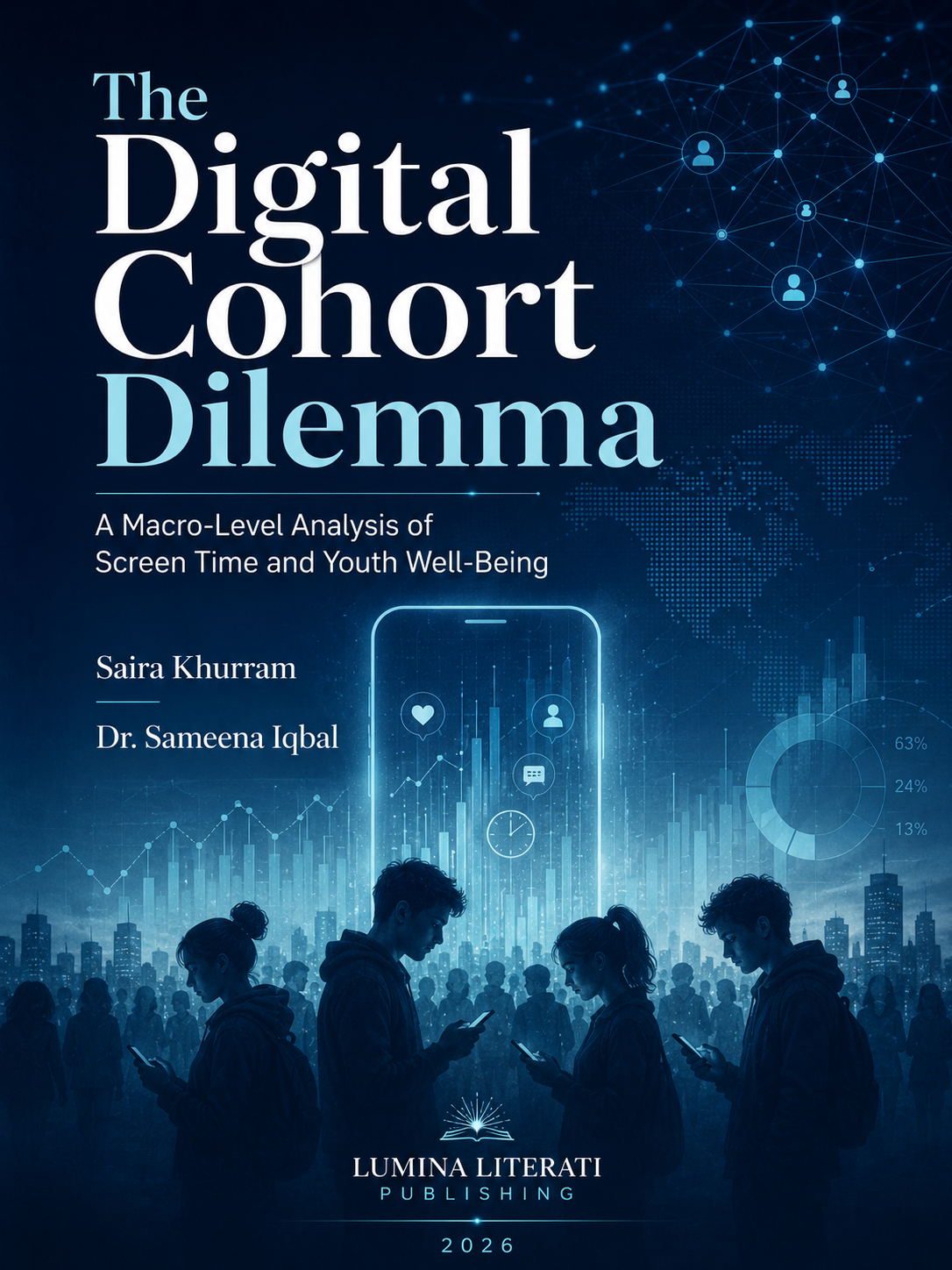
The Digital Cohort Dilemma
A Macro-Level Analysis of Screen Time and Youth Well-Being
Book Overview
The Digital Cohort Dilemma: A Macro-Level Analysis of Screen Time and Youth Well-Being begins from a deceptively simple reframing: the rise in youth screen time is not a failure of individual willpower but a transformation of the environment in which children now grow up. Where public debate reaches for an individual vocabulary — “put the phone down,” “set better limits” — this volume argues that contemporary screen exposure is a structural determinant of well-being, produced by a redesigned childhood in which education, friendship, play, entertainment, and identity have all been re-routed through screen-based systems.
At the heart of the book is the concept of the digital cohort: a birth-year group whose members pass through the critical windows of development under a historically specific technological environment. Drawing on Norman Ryder’s account of cohorts as the vehicle through which history becomes biography, and on life-course epidemiology’s emphasis on the timing, dose, and accumulation of exposure, the book treats birth year not as a destiny but as an index of exposure timing — distinguishing when a technology became available from when it became socially unavoidable.
From this foundation the volume builds outward. It traces the structural shift from scarce screens to ambient saturation; weighs the cross-national epidemiological evidence on dose, duration, and the “displacement cascade” by which mediated time crowds out sleep, movement, and face-to-face contact; documents the institutional vacuum in which schools, healthcare systems, and families were outpaced by the speed of technological diffusion; and examines the attention economy as a structural force whose persuasive design and algorithmic amplification engineer compulsion by intent rather than accident.
Its closing movement is constructive. Extending Bronfenbrenner’s bioecological model to digital ecosystems and applying the precautionary principle to digital childhood, the book advances a population-level policy toolkit, a programme for reconstructing developmental time and space — sleep, movement, and low-bandwidth sociality — and a cohort-responsibility framework that distributes specific duties across technology companies, governments, schools, and researchers.
The central argument is at once diagnosis and call to action: youth screen exposure is not a private habit to be managed by discipline alone, but a structural determinant of a generation’s health — and holding that generation’s development together is a collective responsibility that no single parent, school, or platform can discharge in isolation.
About the Authors
Saira Khurram
Saira Khurram is an educator, researcher, and author whose academic path bridges the biological sciences, psychology, and education. Holding an MSc in Zoology, a BS in Psychology, and a B.Ed, she has established herself as a versatile academic leader specialising in innovative teaching methodologies, curriculum design, and interdisciplinary research.
As Program Leader of Foreign Qualifications at Roots IVY Educational Complex, she guides students through international curricula including IGCSE, O-Level, A-Level, AQA, Pearson Edexcel, IB, and OCR, with a sustained emphasis on fostering critical thinking, integrating technology-based learning, and promoting research engagement among students and faculty alike.
Alongside her leadership in secondary education, she serves as a university lecturer teaching undergraduate and postgraduate psychology modules and supervising research projects across psychology and biology. It is this interdisciplinary vantage — at once educational, biological, and psychological — that she brings to the developmental questions at the heart of this volume.
Dr. Sameena Iqbal
Dr. Sameena Iqbal is a lecturer and trained clinical psychologist with more than thirteen years of experience in psychotherapy, clinical assessment, teaching, and research. Her professional and research work centres on child and adolescent mental health, parenting practices, and the management of disruptive behaviour disorders, culminating in her doctoral thesis on the efficacy of parent–child interventions.
She has published extensively in national and international journals on parenting, student mental health, mindfulness, psycholinguistics, AI and communication, domestic violence, self-esteem, and clinical populations. Her practice integrates evidence-based psychological methods with culturally responsive, research-driven insight across clinical, academic, and community settings.
She holds professional certifications as a Certified Hypnotherapist (NGH, USA), Certified Islamic Psychotherapist, NLP Practitioner (NFNLP, USA), and Behavioral Neuro-Leadership Practitioner, with advanced clinical training in CBT, MMPI-II, Schema Therapy, Narrative Exposure Therapy, and Neurofeedback. She recently established the “Healing Playground” child-psychotherapy lab in the Department of Psychology at IIUI, supporting children’s psychological well-being through community-awareness programmes and direct psychological services.
Endorsements & Reviews
“A bracing reframing of a debate too often reduced to willpower and screen-time limits. By treating digital childhood as a structural determinant of health — and the ‘digital cohort’ as its central unit of analysis — this book gives educators, clinicians, and policymakers the vocabulary the moment demands.”
“Rare is the study that speaks fluently to epidemiology, developmental psychology, and public policy at once. Rigorous about the evidence and honest about its limits, it refuses both moral panic and complacent dismissal — and reframes a debate that has badly needed this clarity.”
“The closing chapters on developmental infrastructure and cohort responsibility are the most practical I have read on this subject. Rather than blaming children or parents, the authors show how schools, platforms, governments, and researchers each carry a share of the duty. Essential reading for anyone raising, teaching, or studying the first fully digital generation.”
Free & Open Access
This scholarly work is available to everyone. Click the cover to start reading our new publication without barriers.
References
Showing 10 of 217 referencesShowing all 217 references