
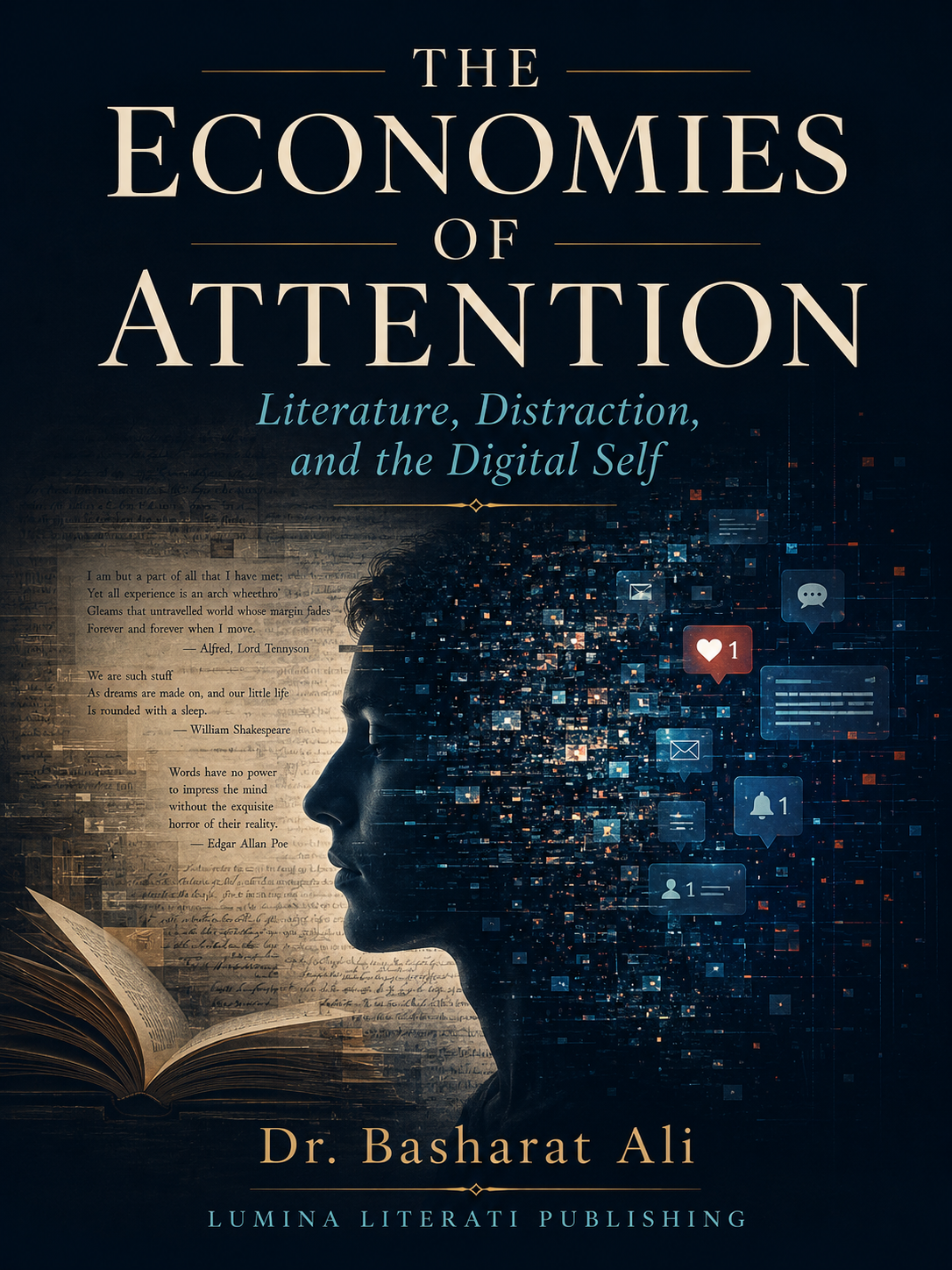
The Economies of Attention
Literature, Distraction, and the Digital Self
Book Overview
The Economies of Attention: Literature, Distraction, and the Digital Self begins from a deceptively simple observation: in an age of digital abundance, the scarcest resource is no longer information but attention itself. Drawing on Herbert Simon’s foundational insight that “a wealth of information creates a poverty of attention,” this volume asks what becomes of literature — and of the reading self — when human focus is fragmented, accelerated, and commodified by the platforms that now mediate so much of our cultural life.
The book opens by mapping the terrain of the attention economy, tracing its lineage from Simon through Georg Franck and Yves Citton and defining the forces — fragmentation, acceleration, and the surveillance and commodification of focus — that condition contemporary reading. It examines the emergence of the “digital self”: an identity continuously curated and performed for metrics of validation, in which Goffman’s dramaturgy of self-presentation is transformed by algorithmic infrastructure, and self-worth becomes tethered to likes, views, and shares.
From there the volume turns to literature itself. It recovers distraction as a recurring literary motif that long predates the smartphone — from Emma Bovary’s restless reading in nineteenth-century provincial France to the sensory overload of the Dickensian city — before confronting the platform era directly: the algorithmic gaze, the metrics of attention, and the “digital cage” in which deep reading must now struggle for a foothold. Its closing movement is constructive, arguing that literature offers not merely a critique of distraction but a practical toolkit for attentional agency and flourishing.
The central argument is at once a defense and a provocation: literature is not a casualty of the attention economy but one of our most enduring resources against it — a sanctuary for sustained thought and a battleground on which the struggle for attentional sovereignty, and for an authentic digital self, is waged.
About the Author
Dr. Basharat Ali
Dr. Basharat Ali is an Assistant Professor (OPS) in the Department of Sociology, Faculty of Arts & Social Sciences, at Government College University, Faisalabad, Pakistan. He holds a Ph.D. in Sociology and brings to his scholarship a sustained commitment to academic excellence in teaching, research, and intellectual inquiry.
His research interests span Digital Sociology, Media and Cultural Studies, Attention Studies, the Sociology of Literature, and Digital Identity, with a particular emphasis on the attention economy, deep reading, and the formation of the self in digital culture. Dr. Ali has contributed to scholarly discourse through research presented at national and international forums and through publications in peer-reviewed outlets.
Working at the intersection of sociology, media studies, and literary inquiry, he examines how digital environments reshape cognition, social interaction, and cultural production. He completed his Ph.D. at Government College University, Faisalabad (2016–2019), following an M.Phil./MS at the University of Agriculture, Faisalabad (2012–2014). His work reflects an enduring belief in the public value of the social sciences and the humanities in an increasingly mediated world.
Endorsements & Reviews
“A timely and erudite intervention. Dr. Ali moves beyond the familiar lament about shrinking attention spans to show how literature itself has always thought about distraction — and why that long history matters now more than ever. Lucid, interdisciplinary, and quietly urgent.”
“Rare is the study that speaks fluently to media studies, sociology, and literary criticism at once. By reading the attention economy through the lens of the novel — and the novel through the lens of the attention economy — this volume reframes a debate too often reduced to moral panic. Essential for scholars of digital culture.”
“The closing chapters on attentional agency are the most hopeful and practical I have read on this subject. Rather than mourning the decline of deep reading, Dr. Ali shows how it can be reclaimed. A vital book for students, educators, and anyone who has felt their focus fracture in the glow of a screen.”
Free & Open Access
This scholarly work is available to everyone. Click the cover to start reading our new publication without barriers.
References
Showing 10 of 83 referencesShowing all 83 references