
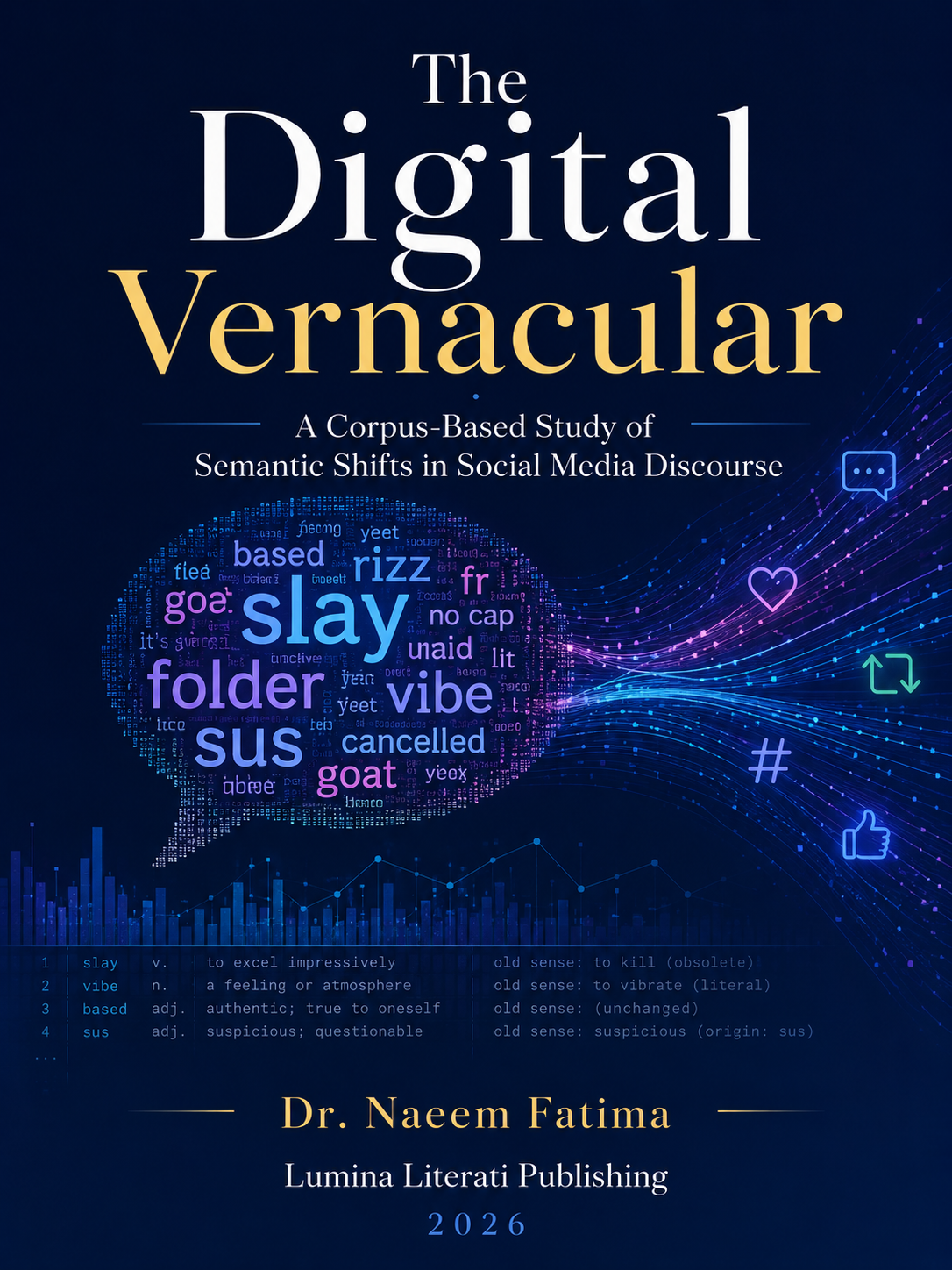
The Digital Vernacular: A Corpus-Based Study of Semantic Shifts in Social Media Discourse – Lumina Literati Publishing
The Digital Vernacular: A Corpus-Based Study of Semantic Shifts in Social Media Discourse book cover

The Digital Vernacular

A Corpus-Based Study of Semantic Shifts in Social Media Discourse

By

Published by Lumina Literati Publishing
Publication Year:
ISBN: 978-627-7813-47-5

Book Overview

The Digital Vernacular: A Corpus-Based Study of Semantic Shifts in Social Media Discourse emerges from the urgent global conversation about how meaning itself is changing in the age of networked communication. While social media is widely recognised as a transformative cultural force, the precise mechanisms by which it accelerates, redirects, and fundamentally restructures the lexicon of contemporary speakers have remained largely under-theorised. This monograph investigates how, why, and at what pace word meanings shift across digital platforms — and what this reveals about the deepening relationship between communication technology and language change.

Drawing on a fifteen-year longitudinal corpus spanning four languages and four major platforms — X (formerly Twitter), Reddit, TikTok, and Instagram — the author moves beyond descriptive accounts of internet slang to construct a rigorous empirical and theoretical framework for the digital vernacular: the hybrid, multimodal third space of practice that has emerged at the intersection of writing and speech, of text and image, of human intention and algorithmic curation. Integrating diachronic word embeddings and computational corpus methods with the deep contextual sensitivities of sociolinguistics and pragmatics, the work distinguishes ephemeral viral variation from durable semantic change, examines how multimodal semiotics co-construct lexical meaning, and tests its findings against typologically distinct linguistic environments through comparative case studies in Spanish, Arabic, and Mandarin Chinese.

This essential volume offers clarity to linguists, computational researchers, lexicographers, language educators, and policymakers, demonstrating that the study of meaning in the twenty-first century requires both the precision of computational scale and the humanism of careful interpretation. It is a sustained argument that the digital vernacular is not a lesser register or a passing fad, but the principal site at which the next chapter of human language is now being written.

About the Author

Dr. Naeem Fatima

Dr. Naeem Fatima is a distinguished educator, researcher, and author with a career spanning over twenty-five years in higher education. She currently serves as the Principal of Fazaia College of Education for Women, Peshawar, where she provides academic and administrative leadership while fostering a transformative learning environment.

Her extensive teaching portfolio encompasses a sophisticated range of subjects, including English Language Teaching, Technical Writing, Functional English, and Research Methodology. In the domain of teacher education, she has profoundly influenced future educators through her courses in Educational Psychology and Teaching Methodology.

As a prolific scholar, Dr. Fatima has authored several influential books that bridge theory and practice. Her publications include Attention Modulation in Reading, Transformative Pedagogies in Higher Education, Theoretical Crossroads: Integrating Formal and Cognitive Approaches to Language, and Use of AI in Social Sciences Research. These works reflect her interdisciplinary approach and her commitment to advancing educational and linguistic thought.

Her research interests are both deep and expansive, firmly rooted in Systemic Functional Linguistics and extending into dynamic, socially relevant applications. Her investigative work includes Interaction Dynamics, Feedback Mechanisms, and Innovative Language Pedagogies, with a particular focus on Translanguaging and Critical Discourse Analysis — exploring themes of language, power, and resistance. Her research portfolio further encompasses an intercultural study of compliments and compliment responses, examinations of the role of technology in teacher–student communication, and investigations into the impact of Project-Based Learning on students’ critical thinking, creativity, and problem-solving skills.

Through her leadership, pedagogy, and scholarship, Dr. Fatima continues to be a vital force in shaping educational practices and linguistic inquiry, dedicated to empowering both students and colleagues through knowledge, critical reflection, and innovative methodologies.

Endorsements & Reviews

“This is a rare monograph that takes the language of the feed seriously, with the methodological care it has long deserved. Dr. Fatima moves between the precision of computational corpus methods and the contextual sensitivity of sociolinguistic analysis with an ease that few scholars working at this intersection have managed. The book sets a new standard for how the digital vernacular ought to be studied.”

“What distinguishes this work is its insistence that meaning change on social media is neither a corruption of language nor merely an acceleration of historical processes — but a phenomenon shaped, in fundamental ways, by the architecture of the platforms themselves. The treatment of multimodality and the cross-linguistic case studies in Spanish, Arabic, and Mandarin Chinese are particularly valuable correctives to the Anglophone bias of the field.”

“A timely and indispensable contribution. Dr. Fatima writes with the authority of a scholar who has spent decades thinking carefully about language, pedagogy, and the lived realities of communication. This volume will be essential reading for linguists, language educators, computational researchers, and anyone seeking to understand how meaning is being remade in the algorithmic present.”

Open Access Promotion – Final Design

Free & Open Access

This scholarly work is available to everyone. Click the cover to start reading our new publication without barriers.

The Digital Vernacular: A Corpus-Based Study of Semantic Shifts in Social Media Discourse

References

Showing 10 of 301 referencesShowing all 301 references

1
Bridges, J. (2021). Explaining “-splain” in digital discourse. Language Under Discussion, 6(1). https://doi.org/10.31885/lud.6.1.253
2
Georgakopoulou, A., & Spilioti, T. (2025). Charting sociolinguistic inquiry in contemporary Greek contexts. Byzantine and Modern Greek Studies, 49(1), 152–161. https://doi.org/10.1017/byz.2024.5
3
Heyd, T. (2014). Folk-linguistic landscapes: The visual semiotics of digital enregisterment. Language in Society, 43(5), 489–514. https://doi.org/10.1017/s0047404514000530
4
Heyd, T., & Schneider, B. (2019). The sociolinguistics of late modern publics. Journal of Sociolinguistics, 23(5), 435–449. https://doi.org/10.1111/josl.12378
5
Ilbury, C. (2022). U Ok Hun?: The digital commodification of white woman style. Journal of Sociolinguistics, 26(4), 483–504. https://doi.org/10.1111/josl.12563
6
Ilbury, C. (2023). The recontextualisation of Multicultural London English: Stylising the ‘roadman.’ Language in Society, 53(3), 395–419. https://doi.org/10.1017/s0047404523000143
7
Kelly‐Holmes, H. (2024). Artificial intelligence and the future of our sociolinguistic work. Journal of Sociolinguistics, 28(5), 3–10. https://doi.org/10.1111/josl.12678
8
LaDousa, C., & Davis, C. P. (2022). South Asian Language Practices: Mother Tongue, Medium, and Media. Annual Review of Anthropology, 51(1), 289–305. https://doi.org/10.1146/annurev-anthro-041420-110048
9
Lillis, T., & McKinney, C. (2013). The sociolinguistics of writing in a global context: Objects, lenses, consequences. Journal of Sociolinguistics, 17(4), 415–439. https://doi.org/10.1111/josl.12046
10
Lutzky, U., & Lawson, R. (2022). Discussing -splain. Language Under Discussion, 6(1). https://doi.org/10.31885/lud.6.1.258
11
Lytra, V. (2019). Revisiting language and religion in a post‐secular world. Journal of Sociolinguistics, 24(1), 126–138. https://doi.org/10.1111/josl.12370
12
Maly, I. (2024). AI, power and sociolinguistics. Journal of Sociolinguistics, 28(5), 11–15. https://doi.org/10.1111/josl.12681
13
Manurung, J., Napitupulu, M. H., & Simangunsong, H. (2022). Exploring the Impact of Slang Usage Among Students on WhatsApp: A Dig-ital Linguistic Analysis. Jurnal Ilmu Pendidikan Dan Humaniora, 11(2), 153–169. https://doi.org/10.35335/jiph.v11i2.21
14
Santos, R. C. dos. (2022). ENSSLIN, A.; BALTEIRO, I. (EDS.). Approaches to Videogame Discourse: Lexis, Interaction, Textuality. New York: Bloomsbury, 2019. 320 p. Bakhtiniana Revista De Estudos Do Discurso, 17(3), 182–188. https://doi.org/10.1590/2176-4573e56675
15
Sapkota, N. (2021). Digital Literacy and Communicative Competence in the New Normal Education. Journal of Nelta Gandaki, 4(1–2), 29–41. https://doi.org/10.3126/jong.v4i1-2.42640
16
Säily, T., Nurmi, A., Palander‐Collin, M., & Auer, A. (2017). The future of historical sociolinguistics? 1–19. https://doi.org/10.1075/ahs.7.01sai
17
Westinen, E. (2017). “Who’s Afraid of the Dark?”: The Ironic Self-Stereotype of the Ethnic Other in Finnish Rap Music. 131–161. https://doi.org/10.1007/978-3-319-59244-2_6
18
Zidjaly, N. A. (2019). Society in digital contexts: New modes of identity and community construction. Multilingua, 38(4), 357–375. https://doi.org/10.1515/multi-2018-0042
19
Carstens, A., & Huyssteen, G. van. (2011). Julie Coleman and Christian J. Kay (Eds.). Lexicology, Semantics and Lexicography: Selected Papers from the Fourth G.L. Brook Symposium, Manchester, August 1998. Lexikos, 12(0). https://doi.org/10.5788/12-0-778
20
Geeraerts, D. (2017). Entrenchment as onomasiological salience. 153–174. https://doi.org/10.1037/15969-008
21
Grondelaers, S., Speelman, D., & Geeraerts, D. (2010). Lexical Variation and Change. https://doi.org/10.1093/oxfordhb/9780199738632.013.0037
22
Hamilton, C. (2016). Dirk Geeraerts, Words and Other Wonders – Papers on Lexical and Semantic Topics. Lexis. https://doi.org/10.4000/lexis.1840
23
Morin, C. (2020). Margaret Winters & Geoffrey Nathan, Cognitive Linguistics for Linguists, Springer International Publishing, 2020. Pp. xi + 81. ISBN 978-3-030-33603-5 (paperback), 978-3-030-33604-2 (E-book). Language and Cognition, 12(3), 564–568. https://doi.org/10.1017/langcog.2020.9
24
Silva, A. S. da. (2020). Complexity, variation and meaning: an integrated view on language and cognition. Gragoatá, 25, 210–243. https://doi.org/10.22409/gragoata.v25iesp.38145
25
Bogetić, K., Batanović, V., & Ljubešić, N. (2022). Untitled. Suvremena Lingvistika, 48(94). https://doi.org/10.22210/suvlin.2022.094
26
Dilkes, J. (2023). Rule 1: Remember the human. A socio-cognitive discourse study of a Reddit forum banned for promoting hate based on identity. Discourse & Society, 35(1), 48–65. https://doi.org/10.1177/09579265231190344
27
D’Arcy, A., & Young, T. M. (2012). Ethics and social media: Implications for sociolinguistics in the networked public1. Journal of Sociolinguistics, 16(4), 532–546. https://doi.org/10.1111/j.1467-9841.2012.00543.x
28
Gertz, H. D. (2023). Collecting migrants’ Facebook posts: Accounting for ethical measures in a text-as-data approach. Frontiers in Sociology, 7. https://doi.org/10.3389/fsoc.2022.932908
29
Gilbert, S., Vitak, J., & Shilton, K. (2021). Measuring Americans’ Comfort With Research Uses of Their Social Media Data. Social Media + Society, 7(3). https://doi.org/10.1177/20563051211033824
30
Marx, J., & Mirbabaie, M. (2022). The Investigator’s Dilemma – A Review of Social Media Analytics Research Ethics in Information Systems. Australasian Journal of Information Systems, 26. https://doi.org/10.3127/ajis.v26i0.3287
31
Stommel, W., & Rijk, L. de. (2021). Ethical approval: none sought. How discourse analysts report ethical issues around publicly available online data. Research Ethics, 17(3), 275–297. https://doi.org/10.1177/1747016120988767
32
Vallejos, E. P., Koene, A., Carter, C., Hunt, D., Woodard, C., Urquhart, L., Bergin, A., & Statache, R. (2017). Accessing Online Data for Youth Mental Health Research: Meeting the Ethical Challenges. Philosophy & Technology, 32(1), 87–110. https://doi.org/10.1007/s13347-017-0286-y
33
Özkula, S. M. (2019). The Issue of “Context”: Data, Culture, and Commercial Context in Social Media Ethics. Journal of Empirical Research on Human Research Ethics, 15(1–2), 77–86. https://doi.org/10.1177/1556264619874646
34
Tam, H. W.-Y., & Tsang, S. C. S. (2023). Cantonese culinary lexical interaction between Hong Kong and Singapore English. English Today, 40(2), 85–96. https://doi.org/10.1017/s0266078423000366
35
AakashSharma, Nilsen, T. B., Brenna, L., Johansen, D., & Johansen, H. D. (n.d.). Accountable Human Subject Research Data Processing using Lohpi. https://doi.org/10.21428/7a45813f.80ebd922
36
Adams, J. B., & Chiarelli, C. A. J. (2021). A guide on extracting and tidying tweets with R. Cadernos De Linguística, 2(4), e410. https://doi.org/10.25189/2675-4916.2021.v2.n4.id410
37
Kondyli, D., & Klironomos, N. (2024). Challenges and opportunities for the re-use of New Data Types (NDTs) in a changing landscape. Επιθεώρηση Κοινωνικών Ερευνών, 193–219. https://doi.org/10.12681/grsr.38517
38
Landi, A., Thompson, M., Giannuzzi, V., Bonifazi, F., Juan, I. L. i, Santos, L. O. B. da S., & Roos, M. (2020). The “A” of FAIR – As Open as Possible, as Closed as Necessary. Data Intelligence, 2(1–2), 47–55. https://doi.org/10.1162/dint_a_00027
39
Lichtenauer, N., Schmidbauer, L., Wilhelm, S., & Wahl, F. (2023). A Scoping Review on Analysis of the Barriers and Support Factors of Open Data. Information, 15(1), 5. https://doi.org/10.3390/info15010005
40
Morehouse, K. N., Kurdi, B., & Nosek, B. A. (2025). Responsible data sharing: Identifying and remedying possible re-identification of human participants. American Psychologist, 80(6), 928–941. https://doi.org/10.1037/amp0001346
41
Morehouse, K., Kurdi, B., & Nosek, B. A. (2023). Responsible data sharing: Identifying and remedying possible re-identification of human participants. https://doi.org/10.31222/osf.io/5m3cx
42
Nguyen, D., Rosseel, L., & Grieve, J. (2021). On learning and representing social meaning in NLP: a sociolinguistic perspective. 603–612. https://doi.org/10.18653/v1/2021.naacl-main.50
43
Sharma, A., Nilsen, T. B., Czerwinska, K. P., Onitiu, D., Brenna, L., Johansen, D., & Johansen, H. D. (2021). Up-to-the-Minute Privacy Policies via Gossips in Participatory Epidemiological Studies. Frontiers in Big Data, 4. https://doi.org/10.3389/fdata.2021.624424
44
Shero, J., Swanz, A., Hanson, A., Hart, S. A., & Logan, J. A. R. (2025). Data Deidentification for Data Sharing in Education and Psychological Research: Importance, Barriers, and Techniques. Aera Open, 11. https://doi.org/10.1177/23328584251352814
45
Shymko, V. (2025). Identifying Key Idiolect Markers in Sociolinguistic Profiling: A Scoping Review and Analytical Framework for Real-world Applications. Sage Open, 15(2). https://doi.org/10.1177/21582440251334276
46
Turper, S. (2023). Big Data in Migration Research: The Ethical Considerations. Istanbul Bilgi University. https://doi.org/10.47613/reflektif.2023.139
47
Zhang, L. (2026). A Study on the Dynamic Evolution of English as an International Language Variant Driven by Big Data. International Journal of Agricultural and Environmental Information Systems, 17(1), 1–19. https://doi.org/10.4018/ijaeis.396952
48
Bakarić, M. B., Prskalo, L. N., & Matetić, M. (2023). Insights Into Automatic Extraction of Metaphorical Collocations. Rasprave Instituta Za Hrvatski Jezik I Jezikoslovlje, 49(1), 1–32. https://doi.org/10.31724/rihjj.49.1.1
49
Edmonds, A., & Gudmestad, A. (2021). Collocational Development during a Stay Abroad. Languages, 6(1), 12. https://doi.org/10.3390/languages6010012
50
Gablasová, D., Březina, V., & McEnery, T. (2017). Collocations in Corpus‐Based Language Learning Research: Identifying, Comparing, and Interpreting the Evidence. Language Learning, 67(S1), 155–179. https://doi.org/10.1111/lang.12225
51
Gribomont, I. (2023). From Diachronic to Contextual Lexical Semantic Change: Introducing Semantic Difference Keywords (SDKs) for Discourse Studies. https://doi.org/10.18653/v1/2023.lchange-1.16
52
Huang, X., & Paul, M. J. (2019). Neural Temporality Adaptation for Document Classification: Diachronic Word Embeddings and Domain Adaptation Models. 4113–4123. https://doi.org/10.18653/v1/p19-1403
53
Inkpen, D., & Hirst, G. (2002). Acquiring collocations for lexical choice between near-synonyms. 9, 67–76. https://doi.org/10.3115/1118627.1118636
54
Kang, B., Chang, B., Chen, Y., & Yu, S. (2005). Extracting Terminologically Relevant Collocations in the Translation of Chinese Monograph. 1017–1028. https://doi.org/10.1007/11562214_88
55
Kolesnikova, O. (2016). Survey of Word Co-occurrence Measures for Collocation Detection. Computación Y Sistemas, 20(3). https://doi.org/10.13053/cys-20-3-2456
56
Lorenzo-Dus, N., Kinzel, A., & Cristofaro, M. D. (2020). The communicative modus operandi of online child sexual groomers: Recurring patterns in their language use. Journal of Pragmatics, 155, 15–27. https://doi.org/10.1016/j.pragma.2019.09.010
57
Lyse, G. I., & Andersen, G. (2012). Collocations and statistical analysis of n-grams. 79–110. https://doi.org/10.1075/scl.49.05lys
58
Oksuz, D. C., Březina, V., & Rebuschat, P. (2020). Collocational Processing in L1 and L2: The Effects of Word Frequency, Collocational Frequency, and Association. Language Learning, 71(1), 55–98. https://doi.org/10.1111/lang.12427
59
Pecina, P. (2005). An extensive empirical study of collocation extraction methods. 13. https://doi.org/10.3115/1628960.1628964
60
Pereira, L., Strafella, E., Duh, K., & Matsumoto, Y. (2014). Identifying collocations using cross-lingual association measures. https://doi.org/10.3115/v1/w14-0819
61
Petrović, S., Šnajder, J., Bašić, B. D., & Kolar, M. (2006). Comparison of Collocation Extraction Measures for Document Indexing. Journal of Computing and Information Technology, 14(4), 321. https://doi.org/10.2498/cit.2006.04.08
62
Roe, J. (2021). Global responsibility: An exploratory corpus assisted discourse analysis of the Rohingya crisis in online media. Journal of Modern Languages, 31(1), 1–21. https://doi.org/10.22452/jml.vol31no1.1
63
Smadja, F., & McKeown, K. (1994). Translating collocations for use in bilingual lexicons. 152. https://doi.org/10.3115/1075812.1075843
64
Suhandano, S., Isti’anah, A., & Febrina, R. (2023). Contesting “growth” and “sustainability” in Indonesia’s capital city relocation: a corpus ecolinguistic study. Research Result Theoretical and Applied Linguistics, 9(3). https://doi.org/10.18413/2313-8912-2023-9-3-0-5
65
Vainshtein, R., Katz, G., Shapira, B., & Rokach, L. (2019). Assessing the Quality of Scientific Papers. https://doi.org/10.48550/arxiv.1908.04200
66
Weichselbraun, A., Scharl, A., & Gindl, S. (2016). Extracting Opinion Targets from Environmental Web Coverage and Social Media Streams. 1040–1048. https://doi.org/10.1109/hicss.2016.133
67
Копотев, М., Klimov, A., & Kisselev, O. (2023). Exploring collocational complexity in L2 Russian: A corpus-driven contrastive analysis. International Journal of Bilingualism, 29(2), 439–455. https://doi.org/10.1177/13670069231168247
68
Akinsanya, T. (2024). MEDIA AND HATE SPEECH: A DISCURSIVE STUDY OF HATE SPEECH ON NAIRALAND FORUM. Sprin Journal of Arts Humanities and Social Sciences, 3(4), 52–61. https://doi.org/10.55559/sjahss.v3i4.268
69
Bolander, B., & Locher, M. A. (2014). Doing sociolinguistic research on computer-mediated data: A review of four methodological issues. Discourse Context & Media, 3, 14–26. https://doi.org/10.1016/j.dcm.2013.10.004
70
Charalampidou, P. (2021). The use of corpora in an interdisciplinary approach to localization. 216–226. https://doi.org/10.26615/978-954-452-071-7_025
71
Jocuns, A. (2019). Multimodality: Foundations, Research and Analysis – A Problem-Oriented Introduction, written by Bateman, John, Janina Wildfeuer, and Tuomo Hiippala (2017). Manusya Journal of Humanities, 22(3), 375–384. https://doi.org/10.1163/26659077-02203006
72
Kelsey, D., & Bennett, L. (2014). Discipline and resistance on social media: Discourse, power and context in the Paul Chambers ‘Twitter Joke Trial.’ Discourse Context & Media, 3, 37–45. https://doi.org/10.1016/j.dcm.2013.12.001
73
Kuswandini, E. (2018). Multimodal Analysis of Car Advertisements. https://doi.org/10.2991/klua-18.2018.52
74
Mestre-Segarra, M.-Á. (2023). A Multimodal Rhetorical Analysis of Video Resumes. Esp Today, 11(2), 349–370. https://doi.org/10.18485/esptoday.2023.11.2.8
75
Mu, J., & Ma, R. (2022). A CiteSpace-based analysis of the application of Critical Discourse Analysis in news discourse. Discourse & Communication, 16(4), 403–425. https://doi.org/10.1177/17504813211070670
76
O’Halloran, K. L., Tan, S., Pham, D.-S., Bateman, J., & Moere, A. V. (2016). A Digital Mixed Methods Research Design: Integrating Multimodal Analysis With Data Mining and Information Visualization for Big Data Analytics. Journal of Mixed Methods Research, 12(1), 11–30. https://doi.org/10.1177/1558689816651015
77
Pan, X., & Yan-yan, J. (2022). Multimodal classroom discourse analysis of TCSL teachers based on ELAN. Curriculum and Teaching Methodology, 5(6). https://doi.org/10.23977/curtm.2022.050616
78
Qin, Y., & Wang, P. (2021). How EFL Teachers Engage Students: A Multimodal Analysis of Pedagogic Discourse During Classroom Lead-Ins. Frontiers in Psychology, 12. https://doi.org/10.3389/fpsyg.2021.793495
79
Smith, C., & Sheyholislami, J. (2022). Current Trends in Critical Discourse Analyses of Textbooks: A Look at Selected Literature. Canadian Journal of Applied Linguistics, 25(1), 47–63. https://doi.org/10.37213/cjal.2022.31515
80
Tan, S., O’Halloran, K. L., & Wignell, P. (2016). Multimodal research: Addressing the complexity of multimodal environments and the challenges for CALL. Recall, 28(3), 253–273. https://doi.org/10.1017/s0958344016000124
81
Tan, S., Smith, B. A., & O’Halloran, K. L. (2015). Online leadership discourse in higher education: A digital multimodal discourse perspective. Discourse & Communication, 9(5), 559–584. https://doi.org/10.1177/1750481315600302
82
Thomas, M. (2020). Multimodality and media archaeology: Complementary optics for looking at digital stuff? Digital Scholarship in the Humanities, 36(2), 482–500. https://doi.org/10.1093/llc/fqaa024
83
Tuominen, T., Hurtado, C. J., & Ketola, A. (2019). Why methods matter: Approaching multimodality in translation research. Linguistica Antverpiensia New Series – Themes in Translation Studies, 17. https://doi.org/10.52034/lanstts.v17i0.522
84
Wang, J., & Jin, G. (2023). Critical discourse studies eleven years on in China (from 2011 to 2021): A critical review. Discourse Studies, 25(3), 361–382. https://doi.org/10.1177/14614456231158519
85
Wilson, A., Wilkes, S., Teramoto, Y., & Hale, S. A. (2023). Multimodal analysis of disinformation and misinformation. Royal Society Open Science, 10(12). https://doi.org/10.1098/rsos.230964
86
Wolbergs, J., & Kasper, B. (2023). Multimodality in Epistemological Foreign Language Research? Two Case Studies in the Field of German as a Foreign and Second Language. Anglica Wratislaviensia, 61(1), 107–125. https://doi.org/10.19195/0301-7966.61.1.6
87
Aldayel, A., & Magdy, W. (2022). Characterizing the role of bots’ in polarized stance on social media. Social Network Analysis and Mining, 12(1). https://doi.org/10.1007/s13278-022-00858-z
88
Antenore, M., Camacho, J. M., & Panizzi, E. (2022). A Comparative Study of Bot Detection Techniques With an Application in Twitter Covid-19 Discourse. Social Science Computer Review, 41(5), 1520–1545. https://doi.org/10.1177/08944393211073733
89
Ferrara, E. (2017). Disinformation and Social Bot Operations in the Run Up to the 2017 French Presidential Election. SSRN Electronic Journal. https://doi.org/10.2139/ssrn.2995809
90
Hickey, D., Schmitz, M., Fessler, D. M. T., Smaldino, P. E., Murić, G., & Burghardt, K. (2023). Auditing Elon Musk’s Impact on Hate Speech and Bots. Proceedings of the International Aaai Conference on Web and Social Media, 17, 1133–1137. https://doi.org/10.1609/icwsm.v17i1.22222
91
Horvát, E.-Á., & Hargittai, E. (2021). Birds of a Feather Flock Together Online: Digital Inequality in Social Media Repertoires. Social Media + Society, 7(4). https://doi.org/10.1177/20563051211052897
92
Martini, F., Samula, P., Keller, T., & Klinger, U. (2021). Bot, or not? Comparing three methods for detecting social bots in five political discourses. Big Data & Society, 8(2). https://doi.org/10.1177/20539517211033566
93
Ng, L. H. X., & Carley, K. M. (2023). BotBuster: Multi-Platform Bot Detection Using a Mixture of Experts. Proceedings of the International Aaai Conference on Web and Social Media, 17, 686–697. https://doi.org/10.1609/icwsm.v17i1.22179
94
Rauchfleisch, A., & Kaiser, J. (2020). The False positive problem of automatic bot detection in social science research. Plos One, 15(10), e0241045. https://doi.org/10.1371/journal.pone.0241045
95
Reuter, K., Leyderman, M., Billinson, E. P., Wallace, J., Moran, M. B., & Milam, J. (2025). Associations Between Characteristics of Adolescent and Young Adult Cancer Survivors and Their Use of Different Social Media Platforms: An Observational Study of Social Media Accounts. Journal of Adolescent and Young Adult Oncology, 14(3), 253–264. https://doi.org/10.1089/jayao.2023.0159
96
Sayyadiharikandeh, M. (2020). Detection of Novel Social Bots by Ensembles of Specialized Classifiers. https://doi.org/10.48550/arxiv.2006.06867
97
Seckin, O. C., Atalay, A. S., Otenen, E., Duygu, U., & Varol, O. (2024). Mechanisms Driving Online Vaccine Debate During the COVID-19 Pandemic. Social Media + Society, 10(1). https://doi.org/10.1177/20563051241229657
98
Shevtsov, A., Oikonomidou, M., Antonakaki, D., Pratikakis, P., Kanterakis, A., Fragopoulou, P., & Ioannidis, S. (2022). Discovery and Classification of Twitter Bots. Sn Computer Science, 3(3). https://doi.org/10.1007/s42979-022-01154-5
99
Tang, A., Kwak, J., Xiao, L., Xie, B., Lahiri, S., Flynn, O., & Murugadass, A. (2023). Online Health Information Wants of Caregivers for Persons With Dementia in Social Media. Sage Open, 13(4). https://doi.org/10.1177/21582440231205367
100
Yang, K., Varol, O., Davis, C. A., Ferrara, E., Flammini, A., & Menczer, F. (2019). Arming the public with artificial intelligence to counter social bots. Human Behavior and Emerging Technologies, 1(1), 48–61. https://doi.org/10.1002/hbe2.115
101
Yang, K., Varol, O., Hui, P.-M., & Menczer, F. (2020). Scalable and Generalizable Social Bot Detection through Data Selection. Proceedings of the Aaai Conference on Artificial Intelligence, 34(01), 1096–1103. https://doi.org/10.1609/aaai.v34i01.5460 1 The Moral Economy of Austerity: Analysing UK Welfare Reform. (2021). 28–50. https://doi.org/10.1515/9780228007586-004
102
Davoudi, S., Galland, D., & Stead, D. (2019). Reinventing planning and planners: Ideological decontestations and rhetorical appeals. Planning Theory, 19(1), 17–37. https://doi.org/10.1177/1473095219869386
103
Dukalskis, A., & Gerschewski, J. (2018). Adapting or Freezing? Ideological Reactions of Communist Regimes to a Post-Communist World. Government and Opposition, 55(3), 511–532. https://doi.org/10.1017/gov.2018.40
104
Finlayson, A. (2012). Rhetoric and the Political Theory of Ideologies. Political Studies, 60(4), 751–767. https://doi.org/10.1111/j.1467-9248.2012.00948.x
105
Gautier, A. (2018). Historically contested concepts: A conceptual history of philanthropy in France, 1712-1914. Theory and Society, 48(1), 95–129. https://doi.org/10.1007/s11186-018-09335-z
106
Gunnell, J. G. (2017). Political Concepts and the Concept of the Political. Teoria Polityki, 1. https://doi.org/10.4467/00000000tp.17.0010.6589
107
Morris, L. (2016). The moral economy of austerity: analysing UK welfare reform. British Journal of Sociology, 67(1), 97–117. https://doi.org/10.1111/1468-4446.12186
108
Pilipets, E., & Paasonen, S. (2024). Memetic commenting: Armenian curses and the Twitter theatre of Trump’s deselection. International Journal of Cultural Studies, 27(3), 302–322. https://doi.org/10.1177/13678779231220397
109
Richardson, J., Giraud, E. H., Poole, E., & Quincey, E. de. (2024). ‘Hypocrite!’ Affective and argumentative engagement on Twitter, following the Christchurch terrorist attack. Media Culture & Society, 46(6), 1105–1123. https://doi.org/10.1177/01634437241229322
110
Riedl, M., Joseff, K., Soorholtz, S., & Woolley, S. (2022). Platformed antisemitism on Twitter: Anti-Jewish rhetoric in political discourse surrounding the 2018 US midterm election. New Media & Society, 26(4), 2213–2233. https://doi.org/10.1177/14614448221082122
111
Shepherd, E. (2017). Continuity and change in the institution of town and country planning: Modelling the role of ideology. Planning Theory, 17(4), 494–513. https://doi.org/10.1177/1473095217737587
112
Shepherd, E., Inch, A., & Marshall, T. (2020). Narratives of power: Bringing ideology to the fore of planning analysis. Planning Theory, 19(1), 3–16. https://doi.org/10.1177/1473095219898865
113
Starbird, K., DiResta, R., & DeButts, M. (2023). Influence and Improvisation: Participatory Disinformation during the 2020 US Election. Social Media + Society, 9(2). https://doi.org/10.1177/20563051231177943
114
Thunø, M., Nielbo, K. L., Paulsen, L. B., & Yang, C. (2025). The memeification of China’s Twitter diplomacy, 2019–2022: Adding memes to the toolkit of China’s wolf warrior diplomats. Global Media and Communication, 21(1), 9–30. https://doi.org/10.1177/17427665251316027
115
Wilde, P. de. (2018). The making of four ideologies of globalization. European Political Science Review, 11(1), 1–18. https://doi.org/10.1017/s1755773918000164
116
Ziegler, R. (2020). Introduction to innovation and ethics: a collaborative philosophy. https://doi.org/10.4337/9781789904543.00005
117
Adolfsson, J. S., & Madsen, O. J. (2019). “Nowadays there is gender”: “Doing” global gender equality in rural Malawi. Theory & Psychology, 30(1), 56–76. https://doi.org/10.1177/0959354319879507
118
Baes, N., Haslam, N., & Vylomova, E. (2023). Semantic Shifts in Mental Health-Related Concepts. 119–128. https://doi.org/10.18653/v1/2023.lchange-1.13
119
Baes, N., Vylomova, E., Zyphur, M. J., & Haslam, N. (2023). The semantic inflation of “trauma” in psychology. Psychology of Language and Communication, 23–45. https://doi.org/10.58734/plc-2023-0002
120
Beeker, T., Witeska-Młynarczyk, A., Meerman, S. te, & Mills, C. (2023). Editorial: Psychiatrization of society. Frontiers in Sociology, 8. https://doi.org/10.3389/fsoc.2023.1258264
121
Dakin, B. C., McGrath, M. J., Rhee, J. J., & Haslam, N. (2022). Broadened Concepts of Harm Appear Less Serious. Social Psychological and Personality Science, 14(1), 72–83. https://doi.org/10.1177/19485506221076692
122
Haslam, N., Tse, J. S. Y., & Deyne, S. D. (2021). Concept Creep and Psychiatrization. Frontiers in Sociology, 6. https://doi.org/10.3389/fsoc.2021.806147
123
Haslam, N., Vylomova, E., Zyphur, M. J., & Kashima, Y. (2021). The cultural dynamics of concept creep. American Psychologist, 76(6), 1013–1026. https://doi.org/10.1037/amp0000847
124
McGrath, M. J., & Haslam, N. (2020). Development and validation of the Harm Concept Breadth Scale: Assessing individual differences in harm inflation. Plos One, 15(8), e0237732. https://doi.org/10.1371/journal.pone.0237732
125
Pišl, V., Bucur, A.-M., & Podină, I. R. (2025). Revisiting the Semantic Severity of Anxiety and Depression: Computational Linguistic Study of Normalization and Pathologization. Journal of Medical Internet Research, 27, e73950–e73950. https://doi.org/10.2196/73950
126
Proceedings of the 4th Workshop on Computational Approaches to Historical Language Change. (2023). https://doi.org/10.18653/v1/2023.lchange-1
127
Rey, A., & Tan, J. (2025). Social Media in Dermatology and Skin Health: Challenges and Opportunities. Jeadv Clinical Practice, 4(S1). https://doi.org/10.1002/jvc2.70096
128
Saini, M., Deutsch, R. M., & Drozd, L. M. (2023). Defining points and transformative turns in family violence, parenting and coparenting disputes. Family Court Review, 62(1), 146–159. https://doi.org/10.1111/fcre.12770
129
Sarı, B. (2025). The Rise of Influencer Practices Among Psychologists: From Therapy Rooms to Instagram Reels. Social Media + Society, 11(2). https://doi.org/10.1177/20563051251353741
130
Sashittal, N. (2023). The enigma of caste atrocities. Oñati Socio-Legal Series, 13(1), 89–126. https://doi.org/10.35295/osls.iisl/0000-0000-0000-1332
131
Stulikova, H., & Dawson, M. (2022). Stretching the Double Hermeneutic: A Critical Examination of Lay Meanings of ‘Emotional Labour.’ Sociological Research Online, 28(4), 1130–1148. https://doi.org/10.1177/13607804221138578
132
Xiao, Y., Baes, N., Vylomova, E., & Haslam, N. (2023). Have the concepts of ‘anxiety’ and ‘depression’ been normalized or pathologized? A corpus study of historical semantic change. Plos One, 18(6), e0288027. https://doi.org/10.1371/journal.pone.0288027
133
Yoon, D. Y., Gil, S., Trumbull, J., & Lim, S. (2024). TikTok and the Prevalence of Self-Diagnoses and Psychological Disorders Among Teen Users. Journal of Student Research, 13(1). https://doi.org/10.47611/jsrhs.v13i1.6317
134
Bogetić, K. (2019). Stylized Quotations as Parodic Practice in Teenage Dating Blogs: Stylizing Patterns, Quotative Marking and Language-Ideological Meanings. Belgrade English Language and Literature Studies, 11, 45–68. https://doi.org/10.18485/bells.2019.11.2
135
Calhoun, K., & Yoo, J. (2024). African American English, racialized femininities, and Asian American identity in Ali Wong’s Baby Cobra. Journal of Sociolinguistics, 28(4), 64–84. https://doi.org/10.1111/josl.12673
136
Callesano, S. (2023). Mediated Bricolage and the Sociolinguistic Co-Construction of No Sabo Kids. Languages, 8(3), 206. https://doi.org/10.3390/languages8030206
137
Chau, D. (2021). Spreading language ideologies through social media: Enregistering the ‘fake ABC’ variety in Hong Kong. Journal of Sociolinguistics, 25(4), 596–616. https://doi.org/10.1111/josl.12486
138
Denis, D., & Elango, V. (2024). ‘If ur from Toronto you’ll understand’: register change and metadiscursive engagement with mediatized Multicultural Toronto English. English Language and Linguistics, 28(4), 774–797. https://doi.org/10.1017/s1360674324000509
139
Donzelli, A., & Bugden, A. P. (2019). The “Tiny Hand” of Donald Trump and the Metapragmatics of Typographic Parody. Signs and Society, 7(2), 217–244. https://doi.org/10.1086/702567
140
D’Onofrio, A. (2020). Personae in sociolinguistic variation. Wiley Interdisciplinary Reviews Cognitive Science, 11(6). https://doi.org/10.1002/wcs.1543
141
Gerwin, J. (2024). The role of dialect in comedy performances: focus on enregisterment and humor. English Language and Linguistics, 28(4), 751–773. https://doi.org/10.1017/s1360674324000492
142
Ilbury, C. (2019). “Sassy Queens”: Stylistic orthographic variation in Twitter and the enregisterment ofAAVE. Journal of Sociolinguistics, 24(2), 245–264. https://doi.org/10.1111/josl.12366
143
Ilbury, C. (2022). U Ok Hun?: The digital commodification of white woman style. Journal of Sociolinguistics, 26(4), 483–504. https://doi.org/10.1111/josl.12563
144
Ilbury, C. (2023). The recontextualisation of Multicultural London English: Stylising the ‘roadman.’ Language in Society, 53(3), 395–419. https://doi.org/10.1017/s0047404523000143
145
Johnstone, B. (2016). Enregisterment: How linguistic items become linked with ways of speaking. Language and Linguistics Compass, 10(11), 632–643. https://doi.org/10.1111/lnc3.12210
146
Ludemann, D. (2024). “Creatures of kek:” Affordance and enregisterment within “kek” on 4chan’s “/pol/” board. Journal of Linguistic Anthropology, 34(3), 396–419. https://doi.org/10.1111/jola.12443
147
Pinta, J. (2023). Correntino Spanish Memes and the Enregisterment of Argentine Guarani Loanwords. Languages, 8(3), 165. https://doi.org/10.3390/languages8030165
148
Squires, L. (2010). Enregistering internet language. Language in Society, 39(4), 457–492. https://doi.org/10.1017/s0047404510000412
149
Yu, Z., & Starr, R. L. (2025). Clip Voice: Misogyny and the Renegotiation of a Gendered Vocal Style in Chinese Digital Discourse. Journal of Sociolinguistics, 29(5), 348–359. https://doi.org/10.1111/josl.12715
150
Benczes, R., & Burridge, K. (2015). Current Attitudes to Ageing as Reflected in the Names of Australian Aged Care Facilities. Names, 63(3), 127–145. https://doi.org/10.1179/0027773815z.000000000108
151
Burns, J. R. (2023). ‘Slaves’ and ‘Slave Owners’ or ‘Enslaved People’ and ‘Enslavers’? Transactions of the Royal Historical Society, 2, 371–388. https://doi.org/10.1017/s0080440123000282
152
Felt, C., & Riloff, E. (2020). Recognizing Euphemisms and Dysphemisms Using Sentiment Analysis. https://doi.org/10.18653/v1/2020.figlang-1.20
153
Gavidia, M., Lee, P. P. C., Feldman, A., & Peng, J. (2022). CATs are Fuzzy PETs: A Corpus and Analysis of Potentially Euphemistic Terms. https://doi.org/10.48550/arxiv.2205.02728
154
Hamilton, C., & Foltzer, A.-S. (2021). On Euphemisms, Linguistic Creativity, and Humor. Lexis, 17. https://doi.org/10.4000/lexis.5355
155
Inomovna, H. I. (2023). Semantic changes of English Euphemisms. Journal of Advanced Zoology, 44(S6), 1794–1800. https://doi.org/10.17762/jaz.v44is6.2620
156
Jamet, D. (2018). The Neological Functions of Disease Euphemisms in English and French: Verbal Hygiene or Speech Pathology? Lexis, 12. https://doi.org/10.4000/lexis.2397
157
Kapron-King, A., & Xu, Y. (2021a). A diachronic evaluation of gender asymmetry in euphemism. https://doi.org/10.48550/arxiv.2106.02083
158
Kapron-King, A., & Xu, Y. (2021b). A quantitative evaluation of gender asymmetry in euphemism. https://doi.org/10.31234/osf.io/d4k6r
159
Kauffman, J. M., Anastasiou, D., Burke, M. D., Felder, M., Hornby, G., Lopes, J., & Wiley, A. (2023). Adventures in Naming EBD Realities: How Words Matter for Special Education. Journal of Emotional and Behavioral Disorders, 32(1), 3–13. https://doi.org/10.1177/10634266231172929
160
Lee, P. P. C., Feldman, A., & Peng, J. (2022). A Report on the Euphemisms Detection Shared Task. 184–190. https://doi.org/10.18653/v1/2022.flp-1.27
161
Nagy, I. K. (2021). Rectifying Language? Snarl Words and Politically Incorrect Language. Acta Universitatis Sapientiae Philologica, 13(2), 130–146. https://doi.org/10.2478/ausp-2021-0017
162
Nowak-Michalska, J. (2020). The Dynamics of Euphemisation in Legal Language: An Analysis of Legal Terms Referring to People with Disabilities Used in Poland and Spain. International Journal for the Semiotics of Law – Revue Internationale De Sémiotique Juridique, 33(3), 559–580. https://doi.org/10.1007/s11196-020-09699-5
163
Terry, A. (2020). Metaphtonymies We Die by: the Influence of the Interactions between Metaphor and Metonymy on Semantic Change in X‑phemistic Conceptualisations of Death. Lexis, 16. https://doi.org/10.4000/lexis.4558
164
Tschapka, L. (2018). “Political Correctness” – A Threat to Free Speech? Overcoming the Dilemma. https://doi.org/10.33107/ubt-ic.2018.385
165
Turitsyna, O. (2022). The Issue of Politically Correct Language in Mass and Social Media. Mìžnarodnij Fìlologìčnij Časopis, 13(4). https://doi.org/10.31548/philolog13(4_2).2022.007
166
Vejdemo, S., & Hörberg, T. (2016). Semantic Factors Predict the Rate of Lexical Replacement of Content Words. Plos One, 11(1), e0147924. https://doi.org/10.1371/journal.pone.0147924
167
Alrikabi, A. A. A.-K., & Yasir, N. S. (2021). Sarcasm in selected modern short stories: A pragmatic Analysis. Journal of Education College Wasit University, 1(44), 543–564. https://doi.org/10.31185/eduj.vol1.iss44.2302
168
Banasik‐Jemielniak, N., & Kałowski, P. (2022). Socio-cultural and individual factors in verbal irony use and understanding: What we know, what we don’t know, what we want to know. Review of Communication Research, 10. https://doi.org/10.12840/issn.2255-4165.036
169
Batoréo, H. K. J. (2017). Irony in language use and communication. https://doi.org/10.1075/ftl.1
170
Burgers, C., Lavalette, K. Y. R. de, & Steen, G. J. (2018). Metaphor, hyperbole, and irony: Uses in isolation and in combination in written discourse. Journal of Pragmatics, 127, 71–83. https://doi.org/10.1016/j.pragma.2018.01.009
171
Chubaryan, A., & Danielyan, H. (2022). SARCASM AS AN INDEPENDENT PRAGMATIC CATEGORY OF NONLITERAL LANGUAGE. Foreign Languages in Higher Education, 26(1), 3–14. https://doi.org/10.46991/flhe/2022.26.1.003
172
Dynel, M. (2017). The Irony of Irony: Irony Based on Truthfulness. Corpus Pragmatics, 1(1), 3–36. https://doi.org/10.1007/s41701-016-0003-6
173
Giordano, M., & Marongiu, M. A. (2023). Netlore, Memes and the Pandemic: Adjusting Virtually to the New Normal. Lingue Culture Mediazioni – Languages Cultures Mediation (Lcm Journal), 10(2). https://doi.org/10.7358/lcm-2023-002-gima
174
Goddard, C., & Levisen, C. (2023). Contrastive Metapragmatics and the Shifting Semantics of “Sarcasm” in English and Danish. Contrastive Pragmatics, 6(2), 364–387. https://doi.org/10.1163/26660393-bja10107
175
Hallmann, K., Kunneman, F., Liebrecht, C., Bosch, A. van den, & Mulken, M. J. P. van. (2016). Sarcastic Soulmates. Linguistic Issues in Language Technology, 14. https://doi.org/10.33011/lilt.v14i.1405
176
Hasyim, N. N., & Hanidar, S. (2022). Verbal Irony in a TV Series The Office (US) Season 2. Lexicon, 9(2), 63. https://doi.org/10.22146/lexicon.v9i2.68005
177
Hew, J., Tarighat, A., Corley, M., & Horne, Z. (2024). Examining structural and semantic predictors of announced sarcasm on r/AskReddit. https://doi.org/10.31234/osf.io/f42mr
178
Kałowski, P. (2020). Polish Psychological Bulletin. https://doi.org/10.24425/ppb.2020.135465
179
Konyaeva, Y., & Samsonova, A. A. (2021). Sarcastic evaluation in mass media as a way of discrediting a person: Greta Thunberg case. European Journal of Humour Research, 9(1), 74–86. https://doi.org/10.7592/ejhr2021.9.1.konyaeva
180
Kwon, W., Mackay, R. R., Clarke, I., Wodak, R., & Vaara, E. (2020). Testing, stretching, and aligning: Using ‘ironic personae’ to make sense of complicated issues. Journal of Pragmatics, 166, 44–58. https://doi.org/10.1016/j.pragma.2020.06.001
181
Makarla, P. R., Joergensen, G. H., Tyner, K. B., Sprinkle, C., & Rothermich, K. (2024). Differences in politeness perception of irony and prosocial lies: Exploring the role of age, gender, and geographic location. Canadian Journal of Experimental Psychology/Revue Canadienne De Psychologie Expérimentale, 78(2), 100–113. https://doi.org/10.1037/cep0000324
182
McLean, C. A. (2024). Making an Influence: Sponsorship and Creolization on Social Media. Reading Research Quarterly, 59(3), 228–256. https://doi.org/10.1002/rrq.559
183
Milanowicz, A., Tarnowski, A., & Bokus, B. (2017). When Sugar-Coated Words Taste Dry: The Relationship between Gender, Anxiety, and Response to Irony. Frontiers in Psychology, 8. https://doi.org/10.3389/fpsyg.2017.02215
184
O’Neil, D. (2019). The Middle English Creolization Hypothesis: Persistence, Implications, and Language Ideology. Studia Anglica Posnaniensia, 54(1), 113–132. https://doi.org/10.2478/stap-2019-0006
185
Pfeifer, V. A., & Pexman, P. M. (2023). When It Pays to Be Insincere: On the Benefits of Verbal Irony. Current Directions in Psychological Science, 33(1), 43–50. https://doi.org/10.1177/09637214231205312
186
Reyes, A., & Rosso, P. (2012). Making objective decisions from subjective data: Detecting irony in customer reviews. Decision Support Systems, 53(4), 754–760. https://doi.org/10.1016/j.dss.2012.05.027
187
Shoaps, R. (2022). “Moral irony.” Pragmatics Quarterly Publication of the International Pragmatics Association (Ipra), 297–335. https://doi.org/10.1075/prag.17.2.05sho
188
Skalicky, S. (2022). Liquid Gold Down the Drain: Measuring Perceptions of Creativity Associated with Figurative Language and Play. Cognitive Semantics, 8(1), 79–108. https://doi.org/10.1163/23526416-bja10018
189
Yehorova, O., Prokopenko, A. V., & Zinchenko, A. (2023). Towards a typology of humorous wartime tweets. European Journal of Humour Research, 11(1), 1–26. https://doi.org/10.7592/ejhr.2023.11.1.746
190
Benor, S. B. (2010). Ethnolinguistic repertoire: Shifting the analytic focus in language and ethnicity1. Journal of Sociolinguistics, 14(2), 159–183. https://doi.org/10.1111/j.1467-9841.2010.00440.x
191
Bleaman, I. L. (2020). Implicit Standardization in a Minority Language Community: Real-Time Syntactic Change among Hasidic Yiddish Writers. Frontiers in Artificial Intelligence, 3. https://doi.org/10.3389/frai.2020.00035
192
Brunila, M., & LaViolette, J. (2022). What company do words keep? Revisiting the distributional semantics of J.R. Firth & Zellig Harris. https://doi.org/10.48550/arxiv.2205.07750
193
CH-Wang, S., & Jurgens, D. (2021). Using Sociolinguistic Variables to Reveal Changing Attitudes Towards Sexuality and Gender. https://doi.org/10.48550/arxiv.2109.11061
194
Callesano, S. (2023). Mediated Bricolage and the Sociolinguistic Co-Construction of No Sabo Kids. Languages, 8(3), 206. https://doi.org/10.3390/languages8030206
195
Cutler, C. (2019). Metapragmatic comments and orthographic performances of a New York accent on YouTube. World Englishes, 39(1), 36–53. https://doi.org/10.1111/weng.12444
196
Grieve, J., Bartl, S., Fuoli, M., Grafmiller, J., Huang, W., Jawerbaum, A., Murakami, A., Perlman, M., Roemling, D., & Winter, B. (2025). The sociolinguistic foundations of language modeling. Frontiers in Artificial Intelligence, 7. https://doi.org/10.3389/frai.2024.1472411
197
Ilbury, C. (2019). “Sassy Queens”: Stylistic orthographic variation in Twitter and the enregisterment ofAAVE. Journal of Sociolinguistics, 24(2), 245–264. https://doi.org/10.1111/josl.12366
198
Ilbury, C. (2022). U Ok Hun?: The digital commodification of white woman style. Journal of Sociolinguistics, 26(4), 483–504. https://doi.org/10.1111/josl.12563
199
Ilbury, C. (2023). The recontextualisation of Multicultural London English: Stylising the ‘roadman.’ Language in Society, 53(3), 395–419. https://doi.org/10.1017/s0047404523000143
200
Jones, L. (2014). “Dolls or teddies?” Journal of Language and Sexuality, 3(2), 161–190. https://doi.org/10.1075/jls.3.2.01jon
201
King, S. (2020). From African American Vernacular English to African American Language: Rethinking the Study of Race and Language in African Americans’ Speech. Annual Review of Linguistics, 6(1), 285–300. https://doi.org/10.1146/annurev-linguistics-011619-030556
202
Lawson, R. (2011). Patterns of linguistic variation among Glaswegian adolescent males1. Journal of Sociolinguistics, 15(2), 226–255. https://doi.org/10.1111/j.1467-9841.2011.00477.x
203
Lucy, L., & Bamman, D. (2021a). Characterizing English Variation across Social Media Communities with BERT. Transactions of the Association for Computational Linguistics, 9, 538–556. https://doi.org/10.1162/tacl_a_00383
204
Lucy, L., & Bamman, D. (2021b). Characterizing English Variation across Social Media Communities with BERT. https://doi.org/10.48550/arxiv.2102.06820
205
Meyerhoff, M., & Ehrlich, S. (2019). Language, Gender, and Sexuality. Annual Review of Linguistics, 5(1), 455–475. https://doi.org/10.1146/annurev-linguistics-052418-094326
206
Nguyen, D., Doğruöz, A. S., Rosé, C. P., & Jong, F. de. (2016). Computational Sociolinguistics: A Survey. Computational Linguistics, 42(3), 537–593. https://doi.org/10.1162/coli_a_00258
207
Pavalanathan, U., Fitzpatrick, J., Kiesling, S. F., & Eisenstein, J. (2017). A Multidimensional Lexicon for Interpersonal Stancetaking. https://doi.org/10.18653/v1/p17-1082
208
Ray, B. (2015). Stylizing Genderlect Online for Social Action. Written Communication, 33(1), 42–67. https://doi.org/10.1177/0741088315621238
209
Schneier, J. (2021). Digital Articulation: Examining Text-Based Linguistic Performances in Mobile Communication Through Keystroke-Logging Analysis. Frontiers in Artificial Intelligence, 3. https://doi.org/10.3389/frai.2020.539920
210
Cohn, N., & Schilperoord, J. (2022). Remarks on Multimodality: Grammatical Interactions in the Parallel Architecture. Frontiers in Artificial Intelligence, 4. https://doi.org/10.3389/frai.2021.778060
211
Cohn, N., Engelen, J., & Schilperoord, J. (2019). The grammar of emoji? Constraints on communicative pictorial sequencing. Cognitive Research Principles and Implications, 4(1). https://doi.org/10.1186/s41235-019-0177-0
212
Fainstein, P. E. (2021). McCulloch, Gretchen, Because Internet: Understanding the New Rules of Language. Revista Estudios Del Discurso Digital (Redd), (4), 146–156. https://doi.org/10.24197/redd.4.2021.146-156
213
Gawne, L., & McCulloch, G. (2023). Communicating about linguistics using lingcomm‐driven evidence: Lingthusiasm podcast as a case study. Language and Linguistics Compass, 17(5). https://doi.org/10.1111/lnc3.12499
214
Junor, R. A. C. (2021). Gap Intepretation About Period Punctuation in Instant Messages Among Indonesian Generation. Jurnal Media Dan Komunikasi, 1(2), 83. https://doi.org/10.20473/medkom.v1i2.26376
215
Karlsson, S. (2019). Rec. av McCulloch, Gretchen: Because Internet. Understanding the New Rules of Language. 326 s. Riverhead Books. New York 2017. ISBN 987-0-7352-1093-6. Språk Och Stil, NF 29. https://doi.org/10.33063/diva-399816
216
Kopacewicz, K., & Krumholc, T. (2022). EMOJI I EMOTIKONY W APLIKACJI RANDKOWEJ TINDER – ANALIZA OPISÓW MĘŻCZYZN. Socjolingwistyka, 36, 263–279. https://doi.org/10.17651/socjoling.36.15
217
Logi, L., & Zappavigna, M. (2021). A social semiotic perspective on emoji: How emoji and language interact to make meaning in digital messages. New Media & Society, 25(12), 3222–3246. https://doi.org/10.1177/14614448211032965
218
Marko, K. (2022). “Depends on Who I’m Writing To” The Influence of Addressees and Personality Traits on the Use of Emoji and Emoticons, and Related Implications for Forensic Authorship Analysis. Frontiers in Communication, 7. https://doi.org/10.3389/fcomm.2022.840646
219
McDonald, L. (2024). Making Sense of Emoji. Philosophy, 99(3), 413–435. https://doi.org/10.1017/s0031819124000135
220
Miller, H., Kluver, D., Thebault-Spieker, J., Terveen, L., & Hecht, B. (2017). Understanding Emoji Ambiguity in Context: The Role of Text in Emoji-Related Miscommunication. Proceedings of the International Aaai Conference on Web and Social Media, 11(1), 152–161. https://doi.org/10.1609/icwsm.v11i1.14901
221
Sampietro, A. (2024). Languaging in Multimodal Digital Interaction: An Enactive Exploration of Emoji Metaphors and Meanings. Signifiances, 7(1). https://doi.org/10.52497/signifiances.v7i1.365
222
Shalevska, E. (2023). THE GEN Z INTERNET SLANG AND EFL SPEAKERS: THE CASE OF N. MACEDONIA. Horizons – International Scientific Journal, 1(1), 179–192. https://doi.org/10.20544/horizons.1.1.23.p16
223
Soriano, E. (2024). Un Political Compass de los estudios sobre memes. Teknokultura Revista De Cultura Digital Y Movimientos Sociales, Avance en línea, 1–12. https://doi.org/10.5209/tekn.92391
224
Tomenchuk, M., & Tiushka, T. (2024). THE IMPACT OF TIKTOK ON ENGLISH LANGUAGE: SLANG AND TRENDS. Věda a Perspektivy, (11(42)). https://doi.org/10.52058/2695-1592-2024-11(42)-441-447
225
Bosco, F. M., Angeleri, R., Colle, L., Sacco, K., & Bara, B. G. (2013). Communicative abilities in children: An assessment through different phenomena and expressive means. Journal of Child Language, 40(4), 741–778. https://doi.org/10.1017/s0305000913000081
226
Bryant, G. A. (2012). Is Verbal Irony Special? Language and Linguistics Compass, 6(11), 673–685. https://doi.org/10.1002/lnc3.364
227
Canal, P., & Bambini, V. (2021). Pragmatics Electrified. https://doi.org/10.31234/osf.io/5z7b2
228
Cruz, M. I. G., & Medina, M. J. R. (2011). On the pragmatic function of anglicisms in Spanish: a case study. Revista Alicantina De Estudios Ingleses, (24), 257. https://doi.org/10.14198/raei.2011.24.11
229
Czypionka, A., Reimer, L., Kharaman, M., & Eulitz, C. (2025). Processing at-issue and non-at-issue content: Evoked and induced brain activities reveal early and long-lasting differences. Plos One, 20(5), e0321953. https://doi.org/10.1371/journal.pone.0321953
230
Gach, N., Trykashna, Y., & Zahrebelnyi, A. (2021). Ukrainian culture fansubbed: Challenges of amateur subtitling. SHS Web of Conferences, 105, 04002. https://doi.org/10.1051/shsconf/202110504002
231
Gibbs, R. W., & Colston, H. L. (2020). Pragmatics Always Matters: An Expanded Vision of Experimental Pragmatics. Frontiers in Psychology, 11. https://doi.org/10.3389/fpsyg.2020.01619
232
Herold, R., Varga, E., Hajnal, A., Hamvas, E., Berecz, H., Tóth, B. T., & Tényi, T. (2018). Altered Neural Activity during Irony Comprehension in Unaffected First-Degree Relatives of Schizophrenia Patients An fMRI Study. Frontiers in Psychology, 8. https://doi.org/10.3389/fpsyg.2017.02309
233
Kapogianni, E. (2016). The ironic operation: Revisiting the components of ironic meaning. Journal of Pragmatics, 91, 16–28. https://doi.org/10.1016/j.pragma.2015.11.001
234
Kwon, W., Mackay, R. R., Clarke, I., Wodak, R., & Vaara, E. (2020). Testing, stretching, and aligning: Using ‘ironic personae’ to make sense of complicated issues. Journal of Pragmatics, 166, 44–58. https://doi.org/10.1016/j.pragma.2020.06.001
235
Mauchand, M., Caballero, J. A., Jiang, X., & Pell, M. D. (2021). Immediate online use of prosody reveals the ironic intentions of a speaker: neurophysiological evidence. Cognitive Affective & Behavioral Neuroscience, 21(1), 74–92. https://doi.org/10.3758/s13415-020-00849-7
236
Regel, S., & Gunter, T. C. (2017). Don’t Get Me Wrong: ERP Evidence from Cueing Communicative Intentions. Frontiers in Psychology, 8. https://doi.org/10.3389/fpsyg.2017.01465
237
Regel, S., Meyer, L., & Gunter, T. C. (2014). Distinguishing Neurocognitive Processes Reflected by P600 Effects: Evidence from ERPs and Neural Oscillations. Plos One, 9(5), e96840. https://doi.org/10.1371/journal.pone.0096840
238
Reyes, A., Rosso, P., & Buscaldi, D. (2012). From humor recognition to irony detection: The figurative language of social media. Data & Knowledge Engineering, 74, 1–12. https://doi.org/10.1016/j.datak.2012.02.005
239
Valles‐Capetillo, E., Giòrdano, M., & Kana, R. K. (2025). Cognitive Resources and the Engagement of the Precuneus During Irony Processing. Psychophysiology, 62(10). https://doi.org/10.1111/psyp.70162
240
Yadlovska, O. (2022). SOCIOLECT ELEMENTS AND GENDERLECTS IN THE MODERN UKRAINIAN LANGUAGE. 589–615. https://doi.org/10.30525/978-9934-26-196-1-69
241
Yu, E. S. H., & Batitskaya, V. (2019). Reflecting Social Reality in Lexicographic Representations (a case-study of Latino-American Sociolects). https://doi.org/10.2991/ismge-19.2019.136
242
Abdelzaher, E. M., & Tóth, Á. (2020). Defining Crime: A multifaceted approach based on Lexicographic Relevance and Distributional Semantics. Argumentum, 16, 44–63. https://doi.org/10.34103/argumentum/2020/4
243
Abu-Ssaydeh, A.-F. (2022). Equivalence Procedures for Culture-Specific Words and Their Application in the Arabic-English Dictionary. University of Sharjah (Uos) Journal of Humanities and Social Sciences, 11(1), 15–50. https://doi.org/10.36394/jhss/11/1/10
244
Adamska-Sałaciak, A. (2016). Continuity and Change in the (New) Kosciuszko Foundation Dictionary. Studia Anglica Posnaniensia, 51(1), 83–98. https://doi.org/10.1515/stap-2016-0003
245
Donlan, L. (2016). Researching the Etymology of Australian English Colloquialisms in the Digital Age: Implications for 21stCentury Lexicography. English Today, 32(3), 40–44. https://doi.org/10.1017/s0266078416000079
246
Frankenberg‐Garcia, A. (2018). Combining user needs, lexicographic data and digital writing environments. Language Teaching, 53(1), 29–43. https://doi.org/10.1017/s0261444818000277
247
Hanks, P. (2011). Compiling a Monolingual Dictionary for Native Speakers. Lexikos, 20(0). https://doi.org/10.5788/20-0-157
248
Hanks, P. (2012). Corpus evidence and electronic lexicography. 57–82. https://doi.org/10.1093/acprof:oso/9780199654864.003.0004
249
Hanks, P., & Franklin, E. (2019). Do Online Resources Give Satisfactory Answers to Questions About Meaning and Phraseology? 159–172. https://doi.org/10.1007/978-3-030-30135-4_12
250
Kosem, I. (2018). From language resources to language commentary: the interview with Ben Zimmer. Slovenščina 2 0 Empirične Aplikativne in Interdisciplinarne Raziskave, 6(1), 72–89. https://doi.org/10.4312/slo2.0.2018.1.72-89
251
Kuhn, T. Z., Holdt, Š. A., Kosem, I., Tiberius, C., Koppel, K., & Zviel-Girshin, R. (2022). Data preparation in crowdsourcing for pedagogical purposes. Slovenščina 2 0 Empirične Aplikativne in Interdisciplinarne Raziskave, 10(2), 62–100. https://doi.org/10.4312/slo2.0.2022.2.62-100
252
Miller, J. (2018). Research in the pipeline. Lexicography, 5(1), 23–33. https://doi.org/10.1007/s40607-018-0044-z
253
Murphy, M. L. (2019). Defining your P’s and Q’s: Describing and Prescribing Politeness in Dictionaries. Dictionaries Journal of the Dictionary Society of North America, 40(2), 61–92. https://doi.org/10.1353/dic.2019.0014
254
Rundell, M. (2015). From Print to Digital: Implications for Dictionary Policy and Lexicographic Conventions. Lexikos, 25. https://doi.org/10.5788/25-1-1301
255
Sajous, F., & Josselin-Leray, A. (2022). Issues in collaborative and crowdsourced lexicography. 343–358. https://doi.org/10.5040/9781350181731.ch-020
256
Salazar, D. (2014). Towards improved coverage of Southeast Asian Englishes in the “Oxford English Dictionary.” Lexicography, 1(1), 95–108. https://doi.org/10.1007/s40607-014-0003-2
257
Salazar, D. (2021). Documenting World Englishes in the Oxford English Dictionary : Past Perspectives, Present Developments, and Future Directions. 271–294. https://doi.org/10.5040/9781350167087.ch-013
258
Schryver, G.-M. de, Chishman, R., & Silva, B. da. (2019). An overview of Digital Lexicography and directions for its future: An interview with Gilles-Maurice de Schryver. Calidoscópio, 17(3). https://doi.org/10.4013/ld.2019.173.13
259
Borelli, M. (2021). Social media corporations as actors of counter-terrorism. New Media & Society, 25(11), 2877–2897. https://doi.org/10.1177/14614448211035121
260
Crosset, V., & Dupont, B. (2022). Cognitive assemblages: The entangled nature of algorithmic content moderation. Big Data & Society, 9(2). https://doi.org/10.1177/20539517221143361
261
DeCook, J. R., Cotter, K., Kanthawala, S., & Foyle, K. (2022). Safe from “harm”: The governance of violence by platforms. Policy & Internet, 14(1), 63–78. https://doi.org/10.1002/poi3.290
262
Fasel, M., & Weerts, S. (2024). Can Facebook’s community standards keep up with legal certainty? Content moderation governance under the pressure of the Digital Services Act. Policy & Internet, 16(3), 588–606. https://doi.org/10.1002/poi3.391
263
Gorwa, R., Binns, R., & Katzenbach, C. (2020). Algorithmic content moderation: Technical and political challenges in the automation of platform governance. Big Data & Society, 7(1), 205395171989794. https://doi.org/10.1177/2053951719897945
264
Griffin, R. (2023). From brand safety to suitability: advertisers in platform governance. Internet Policy Review, 12(3). https://doi.org/10.14763/2023.3.1716
265
Hosny, R., & Nasef, M. A. (2025). Lexical algorithmic resistance: Tactics of deceiving Arabic content moderation algorithms on Facebook. Big Data & Society, 12(2). https://doi.org/10.1177/20539517251318277
266
Kiritchenko, S. (2020). Confronting Abusive Language Online: A Survey from the Ethical and Human Rights Perspective. https://doi.org/10.48550/arxiv.2012.12305
267
Lau, M. (2022). Content moderation as language policy. Working Papers in Applied Linguistics and Linguistics at York, 2. https://doi.org/10.25071/2564-2855.11
268
Liu, D. (2024). Borderline content and platformised speech governance: Mapping TikTok’s moderation controversies in South and Southeast Asia. Policy & Internet, 16(3), 543–566. https://doi.org/10.1002/poi3.388
269
Peterson‐Salahuddin, C. (2024). Repairing the harm: Toward an algorithmic reparations approach to hate speech content moderation. Big Data & Society, 11(2). https://doi.org/10.1177/20539517241245333
270
Rieder, B., & Skop, Y. (2021). The fabrics of machine moderation: Studying the technical, normative, and organizational structure of Perspective API. Big Data & Society, 8(2). https://doi.org/10.1177/20539517211046181
271
Steen, E., Yurechko, K., & Klug, D. (2023). You Can (Not) Say What You Want: Using Algospeak to Contest and Evade Algorithmic Content Moderation on TikTok. Social Media + Society, 9(3). https://doi.org/10.1177/20563051231194586
272
Udupa, S., Maronikolakis, A., & Wisiorek, A. (2023). Ethical scaling for content moderation: Extreme speech and the (in)significance of artificial intelligence. Big Data & Society, 10(1). https://doi.org/10.1177/20539517231172424
273
Williams, J. P. (2023). Deplatforming sex education on Meta: sex, power, and content moderation. Media International Australia, 194(1), 36–52. https://doi.org/10.1177/1329878×231210612
274
Brown, J. J. (2023). GROUPS ARE EASY, FEDERATING IS HARD. Aoir Selected Papers of Internet Research. https://doi.org/10.5210/spir.v2023i0.13403
275
Dunbar-Hester, C. (2024). Showing your ass on Mastodon: Lossy distribution, hashtag activism, and public scrutiny on federated, feral social media. First Monday. https://doi.org/10.5210/fm.v29i3.13367
276
D’Arcy, A., & Bender, E. M. (2023). Ethics in Linguistics. Annual Review of Linguistics, 9(1), 49–69. https://doi.org/10.1146/annurev-linguistics-031120-015324
277
Giorgi, G., & Rama, I. (2024). The contingent macro. Journal of Digital Social Research, 6(1), 31–49. https://doi.org/10.33621/jdsr.v6i1.202
278
Jeong, U., Sheth, P., Tahir, A., Alatawi, F., Bernard, H. R., & Liu, H. (2024). Exploring Platform Migration Patterns between Twitter and Mastodon: A User Behavior Study. Proceedings of the International Aaai Conference on Web and Social Media, 18, 738–750. https://doi.org/10.1609/icwsm.v18i1.31348
279
Lin, J., Swart, J., & Zeng, G. (2023). Theorising TikTok cultures: Neuro-images in the era of short videos. Media Culture & Society, 45(8), 1550–1567. https://doi.org/10.1177/01634437231202167
280
Mannell, K., & Smith, E. T. (2022). Alternative Social Media and the Complexities of a More Participatory Culture: A View From Scuttlebutt. Social Media + Society, 8(3). https://doi.org/10.1177/20563051221122448
281
Peña-Fernández, S., Ureta, A. L., & Morales-i-Gras, J. (2025). Straddling Two Platforms: From Twitter to Mastodon, an Analysis of the Evolution of an Unfinished Social Media Migration. Social Sciences, 14(7), 402. https://doi.org/10.3390/socsci14070402
282
Rozenshtein, A. Z. (2024). Moderating the Fediverse. 177–192. https://doi.org/10.1017/9781009174411.019
283
Theophilos, J. A. (2024). Closing the Door to Remain Open: The Politics of Openness and the Practices of Strategic Closure in the Fediverse. Social Media + Society, 10(4). https://doi.org/10.1177/20563051241308323
284
Tkacz, N. (2025). After Twitter: Fragmentation, Platform Polities and Protective Sociality. Social Media + Society, 11(3). https://doi.org/10.1177/20563051251366907
285
Zulli, D., Liu, M., & Gehl, R. W. (2020). Rethinking the “social” in “social media”: Insights into topology, abstraction, and scale on the Mastodon social network. New Media & Society, 22(7), 1188–1205. https://doi.org/10.1177/1461444820912533
286
Asiaee, A., Minning, T., Doshi, P., & Tarleton, R. L. (2015). A framework for ontology-based question answering with application to parasite immunology. Journal of Biomedical Semantics, 6(1). https://doi.org/10.1186/s13326-015-0029-x
287
Ayres‐Bennett, W. (2021). Modelling Language Standardization. 27–64. https://doi.org/10.1017/9781108559249.002
288
Bakmand, B. (2000). National language planning, why (not)? Journal of Intercultural Communication, 2(1), 1–8. https://doi.org/10.36923/jicc.v2i1.368
289
Bernini, A. (2014). PRESERVING LANGUAGES BEYOND THE POLITICAL DIMENSION: SOME PROPOSALS FOR A DIALECT PLANNING. Sustainable Multilingualism, 4(4), 14–24. https://doi.org/10.7220/2335-2027.4.1
290
Bianco, J. L. (2004). Language Planning as Applied Linguistics. 738–762. https://doi.org/10.1002/9780470757000.ch30
291
Brink‐Danan, M. (2015). Faith in Conversation: Translation, Translanguaging, and the British God Debate. Journal of Linguistic Anthropology, 25(2), 173–194. https://doi.org/10.1111/jola.12088
292
Christiansen, P. V. (2006). Language policy in the European Union. Language Problems & Language Planning, 30(1), 21–44. https://doi.org/10.1075/lplp.30.1.03chr
293
Cristofari, G. (2024). Understanding the “platform” keyword: An inquiry on the contested use of metaphors in platform studies. Platforms & Society, 1. https://doi.org/10.1177/29768624241285294
294
Gil, E. R. (2018). The communicative value of local languages: An underestimated interest in theories of linguistic justice. Ethnicities, 19(1), 174–199. https://doi.org/10.1177/1468796818786310
295
Gromann, D., Apostol, E., Chiarcos, C., Cremaschi, M., Gracia, J., Gkirtzou, K., Liebeskind, C., Mockienė, L., Rosner, M., Schuurman, I., Sérasset, G., Silvano, P., Spahiu, B., Truică, C., Utka, A., & Oleškevičienė, G. V. (2024). Multilinguality and LLOD: A survey across linguistic description levels. Semantic Web – Interoperability Usability Applicability, 15(5), 1915–1958. https://doi.org/10.3233/sw-243591
296
Hodges, A. (2015). Sociocultural Linguistics. 1–11. https://doi.org/10.1002/9781118611463.wbielsi030
297
Huang, C. F. (2022). Transgression in institutional space: Heteroglossic political signs in a Hong Kong university. Journal of Sociolinguistics, 26(4), 441–461. https://doi.org/10.1111/josl.12554
298
Moummou, A. (2021). Microplanning and Language Policy in Morocco. The Journal of Quality in Education, 11(18), 103–113. https://doi.org/10.37870/joqie.v11i18.270
299
Piad-Morffis, A., Gutiérrez, Y., Almeida-Cruz, Y., & Muñoz, R. (2020). A computational ecosystem to support eHealth Knowledge Discovery technologies in Spanish. Journal of Biomedical Informatics, 109, 103517. https://doi.org/10.1016/j.jbi.2020.103517
300
Tollefson, J. W., & Pérez‐Milans, M. (2018). Research and Practice in Language Policy and Planning. https://doi.org/10.1093/oxfordhb/9780190458898.013.1
301
Valle, J. del. (2019). Language planning and its discontents: lines of flight in Haugen’s view of the politics of standardization. Language Policy, 19(2), 301–317. https://doi.org/10.1007/s10993-019-09529-w
Scroll to Top