
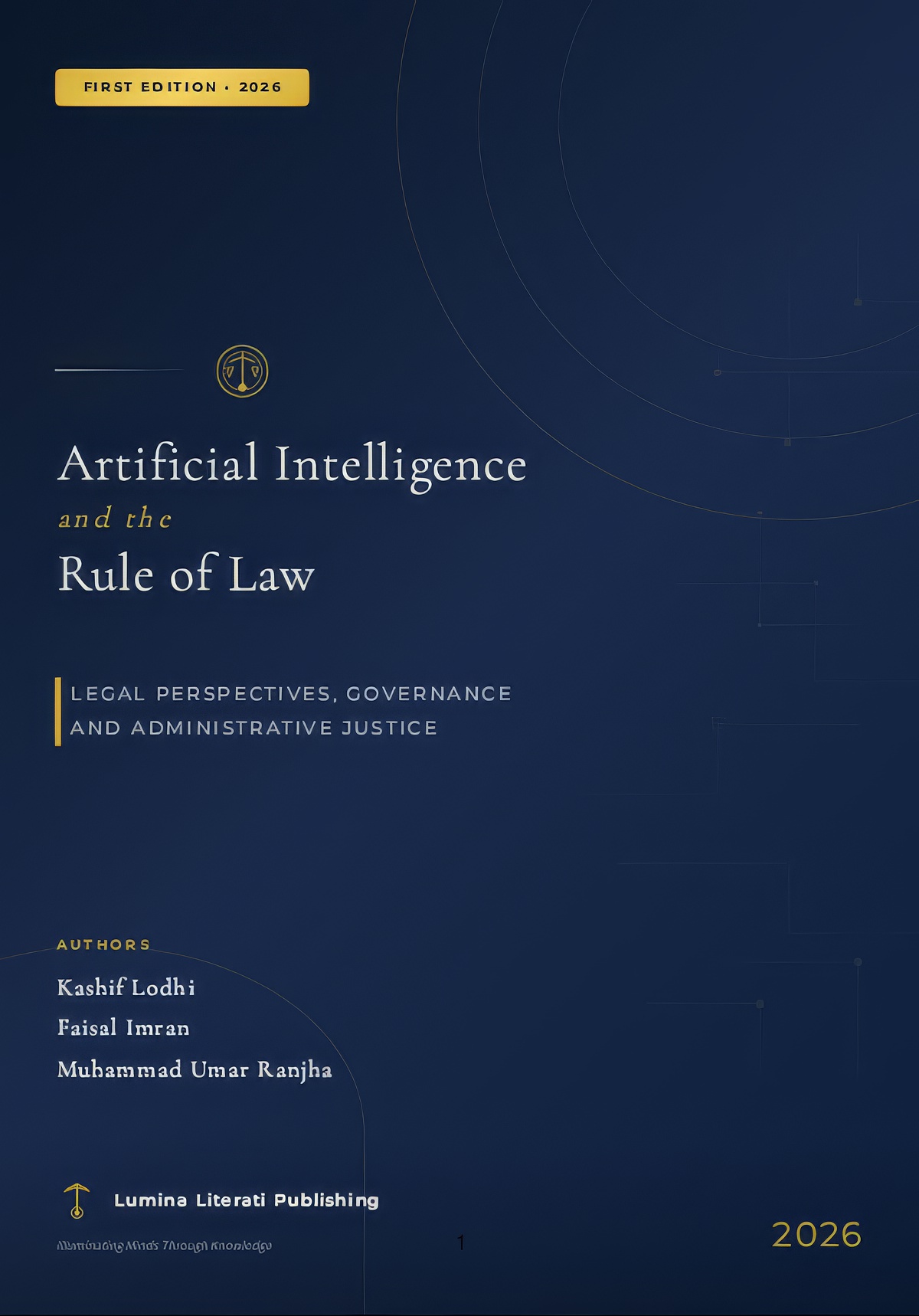
Artificial Intelligence and the Rule of Law
Legal Perspectives, Governance and Administrative Justice
Book Overview
“Artificial Intelligence and the Rule of Law (2026)” investigates the profound constitutional rupture occurring as the modern administrative state transitions toward automated decision-making. The authors argue that this shift moves power from human-mediated judgment to the asynchronous execution of code, creating a Silicon Gavel where an algorithmic bureaucracy enforces a “Shadow Rulebook” of hidden regulations.
This volume challenges the Human-in-the-Loop mythology, arguing that procedural safeguards are often nullified by automation bias. It explores critical concepts such as the Liability Vacuum, the fossilization of discretion, and the digitization of historical injustice. Proposing robust new institutional architectures—including Algorithmic Due Process, Clean Data Mandates, and specialized AI Ombudsmen”—the work advocates for a doctrine of technological subservience, asserting that justice must remain a human deliberative process rather than a computed statistical output.
About the Authors
Kashif Lodhi
Kashif Lodhi is a multidisciplinary scholar with expertise spanning Industrial Engineering, Management, and Food Innovation. Born in Mardan, Pakistan, he holds degrees from the Politecnico di Torino (Italy) and the Università degli Studi di Bergamo. His diverse academic background, including participation in the Erasmus Exchange Program in Greece, fuels his interdisciplinary research approach in engineering and management.
Faisal Imran
Faisal Imran serves as Deputy Director QEC at Liaquat University of Medical & Health Sciences, Jamshoro, and is a PhD scholar in Public Administration. With over 20 years of professional experience, including a decade in Saudi Arabia, he is an expert in quality management, institutional accreditation, and ISO standards, dedicated to fostering accountability in the medical and academic sectors.
Muhammad Umar Ranjha
Muhammad Umar Ranjha is a Lecturer at the College of Law, University of Sargodha, and a PhD candidate at Universiti Utara Malaysia. Specializing in Constitutional and Administrative Law, he brings over a decade of academic experience to the intersection of law and governance. His research focuses on public law frameworks and the evolving role of legal institutions in society.
Endorsements & Reviews
“A critical intervention in the discourse of digital governance. The authors brilliantly dissect the ‘Silicon Gavel,’ exposing how the shift from text to code threatens to hollow out the substance of democracy. This is a mandatory reading for anyone concerned with the privatization of sovereignty.”
“Lodhi, Imran, and Ranjha offer a compelling roadmap for a new Digital Constitutionalism. By exposing the ‘Shadow Rulebook’ and the fallacy of the ‘Human-in-the-Loop,’ they provide the legal tools necessary to ensure that the rule of law implies the rule of humans, not the rule of algorithms.”
“From the ‘Liability Vacuum’ to the proposal of an ‘AI Ombudsman,’ this volume bridges the gap between administrative theory and computer science. It boldly asserts that efficiency must never supersede equity, advocating for a future where technology remains subservient to justice.”
Free & Open Access
This scholarly work is available to everyone. Click the cover to start reading our new publication without barriers.