
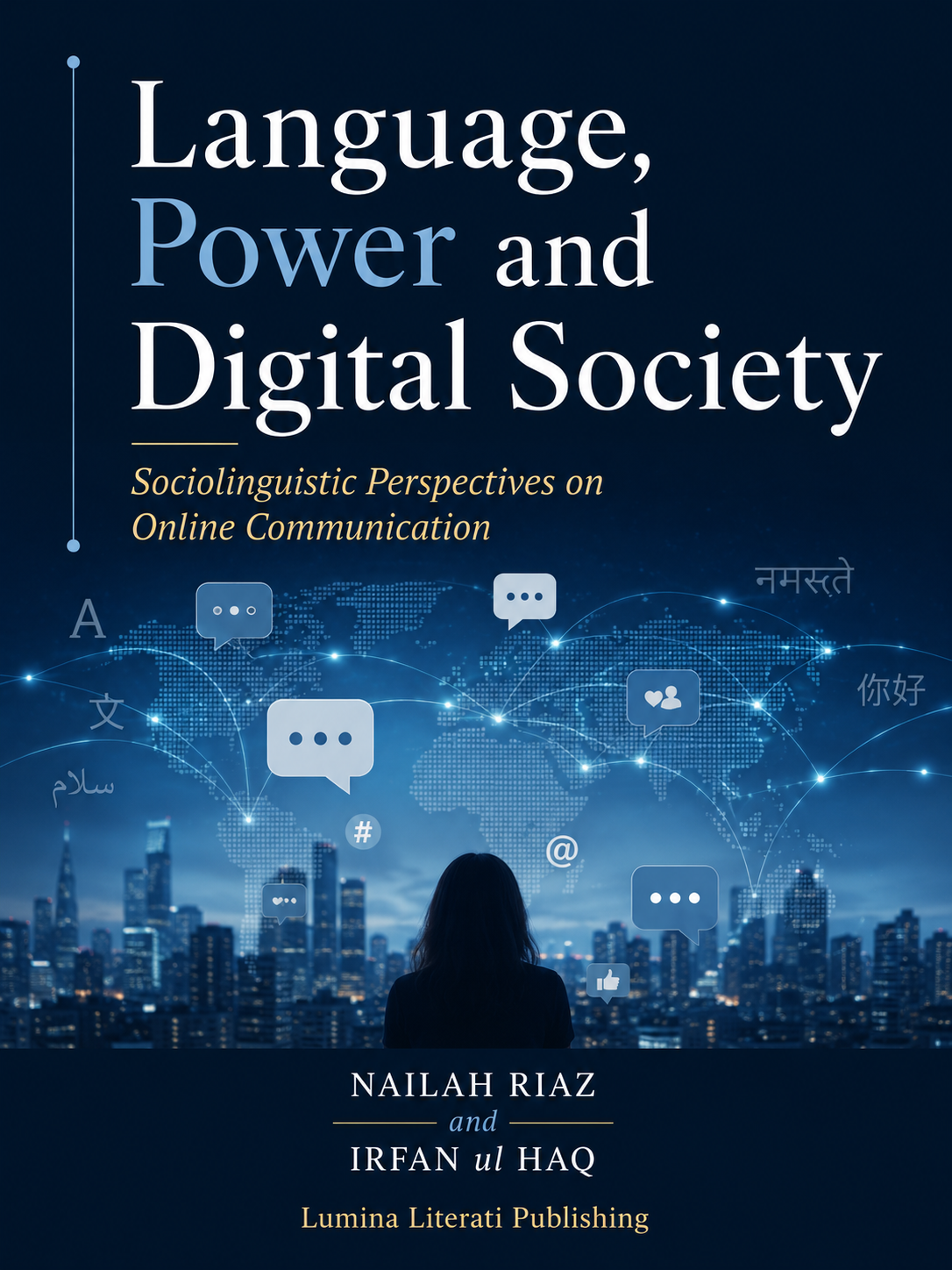
Language, Power and Digital Society
Sociolinguistic Perspectives on Online Communication
Book Overview
Language, Power and Digital Society: Sociolinguistic Perspectives on Online Communication begins from a single, urgent conviction: the language we use online is no longer a private or trivial matter. Every post, comment, share, and silence is now embedded within sociotechnical architectures that determine whose voice carries, whose voice is muted, and whose voice is monetized. Questions that once belonged primarily to sociolinguists, critical theorists, and media scholars have become questions of everyday civic life.
Developed as a sustained dialectical inquiry, the book offers a sociolinguistically grounded account of how communicative power is generated, distributed, and contested in digitally mediated environments. Drawing on Bourdieu’s notion of the linguistic marketplace, the empirical traditions of Critical Discourse Analysis, and recent work on platform affordances and algorithmic governance, the authors trace how offline hierarchies are imported into digital spaces and then reconfigured by the architectures that host them. The argument refuses the comfort of either techno-utopia or techno-dystopia, holding the emancipatory and the extractive together.
Organized to move from theoretical foundations toward empirical and applied terrain, the volume first establishes the conceptual vocabulary — power, habitus, symbolic violence, affordance, gatekeeping — required to read digital discourse critically, before turning to polarization, networked counterpublics, the algorithmic encoding of standard language ideologies, and the asymmetric governance of speech by platform corporations. Closing chapters ask what a more equitable digital linguistic marketplace might look like, and what forms of literacy, regulation, and design would be required to build it.
Students of linguistics will find a careful engagement with variationist, interactional, and third-wave sociolinguistic traditions. Scholars of media and communication will encounter familiar debates about the public sphere recast through the lens of algorithmic governance and platform political economy. Practitioners in education, policy, and digital advocacy will find both diagnostic tools and a vocabulary for naming the new asymmetries that structure online life. The central claim is straightforward, even if its consequences are not: platforms are not neutral conduits, and language online is never just language.
About the Authors
Professor Dr. Nailah Riaz
Professor Dr. Nailah Riaz is a proficient researcher at The University of Faisalabad (TUF), Pakistan. As the Head of the Department of English Language and Literature, she brings a wealth of interdisciplinary expertise to the intersections of education, linguistics, literature, and socio-economic studies. Her prolific scholarship includes numerous research articles across diverse themes, such as teacher training programs in ELT, the role of student organizations in fostering civic engagement, and the globalization of ELT education.
Dr. Riaz is deeply committed to addressing critical issues in higher education and their socio-economic implications in Pakistan. Her research contributions are published in renowned national and international journals, often in lead-author or corresponding-author roles.
Her innovative approach blends data analysis with an eye for policy implications, enabling her to give voice to educational and economic research in the region. Her recent article, “Exploring the Relationship between Higher Education and Economic Growth in Pakistan: A Time Series Analysis,” exemplifies her dedication to generating evidence-based insights to inform policy and practice in the dynamic landscape of higher education.
Squadron Leader (Retd) Irfan-Ul-Haq
Squadron Leader (Retd) Irfan-Ul-Haq brings to this volume a rare combination of military, technological, and educational leadership spanning more than four decades. A graduate of Hailey College of Commerce (B.Com, First Division, 1978), he earned an MBA from the University of the Punjab in 1982 with a perfect grade point average, and later a Master of Computer Science from Preston University in 2000.
His professional trajectory traces the arc of Pakistan’s own digital transformation. Commissioned in the Pakistan Air Force as a systems analyst and programmer, he designed and deployed operations and human-resource management systems and established a country-wide network supporting real-time information availability during Exercise High Mark in 1986, 1987, and 1989. From 1991 to 1994 he was seconded to the Ministry of Interior, Saudi Arabia, where he led the design and implementation of a national Human Resource Management System, and subsequently served as Officer Incharge for the processing and interpretation of satellite imagery at the Directorate General of Inter-Services Intelligence (1995–1999).
A founder of digital-education infrastructure in Pakistan, he established the Fizaia College of Information Technology (FCIT), Islamabad in 2000 — a project later absorbed by the Pakistan Air Force and reconstituted as Air University. As Manager Software at OGDCL (Grade 20) he authored the organization’s IT usage and security policies, designed its Human Resource Information System, and developed its first corporate website. His honours include the Chief of the Air Staff Commendation Certificate (1987) for software development and Honour Graduate at the United States Air Force’s Maintenance Data Systems Analysis Course (1990).
A life member of the Computer Society of Pakistan, he also holds memberships in the Australian Computer Society, the Project Management Institute (USA), and the Pakistan Society for GIS. His contribution to the present volume draws on this lived experience at the intersection of technology infrastructure, institutional governance, and educational reform — perspectives that complement the sociolinguistic and pedagogical orientation of his co-author.
Endorsements & Reviews
“A genuinely dialectical account of online communication. Riaz and Irfan-Ul-Haq refuse the easy consolations of techno-utopia and techno-dystopia alike, showing instead how the same architectures that amplify marginalized voices also extract, sort, and silence them. This is sociolinguistics with its critical edge restored.”
“By reading Bourdieu’s linguistic marketplace through the logic of algorithmic governance, this volume supplies the vocabulary the field has been missing. Its treatment of symbolic violence, platform affordances, and the asymmetric governance of speech will reshape how we teach digital discourse.”
“Rigorous, lucid, and politically serious. The authors move from theoretical foundations to questions of literacy, regulation, and design without ever losing analytical precision. Essential reading for linguists, media scholars, and anyone concerned with the conditions of voice in networked publics.”
Free & Open Access
This scholarly work is available to everyone. Click the cover to start reading our new publication without barriers.
References
Showing 10 of 301 referencesShowing all 301 references